 Runway Gen-3 Hyper
Free
Runway Gen-3 Hyper
Free
Runway Gen-3 Hyper is an AI video generation model launched by Runway that supports text-to-video and image-to-video generation, providing high-quality video output and precise prompt word following.
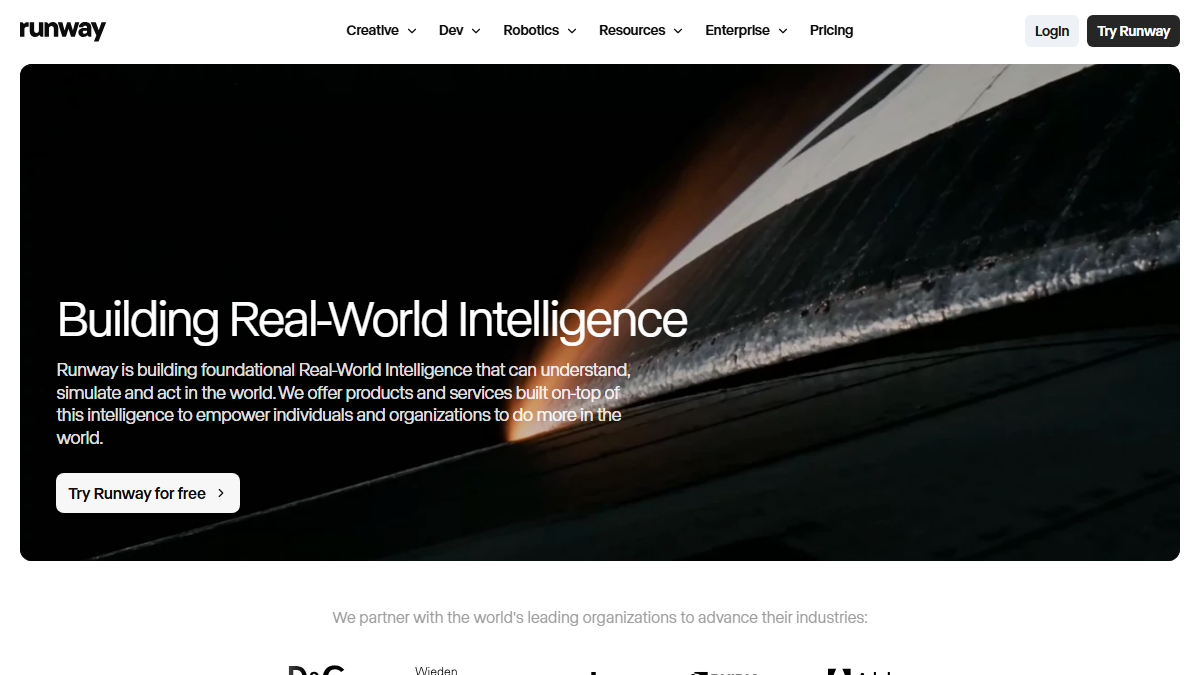
Complete tool analysis of Runway Gen-3 Hyper
Tool type classification: productivity/business-side application (main), with both basic model API infrastructure attributes. Gen-3 Hyper uses web-based products as a delivery form, targeting film and television production, advertising creativity, and content creation scenarios. It also provides API access through the Runway Dev platform, which is a hybrid form of "model as product + model as service".
Core parameters and statistics
Runway Gen-3 Hyper is an AI video generation model released by Runway in July 2024, positioned as a speed and quality upgrade of Gen-3 Alpha. It is not an independent product, but a generation capability module embedded in the Runway Creative platform, which users call through Runway's web application or API.
| Parameters | Specifications |
|---|---|
| Product positioning | AI video generation model (text to video, image to video) |
| Core technology route | Video Diffusion Model |
| Input modal | Text prompt words, reference images |
| Output format | MP4 video file |
| Output resolution | Up to 1080p (HD), supports 4K upscaling (paid plan) |
| Maximum generation length | Approximately 5 seconds of clips generated each time |
| Available platforms | Web desktop browser iOS/Android mobile API (Runway Dev) |
| Developer | Runway AI, Inc. (New York, USA) |
| First Published | July 2024 |
| Platform | Runway Creative (for content creators), Runway Dev (for developers) |
| Platform user base | Officially claimed to have more than 50 million creators and corporate users |
| Key industry collaborations | Lionsgate, Salomon, The New York Times, etc. |
Market Positioning Interpretation: Gen-3 Hyper is the "accelerated version" of the Runway Gen-3 series and forms a complementary relationship with Gen-3 Alpha - Alpha focuses on the quality baseline, while Hyper significantly shortens the generation waiting time while maintaining similar image quality. This strategy is a differentiated approach on the AI video track in mid-2024: competing products in the same period (such as Pika 1.0, Kaiber) focus more on single generation quality, while Runway chooses to prioritize solving the pain point of "waiting anxiety" for high-frequency users.
Generational differences with subsequent models: After the release of Gen-3 Hyper, Runway successively launched new generation models such as Gen-4, Gen-4 Turbo, Gen-4.5 in 2025-2026. The Gen-4.5 represents a significant leap forward in motion consistency, cue word compliance, and visual fidelity, and the Gen-3 Hyper is no longer Runway’s recommended model, but is still accessible through platform packages.
User and market recognition
As a mid-2024 video generation model, Runway Gen-3 Hyper's market recognition needs to be viewed from two dimensions: the overall momentum of the Runway platform and the historical status of the Gen-3 series.
Platform Ecological Endorsement: Official data released by Runway in 2026 shows that its platform has served more than 50 million creators and many corporate customers, including Hollywood studio Lionsgate (Lionsgate has established joint development projects and holds shares in Runway), sports brand Salomon (use Runway to generate video content in global brand campaigns), and media organizations such as the New York Times. As the main generation model in 2024, Gen-3 Hyper carries the actual production tasks of a large number of users during this period.
Industry Impact: The Gen-3 series is the first non-experimental AI video model to gain substantial adoption in the film and television industry. In 2024, a number of short films generated using Runway Gen-3 were shortlisted for major film festivals, and Runway’s own AI Film Festival (AIFF) also attracted thousands of submissions from around the world. Gen-3 Hyper plays the role of "lowering the trial threshold" in this ecosystem - the faster generation speed means that creators can try more creative variations within a limited budget.
Position in the competitive landscape: In mid-2024, Gen-3 Hyper’s direct competitors include Pika 2.0 (2024-07), Kling 1.0 (Kuaishou Keling, 2024-06), and the later-released OpenAI Sora (2024-12). The advantage of Gen-3 Hyper lies in the mature workflow ecosystem of the Runway platform (Video Editor, Inpainting, Motion Brush and other supporting tools). The disadvantage is that the single generation time (5 seconds) is shorter than Kling and Sora, and the stability of characters and hand details is weaker than expected. By the time the Gen-4 series is released in 2025, Gen-3 Hyper will be systematically surpassed in competitiveness.
Third-party evaluation consensus: According to horizontal tests by multiple technology media and creator communities, Gen-3 Hyper is worse than Pika of the same period in terms of prompt adherence, but it is not as good as Kling 1.0 in terms of movement smoothness and physical rationality. In rapid proof-of-concept and storyboard generation scenarios, Gen-3 Hyper received high practical ratings due to its speed of generation. The specific rating data is based on independent testing by each third-party platform, and no guessed numbers are provided here.
Cost advantage
The cost advantage of Gen-3 Hyper needs to be understood within the Runway platform’s unified credit system and model tiered pricing. It is not billed standalone, but is an available model within the Runway platform package.
Three-tier cost structure:
-
C-side/Individual Users: Runway offers a free tier (125 one-time points) that can be used to experience base models including Gen-3 Hyper. The free quota is limited, mainly used for functional evaluation and concept proof, and is not enough to support continuous production. The typical choice for individual users is the Standard package ($12/month, annual payment, 625 points/month), which can cover video output of approximately 52 seconds Gen-4.5 or more than 100 seconds Gen-3 Hyper. For independent creators, the monthly cost is about the same as the price of 1-2 cups of coffee, but points consumption needs to be calculated carefully - points will be deducted for each generation even if you are not satisfied.
-
API/Developer Call: Obtain the API Key through the Runway Dev platform and bill based on usage. API pricing is usually calculated based on video duration and resolution, but Runway has not disclosed the specific unit price of the API, which needs to be viewed after creating an account on the Dev platform. For batch generation scenarios, API calls are more flexible than the web side (can automate pipelines), but cost uncertainty is higher because there is no public price list for budget estimation.
-
Enterprise/Private Deployment: The Enterprise plan provides custom points packages, single sign-on (SSO), workspace analytics and management backend. Enterprise pricing needs to be obtained by contacting the sales team, and only "Contact Sales" is displayed on the public page. For high-compliance scenarios that require private deployment or customized models, Runway offers enterprise-grade security and data isolation solutions, but pricing and contract terms are undisclosed.
Cost comparison with competing products:
| Comparative dimensions | Runway Gen-3 Hyper | Pika 2.0 | Kling 1.0 (Kuaishou Keling) |
|---|---|---|---|
| Personal free file | 125 points (one-time) | Free quota (limited daily) | Registration bonus |
| Starter subscription | $12/month (625 points) | $10/month | Mixed pay-per-view/monthly subscription |
| Single production cost | About $0.3-0.5 (converted) | About $0.1-0.3 (converted) | Undisclosed unit price |
| Points have not been used or expired | Monthly points are not accumulated (Max plan supports rolling for 1 month) | Undisclosed | Undisclosed |
| Commercial use license | Included in subscription | Additional confirmation required | Additional confirmation required |
| Corporate pricing | Business confirmation required | Business confirmation required | Business confirmation required |
Hidden Cost Tip: Runway's point system means that "retrying if you are not satisfied" will also consume points. For professional scenes that require multiple iterations to produce a film (such as key shots in commercials), the actual points consumption may be several times higher than the ideal estimate. In addition, Gen-3 Hyper, as an earlier model, generates results that are less available than Gen-4.5, which means the same output requires more points. Users with ongoing production needs are advised to directly evaluate the per-time availability of Gen-4.5 or the latest models, rather than just comparing unit prices.
Main functions
Gen-3 Hyper's functionality is designed around the core mission of "quickly turning text and images into usable video clips." It is not a stand-alone editing tool, but a production engine embedded in the Runway platform workflow. The highlight of its functionality is not the stacking of functions, but the "hidden linkage" with other tools on the platform.
-
Text-to-Video: Enter a descriptive text (mainly supported in English), and the model will output a 1080p video of up to 5 seconds in about 30-60 seconds. Expert opinion: The real efficiency advantage of this function lies not in "generation", but in "batch iteration" - the advertising team can generate 10-20 alternatives of different lens concepts in one meeting, and then quickly screen out potential directions for refinement. Compared with the traditional method (finding reference films, shooting, and post-production), the efficiency of early concept exploration is improved by an order of magnitude.
-
Image-to-Video: Upload a reference image as the first frame or style anchor, and the model will expand it into a dynamic video. Expert View: This is the most used feature of Gen-3 Hyper in actual production. Brands can convert product still life pictures or conceptual design drafts into dynamic demonstration videos, avoiding the uncertainty of creating them from scratch. Note: The composition, lighting and subject position of the reference image will significantly affect the generated results. It is recommended to upload a high-definition image of at least 1024x1024 and ensure that the subject is centered and the background is simple.
-
Motion Brush: Following the iconic feature introduced in Gen-2, users can use a brush to mark areas on the reference image where they wish to create motion, and the model only adds dynamic effects to that area. Hidden linkage: The combination of Motion Brush + Image-to-Video is the most cost-effective way to use Gen-3 Hyper - first use Motion Brush to lock the motion area, and then generate a complete animation through Image-to-Video, which can greatly reduce the scrap rate caused by "unexpected motion".
-
Seamless connection with Runway video editor: The generated video clips can be directly entered into Runway's built-in Timeline Editor for editing, splicing, overlaying and transition processing, without exporting and then importing. Synergy: This ability integrates "generate" and "post" in the same browser tab, eliminating the frictional cost of repeatedly switching between multiple software in traditional workflows. For short video and social media content production, from creative ideation to finished product export can be completed in a single session.
-
API and workflow integration: Through the API of the Runway Dev platform, developers can embed the generation capabilities of Gen-3 Hyper into their own application pipelines. Expert view: For content factories that require large-scale video production (such as e-commerce main image video, programmatic advertising material generation), API calls can be used in conjunction with automated scripts to achieve full-link automatic output "from copywriting to video", but additional development investment is required for result quality monitoring and exception handling.
Model and version evolution
The Gen-3 series is an important transition stage for Runway from experimental technology verification to commercial products. Its version evolution clearly reflects the product strategy of "establishing a quality baseline first, and then optimizing the generation speed."
The main line of the Gen-3 series
-
2024-06 (Gen-3 Alpha): The initial version of the Gen-3 series, a jump in quality over Gen-2. For the first time, it supports the direct generation of text to video (Gen-2 mainly focuses on image to video), the output resolution is increased to 1080p, and the picture details and motion coherence are significantly better than the previous generation. The release of this version marks Runway’s official entry into the “high-definition era” of AI video generation.
-
2024-07 (Gen-3 Hyper): An accelerated version optimized based on Gen-3 Alpha. The core change is not an improvement in image quality (similar to Alpha), but a significant reduction in generation speed - the official claims that the generation time is reduced by about 30-50%. The specific speed improvement is affected by the generation time, resolution and server load. The launch of the Hyper version targets a core pain point for professional creators: uncertainty while waiting for builds. In the actual workflow, the waiting time shortened from 90 seconds to 45 seconds means a qualitative change in the "sense of iteration" - creators are more willing to try multiple prompt word variations instead of carefully calculating each generation.
Replacement of Gen-3 Hyper in subsequent versions
- Early 2025 (Gen-4): Architecture-level update, introducing a new generation of video diffusion architecture, achieving breakthroughs in motion consistency, multi-agent interaction and prompt word understanding. Gen-4's build quality surpasses Gen-3 Hyper's across the board, but its build speed is not significantly better than Hyper's.
- Mid-2025 (Gen-4 Turbo): Optimize the inference pipeline based on Gen-4, reaching a generation speed equivalent to or better than Gen-3 Hyper, while maintaining the image quality advantages of Gen-4. This version is essentially a true replacement for the Gen-3 Hyper.
- 2025-2026 (Gen-4.5 and subsequent): Continuous iteration, Gen-4.5 is officially positioned as "the best video model in the world" by Runway, reaching new heights in motion quality, prompt word compliance and visual fidelity. The Gen-3 Hyper has completely dropped out of the main lineup at this point.
Product form evolution
In the Gen-3 era, Runway's model versions and product packages have not yet been decoupled - all users use models through the unified Runway Creative platform, and different packages only control the generation amount and resolution. Starting from the Gen-4 series, Runway has explicitly distinguished the point consumption differences of different models (Gen-4.5, Aleph 2.0, Seedance 2.0, etc.) on the pricing page, making the pricing system more refined.
Technical advantages
The technical highlight of Gen-3 Hyper is not the unrivaled performance of a single indicator, but the rationality of the engineering choice of "improving inference efficiency while maintaining image quality."
Temporal consistency problem of video diffusion model: Unlike single-frame image generation, the core technical challenge of video generation is to maintain spatio-temporal consistency between consecutive frames - characters, objects, light and shadow cannot flicker, deform or disappear between frames. The Gen-3 series is based on the Diffusion Model architecture and learns motion patterns and physical constraints between frames through a large amount of video data during the training phase. The optimization direction of Gen-3 Hyper on this basis is inference efficiency: through model distillation and inference step pruning, the number of denoising steps required for generation is reduced while maintaining Alpha image quality.
Engineering Balance of Generation Speed and Quality: Mechanism: Gen-3 Hyper speeds up generation by reducing the number of sampling steps in the diffusion denoising process (from 50-100 steps in Alpha to 25-50 steps). Effect: The generation time is shortened by 30-50%, but the picture details and motion smoothness are slightly reduced in some high-complexity scenes (such as fast movement, camera movement, multi-character interaction). Applicable scenarios: For scenarios with high iteration frequency, such as proof of concept, storyboard drafts, and social media short videos, it is reasonable to prioritize speed. For lenses that need to be used in final delivery, it is recommended to use the Gen-3 Alpha or Gen-4 series to maintain the upper limit of image quality.
Platform-level technology integration: The real technical advantage of Gen-3 Hyper is not in the model itself, but in the Runway platform ecosystem it is embedded in. The platform provides a complete video editing tool chain (Timeline Editor, Inpainting, green screen keying, subtitle generation, etc.), making AI generation no longer an "isolated output" but a step in the creative process. This integrated design of "generate + edit + export" is a differentiated advantage among AI video tools in 2024 - Pika and Kling mainly focused on single generation at that time, and their supporting editing capabilities were relatively weak.
Current technical limitations: Looking back by 2026 standards, the technical shortcomings of Gen-3 Hyper are obvious: unstable hand generation, unreasonable physics in complex actions (such as object crossing, character distortion), and insufficient consistency of character identity in long shots. These limitations have been significantly improved in Gen-4.5, but the Gen-3 Hyper, as a 2024 model, is leapfrogged in terms of technology generation.
How to use
The usage entrance of Gen-3 Hyper is divided into three ways: Web, mobile and API, which respectively correspond to the usage scenarios of different user groups. The three are basically the same in terms of functional coverage, but there are differences in operation methods and integration depth.
| How to use | Suitable for the crowd | Features | Prerequisites | Cost |
|---|---|---|---|---|
| Web side (Runway Creative) | All users, including non-technical creators | Open the browser and have a complete editing workflow built-in | Register a Runway account | Free package available, premium features require subscription |
| iOS/Android App | Mobile creation and review | Touch screen optimization, supports shooting + generating hybrid workflows | Download from the app store | Share subscriptions and points with the web |
| API (Runway Dev) | Developers and content factories | Supports automated pipelines and can be embedded in third-party applications | Apply for API Key and read development documents | Billed by usage, you need to check the unit price on the Dev platform |
| Enterprise Console | Teams and Enterprises | SSO, workspace isolation, usage analysis | Contact sales to activate the Enterprise package | Customized pricing |
Typical steps for using the Web client:
- Visit app.runwayml.com to register or log in to your account.
- Select "Text to Video" or "Image to Video" in Dashboard.
- Enter the English prompt word (it is recommended to include five elements: subject, action, scene, light, and style), or upload a reference picture.
- Select the model as Gen-3 Hyper (if available), set the resolution and duration.
- Click Generate and wait 30-60 seconds to view the results.
- Drag the generated video clips into the Timeline Editor to edit, splice and add transitions.
- Export the final video (supports MP4 format, up to 4K requires paid plan).
API Quick Start Tip: API documentation and Key are available through the Runway Dev platform (dev.runwayml.com). The API supports standard RESTful calls to embed video generation tasks into automated workflows. The specific endpoints and parameters are subject to the live documentation at dev.runwayml.com, and code snippets that may be outdated are not provided here.
Implementation Tips: The typical usage mode of Gen-3 Hyper in actual production is "generate multiple candidates at one time, filter and then refine". It is recommended to prepare 3-5 prompt word variations (such as different angles, different light conditions) for each generation, and after parallel generation, select the results that best meet the expectations and enter the later stage. It is not recommended to use a single generation result directly for delivery - the output availability rate of Gen-3 Hyper is around 30-50% (fluctuating depending on prompt word quality and scene complexity). Multi-solution parallelism is an effective strategy to improve overall availability.
Product Pricing
Gen-3 Hyper’s pricing is part of the Runway platform’s unified points system, rather than being independently priced. After subscribing to the package, users can use the points within the package to access the Gen-3 Hyper and other models.
Runway Creative Subscription Package (subject to 2026 public pricing page):
| Package | Price (annual payment) | Monthly points | Core benefits | Applicable to Gen-3 Hyper |
|---|---|---|---|---|
| Free | $0 | 125 points (one-time) | Basic model trial, 3 projects, 5GB storage | Available, limited credit |
| Standard | $12/month | 625 points/month | All AI models, no watermark, 4K upscaling | Available |
| Pro | $28/month | 2,250 credits/month | Audio tools included, 500GB storage | Available |
| Max | $76/month | 9,500 points/month | Points roll over 1 month, new models first | Available |
| Enterprise | Business Pricing | Custom | SSO, Workspace Analytics, Dedicated Support | Available |
Point consumption logic: The points consumed for each generation depend on the selected model, output resolution and duration. The point consumption of Gen-3 Hyper is lower than that of Gen-4.5 - the 625 points/month of the Standard package can generate more than about 100 seconds of Gen-3 Hyper video (estimated at 5 seconds/time, about 30 points/time), but can only generate about 52 seconds of Gen-4.5 video. This means that choosing Gen-3 Hyper allows for more iterations at a lower credit cost, but requires accepting a lower upper limit on picture quality.
Return on Investment Analysis:
- Personal Creator: The Standard package of $12/month (annual payment) is the most cost-effective starting point. For independent creators who produce 3-5 short videos per week, the points are basically enough. If video production is outsourced in a traditional way, the cost of a single short video is between $50-200 - AI generation reduces the cost of a single production by more than 90%, even including retry costs.
- Small Teams: The Pro package’s 2,250 points/month is suitable for a team of 2-3 people to share. But please note: Runway points are allocated by account rather than by team. Team collaboration requires unified account management or the use of the workspace function of the Enterprise package.
- Content Factory: Teams that need to batch produce video material should consider API solutions instead of web subscriptions. The API solution has advantages in automation and cost predictability, but requires development resources to build the pipeline.
IMPORTANT NOTE: Runway’s pricing page is updated in real time, and the above prices are public information at the time of writing. Specific prices and model availability are subject to runwayml.com/pricing. The actual availability of Gen-3 Hyper may change due to Runway's strategic adjustments - as Gen-4.5 is fully rolled out, older models may gradually be phased out.
Application scenarios
Gen-3 Hyper’s application scenarios focus on areas that “require rapid, low-cost verification and production of visual creativity.” The following four types of scenarios have been verified by a large number of users in 2024-2025:
-
Pre-film and television concept design and storyboards: Directors and concept designers use Gen-3 Hyper to quickly convert text storyboards into dynamic visual materials for lens language verification, tone and composition testing. Efficiency deduction: Traditional storyboarding takes 2-6 hours per frame, while Gen-3 Hyper only takes 1 minute to generate a 5-second concept video. Take the dynamic storyboard verification of a 12-card segment as an example. The traditional method takes 2-3 days, but Gen-3 Hyper can complete multi-version iterations in 2-3 hours. Implementation Tip: AI-generated storyboards cannot replace the accuracy of real shots or hand-drawing, but in the early direction exploration stage of the project, the gains in speed and flexibility far outweigh the loss in accuracy.
-
Advertising creative quick test: The advertising team generates multiple versions of creative concept videos before client proposals for internal screening and preliminary client communication. Efficiency deduction: An advertising proposal containing 5 creative directions. The traditional method requires shooting or producing reference materials for each direction, which takes 1-2 weeks; using Gen-3 Hyper, this cycle can be compressed to 1-2 days, and can be adjusted in real time based on customer feedback during the proposal meeting. Boundary of human-machine collaboration: Concept videos generated by AI are suitable for "showing creative direction" rather than "finally delivering commercials". They must be refined by a professional post-production team before being signed by the customer.
-
Social media and short video content production: Content creators and social media operators use Gen-3 Hyper to batch generate visual materials for daily updates on short video platforms (TikTok, Reels, Shorts). Efficiency deduction: A social media account that publishes an average of 3-5 short videos per day would require 1-2 full-time video editors in the traditional method; using Gen-3 Hyper to assist in production, this can be reduced to 0.5 manpower, and the output frequency can be doubled. Not suitable for the boundary: For video content that requires real people, real product shots, or highly customized branding, AI generation still cannot replace real shots.
-
E-commerce main image video and product display: The e-commerce team converts the still life image of the product into a dynamic display video through Image-to-Video, which is used for product detail pages and advertising. Efficiency deduction: From shooting to producing the main image video of a SKU, the traditional method takes about 2-4 hours (including setting, shooting, and editing); through Gen-3 Hyper's Image-to-Video process, based on the existing product images, the video generation of a single SKU is shortened to 10-15 minutes. Limitations: For products that require multi-angle display, detailed close-ups, and complex operation demonstrations, the length of a single 5-second video generated by AI is insufficient and requires post-production splicing.
Summary of unsuitable scenarios:
- Advertising films that require extremely high picture accuracy (such as luxury brand TVCs, car advertisements) - there are still uncertainties in AI-generated hands and product details
- Technical demonstrations or educational content that require strict physical accuracy - AI may generate images that are physically unreasonable (such as liquid flow in the wrong direction, light and shadow mismatch)
- Content that requires performance and emotional transmission by real actors - AI video has not yet solved the problem of "performance credibility"
- Ultra-long narrative content (>1 minute short story) - the maximum limit of 5 seconds at a time requires manual splicing, and consistency control is difficult
Applicable people
Gen-3 Hyper's applicable audience is clearly stratified - it is most valuable to creators who "require fast visual output and have limited budgets", but it is not suitable for professional teams that "pursue ultimate image quality and physical accuracy".
-
Independent film and television creators and concept designers: Gen-3 Hyper’s core user group. They need a lot of visual materials for communication and review in the early stage of the project, but they do not have high requirements for the perfection of a single frame. Real Benefits: Reduce proof-of-concept cycle from days to hours. Not suitable for borders: If the customer has extremely high visual accuracy requirements for the storyboard (such as Pre-vis for commercial blockbusters), it is recommended to use the Gen-3 Alpha or Gen-4 series to ensure quality instead of Hyper.
-
Advertising Creative Team and Proposal Producer: The team in an advertising company responsible for visualizing creative solutions. The value of Gen-3 Hyper is the ability to generate visual examples of multiple creative directions in real time before or during client meetings. Actual Benefits: Proposal success rate increased (visual ideas are easier for customers to understand), proposal preparation time reduced by 60-70%. Implementation Tips: AI-generated materials should be clearly marked with "AI Generation Concept Illustration" in the proposal to avoid customers from having unrealistic expectations about the final delivery.
-
Social Media Operations and Content Marketing Team: Operators who need to produce short video materials in high frequency and in batches. The speed of Gen-3 Hyper and the integrated editing workflow of the Runway platform make it a highly effective tool for social media teams. Actual income: The number of daily videos produced by a single person increased from 3-5 to 10-15. Not suitable for boundaries: Scenes that require real-life materials (such as unboxing reviews, store visits, character interviews) are not suitable for AI generation.
-
Independent developers and AI application entrepreneurs: Integrate video generation capabilities into your own products or services through the Runway Dev API. Gen-3 Hyper is more cost-effective than Gen-4.5 in API scenarios and is suitable for application scenarios that do not have strict image quality requirements but require large-scale generation. Implementation Tips: Be sure to confirm model availability and pricing on the Dev platform before accessing the API. As Runway continues to update models, Gen-3 Hyper may be taken offline earlier on the API side. It is recommended to provide an abstraction layer for model switching when designing applications.
Summary and Outlook
Runway Gen-3 Hyper occupies a unique position as a "transition bridge from experimentation to usability" in the history of AI video generation. It’s not Runway’s most powerful model, but it’s the tool that’s getting a lot of creators to take AI video seriously for the first time — because it generates it fast enough to be integrated into real workflows, rather than just a “try it out” stage.
Timeliness of Core Competencies: Gen-3 Hyper’s “speed first” strategy in mid-2024 was the correct product decision under the market conditions at the time. It allowed Runway to maintain a differentiated positioning under the attack of Pika and Kling, and bought a time window for the development of the Gen-4 series. But by 2026, that competitiveness has expired—Gen-4.5 has surpassed it in both speed and quality.
Main Current Limitations:
- Model aging: Gen-3 Hyper’s image quality, motion consistency, and prompt word understanding have been systematically surpassed by Gen-4.5.
- Uncertain Availability: Runway may phase out Gen-3 series models in future package upgrades, and existing Gen-3 Hyper-based workflows face migration costs.
- Point efficiency upside down: Although Gen-3 Hyper consumes fewer points per time than the new model, its low availability rate (high scrap rate) may cause the actual effective output cost to be higher than Gen-4.5.
- Ecological support decay: As Runway tilts its R&D and community resources towards new generation models such as Gen-4.5, Aleph, GWM-1, etc., the optimization and problem fixing of Gen-3 Hyper has basically stopped.
Follow-up observation points:
- When will Runway officially roll off the Gen-3 series of models? This directly affects the inventory workflows that rely on this model.
- Will the point consumption of Gen-4.5 be further reduced? This will affect the continued value of Gen-3 Hyper’s “ultra-low-cost iteration” positioning.
- Pricing and feature changes of third-party competing products (Kling, Pika, Sora, Veo) in 2026 will affect Runway’s overall competitiveness.
Acquisition and Adoption Risk Assessment: For new users, Gen-3 Hyper is not recommended as an evaluation target or workhorse model. Currently (July 2026) the best choice for Runway is Gen-4.5 (pursuing image quality) or evaluating other models such as Seedance 2.0, Aleph 2.0 on the platform. If you're on a budget, the Standard plan ($12/month) is the most cost-effective entry-level plan, allowing you to jump right into Gen-4.5 without downgrading to Gen-3 Hyper. For existing Gen-3 Hyper workflows, it is recommended to develop a model switching plan and gradually migrate key production tasks to Gen-4.5 or newer models to avoid business interruption caused by the old model going offline. Before purchasing, enterprises need to focus on verifying the Runway Enterprise package's SSO integration capabilities, data isolation terms, and the impact of model version switching on existing API calls. In addition, the copyright ownership of Runway's generated content needs to be clear in the terms of service - the commercial use rights of AI-generated videos are usually included in personal and commercial packages, but scenarios involving third-party IP (such as uploading copyrighted reference images) require self-confirmation of compliance.
Related tools: runway, pika
Version Info
- Runway Gen-3 Hyper :Gen-3 Hyper is a video generation model launched by Runway that supports text-to-video and image-to-video generation.
- Runway Gen-3 Alpha :Gen-3 Alpha initial version released, supporting text-to-video generation.
User Reviews