 genei
Free
genei
Free
genei is an AI office and efficiency tool designed for researchers, content creators and knowledge workers. It uses AI automatic summarization, keyword extraction, multi-document Q&A and citation management to compress document reading and writing output from hours to dozens of minutes.
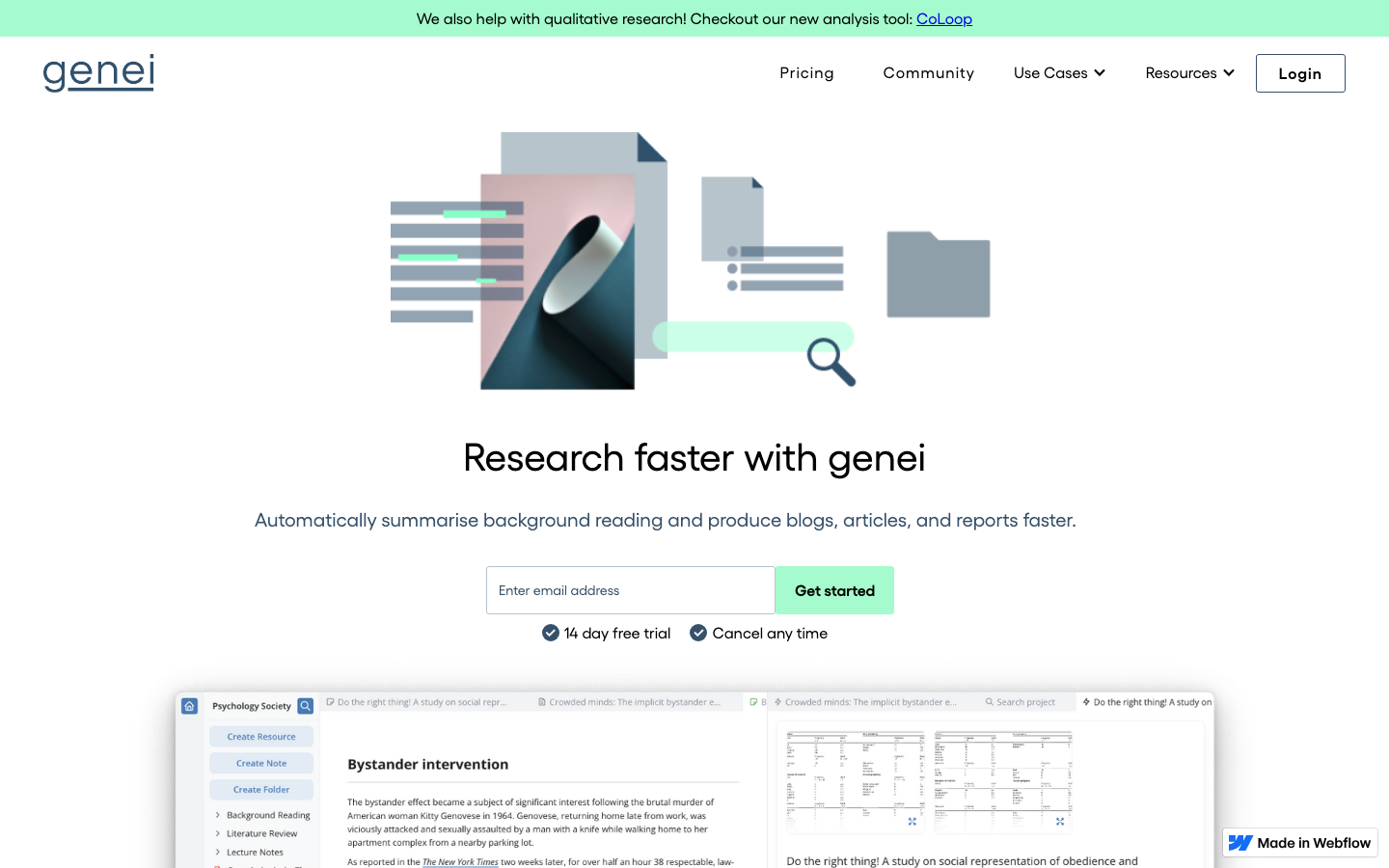
Genei
Genei’s core parameters and statistics
Genei is an AI research acceleration tool for researchers, content creators and knowledge workers. Its core delivery is to "compress hours of literature reading and note-taking into tens of minutes." The product uses web applications as the main entrance, supplemented by Chrome browser extensions, and provides four major capability modules: PDF/webpage automatic summarization, keyword extraction, multi-document Q&A, and citation management.
| Projects | Public Information |
|---|---|
| product name | genei |
| Official positioning | AI-powered summary & research tool |
| Place of Belonging | United Kingdom (GB) |
| Category | AI Office and Efficiency (ai-office) |
| Supported Platforms | Web, Chrome Extension |
| Supported languages | en-US |
| Company Background | Member of Y-Combinator Summer 2021, Winner of Oxford University All Innovate 2020 |
| Pricing model | Subscription (Basic £3.99/month Pro £15.99/month), 14-day free trial |
| User reputation | 95% of users think that efficiency is improved, 98% of users think that time is saved |
| Version visibility | Official undisclosed semantic version number |
Product Boundary: Genei's strength lies in "inputting existing materials and quickly extracting key points" rather than generating original content from scratch. It is more suitable for research scenarios that require structured processing of existing documents, but is not suitable for scenarios that require highly creative writing or in-depth original writing.
Genei’s users and market recognition
Genei's market recognition signals mainly come from entrepreneurial incubation background, industry media reports and user reputation, rather than public revenue or active user numbers (the latter is not officially disclosed).
Entrepreneurial background and financing signals: Genei is a member of the Y-Combinator Summer 2021 batch, which includes many startups that later grew into unicorns. YC’s endorsement itself represents initial recognition of the product direction and team execution capabilities. In addition, Genei won the award in the Oxford University Entrepreneurship Competition "All Innovate 2020", and the product originated from the Oxford academic ecosystem, giving it natural credibility in the academic research scene.
Media Report: TechCrunch listed Genei as a "Favorite Startups" in its 2021 Summer Demo Day report, with reporter Natasha Mascarenhas commenting that "this startup can fully play the role of Grammarly - a convenient extension that optimizes the workflow of the writing community." This analogy directly positions Genei as the "Grammarly of research writing," implying that its core value lies in embedding existing workflows rather than replacing human judgment.
User reputation: User feedback disclosed on the official website points to three groups: business executives (PM Connect CEO), content editors (Find New AI Editor), and data analysis team (PeakMetrics Co-founder). 95% of users said that their work efficiency has improved after using genei, and 98% believed that the paraphrasing function helped find key information faster. However, it should be noted that these data are compiled by the official themselves, and independent third-party verification is limited.
Ecological extension: Genei also operates the qualitative research analysis tool CoLoop (coloop.ai), which shows that the team continues to expand the product matrix in the vertical direction of "research efficiency" instead of staying at a single summary tool.
Genei’s cost advantage
Genei's pricing is mid-low in the UK and European SaaS markets, with a clear cost structure but narrow coverage - currently only available for individual/team subscriptions, with no public API or enterprise privatization options.
C-side/individual users: Provides a 14-day free trial, and you can experience all functions without binding a credit card. After the trial, you can subscribe to the Basic (£3.99/month) or Pro (£15.99/month) plan. Based on annual payment, Basic is about £47.88/year and Pro is about £191.88/year. For researchers who need to process 20-50 documents per month, the cost per article can be as low as £0.10-£0.40, which is much lower than the time cost of manually reading abstracts.
The price-performance ratio between Basic and Pro is a watershed: The Basic layer covers core summarization and document management, which is enough for light users; the Pro layer has 70% more higher-quality AI (official description), GPT-3 access, multi-document search and Q&A, and rewriting functions. The watershed is whether the user needs "cross-document knowledge association" - if you only read a single PDF every day, the Basic layer is enough; if you need to compare multiple papers at the same time and refine common conclusions, the Pro layer's multi-document Q&A can save 2-3 times time.
Hidden Cost: Genei's summary relies on the underlying LLM (Pro layer accesses GPT-3), which means summary quality and response speed are affected by the upstream model. If OpenAI adjusts API pricing or access policies, Genei may be forced to adjust subscription prices or feature boundaries. In addition, the product does not disclose data storage encryption standards and compliance certifications (such as SOC2, GDPR specific terms), and research institutions that are sensitive to data require additional confirmation.
Enterprise/Team Dimension: The public page does not show enterprise-level plan SSO integration or volume seat discounts. Team purchases can currently only be stacked based on individual subscriptions, and there is a lack of unified management backend and audit logs. If the enterprise plans to deploy on a large scale, it needs to communicate the business terms separately through [email protected].
Genei’s main features
Genei's functional design revolves around the research writing link of "reading → understanding → output". It does not package AI into an independent chat robot, but embeds it into the user's original document processing process.
-
AI Automatic Summary: Generate structured summaries of PDF documents and web page content with one click, supporting custom summary length and focus direction. Applicable scenarios: Generate a "one-minute quick overview" when quickly screening massive documents to determine whether the article is worthy of intensive reading. Implementation Tips: The quality of abstracts is highly dependent on the clarity of the original text structure - the IMRaD (Introduction-Methods-Results-Discussion) structure summary of academic papers works best, while the quality of abstracts of interview transcriptions and unstructured notes will be significantly reduced.
-
Keyword Extraction and Content Analysis: Automatically identify core terms, concepts and entities in documents and generate a keyword list. Synergy effect: Keyword extraction results can be directly used for SEO content optimization (such as the use scenario of Find New AI editing), topic clustering of literature reviews, and knowledge graph construction.
-
Multi-document search and Q&A (Pro level): Unified search and questioning across multiple PDFs or web pages, AI combines the content of all documents to give answers and mark sources. Expert perspective: This is the most differentiated function of Genei - not a simple superposition of single abstracts, but "turning multiple documents into a queryable knowledge base". For scenarios such as writing literature reviews, competitive analysis reports, or technical research, the 3-5 day process of "reading 20 papers and summarizing them" can be compressed into 2-3 hours of "questioning + item-by-item verification".
-
Paraphrasing and paraphrasing (Pro level): Automatically paraphrasing the selected text to generate multiple expression versions. Use value: Solve the need of "quoting the original text but not wanting to copy it directly" in academic writing, while helping non-native English speakers optimize their expression fluency. However, the rewritten results still require manual review to avoid semantic deviation of the original argument due to synonymous paraphrasing.
-
Citation management and reference generation: Mark the citation location in the document and automatically generate a reference list. Synergy effect: Linked with the abstract function - highlight key paragraphs when reading, the system automatically records the sources of citations, and directly export structured references when writing.
-
Chrome Extension: Summarize the current web page directly in the browser or save the page to the genei project library. Scenario Benefits: There is no need to repeatedly switch between the browser and genei during online research, reducing context interruption. This is especially important for the workflow of "collect information from multiple web pages → aggregate into genei projects → unified analysis".
Genei’s model and version evolution
Genei does not use semantic version numbers (such as semver) to manage product releases, and its version information is mainly reflected through public pricing pages, feature updates, and milestone events.
Current product form
- Web Latest: Currently publicly available web version, supporting PDF/web excerpts, document management and Chrome extensions. The Pro layer has access to GPT-3 driver multi-document Q&A and rewriting functions.
Known Milestones
- Pro subscription tier online (~2025-01): Launched the Pro subscription plan, introduced multi-document summarization, search, Q&A and rewriting capabilities supported by GPT-3, and upgraded the product positioning from "single summary tool" to "multi-document research platform".
- Chrome extension release (~2022-2023): The browser extension is online, supporting one-click summarization and saving when browsing the web, lowering the threshold for product use.
- Y-Combinator Summer 2021 (~2021-08): Publicly unveiled as a member of the YC S2021 batch, recommended by TechCrunch, which is a key node for the product to gain mainstream attention.
- Oxford University All Innovate 2020 (~2020-08): Winning the Oxford University Entrepreneurship Competition marks the starting point of the product's transformation from academic projects to commercialization.
Version management suggestions
Since there is no official semantic version number and no public changelog, when evaluating the impact of the upgrade, the team recommends conducting regression verification through feature update announcements and key behavioral changes (such as summary quality, question and answer accuracy, latency changes). Before using it in production, use a free trial account to run through 2-3 real processes and record the baseline performance.
Genei’s technical advantages
Genei's technical advantage lies not in the self-research and innovation of the underlying model, but in "encapsulating general LLM capabilities into a vertical workflow for researching writing scenarios."
Mechanism: The product builds a multi-layer context processing pipeline on top of the underlying LLM (GPT-3, etc.). The uploaded PDF goes through OCR/Text Extraction → Segmentation → Semantic Indexing → Summary/Q&A generated links. In a multi-document scenario, the system first processes each document independently, and then merges the results into context through cross-document retrieval to answer user questions.
Effect: Summary generation can be completed within 10-30 seconds for single document processing, and multi-document Q&A response usually takes 30-60 seconds. For users, the actual benefit is not "AI replaces manual labor", but "AI completes the first draft, and humans do verification and deepening" - compressing the "reading and taking notes" of a 20-page paper from 45-60 minutes to 10-15 minutes (AI abstract 1 minute + manual verification 5-10 minutes + note-taking 5 minutes).
Scenario Adaptation: This link works best for well-structured academic papers (title-abstract-introduction-method-results-discussion-conclusion). For papers with purely scanned PDFs (no embedded text layer), complex multi-column layout, or papers containing a large number of formulas and charts, OCR quality will become a bottleneck and the summary accuracy will be significantly reduced. In this kind of scenario, it is recommended to use other tools (such as Grobid, ScienceParse) to do PDF structured preprocessing before importing it into genei.
Architectural significance of Chrome extensions: Compared with independent web applications, the extension form allows genei to be directly embedded in the user's browser workflow. When users read web pages, they can complete summarization, saving, and annotation without leaving the current page, which reduces the context switching between "discovering information" and "recording information". For knowledge workers who need to browse 20-50 information sources every day, this embedded interactive mode saves about 30-40% of the operation time (estimated) compared to "copy and paste to another tool".
How to use Genei
Genei provides two entrances, web application and Chrome extension, to adapt to different research scenarios.
| How to use | Suitable for the crowd | Core capabilities | Cost |
|---|---|---|---|
| Web application (app.genei.io) | All users | PDF/webpage upload, abstract, Q&A, document management, citation export | 14-day free trial, subsequent £3.99-15.99/month |
| Chrome extension | Heavy browser users | One-click summary of the current web page and save to the project library | Free (needs to associate a Web account) |
Typical usage process:
-
Registration and Trial: Visit app.genei.io to register an account, and you can use all functions during the 14-day free trial period. There is no need to bind a payment method to start the evaluation.
-
Import literature: Upload PDF (supports batch import) or save web pages with one click through Chrome extension. The system automatically starts text extraction and semantic indexing, and processing a single PDF usually takes 10-30 seconds.
-
Generate summary: After opening the document, click Summarise, and AI will automatically extract the core arguments of the article. The length and focus of the abstract can be adjusted as needed (e.g. focusing on methods, results or conclusions).
-
Question and Analysis: Under the Pro layer, select multiple documents and enter the search/question and answer mode. Ask comprehensive questions (such as "What are the main differences between experimental methods?"), and AI returns integrated answers across documents and annotated source passages. This step is a key output node - it is recommended to ask broad questions first to understand the big picture, and then gradually narrow down to specific details.
-
Export and Citations: Export abstracts, notes, and citations into structured documents. The system automatically generates a reference list, and the format needs to be confirmed to comply with the citation specifications of the target journal/institution before exporting.
Cost reduction and efficiency improvement deduction (unofficial commitment):
- Graduate Students/Academic Researchers: Read 5-8 papers and take notes per week, traditional process takes 5-8 hours. After using genei (Pro layer), AI summary + manual verification + note organization takes about 2-3 hours, saving 3-5 hours in a single week.
- Content Creator/Editor: Extract themes and key data points from 10-15 source articles for writing, traditional process takes 4-6 hours. About 1.5-2.5 hours after using genei, saving about 60%.
- Product/Competitive Product Analyst: Review the competitive landscape of 20-30 industry reports and press releases, which traditionally takes 2-3 days. About 0.5-1 days after using genei.
Human-machine collaboration boundary (mandatory):
- 100% automatable: summary generation, keyword extraction, and citation formatting of single documents.
- Human intervention required: Accuracy verification of cross-document conclusions (preventing AI hallucinations integrating non-existent arguments), semantic fidelity review of overwritten results, any AI output involving compliance/legal/financial decisions.
Genei’s Product Pricing
Genei uses clear subscription pricing for individual and professional users, and currently does not provide API pay-per-use pricing or enterprise customization plans.
| Plan | Price | Core Differences | Applicability Judgment |
|---|---|---|---|
| Basic | £3.99/month | PDF/web page summary, document management, note annotation, citation export | Light users who process less than 15 single documents per month |
| Pro | £15.99/month | Basic All + 70% higher quality AI, multi-document search and Q&A, rewriting | Heavy users who need to associate knowledge across documents, write literature reviews or competitive product analysis |
| Trial | 14 days free | All Pro features | It is recommended to complete the full process verification of 2-3 real research projects during the trial period |
Recommended judgment criteria for Basic vs. Pro: If the main scenario is "single reading + summary + notes", the Basic layer is sufficient. If you need to comprehensively extract core conclusions from more than 5 documents per week, or frequently use "find answers" instead of linear reading, the value of the multi-document Q&A at the Pro level is much higher than the price difference of £12/month.
Undisclosed information: Enterprise batch seat discount SSO/enterprise-level management backend, data storage area option SLA commitments are not stated on the public page. Team purchasing or organizations with data sovereignty requirements need to confirm via [email protected].
Application scenarios of Genei
Genei's core application scenarios focus on knowledge-intensive work that "requires extensive reading and structured information extraction."
-
Academic Research and Literature Review: Graduate students, postdocs and scientific researchers can batch import PDFs from PubMed, arXiv, Google Scholar and other sources, and use multi-document Q&A to quickly sort out the research status, methodological differences and unresolved issues. Verification focus: Whether the comprehensive conclusion generated by AI has the illusion of "quoting irrelevant literature to support wrong arguments" - the matching of citations must be verified one by one in the original text.
-
Business competitive analysis and industry research: After analysts collect 20-30 industry reports, press releases and competitors' public documents, they use genei's unified search function to extract key data points (market size, growth rate, major player strategies) across documents. Actual benefits: The traditional method requires reading each article one by one and manually organizing them into Excel/Notion. Using genei can reduce the initial screening time by 60-70%, but the data references in the final report must be confirmed twice in the original text.
-
Content Creation and SEO Optimization: After editors and content marketers obtain background information from multiple sources, they use genei's keyword extraction function to identify high-frequency terms and user concerns, and then use the rewriting function to generate multiple expression versions for A/B testing. Implementation Tips: Actual use cases of Find New AI editors show that keyword extraction can find content optimization directions 3-5 times faster than manual analysis, but rewriting content still requires manual adjustment to match the brand tone.
-
Policy Research and Compliance Analysis: Legal and policy researchers conduct structured summaries of dozens of pages of regulatory documents, policy white papers, and regulatory guidance to extract key terms and compliance requirements. Not suitable for boundaries: The original document involves the precise wording and quantitative standards of legal effect. The AI summary may change the meaning of the original text due to simplification and paraphrasing. In policy scenarios, it is recommended that the original text prevail. The AI summary is only used as a navigation tool for positioning thresholds.
Applicable groups of Genei
Genei's product design is naturally biased towards "knowledge workers who already have structured input and need to quickly extract key points", rather than users who create from scratch or rely heavily on generative AI.
-
Academic researchers and students: People who face a large number of academic papers every day and need to screen and read them carefully. Genei helps solve the "document backlog" anxiety - let AI do the preliminary screening first, and then manually decide which full texts to read. But Not Suitable: In scenarios that require in-depth critical reading (such as argument analysis in philosophical papers, close reading of texts in literary criticism), AI summaries may lose the subtle levels of argumentation.
-
Content Creators and Editors: Writers who source material from multiple sources and produce content for blogs, reports, and social media. Keyword extraction and paraphrasing capabilities can be embedded directly into the content production process. But not suitable: creative writing that requires high originality and strong personal style (such as column essays, brand stories), AI assistance may lead to style convergence.
-
Knowledge Management/Competitive Product Analysis Team: Need to regularly scan industry media, research reports and competitive product dynamics to produce structured intelligence summaries. Genei's multi-document search function can act as a "private research search engine". Prerequisite: The team needs to have a stable list of information sources and a clear analysis framework, otherwise the AI output may increase information overload rather than reduce it.
-
Not applicable to people:
- Users who only need general conversation AI: If what you need is a comprehensive conversation assistant such as ChatGPT or Claude, genei's function scope is too narrow and its price/performance ratio is not as good as a general AI chat tool.
- Long-tail field experts: For highly specialized subdivisions (such as cutting-edge papers in a certain sub-direction of quantum computing), the AI model may not have enough knowledge coverage in the field, and the accuracy of summaries and questions and answers will decrease significantly.
- Compliance and Legal Final Decision Maker: AI summaries cannot be used as the final basis for any output involving legal effects and compliance determinations.
Summary and Outlook
Genei's core competitiveness is not the technical originality of the underlying AI model, but "a complete workflow that encapsulates a general LLM into a vertical research scenario" - from document import, abstract, search, question and answer to citation export, users do not need to switch between multiple tools. Its Y-Combinator and Oxford University startup competition endorsements, as well as media recognition from TechCrunch, provide initial support for its credibility in academic and content creation scenes.
Current limitations: The product relies on third-party LLMs such as GPT-3, and the performance and cost of the underlying model are not controlled by genei; there is no public API and enterprise-level solutions, which limits large-scale deployment scenarios; data security and compliance certification (SOC2, GDPR details) are not disclosed, and research institutions that are sensitive to data require additional communication; SEO optimization and brand communication are mainly concentrated in the English market, and support for Chinese and other languages is lacking.
Procurement/Adoption Risk Assessment: Individuals and small and medium-sized teams can first use a 14-day free trial to verify whether efficiency gains match expectations. Before purchasing, enterprises need to focus on confirming: data storage area and encryption standards, whether account-level permission isolation is supported, and downgrade plans when service continuity relies on third-party LLM APIs. It is recommended that "first use the Pro personal version to run through 2-3 real processes" as a prerequisite for expansion decisions, rather than directly purchasing full-year subscriptions in bulk.
Related tools:  Notion AI, google-workspace
Version Info
- genei Web Latest :The official semantic version number is not disclosed and is recorded according to the public page status. The product continues to iterate on summary quality, multi-document Q&A and Chrome extension functions. There is no official precise date yet.
- genei Pro Tier Launch :The Pro subscription tier is online, introducing multi-document summarization, search, Q&A and rewriting functions supported by GPT-3. There is no official precise date yet.
- Y-Combinator S2021 Launch :genei was announced as a member of the Y-Combinator Summer 2021 batch and was recommended by TechCrunch 2021 Summer Demo Day. There is no official precise date yet.
User Reviews