 Generative AI for Beginners
Free
Generative AI for Beginners
Free
Generative AI for Beginners is a free introductory course on generative AI open sourced by Microsoft on GitHub. It consists of multiple lessons, covering topics such as the basics of large language models, prompt engineering, building chat and retrieval applications, and supporting code examples. It is aimed at beginners and developers who want to build generative AI applications.
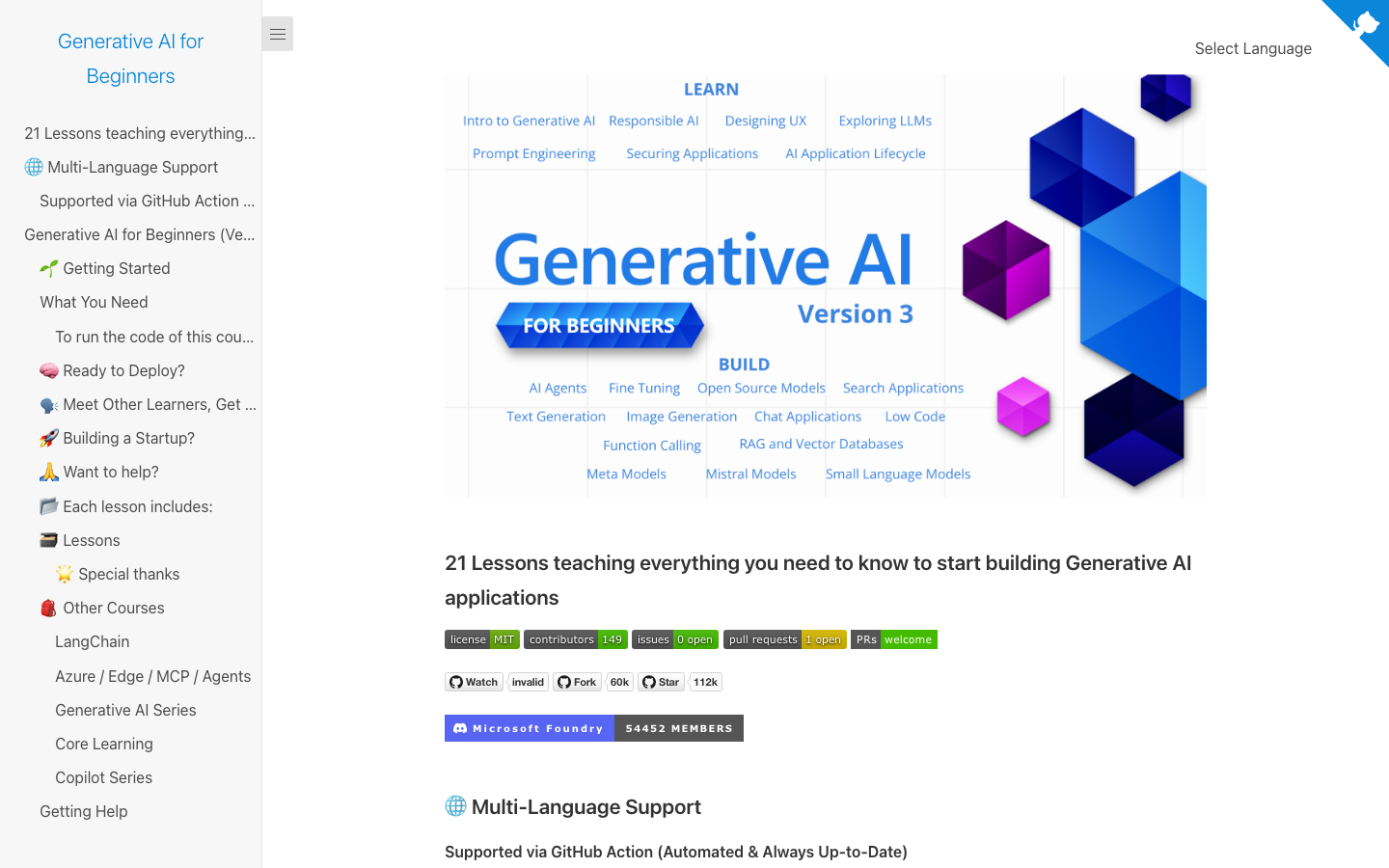
Generative AI for Beginners
Core parameters and statistics
Generative AI for Beginners is a free introductory course on generative AI open sourced by Microsoft on GitHub. Its core feature is "learning by doing": each topic is accompanied by code examples, taking beginners from concepts to running applications.
| Projects | Public Information |
|---|---|
| Positioning | Introductory Course to Generative AI |
| Maintainer | Microsoft (Open Source) |
| Content format | Multiple lessons + code examples |
| Topics covered | LLM basics, prompt engineering, application construction, etc. |
| Hosting method | GitHub open source warehouse |
| Object-oriented | Beginners and developers |
| Price | Free and Open Source |
Positioning Interpretation: Many people want to make GenAI applications but don’t know where to start. This course breaks down the key concepts of generative AI into actionable lessons and uses code examples to reduce "understanding" to "being able to run". It is suitable for beginners to hands-on practice.
Boundary Note: It is for entry-level engineering and requires a certain programming foundation to keep up with the code part; purely non-technical readers may be more suitable for conceptual courses.
User and market recognition
The course is recognized through Microsoft endorsement and an active open source ecosystem.
Official Endorsement: Maintained by Microsoft, the content and examples are in line with mainstream generative AI capabilities, and its authority and update frequency are relatively guaranteed.
Open Source Ecosystem: As a GitHub open source course, the community can contribute translations and improvements to form multi-language versions and continuous updates.
Items to be verified: The number of stars in the warehouse, the number of class hours, etc. will change with updates. The real-time data of the official warehouse should be used as the standard. It is not appropriate to treat the approximate number as a fixed number.
Cost advantage
The cost structure of this course is minimalist: completely free and open source.
- C-side/Individual (Learner): Learn and use code examples for free, which is its biggest advantage.
- Developers: Free for self-study or team training, following its open source license.
- Institutions/Enterprises: It can be used as internal introductory materials for free. The hidden costs are mainly learning time and API fees for running examples.
True Cost Structure: The course is free, the only possible expense is the cost of calling the model service when running the examples (depending on the platform used). When evaluating, you should pay attention to whether the depth of the content and the service context on which the example relies are consistent with your own conditions.
Main functions
Course content is organized around hands-on building GenAI applications:
- LLM Basics: Explain the basic concepts and working methods of large language models.
- Prompt Engineering: Teach how to design effective prompts to obtain stable output.
- Application Construction: Lead the construction of typical generative applications such as chat and retrieval.
- Code Example: Comes with runnable examples for easy learning and practice.
The key to the value of the content is "runnability": the example can be run through directly, which is the core that distinguishes it from purely theoretical tutorials.
Model and version evolution
The course is continuously updated in the form of an open source warehouse, and the version context is mainly based on content additions.
- First Release (~2023-11): Microsoft releases an introductory open source course.
- Continuous Updates (~2026): Additional lessons, updated examples, and expanded multi-language translations.
It does not have a traditional software version number. The content is subject to the official repository and is continuously revised with the development of generative AI technology.
Technical advantages
As a course, its advantages lie in the "engineering teaching path":
Mechanism: Break down the key capabilities of generative AI into lessons, and use runnable code to implement the concepts.
Effectiveness: Learners not only understand the principles, but can also build small applications that can run, reducing the obstacle of "understanding the concept but not knowing how to do it".
Applicable scenarios: Most suitable for developers who have a certain programming foundation and want to get started with the system and build GenAI applications.
The price is that it requires basic programming and operational skills, and the threshold for purely non-technical readers is higher.
How to use
The course is open through the official website and GitHub repository:
| Usage | Suitable objects | Features |
|---|---|---|
| Online course page | Self-learner | Systematic learning by class time |
| GitHub repository | Developers | Get and run code samples |
| Team training | Enterprise/Team | As internal entry material |
The typical process is "learn by class → run the supporting code examples → rewrite and build your own small application". Before you start, you need to configure the development environment and model services required to run the example.
Product Pricing
The course is completely free and open source, and there are no fees for learning and code examples. The only possible cost is the cost of calling the model service when running the examples, which depends on the platform used and has nothing to do with the course itself.
- Individuals/Developers: Free.
- Corporate/Team: Free as internal training material.
Application scenarios
- Personal Introduction: Systematically learn generative AI and practice it. The focus is to verify whether you can run through the examples.
- Team Training: As a unified introductory material for GenAI, focus on the fit with your own technology stack.
- Project Start: Use examples as the starting point for building generative applications, and the focus of verification is the portability of the examples.
Applicable people
- Developer: Have programming foundation and want to get started with generative AI.
- Student: Want to learn completely from concept to code.
- Technical Team: Need ready-made, free and authoritative introductory training materials.
The unsuitable situation is: readers who have no programming foundation at all and just want to understand concepts. They are more suitable for non-technical AI literacy courses.
Summary and Outlook
The core value of Generative AI for Beginners is to turn the introduction to generative AI into a free, open source, and code-supported engineering course endorsed by Microsoft, which is suitable for developers who want to build GenAI applications. Free and working examples are its biggest advantages.
The current limitation is that it requires programming foundation and running environment, and the model services that the example depends on may incur calling charges. For learners, it is recommended to advance at the pace of "learn one lesson, run one lesson, and change one lesson" and keep the examples consistent with the latest version of the official repository to obtain a stable learning experience.
Related tools:  Khanmigo, quizlet
Business process integration and ROI analysis
As a productivity tool for enterprises or professional positions, the true value of Generative AI for Beginners depends on the depth of integration with existing workflows and the quantifiable efficiency improvement effect. The following is a systematic analysis from three core dimensions.
System integration and data interoperability The ability to interoperate with existing business systems is a key prerequisite for productivity tools to be integrated into workflows. It is recommended to focus on evaluating the following integration dimensions: the openness and documentation quality of the RESTful/GraphQL API (whether a complete API reference and SDK examples are provided), the support scope of Webhook event notifications (which business event types are supported for automatic push), the number and depth of pre-built integrations with common collaboration SaaS tools (WeChat Enterprise, DingTalk, Feishu, Slack, Notion, Jira, etc.), and enterprise-level identity authentication support (SSO/SAML/OAuth and LDAP/AD directory integration). Products that lack integration capabilities are easily isolated into information islands, which in turn increases the cognitive cost and operational friction for teams to switch between different tools.
Efficiency Quantification and ROI Estimation Methodology Before purchasing decisions, it is recommended to quantify the input-output ratio through a structured method: Step 1, choose 3-5 Standardized tasks that are frequently repeated and time-consuming in each team are used as test samples; in the second step, the average time consumption of a single task before and after tool intervention, first-time pass rate or error rate, and the number of links requiring manual intervention are recorded under controlled conditions; in the third step, the saved manpower time is converted according to the comprehensive cost of the position (salary, benefits, management sharing), and soft benefits (increased employee satisfaction, standardization of work quality, and improvement in response speed to core business) are superimposed to obtain a comprehensive ROI estimate. It is recommended to continue tracking ROI trends on a monthly basis, as the value of a tool usually increases over time as team proficiency increases and workflows are optimized.
Phase-based implementation strategy and risk control It is recommended to adopt a three-stage implementation path of "pilot verification-gradual promotion-continuous optimization". In the pilot stage (1-2 weeks), a single team or a single business scenario is selected for small-scale verification. The core goal is to verify technical feasibility and user acceptance, and establish preliminary usage specifications and success standards; in the promotion stage (2-4 weeks), after the pilot verification is passed, the coverage is gradually expanded, and standardized activation processes and training materials are developed; in the optimization stage (continuous), the workflow configuration is continuously adjusted based on actual usage data and user feedback, and more high-value application scenarios are explored. Clear quantitative key result indicators should be set at each stage to avoid blindly expanding the scope of use without data support.
Version Info
- Generative AI for Beginners (current course) :The course is continuously updated in the form of an open source warehouse, covering multiple lessons such as LLM basics, prompt engineering, and application construction, and is accompanied by code examples. Specific revisions are subject to the official repository, and there is no unified release version number yet.
- Course first released :Microsoft released this open source generative AI introductory course for the first time, and has since continued to add course hours, updated examples and multi-language translations. There is no official precise date yet, it is recorded according to public milestones.
User Reviews