 Genie Studio
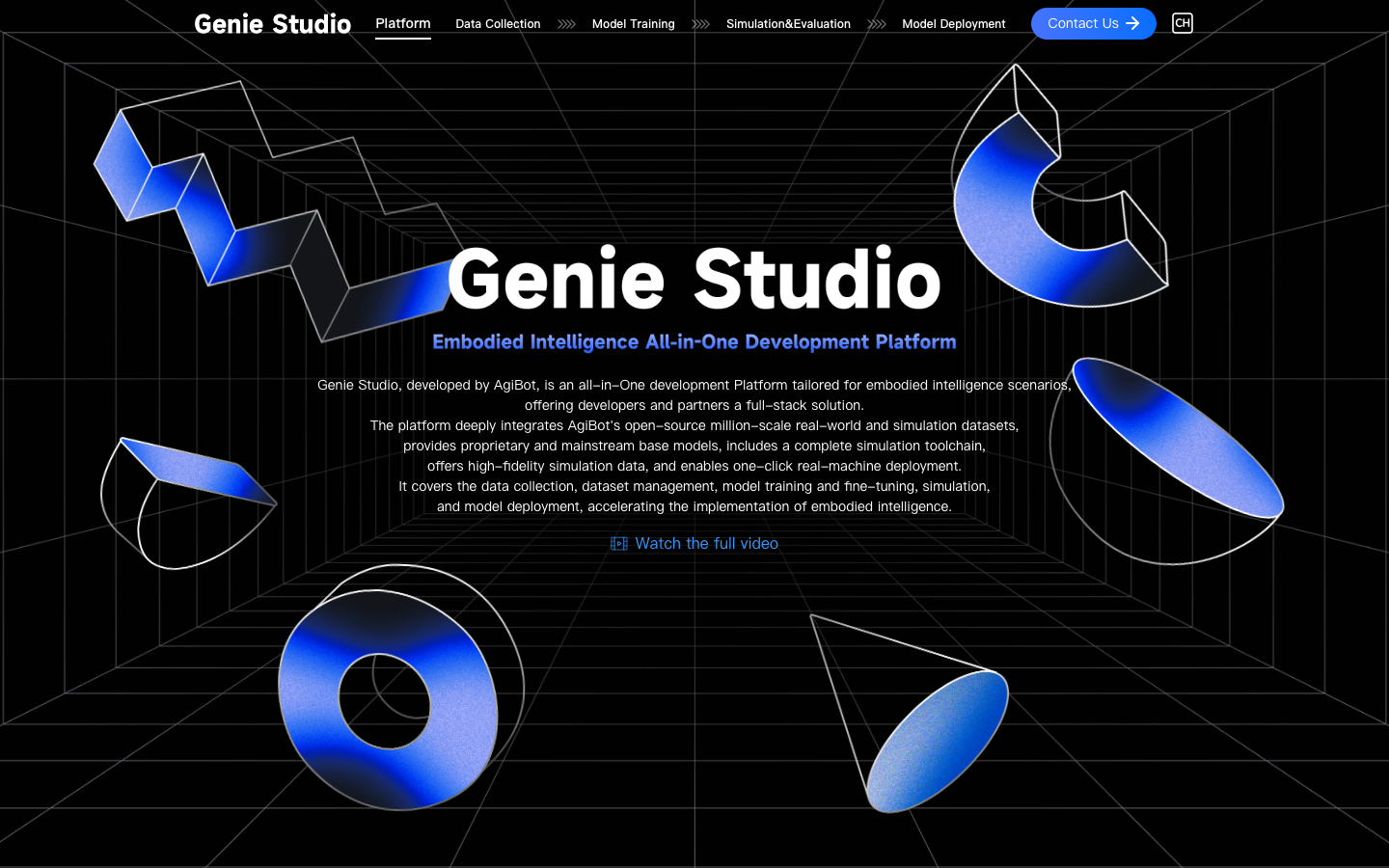
Genie Studio is an embodied intelligence full-stack development platform launched by AgiBot. It covers data collection, data set management, model training and fine-tuning, simulation evaluation and real machine deployment in an integrated environment.
Full review of #Genie Studio
Core parameters and statistics
| Project | Specifications |
|---|---|
| Product Positioning | Embodied Intelligent Full-stack Development Platform |
| Developer | AgiBot (Zhiyuan Robot) |
| Core link | Data collection → Data set management → Model training → Simulation evaluation → Real machine deployment |
| Data collection throughput | Up to 1,000 records/day for a single device |
| Simulation asset scale | 8,000+ high-precision 3D object assets and scenes |
| Basic model support | RDT, Pi0, OpenVLA, GR00T, Go-1 (self-developed) |
| Simulation-Real Machine Calibration Error | < 5% (Go-1 model actual measurement) |
| Inference performance improvement | A single card is 2-3 times faster than traditional solutions |
| Number of assessment tasks | 100+ automated assessment tasks |
| Scene Adaptation Cycle | 48 GPU-days to complete new scene adaptation |
| Video data loading optimization | Storage and bandwidth reduction by 80%+ |
| Supported body types | Multiple robot models + multiple end effectors |
| Deployment Mode | Ontology lightweight operation/edge collaboration/cloud scheduling |
Genie Studio is not just a tool chain aggregator, but a development environment that integrates data management, model life cycle and deployment operation and maintenance in the same platform. The core parameters of "48 GPU-days scene adaptation" and "80%+ storage bandwidth optimization" are important indicators to measure the depth of platform engineering - the former determines the iteration speed from collection to deployment, and the latter directly reduces the infrastructure cost of large-scale video training data.
User and market recognition
Core positioning: Genie Studio is a one-stop full-stack development platform created by Zhiyuan Robot for embodied intelligence (Embodied AI) scenarios, targeting robot algorithm engineers, embodied intelligence research teams and system integrators. Its core value proposition is to integrate the four tool chains scattered in robot development, including data collection, model training, simulation verification, and real machine deployment, into one platform, eliminating cross-section data flow and version management overhead.
A brief comment in one sentence: It is not another robot simulation software, but a "development-related operating system" from data to real machine deployment - but the premise is that you have to use the body of Zhiyuan Robot.
Publicity verification: "Full-link integration" has indeed opened up the data flow of data collection → management → training → simulation → deployment within the platform. The four major modules displayed on the product page (Data Collection, Model Training, Simulation&Evaluation, and Model Deployment) all have specific functional descriptions and technical parameter support, and are not conceptual packaging. However, two points need to be noted: First, the platform solves the problem of link opening at the "software level". At the hardware level, customers still need to prepare the robot body, sensors, and data collection equipment by themselves or purchase them from Zhiyuan; second, the publicity claim of "single-card inference performance increased by 2-3 times" is based on a comparison with traditional single-GPU inference solutions. The specific magnification rate depends on the actual hardware configuration and model scale.
Market positioning: AgiBot was ranked first in global humanoid robot shipments by Omdia in 2025. As of mid-2026, the 15,000th universal humanoid robot has been rolled off the production line. As its software platform, Genie Studio naturally inherits the customer base of Genie Hardware. The platform collaborates with AGIBOT World (a million-level real and simulated data set ecosystem) owned by Zhiyuan, forming a trinity of "hardware + data + platform".
Cost advantage
Genie Studio is a commercial product for enterprise customers. There is no public standard pricing. Solutions and quotations must be obtained through commercial channels. The cost structure can be broken down into three levels:
- C-side/individual users: There is no free trial entrance, and individual developers or small research teams cannot directly obtain platform access. The product page only has the "Contact Us" business entrance, and there is no registration-ready channel.
- Developer/API level: No API pricing or pay-as-you-go model disclosed. The platform is delivered as a turnkey solution rather than billed per API call. The provision method of GDK (Genie Development Kit) and low-code development system requires business confirmation.
- Enterprise/Private Deployment: Typical procurement items include platform license fees, deployment options (cloud/private), technical support services, and custom development. The actual procurement involves multiple negotiable items, and the total cost is highly dependent on the number of robots, data collection scale, GPU cluster configuration, and deployment complexity.
Input-output ratio deduction (based on Rule D quantitative requirements):
| Cost dimension | Traditional multi-tool chain solution | Genie Studio | Changes |
|---|---|---|---|
| Data collection to deployment cycle | 2-3 weeks (cross-tool transfer + debugging) | 3-5 days (all within the same platform) | 70-80% shortened |
| Video storage and bandwidth | Full storage of original video | Dedicated video loading framework reduces 80%+ | Storage cost reduced to 1/5 |
| Real machine test loss | High-frequency real machine testing causes hardware wear | Simulation verification + <5% calibration error | Real machine test times reduced by 50-70% |
| Cross-position coordination costs | Data team/training team/deployment team work independently | Unified platform + task chain orchestration | Coordination costs are significantly reduced |
Hidden costs: The platform is deeply bound to the Zhiyuan robot body, and teams using robots from other brands require additional adaptation work; the enterprise-level procurement cycle (POC verification → business negotiation → contract signing → deployment and implementation) is usually calculated in months, which is not suitable for quick verification scenarios; the platform itself does not contain GPU computing resources, and customers need to bring them themselves or rent them. This part is the largest ongoing operating cost.
The Free Truth: There is no free version, and there is no community version. The product pages and business processes all point to enterprise-level customers, and small teams or academic research institutions cannot access the actual functions of the platform before obtaining business approval.
Main features of Genie Studio
The functional system of Genie Studio is organized into four major modules according to the complete life cycle of embodied intelligence development. There is significant synergy within each module, rather than a simple list of functions.
Data acquisition module
- Template task configuration: Provides data collection task templates, tracks data status with the full-process dashboard, and supports cross-scenario and cross-device collection management. Multiple collection tasks can be scheduled uniformly under the same interface.
- Multiple bodies and multiple end effectors: Supports asynchronous collection of data from different robot models and end effectors (grippers, suction cups, etc.), and is equipped with custom data verification rules to ensure that the warehousing data is complete and compliant.
- High-throughput real-time processing pipeline: The distributed architecture supports real-time/offline dual-mode processing, covering data cleaning, anomaly detection and zero-latency data supply. The daily throughput of a single device is up to 1,000 collection records.
- Manual quality assurance: Provides visual annotation workflow, and manual intervention in data quality inspection to ensure the credibility and availability of the data set.
Expert’s point of view: The four-layer design of "template + multi-ontology + real-time pipeline + artificial presence" of the data collection module forms a complete data management system. Templating reduces the cost of repeated configuration of collection tasks, multi-ontology support allows the same platform to be compatible with different types of robots, real-time pipelines ensure that the delay from data collection to storage is controllable, and manual presence sets the last gate for data set quality. Lack of any one of these four will create a bottleneck in the data pipeline.
Model training module
- Multiple basic model integration: In-depth integration of self-developed Go-1 models and mainstream open source models (RDT, Pi0, OpenVLA, GR00T), compatible with public and private data sets. The model selection range covers a variety of capability orientations from general operations to specific scenarios.
- Task Templates and Exclusive Training Framework: Pre-training/fine-tuning templates and self-developed training framework can complete model adaptation to new scenarios within 48 GPU-days. This metric directly determines the delivery speed from scenario requirements to usable models.
- Video data loading framework: Hardware-level video decoding and random frame data access, effectively reducing storage and bandwidth consumption by more than 80%. For large-scale video training data, this means a significant reduction in infrastructure investment.
- Task chain orchestration: Build an end-to-cloud unified resource scheduling and orchestration system to form an observable full-link delivery pipeline. Resource allocation, progress tracking and fault recovery of training tasks are completed on the same interface.
Expert View: The hidden synergy of the model training module lies in the combination of "48 GPU-days scene adaptation" and "video data loading framework". In traditional solutions, the I/O bottleneck of video data often leads to insufficient GPU utilization, while Genie Studio's hardware decoding solution allows the GPU to be used more for calculations instead of waiting for data. This may be the basis for the relatively aggressive adaptation cycle of 48 GPU-days.
Simulation evaluation module
- Automated Evaluation Tasks: 100+ configurable evaluation tasks, supporting flexible configuration and intuitive automated performance benchmark testing interface.
- Automatic task generation: 8,000+ high-precision 3D assets and contextual support automatically generate evaluation tasks, eliminating the need for users to manually build each test scenario.
- Simulation remote control: Supports VR and keyboard remote control, which can quickly verify the performance of the algorithm on the real machine in the simulation environment.
- Accuracy Evaluation Calibration: The calibrated simulation environment can achieve an error of less than 5% between the Go-1 model simulation test results and the real machine results, which is the core indicator of simulation credibility.
Expert point of view: The value of simulation evaluation does not lie in "being able to run the evaluation", but in "the evaluation results can reflect the performance of the real machine". The official calibration error of <5% is a key trust indicator - if the gap between simulation and real machine is too large, the simulation evaluation will lose its guiding significance. The combination of 100+ evaluation tasks and 8,000+ asset libraries ensures coverage and scene diversity.
Real machine deployment module
- One-click deployment: The algorithm is seamlessly migrated from the cloud to the real machine, and the single-card inference performance is improved by 2-3 times compared with traditional solutions. The deployment process is completed visually within the platform, eliminating the need for manual configuration and operation.
- Full-stack Development Kit: Integrated model compiler GDK (Genie Development Kit) real machine control system, low-code development system, application development framework and application release system, forming a complete package of "algorithm → deployment → management".
- Evaluation and Optimization: Provides effect evaluation, performance analysis, version management, remote diagnosis and real-time monitoring capabilities, and combines simulation and real machine data to ensure that deployment results are traceable and iterable.
- Flexible computing power and hybrid deployment: Support lightweight ontology operation or edge collaboration, expand computing power on demand, and take into account precise control and performance optimization. It also supports model encryption and multi-platform publishing, adapting to different hardware environments.
Expert View: The GDK and low-code system of the real machine deployment module are the points of differentiation from other robot platforms. In traditional solutions, engineers usually need to manually complete model conversion, compilation, deployment and debugging from training completion to real machine operation. Genie Studio standardizes this process through GDK and model compiler, reducing the dependence on senior engineering personnel for smooth deployment.
Model and version evolution of Genie Studio
Mainline release
Genie Studio is currently in the official version 1.0 stage, which is the first public version of the product. The product roadmap has the primary goal of covering the entire link of "acquisition→training→simulation→deployment". The directions for subsequent versions are expected to include:
- 1.0 Official Version (~2026-06): The first public version, providing full-link capabilities for data collection, data set management, model training and fine-tuning, simulation evaluation, and real machine deployment. Integrates RDT, Pi0, OpenVLA, GR00T and self-developed Go-1 models, supporting 8,000+ simulation assets and 100+ evaluation tasks.
Version context description
Genie Studio is a commercial product that evolved from Genie Robot's internal development tools, so the public version history is relatively short. The core logic of its version evolution is:
- First open the whole link (data → model → simulation → deployment) to ensure that every node is available
- Further optimize the engineering depth of each section (such as video loading framework, simulation calibration accuracy, deployment performance)
- Gradually open up partner ecosystem and third-party model access
Subsequent versions are expected to iterate in the following directions: more third-party model adaptation, simulation asset library expansion, deployment target hardware expansion, and enhanced integration capabilities with enterprise IT systems.
Technical advantages of Genie Studio
Genie Studio's technical competitiveness comes from the two-wheel drive of "full-link integration + key engineering optimization" rather than the stacking of single function points.
The true meaning of full-link integration: Data collection, model training, simulation evaluation, and real machine deployment complete data flow and status synchronization on the same platform, eliminating the cost of data format conversion, version alignment, and cross-team coordination between multiple tool chains. This means that a team can complete all work from collection to deployment under the same permission system, the same data origin, and the same monitoring dashboard.
Mechanism and effect of video data loading framework: Traditional video training data loading relies on CPU decoding and random disk reading, which can easily become an I/O bottleneck in large-scale training scenarios. Genie Studio adopts a hardware-level video decoding solution that supports random frame data access, offloads the decoding work from the CPU to dedicated hardware, and reduces storage and bandwidth consumption by more than 80%. The effect is that GPU utilization is improved, training waiting time is reduced, and storage costs are reduced to one-fifth of the original.
Technical path for simulation-real machine calibration: The migration from simulation to real machine (Sim-to-Real) is the core problem of embodied intelligence. Genie Studio uses calibrated simulation context (including 8,000+ high-precision 3D assets) and domain randomization technology to achieve an error of less than 5% between the Go-1 model simulation test results and the real machine results. The industry significance of this accuracy is that most model verification work can be completed in the simulation environment, and real machine testing is only used for final confirmation, greatly reducing equipment loss and safety risks of real machine testing.
Source of inference performance optimization: The single-card inference performance is improved by 2-3 times compared with traditional solutions, mainly from model compilation optimization (including operator fusion, memory multiplexing, quantitative reasoning) and GDK runtime optimization. In the traditional solution, exporting the model from the training framework to the deployment engine requires manual optimization. Genie Studio's model compiler automatically completes these tasks.
Flexibility of deployment architecture: Supports three modes of ontology lightweight operation, edge collaboration and cloud scheduling. Models can be encrypted and released to a variety of hardware platforms. For scenarios that require rapid iteration, you can choose the cloud mode. For scenarios that require high real-time performance, you can choose the edge mode. For simple tasks, you can run them directly on the ontology.
How to use Genie Studio
Genie Studio is an enterprise-level product, and its usage entrance and process are fundamentally different from consumer-level products:
Comparison of access methods:
| Access method | Applicable scenarios | Prerequisites |
|---|---|---|
| Business consultation access | Formal corporate procurement | Contact the Zhiyuan sales team through the official website business portal to complete the needs assessment, POC verification, and contract signing |
| Private Deployment | Enterprises with high data security requirements | Prepare your own server/GPU cluster, and the Zhiyuan team will provide deployment support |
| Cloud Deployment | Quick start and elastic expansion | Zhiyuan or partners provide cloud infrastructure, pay on demand |
Typical usage process:
- Business Contact: Submit requirements through the "Contact Us" portal on the product page or the official website of Zhiyuan Robot, and the Zhiyuan business team will conduct demand assessment and solution design.
- Boundary preparation: Configure the robot body, sensors, data acquisition equipment and GPU computing resources according to the plan
- Platform deployment: The Genie team completed the Genie Studio platform deployment and context configuration
- Data collection: Use the template to create a data collection task, configure the robot body and end effector parameters, and start the collection pipeline
- Dataset Management: Verify, annotate and version the collected data in the platform
- Model training/fine-tuning: Select a basic model (Go-1, RDT, etc.) and use the pre-training/fine-tuning template to complete scene adaptation
- Simulation Verification: Run 100+ evaluation tasks in the simulation environment to verify the model effect and generalization ability
- Real machine deployment: Publish the model to the real machine through one-click deployment, and use remote diagnosis and real-time monitoring to track the running status
- Iterative Optimization: Feed back the real machine operating data to the data set and model to form a continuous optimization system
Get started quickly: Since the product is for enterprise customers, there is no public self-service registration and online trial entrance. Potential users can obtain more detailed technical information through the following channels:
- Learn about the robot body and overall solution on the official website of Zhiyuan Robot
- AGIBOT World (agibot-world.cn) Obtain public data sets and simulation assets to understand the data ecosystem
- Business contact [email protected] to apply for POC testing
Product Pricing for Genie Studio
| Project | Description |
|---|---|
| Platform license fee | Undisclosed, business consultation required. Neither annual subscription nor one-time buyout model confirmed |
| Deployment Mode | Supports cloud deployment and private deployment. Private deployment requires customers to provide their own servers and GPU clusters |
| Technical Support | Included in the business plan, the specific SLA level needs to be confirmed by the business |
| Customized development | Customization requirements for special hardware adaptation, specific data set formats or exclusive model access need to be communicated separately |
| Training Services | Undisclosed, expected to be included in the overall solution |
| G computing power cost | The platform does not include GPU computing power, which must be borne by the customer or rented through a partner |
Pricing Summary: Genie Studio is a typical enterprise-level industrial software pricing model, with no public price list or pay-as-you-go billing options. The actual total cost consists of five components: platform license, deployment plan, support services, custom development and GPU computing power, of which GPU computing power is the largest ongoing operating cost. It is recommended to ask the Zhiyuan team to provide a complete solution including the POC cycle, deployment implementation schedule, SLA terms and expansion costs before purchasing.
Application scenarios of Genie Studio
-
Industrial robot operation data collection and management: In the factory environment, multiple robots of different models perform operating tasks at different stations. The unified platform collects the operation data of each workstation, and forms a standardized data set after verification and annotation. The traditional approach is to use independent collection tools for each workstation, resulting in inconsistent data formats, lack of quality inspection, and confusing versions. Genie Studio's templated task configuration and manual quality inspection solve these problems, and the data utilization efficiency changes from "mostly idle after collection" to "available as soon as it is put into the database".
-
Customized training of service robot basic model: In service scenarios such as hotels and shopping malls, the types of tasks that robots need to perform are greatly different from those in industrial scenarios. Using Genie Studio's pre-trained/fine-tuned templates, adaptation from a base model to a scene-specific model can be completed in 48 GPU-days. After the fine-tuned model has been verified by 100+ evaluation tasks in the simulation environment, it can be deployed to the real machine with one click. The key acceptance point is: whether the simulation evaluation results are consistent with the performance of the real machine (calibration error <5% has been verified by the Go-1 model).
-
Simulation-driven robot algorithm iteration: The R&D team first conducts large-scale strategy testing in a simulation environment before deploying it to real machines. 8,000+ 3D assets support automatic generation of diverse test scenarios, and VR remote control allows algorithm engineers to intuitively evaluate model performance. The simulation-real machine calibration error is <5%, which means that strategies that perform well in simulation have a high probability of being equally effective on real machines, significantly reducing the frequency and risk of real machine testing.
-
Unified management platform for multiple models of robots: Enterprises operate multiple different models of robots at the same time (such as A2 series humanoid robots, G1 universal robots, and X1 open source robots), and require a unified algorithm development and deployment platform. Genie Studio's hybrid deployment architecture supports different models of robots to be managed under the same platform, and models can be published and monitored separately by model.
Who is Genie Studio suitable for?
-
Robot Algorithm Engineer: Robot software developers who need full-link tools from data collection to model deployment. The value of Genie Studio lies in completing work that was originally scattered in multiple tool chains on a unified platform, reducing the time loss of tool switching and data conversion. The prerequisite is that your team has purchased or plans to purchase the Zhiyuan robot itself.
-
Embodied Intelligence Research Team: Academic and industrial research teams who need a unified platform to manage research experiments. The platform's data management and simulation evaluation capabilities can improve the reproducibility and efficiency of experiments. But be warned: Research teams have limited budgets, and Genie Studio's enterprise-level pricing may exceed academic budgets. It is recommended to obtain access through collaborative research projects or academic cooperation programs provided by Zhiyuan Robotics.
-
Robot system integrator: An integration team that implements robot solutions for different customers. Genie Studio’s full-link capabilities reduce the workload of integration teams coordinating across multiple tool chains. The prerequisite for application is that the integration solution uses Zhiyuan robots as the core, and projects using robots from other brands need to evaluate compatibility.
-
Automation department of manufacturing enterprises: The internal team responsible for the deployment and operation and maintenance of production line robots. The platform's remote diagnosis and real-time monitoring capabilities can reduce operation and maintenance costs, and the one-click deployment function can speed up the launch of new workstations.
Not suitable for crowds and scenes:
- Teams that only use third-party robots: Genie Studio is deeply bound to the Zhiyuan robot body. Teams that use robots from other brands such as UBTECH, Yushu Technology Figure AI, etc. may face compatibility issues. It is recommended to first confirm the platform's support for the target body.
- 1-2 person early stage research group: The procurement cycle and cost of enterprise-level products are too heavy for small-scale exploratory research. It is recommended to use open source solutions (such as Isaac Sim, RoboCasa, MuJoCo) for preliminary verification, and then evaluate the input-output ratio of Genie Studio after confirming the direction.
- Teams who only need a single structured tool: If a team only needs simulation tools or only data acquisition tools, Genie Studio's full-link design may introduce unnecessary complexity and cost. It may be more economical to use professional tools on demand (such as Isaac Sim for simulation and Roboflow for data management).
Summary and Outlook
Core competitiveness: The core competitiveness of Genie Studio lies in the double barriers of "full-link integration + hardware ecological binding". It integrates data collection, model training, simulation evaluation and real machine deployment into a unified platform, solving the core pain points of multi-tool chain integration in embodied intelligence development. The three engineering indicators of simulation-real machine calibration error <5%, video data loading framework reduction of 80% + storage bandwidth of 48 GPU-days and scene adaptation cycle are key criteria for measuring the practicality of the platform.
Current Limitations:
- Hardware binding: The platform is deeply bound to the Zhiyuan robot body. Teams using robots from other brands may face compatibility issues. For mixed deployment scenarios of multi-brand robots, Genie Studio is currently not a universal solution.
- Procurement threshold: The procurement cycle of enterprise-level products is long (usually measured in months), and there is no public pricing and no self-service trial entrance, making it difficult for small-scale teams to quickly access and verify. Academic and research institutions need to confirm individually whether there are preferential cooperation programs.
- Data dependence: The effectiveness of the platform is highly dependent on the continuous supply of high-quality data. For new teams with weak data collection infrastructure, building a data collection pipeline from scratch still requires time and investment.
- Ecological maturity: As a version 1.0 product, the number of third-party model accesses and the industry coverage of the simulation asset library are still expanding. Compared with mature platforms such as Isaac Sim and RoboCasa that have been running for many years, there is a gap in ecological richness.
Follow-up observation points:
- Version iteration rhythm: whether versions after 1.0 can maintain continuous optimization of the entire link, especially progress in third-party model support and simulation asset expansion
- Pricing strategy clarified: whether there will be a lightweight version or a pay-as-you-go model for small and medium-sized teams
- Third-party robot compatibility: whether support for non-Zhiyuan robots will be opened, which will determine the upper limit of the market size of the platform
- Community and ecological construction: The establishment of developer community, plug-in market and partner network is the key to the long-term competitiveness of the platform
Procurement/Adoption Risk Assessment: For enterprises that have purchased Genie Robot ontology, Genie Studio is a natural choice to reduce the development and deployment cycle. It is recommended to verify the actual effect of the platform in its own scenarios through POC projects (especially the simulation-real machine calibration accuracy and 48 GPU-days scene adaptation commitment). For teams that are only doing preliminary exploration and have not yet determined the robot platform, it is recommended to use open source solutions to accumulate experience and data first, and then evaluate the input-output ratio of Genie Studio after the direction is clear and the hardware is selected. In either case, before purchasing, be sure to ask the Zhiyuan team to provide a complete business plan that includes SaaS/privatized deployment costs, GPU computing power demand estimates, SLA terms, and scalability plans to avoid budget overruns due to hidden costs (GPU computing power, custom development, training support).
Related tools:  Hugging Face, replicate
Version Info
- Genie Studio official version :The first public version provides complete full-link capabilities of data collection, training, simulation and deployment.
- Genie Studio official version :The first public version provides the full link of data collection, model training, simulation evaluation and real machine deployment.
User Reviews