 GensBot
Free
GensBot
Free
GensBot is an AI-driven print-on-demand platform. Users only need to describe the desired pattern in natural language, and AI will instantly generate the design and print it on T-shirts, mugs, mobile phone cases, canvas paintings and other products. The platform adopts a Token reward mechanism, with free design and payment only after purchase, and is committed to allowing everyone to easily own unique and personalized products.
GensBot
Core parameters and statistics
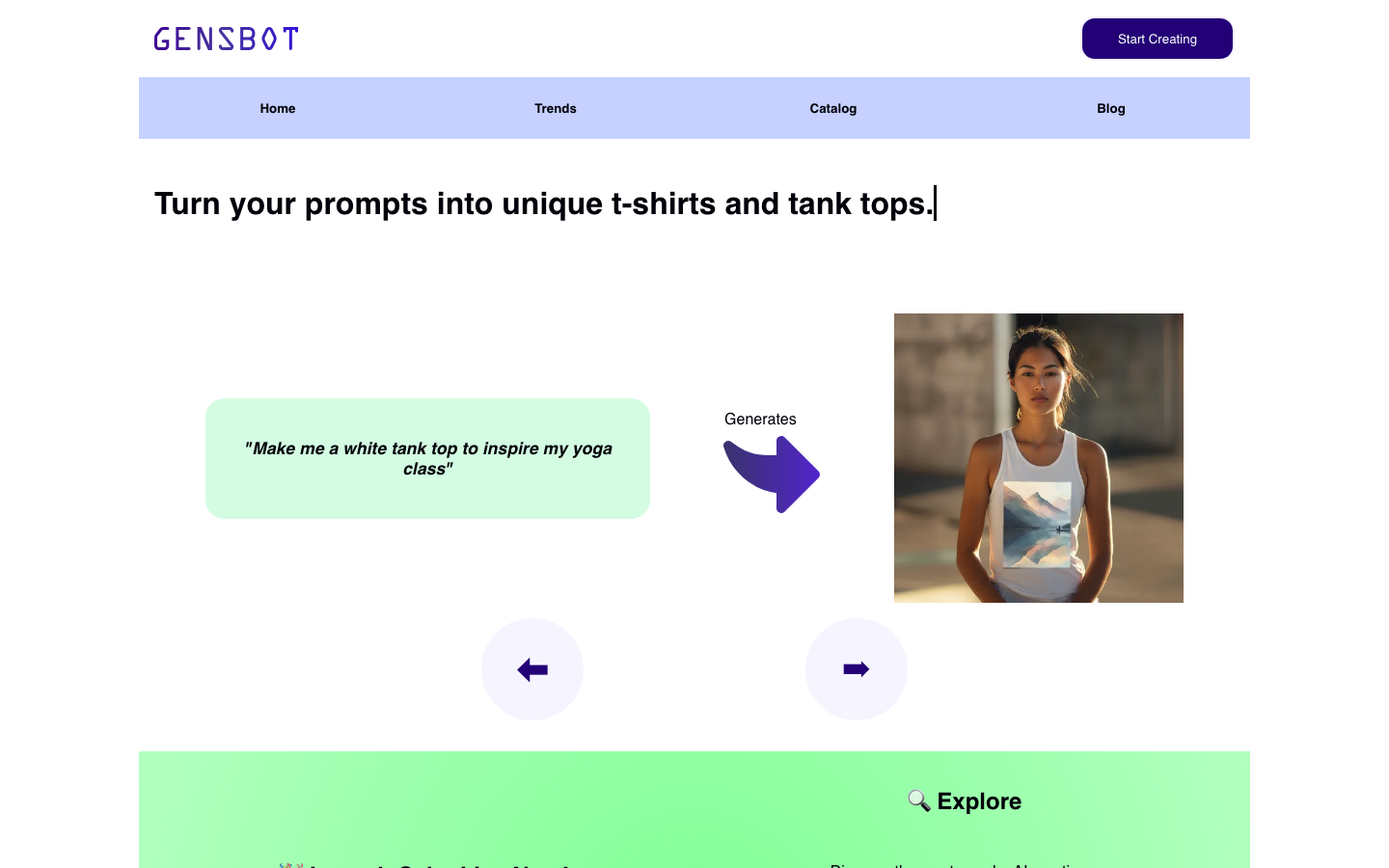
GensBot is an AI-driven Print-on-Demand (POD) e-commerce platform. The core logic is "you describe the AI to do the design, and the platform will help you print and deliver it" - it is not an agent or automation tool, but a productivity/business-side application (Type D). Users only need to describe the desired pattern in natural language, and AI will generate 4 design variants in a few seconds. Once selected, they can place an order to purchase physical goods. The design process is completely free.
| Projects | Public Information |
|---|---|
| Product positioning | AI on-demand printing product customization platform |
| Core Competencies | AI generation from text to product design + on-demand printing and global distribution |
| Platform | Web |
| Place of Attribution | GB (London, UK) |
| Business model | Free design + paid for purchase + Token reward system |
| Online time | ~April 2024 |
| Product Categories | Clothing (T-shirts/hoodies/camisoles), mugs, mobile phone cases, canvas paintings, posters, handbags, water bottles, baby onesies, etc. |
| AI design mode | Generate 4 variants at a time, which can be generated repeatedly until you are satisfied |
| Reward mechanism | Free tokens will be given when you register, and additional tokens will be rewarded for shopping |
| Global distribution | Support localized production and reduce carbon emissions from cross-border transportation |
Brief review in one sentence: GensBot is not another AI painting tool, but an end-to-end on-demand printing platform that "you say you need AI design, it will be made directly and sent to you" - compressing the link from creativity to products from "find a designer → revise the draft → contact the factory → place an order" into "type a sentence → choose one → pay and receive the goods".
User and market recognition
As a young platform to be launched in 2024, GensBot has established initial brand recognition and community foundation in the fields of AI e-commerce and on-demand printing.
Community and Social Coverage: GensBot has official accounts operating on mainstream social platforms, including YouTube, Facebook, Instagram, TikTok, X (Twitter), Reddit, and has a Trustpilot user review page. This provides it with multi-touch user acquisition and word-of-mouth channels.
User Evaluation and Trust: The platform is connected to the Trustpilot third-party evaluation system, and users can share their shopping experience on the platform. The very existence of Trustpilot demonstrates GensBot’s emphasis on transparency in user reviews – something that is not common among AI e-commerce startups.
Industry positioning: GensBot is at the intersection of AI e-commerce and on-demand printing. Compared with traditional POD platforms (such as Printful, Printify), GensBot's differentiation lies in using AI to replace the "upload design drawings" step, lowering the threshold to zero. Compared with AI design tools (such as Midjourney, DALL·E), GensBot not only generates images, but also directly makes them into purchasable products. This "AI design is a commodity" model is still a niche track, and there is no leading monopoly yet.
The specific number of users and revenue data have not been made public and are subject to official real-time disclosure. Judging from the number of Trustpilot reviews and the frequency of social media interactions, the platform is in the early stages of growth, with active users numbering in the tens of thousands rather than millions.
Cost advantage
GensBot's cost structure is fundamentally different from traditional on-demand printing platforms - it eliminates the cost of "purchasing design drawings" or "hiring designers", making design completely free and only charging for the production and delivery of physical goods.
Three-tier cost structure
C-side/individual users: Design is completely free, and free tokens will be given when you register. You can use the tokens to repeatedly generate design variants without incurring any fees. Only pay if you decide to purchase physical goods. The product price is expected to include printing cost + platform profit + delivery fee, please refer to the checkout page for details. Compared with the traditional customization process (design fee 50-200 yuan + single product production fee), GensBot eliminates independent design costs.
Small and medium-sized sellers/brand owners: For individual sellers who need small batches of brand peripherals or promotional items, GensBot provides a "zero inventory, zero design fee" solution - there is no need to prepare goods in advance, and there is no need to find a designer to design patterns. You can directly input the requirements to generate the design, and place orders on demand. Whether there are discounts for bulk purchases is subject to the official real-time policy.
Corporate/Team Gift Procurement: Customized corporate gifts (such as annual party peripherals, customer souvenirs) traditionally require a high-cost link from design company → proofing → factory mass production. GensBot's single-piece customization model makes small batches and even single-piece gift customization economically feasible, but in large-volume (100+ pieces) scenarios, the single-piece cost of traditional factory direct procurement may be lower.
The truth about free: Free design is a customer acquisition strategy, not charity - users consume tokens every time they generate a design. When the tokens are used up, they must either wait for daily gifts or purchase products to obtain additional tokens. The core profit point of the platform lies in the gross profit from the sales of physical goods, not in the design.
Hidden costs: ① Uncertainty of AI design - repeated generation until satisfied may consume a large amount of Tokens; ② International delivery costs - for users in non-localized production areas, cross-border shipping costs may account for 20%-40% of the total order; ③ Return and exchange policy - Customized products usually do not support returns without reason, and the size and style need to be confirmed before purchasing.
Compliance and Risk: AI-generated designs may unintentionally infringe the copyright or trademark rights of others (such as generating designs containing well-known IP images), and users are solely responsible for the content of the submitted Prompt. The platform should have relevant disclaimers in the "Terms of Service" and "Privacy Policy". For specific terms, please refer to the official real-time page.
Hidden benefits: The greatest value of GensBot is not in "saving design fees", but in compressing the turnaround time of "ideas to physical objects" from weeks to minutes. The traditional customization process requires: Conception → Find references → Hire designers → Repeatedly modify → Confirm files → Contact factory → Prototype → Mass production → Delivery. GensBot combines the first six sections into one action of "enter prompt and select design", reducing the creative verification cycle from days to seconds.
Main functions
GensBot's functional design revolves around the core link of "from text to product". It does not use AI as an additional filter, but deeply binds AI design to product printing.
-
AI text to product design: The user describes the desired pattern (such as "black women's T-shirt with sunset pattern") in natural language. After AI understands the semantics, it generates 4 design variants in a few seconds and renders them directly on the selected product style. Applicable tasks: Quickly transform abstract ideas into visual product renderings, suitable for creative expression by non-design professionals.
-
Multi-category product coverage: Supports dozens of product styles in 7 categories - clothing (T-shirts, hoodies, tank tops, hoodies, sweatshirts), home furnishings (mugs, canvas paintings, posters, woodblock prints), accessories (mobile phone cases, handbags, water bottles), stationery (notebooks, folders, business cards, flyers), and baby clothing (onesies). Applicable tasks: One platform covers all scene customization needs from clothing to home furnishings, without the need to connect with multiple printers.
-
Token Reward Economic System: The platform has a built-in virtual Token (Gens Token) mechanism. Registration will give you an initial Token. Each AI generation consumes Token, and you will receive additional Token rewards after shopping. Tokens can be used in future designs or redeemed for exclusive offers. Practical tasks: Encourage users to continue to participate and repurchase, forming an application relationship of "Design → Purchase → Earn Token → Redesign".
-
Trendsbot Trend Discovery: The platform has a "Trendsbot" section that displays the most popular AI creative designs and popular products. Users can browse other people's creative inspiration and learn about current fashion trends. Applicable tasks: Solve the blank canvas dilemma of "don't know what to design" and provide a source of inspiration for users who are exhausted of creativity.
-
Global localized production and distribution: GensBot adopts a localized production strategy and supports local suppliers to print and ship in multiple regions to reduce international transportation distances and carbon emissions. Applicable tasks: Taking into account the warranty concept and delivery efficiency, shorten the user's delivery time.
Expert View: The functional design of GensBot has two hidden collaboration links. First, Design is Marketing—the popular designs displayed by Trendsbot are not only an inspiration library, but also a display window for the platform's UGC content. Each user's public design may become a purchasing inspiration for others, forming a positive pattern of "users help the platform create content, and the platform helps users sell designs." Second, Double locking of the Token system - Token is designed to be both a consumable product and a shopping rebate. This design allows users to recharge for the next interaction every time they consume, which can theoretically increase the retention rate. However, Token’s economic model design (inflation/deflation, purchasing power anchoring) determines the sustainability of the system, and this information has not been officially disclosed.
Model and version evolution
As a young platform that will be launched in 2024, GensBot's version evolution is based on public milestones instead of the traditional semantic version numbering system.
Public Milestones
- ~January 2024 (Beta internal testing): The product’s core AI design engine and Token reward mechanism have completed internal verification. Early test users participate through an invitation system, mainly to verify the resolution, color reproduction and composition suitability of AI-generated patterns on physical printing.
- ~April 2024 (public launch): GensBot is officially open to the public, and the first batch supports core categories such as T-shirts, mugs, canvas paintings, and mobile phone cases. Simultaneously publish the brand blog and publish brand narrative articles such as "Our Mission" and "Gensbot explained" to explain its "AI-driven on-demand shopping" concept. Founder Aurash Karimi communicates the brand vision through blog posts.
- ~The end of 2024 to 2025 (category expansion and function iteration): Continue to expand product categories, and gradually add new categories such as hoodies, handbags, water bottles, baby onesies, business cards, flyers, etc. Trendsbot’s trend discovery function is online to help users get design inspiration. The Token system continues to operate and launches promotions such as "Launch Sale".
Version Note: GensBot is a continuously iterative cloud service platform with no semantic version number. The above time nodes are based on the official blog release date and product function speculation. The precise date is subject to the official announcement. The product is still in the early iteration stage, and the main optimization directions are expected to include improving the quality of AI design, expanding product categories, optimizing distribution timeliness, and improving the Token economic model.
Technical advantages
GensBot's technology stack is not a parameter scale competition that pursues large models, but focuses on the engineering implementation of the vertical scenario of "AI design → product printing".
Vertical optimization of AI design engine: GensBot's AI design capabilities are different from general Vincent diagram models (such as Midjourney or DALL·E). It needs to solve the special constraints of several vertical scenarios: ① The pattern must adapt to the shape and size of the specific product (such as the curved surface of the mug, the camera opening position of the mobile phone case); ② The generated results must meet the printing resolution requirements (usually above 300 DPI); ③ The design must take into account the differences in color expression of different materials (cotton vs polyester vs ceramic). This means that GensBot’s AI engine overlays product template mapping, resolution optimization and material color adaptation layers on top of the underlying model – this is a core technical barrier that cannot be directly replaced by general-purpose AI painting tools.
Print-on-demand (POD) supply chain integration: GensBot's backend is not simply "AI generation + express delivery", but is connected to a network of local printers in multiple regions. After the user places an order, the system needs to: ① automatically map the AI-generated design drawings to the production file format of the corresponding product (including bleed bits of different sizes, crop marks, and color profiles); ② route the order to the nearest production node to reduce transportation distance; ③ track production and distribution status. This supply chain integration capability determines the stability of the delivery experience, and is why e-commerce AI tools are more difficult to do well than pure design tools.
Technical support for localized production and guaranteed concepts: The platform promotes "local production and reduced carbon emissions", which means that its order routing system needs to dynamically determine the optimal production location based on the user's delivery address, real-time production capacity of each production node, and transportation costs. This involves logistics optimization algorithms. Although the complexity is controllable for early platforms with annual order volumes of 10,000, as orders grow, the intelligent scheduling capabilities of the routing system will become a key bottleneck for scale.
Consistency vs. Diversity Balance of AI Design Quality: Generating 4 variations of designs per Prompt means that the AI needs to strike a balance between "consistency (matching user descriptions)" and "diversity (different styles/compositions)". If the four variants are too similar, the user-perceived value will be reduced; if the differences are too large, none of them may meet user expectations. This balance relies on prompt understanding, latent space sampling strategies, and fine tuning of Classifier-Free Guidance parameters.
How to use
The entire process of using GensBot is completed on the Web without installing any software. It only takes 4 steps from entering requirements to placing an order.
| Steps | Action | Instructions |
|---|---|---|
| 1. Visit the official website | Open gensbot.com | Browse Trendsbot popular designs without registration |
| 2. Select the product | Select the product category (T-shirt, mug, mobile phone case, etc.) and style/color from the homepage or Catalog | Each category has an independent Prompt input port |
| 3. Input Prompt | Use natural language to describe the desired pattern (such as "a black t-shirt for women with a sunset graphic") | The more detailed the description, the more accurate the AI generated effect will be; English input is supported |
| 4. Select and place an order | AI generates 4 design variants → choose the one you like the most → add to shopping cart → checkout and pay | If the design is not ideal, it can be regenerated (consuming Token), and you will buy again if you are satisfied |
Detailed usage tips:
- Prompt Tip: GensBot’s AI understands English prompts best. It is recommended to include elements such as subject, style, color, composition, etc. For example, "white unisex zip hoodie with good vibes and a penguin" is more controllable than simply "good vibes". At present, no clear support for Chinese Prompt has been observed. Chinese users are recommended to use English descriptions.
- Token Management: Newly registered accounts will receive initial Tokens, and each AI generation consumes a fixed number of Tokens. After the Tokens are exhausted, you can obtain additional Tokens by purchasing goods, or waiting for possible daily/regular giveaways on the platform. It is recommended to generate a few more design variants and save them when there are enough Tokens, so that you can place orders directly later.
- Product Selection Suggestions: For gift scenarios, mugs and mobile phone cases have small printing areas and low failure rates; for clothing, it is recommended to confirm the size chart first. Customized products usually do not support unreasonable returns.
- Delivery: GensBot supports global delivery and adopts a localized production strategy. The specific delivery time and freight are subject to the settlement page.
Product Pricing
GensBot's pricing adopts a two-tier model of "free for design, paid for shopping", and also introduces the Token system as a user incentive and retention tool.
Design with restraint : Design generation is completely free - users will receive an initial token after registration, and each AI generation consumes tokens. After the Tokens are consumed, you only need to purchase the product once to obtain additional Tokens, without direct recharge. This means that in theory, as long as you continue to shop, design tokens can be obtained continuously.
Product Price: Product prices are divided by category and style, and are subject to the real-time price on the official website's settlement page. The platform launches promotional activities from time to time (such as "30% off all items + Double rewards" during the launch period), and the discount and reward policies are dynamically adjusted.
Token reward mechanism:
| Dimensions | Description |
|---|---|
| How to obtain Token | Register for free + shopping rewards + promotions |
| Token consumption path | Each AI design generation consumes a fixed amount |
| Whether Token can be recharged | Undisclosed, subject to official real-time policy |
| Token expiration policy | Undisclosed |
| Token Purchasing Power | Undisclosed (the number of Tokens consumed for each generation is not clearly disclosed) |
Cost structure deduction: Inferred from the experience of similar POD platforms (Printful, Printify), product pricing usually includes: basic product cost (blank product purchase price) + printing processing fee + platform gross profit + delivery fee. GensBot is an AI-driven platform, and the cost of AI design has been included in the operating expenses of the platform rather than being charged separately to users. Compared with traditional POD platform users who need to prepare design files by themselves (need to purchase additional designs or hire designers), GensBot's "design for free" model has a clear cost advantage for non-design professional users.
Recommendation: Be sure to check the final price (including shipping and taxes) on the checkout page before purchasing, and confirm the return and exchange policy. Customized products are usually "produced on demand" and do not support returns without reason.
Application scenarios
The core value of GensBot is to quickly transform ideas into physical products. The following four scenarios have been verified:
-
Personal gift customization: In birthdays, anniversaries, holidays, etc., users can enter a personalized description related to the recipient (such as "a mug for cat lovers with cute penguin"), and AI will instantly generate a unique gift design. Scenario Benefit: The several-day process from selecting gifts → finding customization → waiting for production is compressed into "5 minutes to describe the design, 3 seconds to place the order and receive the goods." Say goodbye to the embarrassment of "searching for the same style on Taobao" to get gifts. Landing Tips: For gift scenarios, it is recommended to reserve delivery time in advance. The printing and delivery cycle of customized products is usually 3-7 working days longer than standard products.
-
Brand peripherals and fan merchandise: Individual creators YouTubers, podcasters, and small brands can use GensBot to quickly produce brand peripherals (Logo T-shirts, slogan mugs, brand canvas paintings) without a design team or minimum order quantity. Scenario benefits: From "design outsourcing starting from 500 yuan + factory ordering minimum of 50 pieces" to "zero design fee + minimum ordering of 1 piece", the trial and error cost of peripheral products has been reduced from thousands of yuan to the price of a single product. Implementation Tip: It is recommended to unify the visual style around the brand, and the brand color and core elements can be fixed in the prompt.
-
Event Promotional Materials: Organizers of parties, markets, exhibitions, conferences and other events can quickly produce themed flyers, posters, banners and other materials. For example, "I want a flyer to promote my event, it's an Elvis impersonator at a local bar, make it horizontal orientation". Scenario Benefits: In event planning, we often face the dilemma of "posters are changed over and over again, and printing cannot keep up with the event." GensBot makes last-minute revisions feasible - change prompt → regenerate → place order, which is several times faster than the traditional design-proofing process.
-
Home Decoration and Personality Expression: Users can use descriptions to generate decorative paintings that match their home style (such as "landscape 4:3 canvas to go in my 80's decor living room"), or create daily necessities (mobile phone cases, water bottles, handbags) that reflect personal preferences. Scenario Benefit: Change the luck-based process of "visiting a home furnishing store to find suitable decorative paintings" to an on-demand creation of "describe the style of your home, and AI will match the design for you".
Not suitable for scenarios: It is not suitable for commercial projects that require extremely high precision control of design (scenarios where brand VI must use specific vector graphics and precise Pantone color numbers are required), because the design generated by AI is random and cannot accurately reproduce specific visual elements. It is also not suitable for bulk purchasing scenarios (corporate work clothes, bulk conference gifts). The traditional factory solution has more cost advantages in large quantities.
Applicable people
GensBot's core audience is the long-tail user group who "have customization needs but do not understand design", which complements rather than replaces the traditional link of "designer + factory":
-
Individual Consumers and Gift Buyers: This is GensBot’s core user group. They want to give a special gift, want a unique T-shirt, or want to add a personalized decoration to their home, but they do not have the design ability and do not want to spend money to hire a designer. Prerequisites: Be able to describe requirements in English (the platform interface and prompt input are mainly in English), and have basic online shopping experience. Not suitable for the border: Consumers who pursue the ultimate cost-effectiveness will find that the same blank T-shirt with no printed pattern is sold at a lower price at fast fashion brands - GensBot's premium comes from "uniqueness" rather than "basic functionality".
-
Content Creators and Micro-Brands: YouTubers, podcasters, Instagram bloggers, Substack authors, and other personal IP holders who need to sell brand peripherals. The value of GensBot is that it allows them to test the market response of peripheral products without a design team and no minimum order limit. Prerequisites for use: Have a clear brand visual direction (the style can be specified in Prompt), and be able to accept the randomness of AI design. Not suitable for the border: For brands that have extreme requirements for the quality of peripheral products (such as specified fabric weight and printing process type), it is recommended to find a professional clothing supplier.
-
Event Planners and Small Business Owners: Wedding planners, party organizers, small event organizers need to quickly create posters, flyers, souvenirs and other materials. GensBot’s ability to iterate quickly gave them room to adjust the design late in the campaign’s run. Using Prerequisites: Campaign timeline allows for a 5-15 day lead time for print shipping. Not suitable for boundaries: If urgent delivery is required on the day of the event, GensBot's on-demand printing cycle cannot meet the requirement - it is recommended to plan in advance.
-
AI and Technology Enthusiasts: Early adopters with strong curiosity about AI application scenarios. They may not use GensBot for shopping, but to experience the emerging interaction paradigm of "AI directly generates physical goods from text". Use preconditions: Tolerant of English interface and random results generated by AI.
Summary and Outlook
GensBot represents a direction worthy of attention in the field of AI e-commerce - instead of using AI to optimize recommendation algorithms or customer service skills, AI is used to directly participate in the creation process of the "product itself". It completely automates the functions that originally belonged to designers in the traditional on-demand printing industry, turning "everyone can design the products they want" from a concept into an operational business service.
Current core advantages: ① End-to-end experience - from AI design to product printing to global distribution, users complete all operations on one platform; ② Zero design threshold - eliminates the obstacle of "requiring to prepare design files by yourself" in the traditional POD model, which is a major expansion of the user base; ③ Token incentive system and Trendsbot social function form a basic user stickiness mechanism; ④ Localized production strategy takes into account guaranteed narrative and distribution efficiency.
Current main limitations: ① Limited brand awareness - As a start-up platform launched in 2024, compared with mature platforms such as Printful and Printify in the POD field, there is a significant gap in brand trust and user base; ② The copyright ownership of AI designs is unclear - when users use AI-generated designs, does the copyright belong to the user or the platform? What are the boundaries of commercial use? These issues are not clearly stated on the public page; ③ The Token economic model is not transparent enough - the Token acquisition rate, consumption rate, purchasing power anchoring and expiration policy are not disclosed, making it difficult for users to rationally evaluate the "real cost of each design generation"; ④ The English-based experience limits the penetration of non-English users, and there is no localized operation in the Chinese market; ⑤ The lack of a public pricing page (/pricing returns 404), users cannot understand the price range before purchasing, which may affect the conversion rate.
Follow-up observation points: ① The continuous improvement of AI design quality - especially the ability to understand complex prompts and the ability to control design diversity; ② The speed of category expansion - whether to enter high-frequency customized categories such as sweaters, shoes, pillows, etc.; ③ The transparency of the Token economic model - whether to launch public pricing and Token exchange rate pages; ④ Multi-language support - especially the layout of the Chinese market; ⑤ Enterprise/B-side services - whether to launch APIs Interface or bulk ordering solutions to penetrate the brand merchandise and corporate gift markets.
Procurement and Adoption Risk Assessment: For individual consumers, the risk of using GensBot is extremely low - the design is free, and you only pay to purchase the physical product when you are satisfied. There is no financial risk of "pay first and see the effect later". The main risks are that customized goods cannot be returned, and the AI-generated effects may deviate from expectations. For content creators who are interested in using GensBot for brand peripherals, it is recommended to test the printing quality and delivery experience with a small number of single products first, and then expand the category and quantity after confirming that it meets expectations. For enterprise batch purchasing scenarios, it is recommended to compare the batch unit price and delivery time between GensBot and traditional factory solutions before making a decision. Before purchasing, it is important to confirm: ① the return and exchange policy for customized products (especially printing quality issues); ② the commercial use rights terms of AI design content; ③ the delivery timeline and tariff bearer.
Related tools:  Midjourney, stable-diffusion
Version Info
- Public Launch :GensBot is publicly launched and supports AI custom printing of multiple categories such as T-shirts, mugs, mobile phone cases, and canvas paintings.
- Beta :During the product internal testing phase, the core AI design engine and Token reward mechanism are verified.
User Reviews