 Giskard
Free
Giskard
Free
Giskard is an AI testing and security platform for AI training model scenarios, covering LLM Agent red team testing RAG quality assessment, vulnerability scanning Guardrails and open source Python testing framework. It is suitable for incorporating quality, security and compliance risks before and after the model goes online into the continuous assessment process.
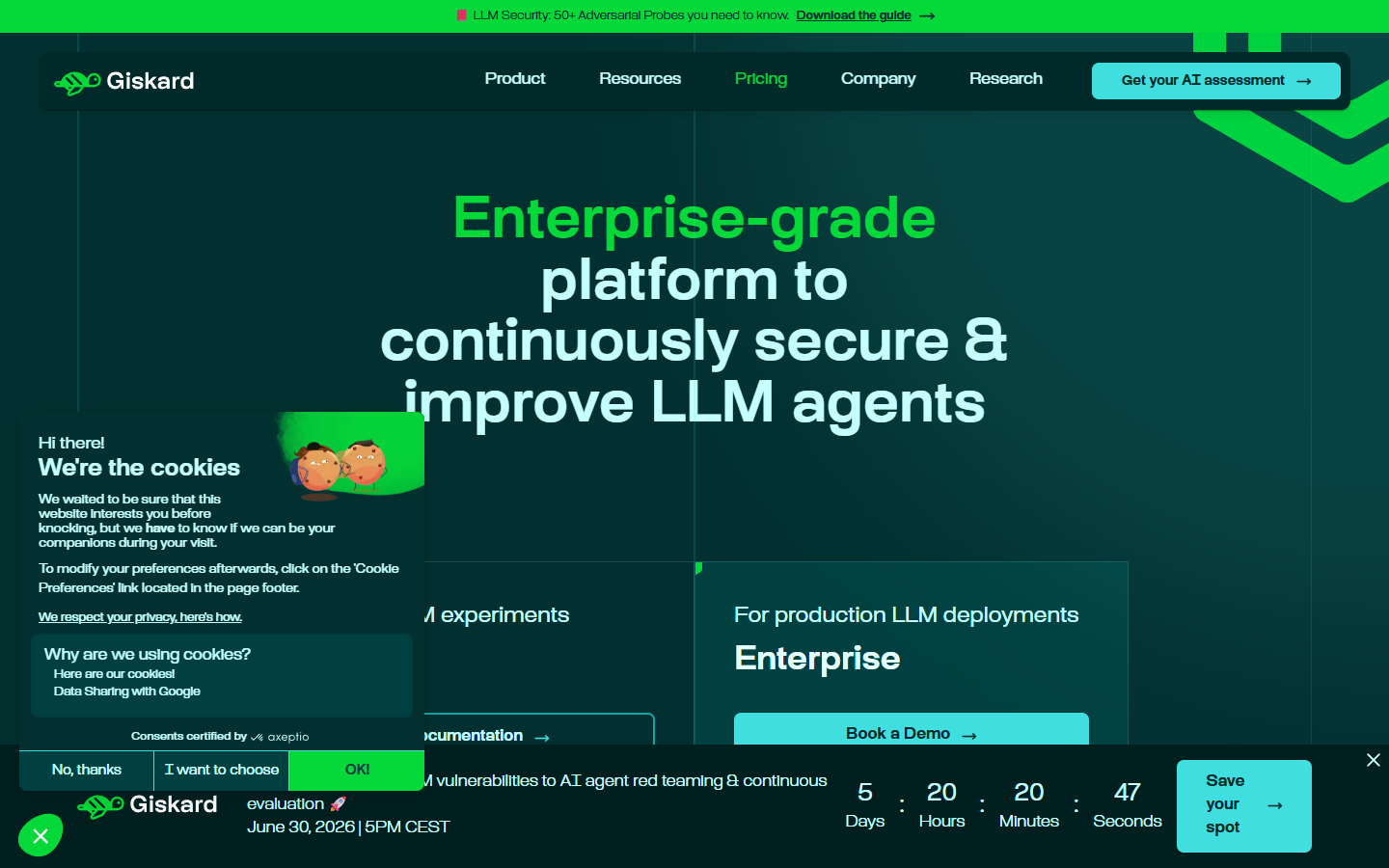
Giskard
Core parameters and statistics
The core value of Giskard is not to retrain a basic model, but to add a repeatable quality and safety testing layer to the LLM application RAG system and AI Agent. It organizes red team attacks, data set generation LLM-as-a-judge, RAG indicators and team review into the same process, which is suitable for acceptance before going online and continuous monitoring after going online.
| Projects | Information |
|---|---|
| Product Positioning | AI Red Team Test LLM Evaluation RAG Evaluation and AI Agent Security Platform |
| Main forms | Web platform Giskard Hub, Python SDK, open source testing library, vulnerability scanning component |
| Open source repository | Giskard-AI/giskard-oss, Apache-2.0 |
| Community popularity | About 5,460 stars, 476 forks |
| Latest public package | giskard-scan 1.0.0b2; giskard 2.19.1 |
| Adaptation objects | LLM Agent, RAG, chat robot, traditional ML model |
| Key risk types | Hallucination, prompt injection, jailbreaking, sensitive information leakage, harmful output, bias, robustness |
| Run Portal | Web, API, Python, local or enterprise deployment |
These parameters suggest that Giskard is closer to an "AI quality infrastructure" than a single point of inspection page. For teams that already have models or agents, the benefit is to turn one-time manual acceptance into a traceable, regressible, and collaborative test asset.
User and market recognition
Giskard's audience is focused on the B-side and the developer community: enterprise teams use Hub for production-level LLM Agent assessment and auditing, and developers use the Python library to scan model risks in notebooks, CI/CD, or local environments. The number of stars and forks in its open source warehouse shows that it has formed a relatively stable technical community foundation.
| Dimensions | Performance | Meaning to users |
|---|---|---|
| Open source adoption | Apache-2.0 repository, about 5,460 stars | Auditable, scalable, easy to trial in the development process |
| Enterprise adoption | Hub for production LLM deployment | Supports permissions, auditing, tickets, collaboration and deployment governance |
| Education and Ecology | Used in LLM red team-related courses and practical materials | Clear learning path, suitable for entry into security and assessment teams |
| Compliance focus | Emphasis on SOC2, HIPAA, GDPR, data residency and isolation | Closer to high-demand scenarios such as finance, medical care, government and enterprises |
Giskard’s market recognition does not rely on C-side traffic, but comes from the AI engineering team’s need for “provable quality.” As Agents begin to call tools, process private data, and enter business processes, continuous red team testing, log auditing, and manual review will become more important than a single Prompt test.
Cost advantage
Giskard's cost structure is divided into two tiers: open source trial and enterprise delivery. Open source libraries are suitable for R&D teams to verify model risks at low cost; Hub and enterprise platforms shift costs to collaboration, permissions, deployment, security compliance, and support services.
| Plan | Suitable objects | Public price form | Main capabilities |
|---|---|---|---|
| Free / Open Source | Personal experiments, developers, research teams | Free | Local deployment, basic LLM vulnerability scanning, basic RAG evaluation, community support |
| Enterprise | Production LLM Deployment Team | Contact Sales / Schedule a Demo | 50+ Adversarial Probes, Multi-round Attack Agent Tool Invocation Secure SSO, RBAC, CI/CD, Private Cloud or On-Premise Deployment |
| Customized services | High-risk industries or complex Agent projects | Communication by project | Customer Success Agent remediation consulting, custom Guardrails, audit reports |
The cost advantage is mainly reflected in two aspects: in the early stage, open source libraries can be used to move risk discovery forward, reducing online accidents and manual evaluation costs; in the production stage, a unified platform can be used to accumulate test sets, review records, and version trajectories, reducing the cost of repeated evaluations by the team.
Main functions
- Continuous AI Red Team Test: Automatically generate confrontation scenarios, covering jailbreak, prompt injection, sensitive information leakage, harmful requests, multiple rounds of attacks and tool call security.
- LLM Quality Assessment: Generates assessment datasets around factuality, instruction compliance, format stability, domain quality, and failure samples.
- RAG Assessment: Split components such as retrieval, rewriting, generation, routing and knowledge base to help locate which layer RAG quality issues come from.
- AI Guardrails: Establish interception and assessment logic around input and output security, policy violations, risk topics, and enterprise rules.
- Human-in-the-Loop Review: Supports manual review, task prioritization, tag management and version auditing, suitable for compliance or security teams.
- SDK and CI/CD Integration: Automate tests during development, review, and deployment phases with Python SDK and Pipeline integration.
- Enterprise Security Capabilities: Provides SSO, RBAC, data residency, isolation, private cloud/on-premises and SLA support.
The combination of these functions can cover the entire process of "designing tests, running attacks, analyzing results, repairing agents, and regressing again" instead of just outputting a static report.
Model and version evolution
Giskard's version evolution has two main lines: one is an open source Python testing library, which extends from traditional ML quality inspection to LLM and RAG; the other is an enterprise-level Hub that integrates scanning, review, collaboration, auditing, and deployment governance into production workflows.
| Time | Version/Form | Key points of changes |
|---|---|---|
| 2022-03 | Establishment of open source warehouse | Based on model testing and quality assurance |
| 2024-2025 | Giskard 2.x | Enhanced LLM scan RAGET, performance/bias/security detection |
| 2026-02-17 | giskard 2.19.1 |
PyPI 2.x stable line, supports Python 3.9-3.12 |
| 2026-06-09 | giskard-scan 1.0.0b2 |
For Agent vulnerability scanning, red team testing and confrontation scenario generation |
| 2026-06 | Giskard Hub | Enterprise Platform Focus on Continuous Red Team Testing LLM Assessment and Collaborative Governance |
Currently, you need to pay attention to version boundaries: Giskard v3 documentation is in the Beta stage, and some v2 capabilities are still being migrated; production projects should distinguish the capabilities of the open source library, giskard-scan package and Hub platform.
Technical advantages
Giskard's technical advantage lies in upgrading AI testing from "manual prompt list" to "generable, evaluable, and auditable test projects." It has built-in adversarial probes, vulnerability classification RAG indicators and LLM-as-a-judge evaluation methods, which can generate test sets that are closer to actual risks based on Agent descriptions, knowledge bases and business rules.
In terms of engineering integration, Giskard supports Python SDK, local operation, enterprise web platform and CI/CD access. For security teams, this means that test results can enter the version management and audit process; for model teams, this means that core risks can be quickly returned to after every prompt, retrieval chain, tool call, or model version change.
Compared with tools that only perform content security filtering, Giskard has wider coverage: it not only looks at whether the output violates the rules, but also looks at whether the Agent is easily induced to bypass the rules, whether the tool is used incorrectly, whether sensitive context is leaked, and whether the RAG is retrieved or generates wrong answers.
How to use
| Entrance | Typical steps | Suitable scenarios |
|---|---|---|
| Web platform | Create projects, access Agents, configure assessments, run red team tasks, and review results | Enterprise team collaboration, auditing and continuous evaluation |
| Python SDK | Install packages, package models or agents, run scan/check, export results | Developers, local experiment CI/CD |
| Open source library | Local deployment, create test data, scan for performance/bias/security issues | R&D validation, research and PoC |
| Enterprise deployment | Connecting with SSO/RBAC, selecting SaaS/private cloud/local, accessing alarms and pipelines | Production LLM system and high compliance scenarios |
The typical implementation process is: first define the agent's task boundaries and prohibited behaviors, and then access the model or API; then run basic vulnerability scanning and quality assessment; manually review and classify failed samples; finally, add high-value test sets to the regression process and continue to run with the version.
Product Pricing
Giskard's public pricing structure is clearly divided into Free and Enterprise. Free is for personal LLM experiments and includes documentation, open source libraries, local deployment, basic vulnerability scanning, basic RAG assessment, best effort maintenance and community support; Enterprise is for production LLM deployment and includes more complete red team, assessment, collaboration, integration, security and support capabilities.
| Pricing Dimensions | Free | Enterprise |
|---|---|---|
| Usage threshold | Free, local and open source preferred | Make an appointment for a demonstration and communicate according to corporate needs |
| Red team capabilities | Basic LLM vulnerability scanning | 50+ automatic confrontation probes, multiple rounds of attacks, tool call security verification |
| Quality assessment | Basic RAG correctness report | Domain evaluation data set, fine-grained RAG metrics, custom evaluation metrics |
| Collaborative governance | Community support | SSO, RBAC, audit records, task labels, email alerts CI/CD |
| Deployment and security | Local self-management | SaaS, private cloud, local, data isolation 0-training policy, SLA |
For team trials, Free is more suitable for quickly determining whether there are obvious risks in the model; for Agents that have entered production, the value of Enterprise lies in incorporating risk scanning, manual review, permission control and audit traces into unified management.
Application scenarios
- Enterprise customer service agent acceptance before going online: Detect jailbreaks, incorrect refund suggestions, privacy leaks and policy bypasses to reduce security incidents after going online.
- Financial or Medical RAG Assessment: Split retrieval versus generation quality, pinpointing answer errors from knowledge base recall, context omissions, or model generation.
- Internal Knowledge Base Assistant Governance: Verify that employees can obtain unprivileged information through prompt injection, assisted design permissions and Guardrails.
- AI Product CI/CD Regression: Automatically run the core test set after each modification of Prompt, retrieval strategy or tool chain to avoid fixing a problem and introducing new vulnerabilities.
- Compliance and audit report: precipitation test records, failure samples, review conclusions and version tracks, supporting security review and customer due diligence.
What these scenarios have in common is that risks cannot be solved solely by manual testing before going online, but require a continuous, reproducible, and traceable evaluation mechanism.
Applicable people
Giskard is suitable for teams that are building or operating AI applications, especially scenarios where agents already come into contact with real users, business data, or external tools. AI engineers can use it to do model and prompt regression; security teams can use it to organize red team testing; product and compliance teams can use Hub to view risks, review samples, and precipitate audit records.
The scenarios that it is not suitable for are also clear: if it is just an individual who occasionally tests whether a piece of text is generated by AI, Giskard will appear too heavy; if the team does not have a clear model interface agent task or evaluation goal, it also needs to sort out the business boundaries first, otherwise it will be difficult for automated testing to produce actionable conclusions.
Summary and Outlook
Giskard's competitiveness lies in putting LLM security RAG quality agent behavioral testing and corporate governance into the same evaluation system. It has both open source libraries to lower the trial threshold, and a Hub to meet the production team's requirements for permissions, auditing, collaboration, and deployment security.
The current main limitation is that there are many version lines. The capability boundaries of v2, v3 Beta, Hub and giskard-scan need to be confirmed when the project is started; the enterprise price also needs to be communicated with sales. What is worthy of continued observation in the future is the depth of coverage of v3 capabilities to complement the speed of Agent tool call security, data interoperability with the monitoring platform, and whether more industry compliance templates will be standardized.
Related tools:  Hugging Face, replicate
Technical advantages and capability boundaries
As an AI model and API product, Giskard's core capabilities can be deeply understood through the following dimensions, which directly affect technology selection and implementation effects.
Inference Performance and Benchmark Performance The model’s reasoning performance is reflected in its performance on standard NLP tasks (text generation, code completion, semantic understanding, multi-turn dialogue, information extraction, etc.). It is recommended to conduct horizontal comparison through public benchmark test lists (such as MMLU, HumanEval, GSM8K, etc.), but please note that there may be a gap between benchmark test scores and actual business scenario performance. Key indicators that affect the actual user experience include: inference speed (Token/s or response delay, which directly determines the smoothness of the user experience), context window length (which determines the input size that can be processed at a time, affecting the complexity of the tasks that can be processed), and consistency of output quality (the stability of the results of multiple outputs of the same input, which affects the perception of reliability).
API Compatibility and Development Ecosystem The depth of API compatibility with mainstream development frameworks (LangChain, LlamaIndex, Semantic Kernel, etc.) directly affects the cost and cycle of integrated development. It is recommended to pay attention to the following integration dimensions: the coverage of language types supported by the SDK (whether mainstream languages such as Python, JavaScript, Go, and Java have official SDKs), streaming output support (SSE/WebSocket protocol compatibility), function calling and tool usage capabilities (whether it supports mapping model output to structured function calls), the flexibility of structured output (JSON mode), and the ability to integrate with enterprise-level infrastructure (VPC deployment, Private Link, unified identity authentication). Complete API documentation and rich code examples can significantly lower the entry barrier to development and reduce integration time and costs.
Deployment Flexibility vs. Cost Tradeoff Depending on data privacy requirements, latency sensitivity and usage scale, Giskard can choose between cloud API calls or on-premises deployment options. The advantages of cloud deployment are zero operation and maintenance costs and elastic scalability, which is suitable for scenarios with large fluctuations in usage and rapid prototype development; local deployment provides complete data sovereignty and low latency (no network round-trip overhead), but you need to bear the cost of purchasing hardware such as GPUs and operation and maintenance manpower. It is recommended to use a monthly API call volume of 1 million times or a monthly fee of US$1,000 as a reference dividing line: below this threshold, cloud APIs have better cost-effectiveness and flexibility. After exceeding this threshold, the total cost of ownership of the self-deployment solution should be comprehensively evaluated, taking into account factors such as hardware depreciation, electricity, operation and maintenance manpower, etc.
Model selection and version strategy
For the selection of Giskard series models, it is recommended to match the model capabilities of different versions according to specific usage scenarios. The large-parameter version performs better on complex reasoning and multi-step tasks, but has higher costs and longer delays; the small-parameter version can already provide satisfactory output quality in scenarios such as daily conversations and simple question and answer, and the cost is only a fraction of the large version. The recommended selection strategy is: use small and medium versions in standard scenarios to reduce costs, and only call large version models when complex inference tasks need to be processed. This hierarchical calling strategy can reduce the overall API cost by 40-60% without significantly affecting the output quality.
Version Info
- Giskard Hub :Enterprise-level LLM Agent testing platform, providing continuous red team testing, vulnerability scanning, manual review, audit recording CI/CD integration and privatized deployment options.
- Giskard Scan Beta :The vulnerability scanning component for AI Agent covers red team testing, prompt injection detection and confrontation scenario generation; it complements Giskard Hub's enterprise-level red team testing, LLM assessment and team collaboration capabilities.
- Giskard Python Library :Giskard 2.x open source testing framework version on PyPI for traditional ML, LLM applications and RAG scenarios, supporting scanning for performance, bias and security issues.
User Reviews