 Gist AI
Free
Gist AI
Free
Gist AI is an AI-driven meeting summarization tool that automatically converts meeting recordings into text and generates structured bullet points summaries. It supports mainstream meeting platforms such as Zoom, Teams, and Google Meet, helping participants quickly review meeting content, extract action items, and key decisions. Gist AI is positioned at efficient information extraction where "you don't need to read the complete record after reading the summary".
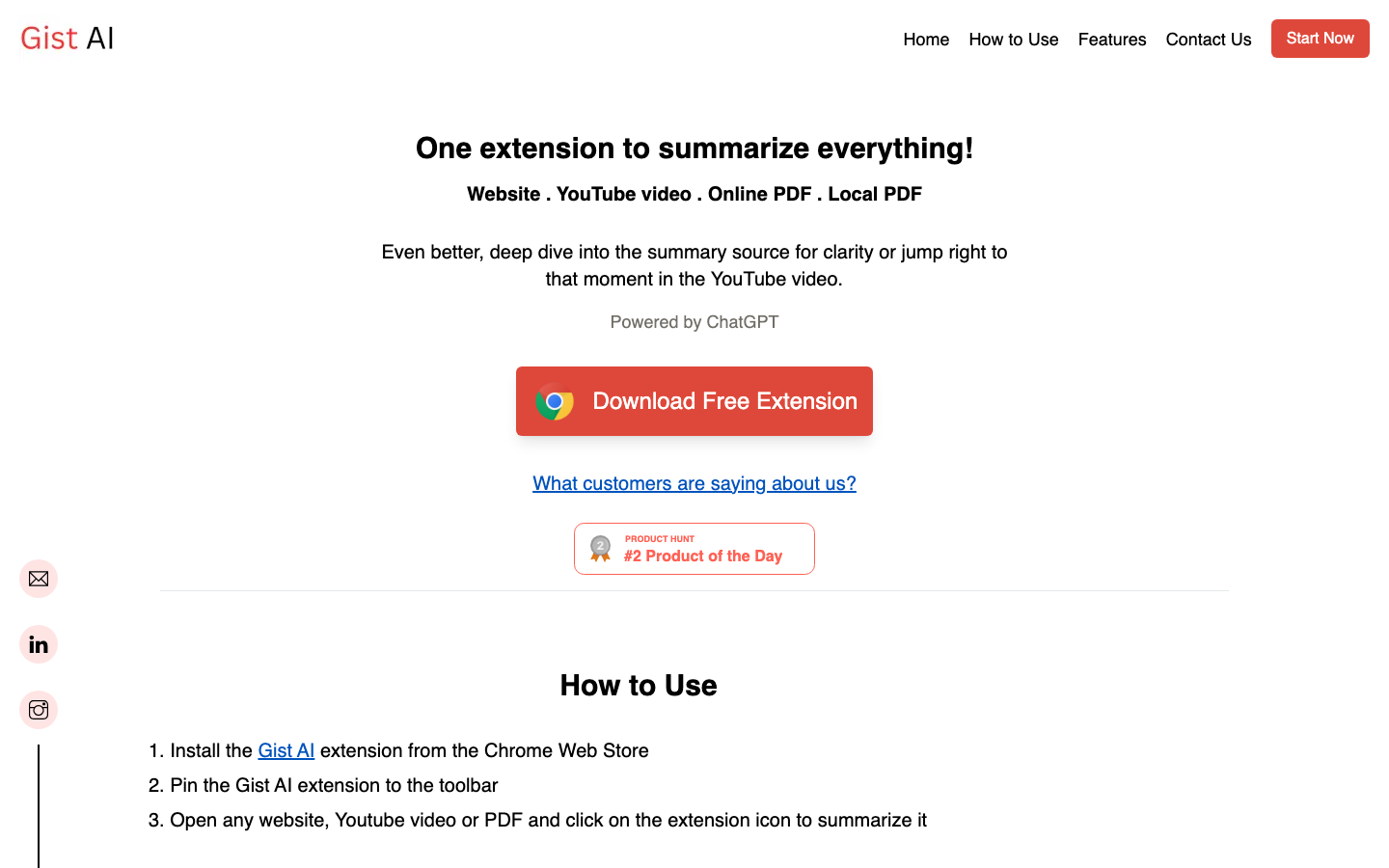
GistAI
Core parameters and statistics
Gist AI is an AI-driven browser extension (Type D - productivity/business application). Its core capability is to use ChatGPT to extract key points of web articles, YouTube videos and PDF documents with one click. It is not a meeting recording tool, but a "universal content summarizer" - positioned in the era of information overload to help users compress long content into quickly digestible essential paragraphs.
| Projects | Public Information |
|---|---|
| Product positioning | ChatGPT driven web/video/PDF summary browser extension |
| Core Competencies | Web page summary YouTube summary PDF summary (online + local), "Read More" in-depth questioning, video timestamp jump |
| Delivery Form | Chrome Browser Extension |
| Underlying model | ChatGPT (OpenAI API) |
| Languages covered | 54 languages |
| User scale | Chrome Web Store 10,000+ users |
| User Rating | 4.1 / 5 (137 reviews) |
| Latest version | 0.0.1.22 (2025-08-29) |
| Home | US |
| Business model | Free (the extension itself is free, supported by the cost of the ChatGPT API) |
| Privacy Policy | No user data is collected, only the content text is sent to the AI model to generate summaries |
Brief review in one sentence: Gist AI is not another note-taking or transcription tool, but a "content compressor in the browser" - install an extension, and web pages and video PDFs become information sources that can extract key points with one click.
Type determination basis: Gist AI belongs to Type D (productivity/business application) because it directly delivers complete summary functions to end users in the form of a browser extension, without the need for developers to intervene in configuration and can be used out of the box. Its underlying layer relies on the ChatGPT API, but is transparent to users - users do not need to manage models or API Keys, they only need to install the extension to use it.
Users and market recognition of Gist AI
Gist AI is positioned in the market as a "lightweight general-purpose content summarizer" rather than a professional note-taking or transcription tool. Its market recognition is mainly reflected in the user accumulation and word-of-mouth data of Chrome Web Store.
User Size and Rating: Chrome Web Store shows 10,000+ users, with an overall rating of 4.1/5 (137 reviews). For a free extension maintained by a two-person team, this rating is above average for tool extensions. Positive comments focused on "one-click summarization saves a lot of time" and "very useful for long articles and videos"; negative feedback mainly related to the inaccurate summary of some web pages and the occasional timeout in processing long PDFs.
Product Hunt Exposure: Gist AI was featured on Product Hunt, gaining early user and media attention, which provided a critical boost in its cold launch from zero to 10,000 users.
Target customer group distribution: According to customer testimonials on the official website, users cover three typical roles: business analysts, research students, and consultants. The common pain point of these groups is that they need to process a large number of articles, reports, and video content every day, and they have a rigid need for "quickly obtaining key information."
Market position comparison with competing products:
| Product | Form | Covered content type | User level | Rating | Differentiation |
|---|---|---|---|---|---|
| Gist AI | Chrome Extension | Web + YouTube + PDF | 10,000+ | 4.1 | One installation covers three types of content, no need for multiple extensions |
| AI Summarizer | Chrome extension | Web + YouTube + PDF | — | 4.3 | Support ChatGPT/Claude/Gemini multi-model switching |
| YouTube Summary with ChatGPT | Chrome extension | YouTube + web + PDF | — | 4.3 | Focus on YouTube summary scenarios |
| Glasp | Chrome Extension | Web + YouTube + PDF | — | 4.5 | Highlight Notes + AI Summary Dual Mode |
Gist AI's differentiator is "All-in-One simplicity" - one extension replaces multiple specialized tools and is ready to use with zero configuration. Compared with AI Summarizer, which supports multi-model switching flexibility, Gist AI uses ChatGPT, which simplifies user selection but sacrifices model flexibility.
Cost Advantages of Gist AI
The cost structure of Gist AI presents completely different appearances on the "user side" and the "developer side", reflecting the typical characteristics of the free expansion business model.
C-side/Individual Users: Totally Free: Gist AI’s Chrome extension itself is completely free, and users don’t have to pay any fees to install and use all core features - Web Summary YouTube Summary PDF Summary. This is in contrast to similar tools such as AI Summarizer whose premium features require a subscription. The source of free is: The API cost of the summary service is borne by the developer (calling the ChatGPT API), there is no direct expenditure on the user side.
The truth about free: The core limitation of the current free model is that developers bear API costs, which means that the sustainability of the free strategy depends on whether the growth in user volume can be monetized through other methods (such as donations, future premium versions, enterprise versions). Currently, there is no clear payment plan or usage quota description on the official website, and there is no SLA guarantee for user availability and response speed during peak periods. If the number of users continues to grow, developers may need to introduce usage limits or payment tiers at certain points.
API/Developer: Gist AI does not provide independent API services. Its bottom layer relies on OpenAI's ChatGPT API, but this layer is completely transparent to users - users do not need to register OpenAI, no API Key, and no need to manage model parameters. This means that developers cannot embed Gist AI’s summarization capabilities into their own workflows and can only use it through browser extensions.
Enterprise/Private: No enterprise or privatized deployment options are provided. The privacy page states that "no data is collected from users, and only article content is sent to the AI model to generate summaries." However, enterprise users need to evaluate the compliance of sending internal document content to the ChatGPT API through Gist AI - although the extension itself does not store data, the data processing terms on the OpenAI side still need to be taken into consideration.
Hidden Costs:
- Rely on a single model: Fixed using ChatGPT, when the OpenAI API is interrupted or delayed, the summary function of Gist AI is directly unavailable. Users cannot switch to alternative models such as Claude, Gemini, etc.
- No offline capability: All summary generation relies on cloud API and cannot be used without network connection.
- Browser binding: Only supports Chrome browser (and Chromium core browser), Safari and Firefox users cannot use it.
Main functions of Gist AI
The functional design of Gist AI is centered around "one extension covering three types of content". The core features are the timestamp jump in YouTube video summaries and the "Read More" questioning mechanism.
-
One-click summary of web articles: Click the expansion icon on any web page, and AI will automatically extract the key points of the article and generate a structured summary. Acceptance concerns: Summary quality varies depending on the structure of the web page - well-structured news articles and blogs work best; for single-page applications (SPAs), dynamically loaded content, or web pages that require a login, the extension may not crawl the full text content correctly. Synergy effect: The "Read More" button in the abstract can locate the corresponding paragraph of the original text, which solves the reverse demand of "the abstract is too short and wants to read more", forming the "overview → positioning → in-depth reading" problem.
-
YouTube video summary and timestamp jump: Click the extension on the YouTube video page, and AI will extract the core points of the video and mark the timestamp when it appears. Core Value: This is the most differentiated function of Gist AI - when users find a point of interest while reading the summary, they can jump directly to the corresponding moment in the video, avoiding the repeated trial and error of "opening the video → dragging the progress bar → missing key content". For long tutorial and lecture videos (30 minutes+), this function increases the efficiency of information acquisition several times. Limitations: The summary relies on the quality of YouTube's automatically generated subtitles or CC subtitles; for videos without subtitles or with high automatic subtitle error rates (such as strong accents, non-English content), the summary quality will be significantly reduced.
-
PDF Document Summarization (Online + Local): Supports summarizing online PDFs and locally uploaded PDFs. The official website clearly states that "there are no restrictions on PDF file size and number of pages." Acceptance concerns: For text-based PDFs (digitized PDFs with Chinese characters optional), the summary quality is close to web articles; for scanned PDFs (image scans), the extension relies on text extraction after OCR, and the structural restoration accuracy of complex tables, charts, and multi-column layouts is limited. Implementation Tip: The abstract generation of long documents (50+ pages) such as research papers, contracts, reports, etc. may take a long time, so it is recommended to use it in sections.
-
"Read More" in-depth questioning: This is the unique mechanism that distinguishes Gist AI from most summary tools. Click "Read More" in the summary, and AI will provide a more detailed explanation based on the original content associated with the paragraph. Synergy effect: Traditional summary tools only perform "one-time compression". If users are interested in a certain point in the summary, they can only go back to the original text to search. Gist AI implements "layered reading" through Read More - first uses the summary to determine whether the entire article is worth reading in depth, and then expands on points of interest step by step, achieving a progression from "information filtering" to "accurate acquisition".
-
Content segmentation understanding: Automatically divide long content into several logical blocks, and each block independently generates summary paragraphs. This design draws on the "chunking theory" in cognitive psychology - the capacity limit of human short-term memory (7±2 information units) determines that the efficiency of "reading the entire text in one breath and then summarizing" is much lower than "understanding paragraph by paragraph and then concatenating". Actual effect: For long articles of more than 5,000 words, segmented summaries are easier to locate specific information segments than full-text summaries, and also reduce the context load of a single API call.
Gist AI model and version evolution
The version iteration of Gist AI is deeply bound to the underlying ChatGPT model update, but the iteration rhythm of expanding its own functions is relatively independent. Due to the small size of the developer team (2 people), version updates are less frequent than for larger products.
Chrome Web Store version context:
-
Version 0.0.1.22 (2025-08-29): The current public version of Chrome Web Store, which is the latest stable version. Previous versions include multiple 0.0.1.x series iterations, mainly focusing on UI optimization, PDF summary stability improvements, and YouTube subtitle parsing enhancements. From the version number 0.0.1.x, it can be seen that the product is still in the early stage of continuous iteration and has not yet entered the 1.0 official release cycle.
-
Product launch (mid-2024): Marked by the registration of the official website domain name gistai.tech and the release of Product Hunt, the product enters the public beta period. The initial version only supports web page snippets, and YouTube and PDF support will be gradually added later.
Underlying model dependency: Gist AI's summary generation completely relies on OpenAI's ChatGPT API. This means that every qualitative leap in its summarization capabilities is synchronized with the upgrade of the ChatGPT model version - when OpenAI upgrades from GPT-3.5 to GPT-4 and then to GPT-4o, Gist AI's summary quality will naturally improve without modifying or extending its own code. But this also means that users cannot actively choose the model version, nor can they maintain consistency when ChatGPT undergoes behavior changes (such as output style adjustment, security policy tightening).
Comparison of version strategies with competing products:
| Product | Version Number | Update Frequency | Underlying Model | Model Selection Flexibility |
|---|---|---|---|---|
| Gist AI | 0.0.1.22 (2025-08) | Low frequency (months) | ChatGPT (fixed) | None, users cannot switch |
| AI Summarizer | Continuously updated | High frequency | ChatGPT/Claude/Gemini optional | High, supports multi-model switching |
| YouTube Summary | Continuously updated | Medium frequency | ChatGPT/Claude optional | Medium, supports 2-3 models |
Gist AI's version strategy is relatively restrained in function iteration, relying more on improving the capabilities of the underlying model rather than expanding its own function stack. This is an advantage for users seeking simplicity, but a limitation for users who require specific model behavior or the latest model features.
Gist AI’s technical advantages
The technical advantage of Gist AI lies not in self-developed models or algorithm innovation, but in embedding ChatGPT's universal summary capabilities into the browser workflow, and engineering optimization around the complete link of "content acquisition → text extraction → AI summary → interactive feedback".
Zero configuration out of the box: This is the core technical experience advantage of Gist AI. After the user installs the extension, no configuration is required (no API Key, no need to register an account, no need to select model parameters), and the summary can be obtained by clicking on the icon. In contrast, although AI Summarizer has more functions, its first use requires steps such as selecting a model and setting language preferences. Gist AI reduces decision-making costs to zero, which is especially important for non-technical users.
Content extraction and cleaning pipeline: Before sending content to the ChatGPT API, Gist AI needs to complete three steps: content extraction (parsing the text from the DOM), noise filtering (advertising, navigation, footer), and format standardization (Markdown). For different types of pages (article pages, video pages PDF), the extraction strategies are different:
- Web page: Use Readability-like algorithms to identify text areas and trim noisy areas such as comment areas, sidebars, and recommended readings.
- YouTube: Prefers using the YouTube Subtitles API to get text, while extracting video titles, descriptions and comments as supplementary context.
- PDF: Built-in PDF parser, supports full-text extraction of text PDF, and scanned PDF relies on the browser's built-in OCR capability.
Context progression mechanism of "Read More": When the user clicks "Read More", the extension does not simply re-call the API to ask "Please explain X in detail", but carries the paragraph corresponding to X in the original text as the context, allowing AI to expand on the basis of existing information instead of generating it out of thin air. This "progressive summary anchored by the original text" mechanism is more reliable than pure model reasoning in ensuring the factual accuracy of extended answers.
YouTube Timestamp Alignment: Gist AI aligns each point in the summary with the timestamp of the video subtitles. In terms of technical implementation, the extension first requests the YouTube subtitle API to obtain the complete text with timestamp, and then the AI semantically matches the generated summary points with the original subtitle paragraph to find the most likely corresponding start time. This match isn't perfect - content with a lot of semantic overlap may be anchored to a slightly earlier or later time point - but it's accurate enough in most scenarios.
Technical solution comparison with competing products:
| Technical Dimension | Gist AI | AI Summarizer | YouTube Summary with ChatGPT |
|---|---|---|---|
| Underlying model | ChatGPT (fixed) | ChatGPT/Claude/Gemini (optional) | ChatGPT/Claude (optional) |
| Content extraction | Built-in Readability parsing | Built-in parser | Built-in parser |
| YouTube subtitle dependency | Required, no OCR cover | Required | Required |
| PDF scan support | Depends on browser OCR | Not supported | Not supported |
| "Read More" question | Supported, progression based on original text context | Not supported | Not supported |
| Timestamp jump | Support | Partial support | Support |
| User configuration requirements | Zero configuration | The model needs to be set up for the first time | The model needs to be set up for the first time |
Guide to engineering pitfalls:
- Incomplete content extraction: SPA pages, content that needs to be scrolled to load (infinite scrolling), content visible after logging in, the extension may only be able to capture the text of the initial rendering of the page. Solution: For key content, it is recommended to manually select all the text on the page and then click Expand.
- Missing YouTube subtitles: For videos without subtitles or videos with poor automatic subtitle quality (strong accent, noisy background sound), the summary quality will be significantly reduced. There is currently no alternative to manually uploading subtitles. It is recommended to use YouTube's built-in subtitle editing function to first correct the subtitles and then use the extension.
- Long PDF Timeout: Although the official statement is that there is no page limit, in actual use, high-definition scanned PDFs of 100+ pages may fail due to browser memory limitations or API call timeouts. It is recommended to split long documents into chapters with separate summaries.
How to use Gist AI
The usage process of Gist AI is extremely simple, with only three steps in the core path:
- Install the extension: Search for "Gist AI" in the Chrome Web Store or visit the corresponding page of the Chrome Web Store and click "Add to Chrome" to complete the installation. The expansion size is only 850KiB and the installation process is completed in 3 seconds.
- Pin to Toolbar: After installation is complete, the Gist AI icon will appear on the right side of the Chrome toolbar. It is recommended to right-click the icon and select "Show in toolbar" to facilitate calling at any time.
- One-click summary: Open any web article YouTube video or PDF file, click the Gist AI extension icon, and AI will automatically extract the key points of the content and display a summary pop-up window. The summary typically completes in 3-10 seconds (depending on content length and network latency).
Special steps for YouTube video summary: Open the YouTube video page → Wait for the video page to fully load → Click the Gist AI icon → The summary panel displays a list of points, each point is accompanied by a timestamp → Click the timestamp to jump to the corresponding moment of the video.
Special steps for PDF file summarization:
- Online PDF: Open the PDF URL in your browser and click on the Gist AI icon.
- Local PDF: Select "PDF tab" in the extension pop-up window, click the upload button to select the local PDF file, and wait for AI to generate a summary.
"Read More" function usage: In the summary panel, there is a "Read More" link below each bullet point. After clicking, AI will expand the detailed description of the key point based on the original text context, without going back to the original text to search. This feature is especially useful for quickly getting more details after discovering a topic of interest in the summary.
Supported triggering methods: Currently, only manually clicking the extension icon to trigger the summary is supported. Automatic triggering (such as automatic summary after the page is loaded) or shortcut key triggering is not supported. For workflows that require batch summarization (such as multiple long articles that need to be summarized in one day), the operational cost of manual clicks will accumulate.
Product Pricing for Gist AI
Gist AI currently adopts a completely free pricing model, which is a rare "no paywall" solution among similar tools.
Current free policy:
- Chrome extensions are completely free, with no trial period and no functional limitations
- All core functions (webpage summary, YouTube summary, PDF summary) are available for free
- No usage limit or daily quota limit
- No need to register an account or bind a payment method
Sustainability of Free Model: Every digest call to Gist AI consumes OpenAI API fees (paid by the developer). Under the current user scale (10,000+), if each user uses it 10 times a day, the number of API calls in a single day will be at the level of 100,000. Based on the ChatGPT API summary scenario, the cost per call is in the range of $0.01-$0.05 (depending on the input length), and the average daily cost may reach $1,000-$5,000. This means that the current free-to-play model requires external financial support (such as developers’ own pockets, advertising revenue, future financing) to maintain it in the long term.
Pricing comparison with competing products:
| Products | Free Policy | Paid Plans | Paid Prices |
|---|---|---|---|
| Gist AI | Fully functional and completely free | No paid plan yet | Free |
| AI Summarizer | Basic functions are free | Advanced version removes watermarks + more models | Starting from $4.99/month |
| YouTube Summary | Basic features free | No paywall (completely free) | Free |
| Glasp | Basic features free | No paywall | Free |
Hidden Costs: There is no direct monetary expenditure for users to use Gist AI, but they need to accept two hidden costs: ① All summary content is processed through the OpenAI API, and the content privacy boundary is subject to the OpenAI privacy policy; ② Relying on a single AI model, when the ChatGPT service is interrupted or behavior changes, the quality of the summary is uncontrollable.
Gist AI application scenarios
The application scenarios of Gist AI span the three major fields of learning, work efficiency and professional research, and its core value is "content compression in the context of information overload".
-
Academic Research and Document Speed Reading: Graduate students and scientific researchers need to read a large number of papers every day. Using Gist AI, you can compress a 10-page academic PDF into 3-5 key points in 10 seconds, and quickly determine whether the paper is relevant to the research direction. Key points to verify: AI abstracts may lose key methodological details and experimental data in the paper - abstracts are only suitable for "screening" and not for "replacement reading". It is recommended to use Gist AI to complete the first round of quick screening (50 articles → judge 10 articles worthy of careful reading), and then read the original text of the screened papers intensively. Deduction effect: From "20 minutes of preliminary screening for each paper" to "10 seconds of abstract scanning + 10 minutes of intensive reading and screening of each paper", the overall research efficiency is increased by about 3-5 times.
-
Business Information Compilation and Competitive Intelligence: Business analysts and consultants need to track industry news, competitor dynamics, and market reports every day. Gist AI can compress the information load of 20-30 long articles per day into a collection of 1-page summaries. Key points for verification: Data charts and statistics in industry reports may be simplified or ignored in the summary. You need to go back to the original text to verify key data points. Implementation Tips: It is recommended to establish a three-level processing process of "summary → mark interesting articles → intensive reading of the original text" instead of relying entirely on AI summaries for decision-making.
-
Video Tutorials and Online Learning: There are a large number of technical tutorials, open classes, and lecture videos on YouTube (30 minutes-2 hours). Through Gist AI's timestamp jump function, learners can quickly locate core knowledge points and skip opening remarks, repeated explanations, and Q&A sections. Deduction Effect: A 1-hour teaching video needs to be watched completely in the traditional way. After using Gist AI summary + timestamp jump, the time to obtain the core content is shortened to 10-15 minutes. Limitations: For videos that emphasize the "demonstration process" (such as programming practice, design operations), only viewing text summaries will miss the operation details and visual feedback of intermediate states. It is recommended to obtain the knowledge framework in the summary and then watch the key operation paragraphs on demand.
-
Quick review of contracts and legal documents: Lawyers and legal personnel can use Gist AI to initially summarize long contract documents (50-100 pages) to quickly understand the contract framework and main terms. Important limitation: The output of Gist AI in this scenario must not be used as a basis for formal review - the AI may miss details such as key disclaimers, jurisdiction clauses, and fail to assess the risk of cross-references between clauses. The summary is only suitable for the auxiliary workflow of "look at the structure first, and then locate the key paragraphs". Human-machine collaboration boundary: 100% automated section-contract text extraction and paragraph classification; manual confirmation of sections - assessment of legality of clauses, understanding of liability limits, and judgment of compliance with relevant laws.
-
Daily Information Consumption and Personal Efficiency: Ordinary users face dozens of public account articles, news, and blogs every day, and can use Gist AI to quickly determine which ones are worth reading in full. Dimensionality reduction attack scenario: Scan the abstracts of 10 long articles within 15 minutes while commuting, mark 2-3 articles for intensive reading after returning to the workstation - this is the best practice for Gist AI to form a collaboration with "read later" tools on the mobile phone (such as Pocket, Instapaper).
Applicable groups of Gist AI
The product form of Gist AI determines that its core user group is "readers who input a lot of information but have limited time", rather than content creators or technology developers.
-
Students and Researchers: Study groups who need to read a lot of papers, textbooks, and technical documents. Gist AI's four-step process (long article → abstract → screening → intensive reading) can reduce the literature research cycle from "reading through articles one by one" to "abstract scanning + on-demand in-depth reading". Unsuitable Boundary: For formal academic writing that has strict requirements on citation format and authenticity of references, the simplified content of the AI abstract does not have citation effect, and the original text must be checked back to confirm the accuracy of the citation.
-
Business Analysts and Consultants: Daily needs to track industry trends, analyze market reports, and write business plans. Gist AI's "Abstract→Read More→Original" three-layer information acquisition model is highly consistent with its daily workflow. Implementation Tips: It is recommended to incorporate Gist AI into the daily information briefing process - open 20 industry-related tabs in the morning, click Gist AI in sequence to generate summaries, and form an automated assembly line for daily competitive intelligence summaries. Not suitable for boundaries: Internal reports and outgoing analysis documents involving confidential customer information. Sending the content to the OpenAI API involves the risk of data leakage, and such scenarios should be disabled.
-
Product Managers and Entrepreneurs: Need to have a broad understanding of product dynamics, user feedback and market trends, but time is severely fragmented. Gist AI can quickly summarize long articles and competitive analysis reports on mobile (via Chrome mobile extension or desktop remote access). Unfit Boundary: For product reviews and user interview records that require a deep understanding of user emotion, tone, and context, AI summaries will lose non-verbal signals (tone, emotion, metaphor) and are not suitable for qualitative analysis that replaces the original data.
-
Legal and Compliance Practitioners: Quick preliminary screening of long contracts, regulatory documents, and case law. Important premise: This group of people must use Gist AI as an auxiliary tool under the premise of understanding that "AI summaries do not constitute legal advice" and must not rely on summaries to replace original text review. Not suitable for the boundary: Communication content involving client-client privilege (Attorney-Client Privilege) is strictly prohibited from being processed through third-party APIs.
-
General Knowledge Consumer: Any user who needs to obtain information efficiently in fragmented time. Gist AI's zero-configuration experience makes it an "install-and-use" information assistance tool, suitable for non-technical users with limited technical literacy but requirements for information efficiency. Not suitable for the boundary: Users who have privacy concerns about AI, users who need to use non-Chrome browsers, and users who require 100% offline availability are not suitable for Gist AI.
Summary and Outlook
With the minimalist concept of "one extension for all content summarization", Gist AI has found its own ecological niche in the highly competitive AI summarization tool market - it does not stack functions, does not do multi-model switching, does not do community or note-taking systems, and only focuses on doing a good job in "content → summarization".
Current core advantages: The zero-configuration out-of-the-box user experience is the simplest in the same category; the two special functions of "Read More" and timestamp jump form an information consumption model of "one summary, hierarchical acquisition" instead of simple "compression and throwing away"; support for 54 languages enables it to cover a wide range of multilingual user groups; it is completely free and lowers the trial threshold for all potential users.
Current major limitations: Fixed use of the ChatGPT model, users cannot switch or select model versions, and summary quality is uncontrollable when ChatGPT behavior changes or service is interrupted; only supports the Chrome browser, excluding Safari and Firefox users; no user account system, which means that settings and preferences cannot be synchronized across devices; no usage statistics and quota management, users cannot estimate and manage their own usage; maintained by a small team of two people, the version update rhythm is slow, and there may be great uncertainty in the priority of feature iterations.
Follow-up observation points: ① Whether to launch a paid premium version (such as higher frequency summaries, custom prompts, multi-model support); ② Whether to expand to Firefox/Safari browsers; ③ Whether to introduce a user account system to support settings and synchronization between devices; ④ The sustainability of the free model after the number of users continues to grow - when the API cost exceeds the tolerance of developers, whether to introduce limits or shift to a subscription model will determine the direction of product development.
Purchase and Adoption Risk Assessment: Gist AI is a free tool, and there is no real risk for individual users in "zero-cost trial and error". It is worth installing and experiencing and incorporating it into the daily information processing tool chain. For enterprise teams, it is recommended to use it prudently under the following conditions: ① Confirm that the browser used by the team is Chrome/Chromium core; ② Assess the compliance risks of sending internal document content (especially non-public business information) to the OpenAI API; ③ Establish usage specifications that "AI summaries are only used for auxiliary screening, and key information must be returned to the original text." In scenarios involving customer non-disclosure agreements (NDA) or data sovereignty regulations (such as GDPR, China Data Security Law), Gist AI should be disabled for processing any sensitive content and an offline or self-hosted digest solution should be used instead. Long-term dependence on a free tool maintained by a two-person team with no visible revenue model risks product continuity risks of service outage or feature degradation, and it is recommended to keep alternatives (such as AI Summarizer or Glasp) in key workflows.
Related tools:  Notion AI, google-workspace
Version Info
- current :Current version.
- launch :Product goes online.
User Reviews