 Glean
Glean
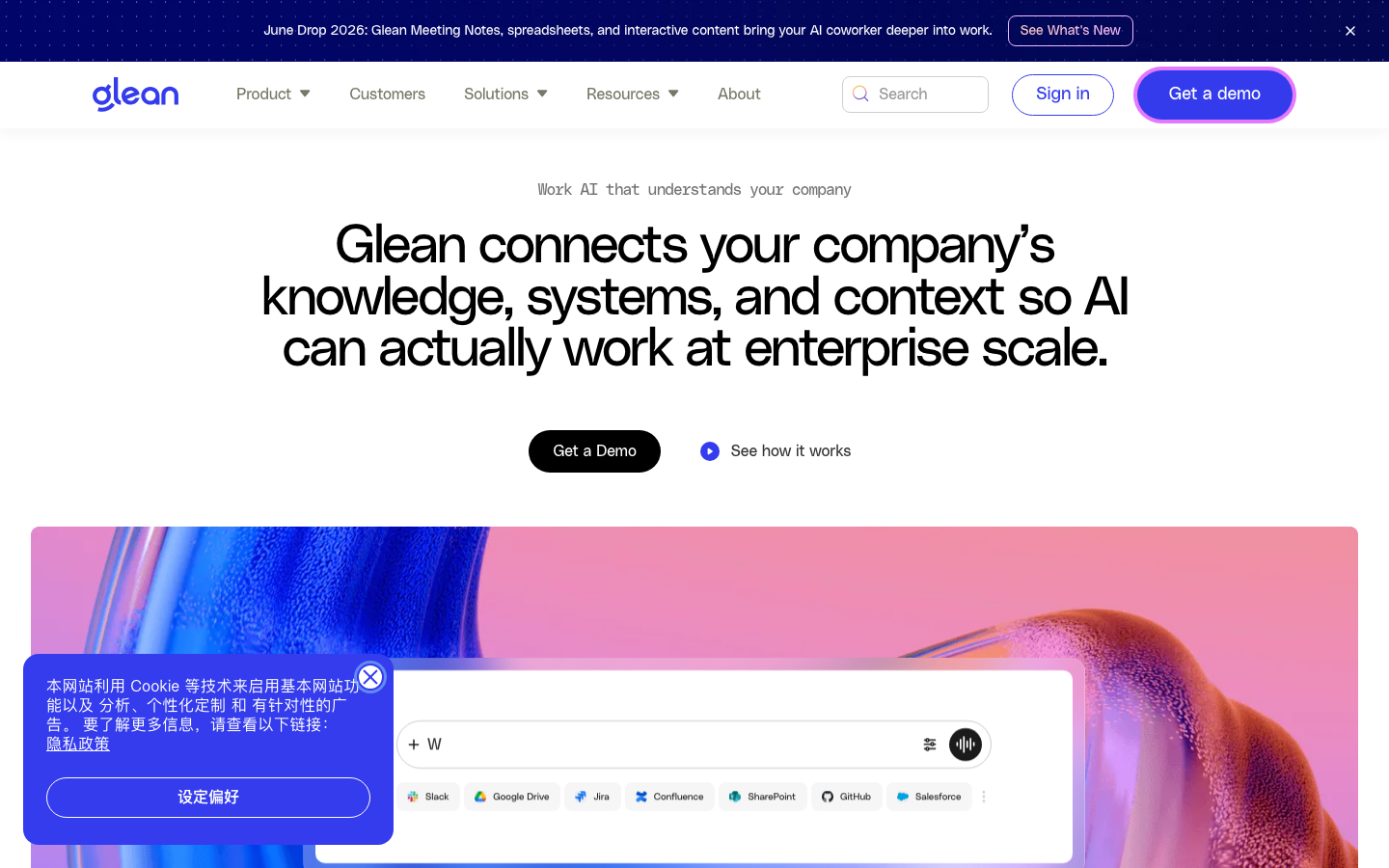
Glean is an enterprise-oriented Work AI platform that integrates unified enterprise search AI assistants and customizable agents into a permission-controllable system. It connects to hundreds of enterprise applications such as Slack, Google Workspace, Microsoft 365, Jira, Confluence, and Salesforce through connectors to build a company knowledge graph. Under the premise of strictly complying with the original access permissions, employees can use natural language to search for information, obtain answers with references, and use agents to automate cross-system workflows.
Glean
Core parameters and statistics
Glean is a Work AI platform for enterprises, officially positioned as "making AI truly usable at work (Work AI that Works)". It uniformly indexes enterprise knowledge dispersed in various SaaS systems into a knowledge graph, and then overlays the three-layer capabilities of search, assistant and agent on top of it. The core premise is to strictly retain the access rights of each employee in the original system.
| Projects | Public Information |
|---|---|
| Official positioning | Enterprise-level Work AI platform (search + assistant + agent) |
| Core Competencies | Unified enterprise search, conversational assistant, customizable agents, enterprise knowledge graph |
| Data access | Hundreds of official connectors (Slack, Google Workspace, Microsoft 365, Jira, Confluence, Salesforce, etc.) |
| Permission model | Inherit source system permissions (permissions-aware) in real time, without unauthorized retrieval |
| Deployment form | Cloud SaaS, providing web, desktop, mobile, browser extensions and API |
| Company Information | Founded in 2019 in Palo Alto, California, USA, founder Arvind Jain |
Mechanism value: Enterprise knowledge is naturally scattered in dozens of SaaS systems. Traditional full-text search cannot sort across systems, and it is difficult to ensure permission security. Glean continuously captures and builds knowledge graphs through connectors, structuring the relationship between "people, content, and activities" so that the search results have relevance and authority boundaries. This is the fundamental difference between it and general chatbots.
Deployment value: Glean respects each user's access rights in the source system by default. Employees can only search for content that they have access to, avoiding the compliance risk of "one pot" of sensitive data into large models. This is also a key prerequisite for large enterprises to adopt it.
User and market recognition
Glean's market recognition is mainly reflected in the scale of corporate customers and capital valuation.
Customer and positioning: Glean is marketed to medium and large enterprises, and its public customers include large organizations in technology, finance, manufacturing, media and other industries. It is positioned as a "unified AI portal for employees' daily work." Its value proposition is to reduce the time employees spend searching repeatedly across multiple systems and to precipitate internal knowledge into assets that can be called upon by AI.
Capital Approval: Glean has experienced multiple rounds of large-scale financing, and its valuation will enter the multi-billion dollar range in 2025. It is recognized as one of the leading companies in the enterprise Work AI track. The high valuation reflects the capital market’s long-term expectations for the direction of “unified AI search + intelligence for enterprises”. The specific financing amount and valuation shall be subject to real-time disclosure by official and authoritative media.
Premise for implementation: The value of Glean is positively related to the scale, quality and number of systems within the enterprise. Organizations with more systems and more dispersed knowledge will see more obvious benefits; while small teams with small amounts of data and single tools have relatively limited room for improvement.
Cost advantage
Glean is a paid product for enterprises. Its "cost advantage" does not lie in its low unit price, but in using a unified entrance to replace the hidden time cost of employees' repeated searches, repeated questions, and waiting for answers among multiple systems.
For C-side individuals: Glean is not sold to individual consumers, there is no free personal version, and individual users cannot subscribe separately.
For developers/API: Glean provides API and agent development capabilities. Enterprises can build their own search enhancement applications and automation processes on the platform, avoiding the engineering investment of building enterprise-level RAG, permissions and connector systems from scratch.
For Enterprises: Glean adopts a per-seat enterprise subscription model, and the price usually needs to be customized according to scale and functions by contacting sales. The cost trade-off is: comparing licensing and implementation fees with the retrieval time saved by employees, faster decision-making, and less duplication of work. The larger the employee size and the more dispersed the knowledge, the higher the unit value.
Cost Judgment Suggestions: Large organizations with numerous knowledge systems and heavy retrieval burdens on employees are more likely to calculate back costs; teams with simple systems and a small number of people need to evaluate carefully and first use the pilot scope to verify the actual savings before deciding whether to roll it out to all employees.
Main functions
Glean’s capabilities revolve around “unified access to enterprise knowledge and providing search, assistants and intelligence on top of it”:
- Unified Enterprise Search: One search box retrieves documents, messages, work orders, and customer records across hundreds of systems, sorting them uniformly by relevance and permissions.
- AI Assistant (Assistant): Conduct conversational Q&A based on company knowledge, and answers come with traceable reference sources, reducing the risk of "generating out of thin air".
- Agents: Enterprises can customize cross-system automated agents to connect "search-summarization-execution" into a reusable workflow.
- Enterprise Knowledge Graph: Automatically build relationships between people, content and activities to improve the quality of retrieval and recommendation.
- Permission Management and Connector: The official connector is connected to mainstream SaaS, and access permissions are verified in real time during each retrieval to ensure no unauthorized access.
Model and version evolution
Glean adopts a continuous delivery model, and its main line of evolution is the ability upgrade from "search" to "assistant" to "agent" instead of traditional version number iteration.
Main line of abilities
In the early days, Glean started with unified enterprise search to solve the pain point of "knowledge is dispersed and cannot be found". Later, Glean Assistant was launched to upgrade the search results to conversational answers with references. In recent years, the focus is on Glean Agents, which allows enterprises to orchestrate executable automated agents based on their own data and permissions, advancing Work AI from "answering questions" to "completing tasks."
Model Strategy
Glean adopts a "model-neutral" strategy at the bottom layer, combines self-developed retrieval and sorting capabilities, and can connect to a variety of mainstream large models to generate answers. This architecture allows it to take advantage of cutting-edge model generation capabilities and ensure accuracy and security in enterprise scenarios through its own knowledge graph and permissions layer. The specific supported models and versions are subject to the official real-time page.
Technical advantages
Glean’s technical advantages can be explained by the chain of “mechanism-effect-scene”.
Mechanism: Enterprise knowledge graph + search enhancement. Glean does not directly throw the question to the large model, but first performs a permission-based search on the knowledge graph, and then lets the model answer based on the real content retrieved. The effect is that the answers are well-documented and traceable for reference, which is suitable for enterprise Q&A scenarios that require high accuracy.
Mechanism: Permissions are inherited in real time. Each search is filtered in real time according to the access control of the source system. The effect is that employees can only see the content they have access to, avoiding data leakage. It is suitable for finance, legal HR and other departments with strict compliance requirements.
Mechanism: Connector Ecosystem. Officially maintain hundreds of connectors and continuously update them. The effect is that enterprises can connect dispersed systems without having to build their own integrations, which is suitable for large organizations with many SaaS tools and high integration costs.
How to use
Glean is designed for enterprise deployment. The typical implementation path is as follows:
- Administrator access data: The administrator accesses the SaaS system used by the company through the official connector, and Glean automatically builds indexes and knowledge graphs.
- Daily use by employees: Employees can search and ask questions in natural language through the web, desktop client, mobile client or browser extension, and get answers with quotes.
- Build Intelligent Agents: The business team configures intelligent agents based on its own data and permissions to automate repetitive retrieval, aggregation and cross-system operations.
When implementing, you need to focus on the correctness of connector coverage and permission mapping, as well as the quality of indexing and the cultivation of employee usage habits in the early stage of launch. It is recommended to pilot it in some departments before gradually promoting it.
Product Pricing
Glean is a subscription-based commercial product for enterprises and does not offer a free personal version.
- Enterprise Subscription: Billed on a per-seat basis. The specific price is customized based on the size of the enterprise, functional modules and implementation scope. You need to contact official sales to obtain a quote.
- Implementation Cost: In addition to the license fee, it also includes one-time investments such as connector configuration, permission mapping, and staff training.
- Association capabilities: Agent API and advanced management functions may be billed according to packages or add-ons. The details are subject to the official real-time page and business plan.
Application scenarios
- Unified knowledge retrieval: Employees can search documents, conversations and work orders across all systems at one portal. The focus of verification is search coverage and permission accuracy.
- Internal support and self-service Q&A: Handle high-frequency internal questions such as IT, HR, and legal affairs to Assistant for self-service answers. The focus of verification is answer accuracy and reference traceability.
- Cross-system process automation: Use Agents to search, summarize and operate in series. The focus of verification is process stability and secure access to the source system.
Applicable people
- IT and knowledge management teams of large enterprises: need unified access to distributed SaaS and provide safe and controllable AI search portals for all employees.
- Business and Operations Team: Hope to use agents to automate repetitive retrieval and summary work and improve cross-system collaboration efficiency.
- Compliance-sensitive departments: Teams such as finance and legal HR that have strict requirements on data permissions and require traceable answers.
Not suitable for the boundary: Glean is not for individual consumers, nor is it suitable for small teams with a single system, centralized knowledge, and a small number of people. In such scenarios, it is often more cost-effective to use general search or lightweight tools, and it is difficult to dilute the licensing and implementation costs of enterprise-level platforms.
Summary and Outlook
Glean uses the enterprise knowledge graph and real-time inheritance of permissions as the base, integrating the unified search AI assistant and customizable agents into a safe and controllable Work AI platform, solving the core pain points of "dispersed knowledge, inefficient retrieval, and difficult permission control" in large organizations. The evolution from search to assistant to intelligent agent reflects its product route of advancing Work AI from “finding answers” to “automatically completing tasks”. The multi-billion dollar valuation also confirms the market’s long-term expectations in this direction.
For organizations planning to implement it, it is recommended that one or two departments with intensive knowledge and heavy retrieval burdens be piloted first to verify connector coverage, permission mapping and the real time saved by employees, and then decide whether to promote it to all employees; before expanding to the whole company, it is necessary to verify the data security policy, data use and privacy terms in the procurement contract, and the governance complexity caused by large-scale indexing. The current uncertainties that need to be noted are: specific pricing, model support, and functional boundaries will continue to be adjusted with versions. The latest official plans and business terms should prevail before formal purchase.
Related tools: perplexity, you-com
Comparison of competing products
| Comparison dimensions | Glean | Competitor A | Competitor B |
|---|---|---|---|
| Core Differences | — | — | — |
| Price | — | — | — |
| Target Users | — | — | — |
Note: The above comparison is based on product public information, and actual differences are based on user experience.
Version Info
- Glean Work AI Platform (2026 Q2) :The continuously iterative version of the enterprise Work AI platform strengthens agent orchestration, enterprise-level permission management and connector ecology. The official adopts the continuous delivery model, and there is no precise version date disclosed to the public. It is marked here with quarterly nodes.
- Glean Agents :Launched Glean Agents, allowing enterprises to build and orchestrate automated agents based on their own data and permissions, extending Work AI from "question and answer" to "execution". There is no official precise date yet, it is approximated according to the public release node.
- Glean Assistant :Glean Assistant is launched on the basis of unified enterprise search, providing conversational Q&A capabilities based on company knowledge and cited sources. There is no official precise date yet, it is approximated according to the public release node.
User Reviews