 Google Cloud AI
Google Cloud AI is a full-stack artificial intelligence platform provided by Google Cloud. It uses the  Gemini model as the engine and provides model training, deployment and inference services through the Vertex AI platform, covering the full link requirements from basic model invocation to enterprise-level AI implementation.
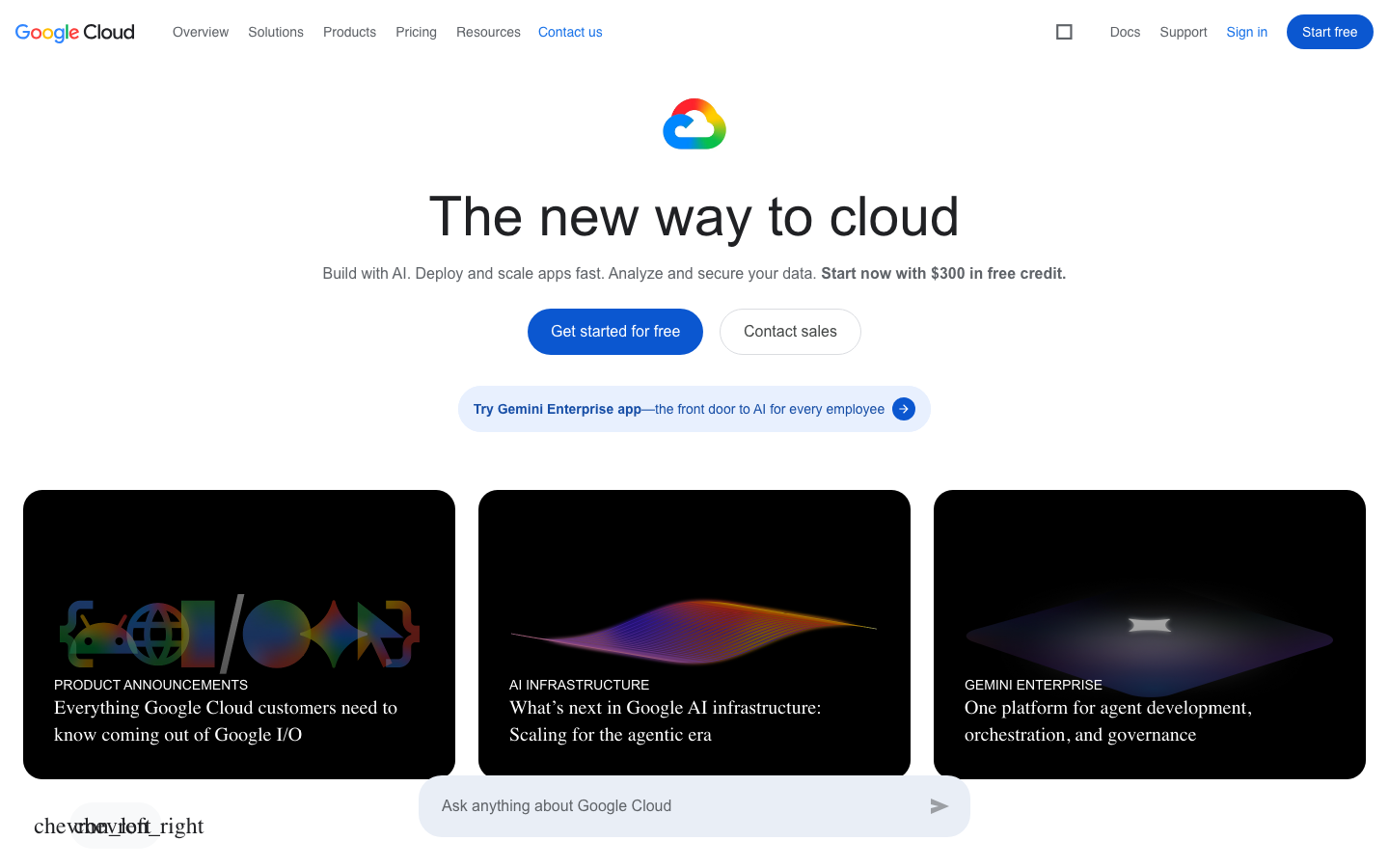
GoogleCloudAI
Core parameters and statistics
Google Cloud AI is not a single product, but a full-stack AI infrastructure using the Gemini model as the engine and Vertex AI as the platform. Its coverage ranges from underlying TPU computing power to upper-layer AI applications, forming a three-layer capability stack.
| Projects | Public Information |
|---|---|
| Official positioning | Full-stack AI platform on Google Cloud |
| Core Model | Gemini 2.5 Pro / 2.0 Flash / 1.5 Pro |
| Platform Services | Vertex AI, AI Studio, Model Garden |
| Context Window | Gemini 2.5 Pro supports 1M+ tokens |
| Multi-modal capabilities | Joint understanding of text, images, audio, and video |
| Deployment methods | Cloud API, Vertex AI hosting, privatization |
| Basics of computing power | Google TPU v5e / v5p |
| Support Platform | Web, API |
Three-layer structure: The bottom layer is the TPU computing infrastructure, the middle layer is the Vertex AI platform (model training, deployment, monitoring), and the upper layer is the Gemini model API and AI Studio developer portal. This structure means that users can choose to only consume the model API, or use full platform capabilities for model fine-tuning and private deployment.
Ecological binding: Vertex AI is deeply integrated with other Google Cloud services (BigQuery, Cloud Storage, Dataflow), and teams already on Google Cloud can get minimal data migration costs.
User and market recognition
Google Cloud AI's market recognition is mainly reflected in the two dimensions of enterprise customers and developer ecosystem.
Enterprise market: Google Cloud has achieved a year-on-year growth of more than 30% in AI infrastructure revenue for multiple consecutive quarters in its 2025 public financial report, and its service customers cover finance, retail, medical, media and other industries. The Vertex AI platform has been connected to hundreds of large enterprises for model customization and private deployment.
Developer Ecosystem: Gemini API provides free quota on Google AI Studio, attracting a large number of small and medium-sized teams and independent developers to try it out. However, compared to OpenAI and Anthropic, Gemini still lags behind in terms of the popularity of the developer community and the richness of third-party tutorials.
Industry evaluation: Gemini 2.5 Pro is in the same echelon as the GPT-5 series and Claude Opus series in multiple public benchmark tests (MMLU, HumanEval, GSM8K), especially showing leadership in the multi-modal understanding (video + audio) dimension.
Cost advantage
- C-side/Individual: Usually a free version is provided to experience the core functions, and high-frequency use requires a paid package subscription.
- API/Developer: Billed by call volume, suitable for development teams that can be flexibly integrated into their own systems.
- Enterprise/Privatization: Contact the business owner to obtain customized quotation and deployment plan. The specific price is subject to the official real-time pricing page.
Main functions
- Gemini multi-modal model: natively supports text, image, audio, and video input and comprehensive understanding, and is suitable for industry scenarios dominated by unstructured data, such as meeting record analysis, video content review, and multi-modal search.
- Vertex AI Platform: Provides full-link management from model training (AutoML and custom training), model evaluation, deployment to production, and is suitable for enterprise teams with model customization needs.
- Model Garden: Presets more than 150 basic models (including Google self-developed models and third-party open source models), supports one-click deployment and comparative evaluation, and reduces selection costs.
- AI Agent Construction: Build a conversational agent through Vertex AI Agent Builder, integrating grounding (connecting with enterprise data), function calling and manual transfer capabilities.
- TPU computing infrastructure: Google's self-developed TPU v5e/v5p provides hardware-level cost and latency advantages for large-scale training and inference.
Model and version evolution
Continuous iterative updates, the latest version introduces performance optimization and new features. Historical version information can be viewed on the official release page. There is no complete public version evolution timeline yet. It is recommended to pay attention to the official announcement to understand the rhythm of feature updates.
Technical advantages
TPU computing power cost advantage: Google's self-developed TPU has obvious advantages over NVIDIA GPU solutions in terms of training cost performance. TPU v5p is oriented to large-scale training, and v5e is oriented to inference optimization. For enterprises focused on training workloads, TPU reservations promise to reduce the cost of a single training session to 50%-70% of the GPU solution.
Full-stack deep integration: Vertex AI seamlessly integrates with Google Cloud native services such as BigQuery, Cloud Storage, Looker, Dataflow, etc., and data can be used for model training and online prediction without exporting. This integration means near-zero data migration costs for teams already using Google Cloud.
Multi-modal native capabilities: Gemini uniformly encodes text, images, audio, and video at the architectural level instead of splicing multiple single-modal models. In practical terms, video content understanding (such as creative review, surveillance video analysis) is Gemini's most distinguishing capability.
End-to-end MLOps: Vertex AI has built-in model version management, automatic expansion and contraction, online monitoring and alarms, reducing the operation and maintenance gap from experiment to production.
How to use
| How to use | Suitable for people | Features | Cost |
|---|---|---|---|
| Google AI Studio | Individual developers | Experience Gemini API directly in the browser, including free quota | Free + pay-as-you-go |
| Vertex AI API | Enterprise Development Team | Complete Authentication, Monitoring and Governance Capabilities | By Volume / Business |
| Vertex AI Workbench | Data Scientist | Hosted Jupyter notebook environment to support model training and tuning | Billed by computing resources |
| Enterprise privatization | Organizations with high compliance requirements | Deployed through Vertex AI dedicated cluster or GDC | Business confirmation required |
Actual usage process: First use free credits to verify the model effect and Prompt mode in AI Studio, select the model and parameters, then transfer to Vertex AI, configure IAM permissions, service account and network policy, and finally integrate into the production system through API or SDK. It is recommended to lock the API return format stability and latency SLA in Phase 1.
Product Pricing
The pricing model is divided into three tiers, which are strongly related to usage and technical solutions:
- C client/individual: AI Studio provides free calling quota (with a daily upper limit), and will be billed according to the API standard price after exceeding the limit. No long-term contract.
- Developer/API: Billed by Token, Gemini 2.5 Pro is about $2.50/million Tokens (input) and $10.00/million Tokens (output); the Flash series is even cheaper. Please refer to the official real-time pricing page.
- Enterprise/Private: The Vertex AI platform is billed by resource (CPU/GPU/TPU node hours), plus model invocation fees. Companies usually sign 1-3 year contracts that include minimum spending commitments and discount terms. TPU Reserve Pledges are available at 30%-60% off.
Application scenarios
- Enterprise Knowledge Base and Intelligent Search: Utilize Gemini's long context and multi-modal capabilities to conduct unified indexing and intelligent Q&A on documents, emails, and meeting records within the enterprise. The benefits are reflected in the reduction of information retrieval time from minutes to seconds, but data cleaning and permission mapping need to be completed first.
- Content Review and Compliance: Automated compliance review of images, videos, and text content. Gemini’s video understanding capabilities have a clear advantage in this scenario, as it can process the entire video at once instead of analyzing it frame by frame.
- Code Generation and Assistance: Gemini 2.5 Pro's performance in code generation and debugging scenarios is close to the level of the GPT-5 series, and is suitable for integration into CI/CD pipelines for code review and test generation.
- Customer Service and Dialogue Agent: Build an enterprise-level dialogue agent through Vertex AI Agent Builder, supporting knowledge base grounding, emotion recognition and manual transfer.
Applicable people
- Enterprise AI Team: Organizations already on Google Cloud who want to use Vertex AI to manage the entire process from model fine-tuning to production deployment. Not suitable for teams whose data is completely outside of Google Cloud and has no plans to migrate.
- Data Scientists and ML Engineers: Requires model training, tuning, and deployment in a managed environment. Google Cloud’s TPU ecosystem and MLOps tools are the core attraction.
- Independent developers and start-up teams: Quickly verify product prototypes through AI Studio free credits. However, if the business relies heavily on AI, the cost of API calls will increase linearly with scale in the long run, and the cost structure needs to be evaluated in advance.
- Not suitable for the crowd: Scenarios that require complete offline deployment and cannot accept any cloud dependency; or small teams with extremely low budgets and only need a single model call. Simple model API calls are more suitable for direct use of lightweight AI services rather than full-stack cloud platforms.
Summary and Outlook
The core competitiveness of Google Cloud AI lies in the combination of self-developed TPU computing power, full-stack platform integration, and Gemini multi-modal capabilities. It is not the cheapest model API (based on the price of a single token), but for enterprises that are already running their business on Google Cloud, need customized models or process multi-modal data, it provides the shortest path from computing power to platform to model.
Current limitations and uncertainties: The developer community size of the Gemini model and the richness of third-party tool chains still lag behind OpenAI and Anthropic; the complexity of Vertex AI has a learning curve for small and medium-sized teams; the cost-effective advantage of TPU is highly dependent on the length of use (reservation commitment), and the advantages are not obvious in short-term on-demand usage scenarios.
Procurement/Adoption Risk Assessment: It is recommended to start with the free AI Studio quota, lock in 1-2 clear scenarios (such as multi-modal audit or enterprise search), verify the model effect and delay the SLA before signing the Vertex AI contract. Key points to review before signing: the locking period of the TPU reservation discount, the compliance terms of the data residence area, and the compatibility guarantee for model version switching.
Related tools:  Hugging Face, replicate
Version evolution of Google Cloud AI
The version evolution of Google Cloud AI revolves around the Gemini model series, while the Vertex AI platform itself continues to iterate.
Gemini model main line
- Gemini 1.0 Pro (~2024-02): The initial version of the multi-modal basic model, establishing the native understanding capabilities of text + image + audio.
- Gemini 1.5 Pro (~2025-02): Long context milestone, supports 1M token for the first time, and can process an entire book or hour-level video at a time.
- Gemini 2.0 Flash (~2025-12): A low-latency version that compresses inference latency from seconds to hundreds of milliseconds, suitable for real-time interaction scenarios.
- Gemini 2.5 Pro (~2026-05): The current flagship, further improved in reasoning, code and multi-modal understanding, and the context window is expanded to 1M+.
Vertex AI Platform Evolution
Since its release in 2021, Vertex AI has continued to add capabilities such as Agent Builder, Model Garden, Model Registry, and Continuous Monitoring. In 2025-2026, the focus will be on promoting Agent building tools and MLOps governance.
Version Info
- Gemini 2.5 Pro :Google's current flagship multi-modal model supports 1M+ context windows and native tool calls, and is provided on Vertex AI. There is no official precise release date yet.
- Gemini 2.0 Flash :A low-latency, high-throughput version suitable for real-time conversations and lightweight reasoning tasks. There is no official precise release date yet.
- Gemini 1.5 Pro :Long context milestone, supporting 1M token context window for the first time. There is no official precise release date yet.
- Gemini 1.0 Pro :The first public version of the Gemini series, laying the foundation for multi-modal capabilities. There is no official precise release date yet.
User Reviews