 Google Gemini
Google Gemini is a multi-modal large model family launched by Google DeepMind. It forms a complete capability gradient from lightweight Flash-Lite to the flagship Gemini 3 Pro. It supports native multi-modal input of text/image/audio/video, 1M long context Function Calling, Live API real-time streaming and Agent automation. It can be accessed through three paths of free trial Gemini API pay-as-you-go and Vertex AI enterprise deployment through AI Studio.
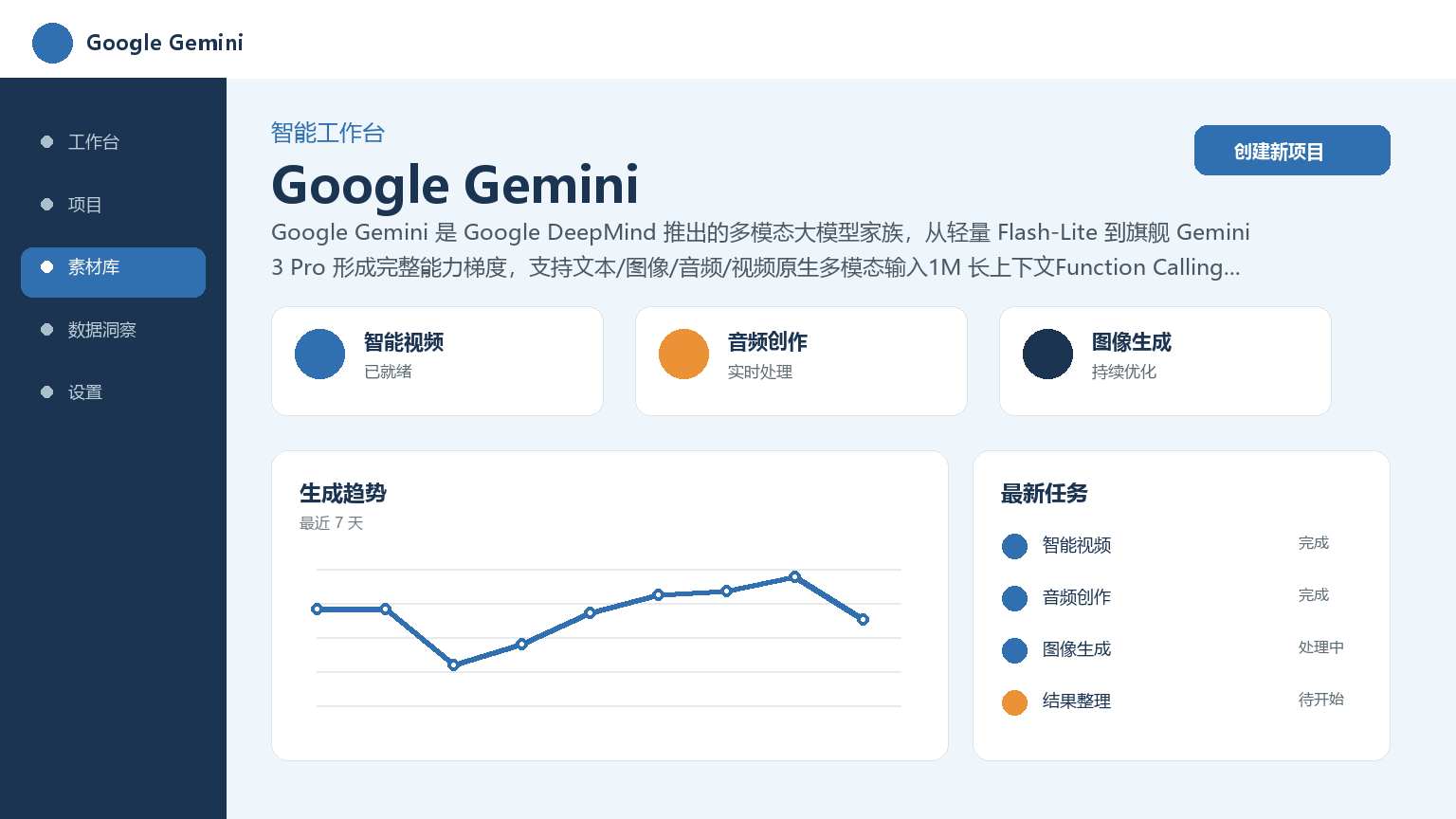
In-depth analysis of Google Gemini’s multi-modal large model family
Core parameters and statistics of Google Gemini
Google Gemini is not a single model, but a four-layer model matrix built by Google DeepMind based on the "capability-cost-latency" gradient, plus professional multi-modal engines such as image generation (Nano Banana Pro), video generation (Veo 3.1), and music generation (Lyria 2). To accurately evaluate its actual capabilities, you need to look at specific model specifications, entrance differences, subscription packages, and API pricing.
| Dimensions | Key facts |
|---|---|
| Current flagship model | Gemini 3 Pro (released on 2025-11-18) |
| Main production models | Gemini 2.5 Pro, Gemini 2.5 Flash, Gemini 2.5 Flash-Lite |
| Professional multi-modal models | Nano Banana Pro (image generation and editing), Veo 3.1 (video generation with audio), Imagen 4 (image generation), Lyria 2 (music generation) |
| Context window | Maximum 1M token (Gemini 2.5 Pro historically supports 2M) |
| Model access portal | Gemini API (ai.google.dev), AI Studio (ai.studio), Vertex AI, Gemini App (gemini.google.com) |
| Consumer subscription tiers | Free ($0), Google AI Plus/Pro (~$19.99/month), Ultra (~$249.99/month) |
| API input price range | $0.10~$40/million tokens (floating according to model and context length) |
| Developer tool chain | Google AI Studio SDK (Python/JS), Gemini API, Firebase AI Logic, LiteLLM compatible |
| Agent capabilities | Deep Research, Function Calling, Live API (real-time duplex streaming), Agent Mode, Computer Use (preview) |
| Context Caching | Context Caching support, greatly reducing input costs when cache hits |
| Applicable objects | Individual users, independent developers, start-up teams, medium and large enterprises, public sectors and educational institutions |
| Public information transparency | Model specifications and pricing are public at deepmind.google and ai.google.dev; precise TTFT/TPM is not continuously announced |
Actual selection meaning of four-layer model gradient: Gemini 3 Pro maintains the highest level within Google on benchmarks such as MATH, GPQA, SWE-bench, etc., and is suitable for complex tasks that require deep reasoning; Gemini 2.5 Pro is a long-term proven thinking workhorse, performing stably in long-context Agent tasks; Gemini 2.5 Flash is suitable for more than 80% of daily production scenarios, and is the optimal solution in terms of cost performance; Flash-Lite It pushes low latency and low cost to the extreme, and is suitable for high concurrency, embedded and edge reasoning. The mixed calling strategy - Flash for daily processing + Pro for solving difficult problems - is the officially recommended mainstream usage.
Real usage boundary of 1M context window: 1M token is enough to read the core source files of the entire medium and large code warehouse or a collection of hundreds of pages of technical documents at one time for analysis. However, the longer the context window, the KV cache overhead and inference delay increase sub-linearly - the first word delay of an extreme full 1M scenario may reach 3-5 seconds. In actual use, it is recommended to enable full context only when cross-chapter and cross-file associations are required, and daily tasks should be controlled within 128K to balance cost and response speed. Google's Context Caching mechanism can cache recurring input prefixes, significantly reducing actual input costs in long context scenarios.
Performance and throughput status: Google has not continued to disclose the precise TTFT (first word delay) and TPM/RPM frequency control values of each Gemini model. Based on the actual use experience of AI Studio and Vertex AI, the TTFT of Gemini 2.5 Flash under medium concurrency is about 200-500ms, and the Gemini 3 Pro is about 500-1500ms (including thinking mode). The free tier of AI Studio has quota limits on the number of requests per minute and the total amount of tokens per day, and the Vertex AI Enterprise Edition can be expanded as needed. The specific values are subject to the official real-time page and actual deployment measurements.
User and market recognition of Google Gemini
Gemini's market recognition is reflected in the large-scale distribution capabilities of Google's own channels and the extensive access to the developer community, but the visibility of third-party independent evaluation is lower than that of OpenAI and Anthropic.
Distribution barriers for individual clients: Gemini App is publicly available on the Web, iOS, and Android, and has replaced Google Assistant as the default AI assistant for Android devices in many countries. Relying on system-level pre-installation on flagship models such as Pixel and Samsung Galaxy, Gemini reaches far more users in the Android ecosystem than similar conversational AI products. However, the actual user activity and retention rate data are not disclosed by Google and cannot be directly aligned with ChatGPT or Claude's user participation indicators.
Two-tier entrance design for the developer ecosystem: AI Studio (ai.studio) provides zero-threshold model trial and API Key acquisition channels. The free tier allows you to call Gemini 2.5 Flash and experience Deep Research and image/video generation. Vertex AI is geared towards enterprise-level production deployment, providing SLA guarantees, data area residency, audit logs and private model fine-tuning. This two-tier path of "AI Studio rapid verification → Vertex AI production deployment" gives Gemini a clear access ladder from independent developers to large enterprises.
Industry coverage and depth of enterprise customers: Google Cloud’s public enterprise cases include Mercedes-Benz (auto intelligent customer service), Wendy’s (retail and catering automation), Verizon (telecommunications network operation and maintenance), HSBC (financial compliance), Deutsche Bank (investment analysis), Wayfair (e-commerce recommendation), Toyota (travel services) and other industry leading enterprises. Most cases are AI integration explorations for specific business lines rather than full-business replacements. Before purchasing, enterprises need to evaluate ROI expectations based on specific scenarios and clarify the business terms and SLA details of Vertex AI.
Third-party ecological integration: The Gemini model has been integrated as an optional model by mainstream developer tools and frameworks such as Cursor, Vercel v0, Replit, LangChain, LlamaIndex, and Pinecone. This third-party integration verifies Gemini's recognition in the developer community, but the depth of integration and the number of API calls are inferior to OpenAI's GPT series. It is worth noting that the ecological coverage Gemini has established through its own products such as Google Workspace (Docs/Gmail/Meet/Slides), Google Search (AI Mode/AI Overviews), Android system Chrome browser NotebookLM, etc. is a structural advantage that OpenAI and Anthropic cannot replicate.
Cost Advantages of Google Gemini
Gemini's cost structure covers different user groups with three layers of "consumer-level subscription × API pay-as-you-go billing × enterprise negotiation". The following is a layer-by-layer disassembly from the three dimensions of C-side, developers and enterprises.
C client/personal layer (Google AI Plans):
| Package | Monthly fee | Core capabilities | Boundary of application |
|---|---|---|---|
| Free | $0 | Gemini 2.5 Flash, basic Deep Research, limited image and video generation quota | Light use, advanced models require subscription |
| Google AI Plus | ~$19.99 | Gemini 3 Pro quota, expansion Deep Research, Veo 3.1 quota Workspace AI function 2TB cloud storage | Daily heavy personal user |
| Google AI Pro | ~$19.99 | Gemini 3 Pro high quota NotebookLM Plus, Veo/Imagen high quota Whisk/Flow creative tools | Main force in Asia Pacific region, content creators are given priority |
| Google AI Ultra | ~$249.99 | Gemini 3 Pro / Deep Think highest quota Veo 3.1 flagship quota Project Mariner and other cutting-edge capabilities priority access | Professional creators and heavy users |
Developer/API layer (billed per million tokens):
| Model | Input (≤200K tokens) | Input (>200K tokens) | Output (≤200K tokens) | Output (>200K tokens) |
|---|---|---|---|---|
| Gemini 3 Pro | $2.00 | $4.00 | $12.00 | $18.00 |
| Gemini 2.5 Pro | $1.25 | $2.50 | $10.00 | $15.00 |
| Gemini 2.5 Flash | $0.30 | $0.30 | $2.50 | $2.50 |
| Gemini 2.5 Flash-Lite | $0.10 | $0.10 | $0.40 | $0.40 |
Key insights into the cost structure: The unit input cost of Flash-Lite ($0.10/million tokens) is in the same order of magnitude as DeepSeek V4-Flash (1 yuan/million tokens, about $0.14), which is the price anchor for large-scale production scenarios. Flash ($0.30/million tokens) covers more than 80% of daily production scenarios and has the best price/performance ratio. The input price of 3 Pro and 2.5 Pro is 4-13 times higher, but the quality advantage of its Thinking mode on complex reasoning tasks is significant. The mixed strategy of "Flash for daily processing + Pro for problem solving" can reduce the overall API cost by 60-80% compared to using all Pro. Context Caching reduces the input cost by about 70-90% when the cache is hit, and is suitable for scenarios where the system prompt word is fixed and the dialogue prefix is stable. The Batch API offers approximately 50% discount and is suitable for non-real-time batch inference tasks.
Enterprise layer (Vertex AI): There is no public standard price, you need to contact Google Cloud sales to obtain a commercial quotation. Typical billing dimensions include: model call volume (committed consumption), data residence region (such as Europe, Asia localization requirements), compliance certification level (SOC2, HIPAA, ISO 27001), SLA level, fine-tuning resource consumption, and whether to bundle other Google Cloud services (BigQuery, Cloud Storage, Looker). For larger customers with annual spending exceeding a million dollars, significant discounts and dedicated support teams can often be negotiated. Before purchasing, enterprises need to focus on confirming the data sovereignty terms, model version update notification cycle, and data migration plan after service termination.
Hidden Cost Tip: The amount of token output in Deep Think/Thinking mode can reach 3-8 times that of normal mode, and the actual cost of a single call is significantly higher than the basic pricing table. In the Agent multi-step calling scenario, the intermediate Token consumption of Function Calling and the input Token of the tool return content are both included in the billing. It is recommended to set a single-call token budget limit in the production environment and continuously track the token consumption distribution through Cloud Monitoring.
Key features of Google Gemini
Gemini's functional matrix is not a single chat interface, but a modular system built around six capability lines of "multimodal understanding + in-depth research + agent automation + multimodal generation + coding collaboration + enterprise integration". There are significant synergies between the following six functions - the output of one task can directly become the input of another task, thereby reducing cross-tool switching and data portability costs.
-
Native multi-modal understanding and reasoning: Gemini has adopted a native multi-modal architecture (rather than plugging a visual encoder on the text model) since the first version. Text, images, audio, and video share the same model representation layer. Hidden linkage: Video understanding results can be directly used as input material for Deep Research reports, and the report conclusions can drive Veo 3.1 to generate video summaries - a single video upload can trigger the complete cycle of "understanding → analysis → regeneration", without the need to switch data formats between multiple professional models.
-
Deep Research Long Task Automation: Schedule Gemini models to perform multi-step retrieval, reading, sorting and output of research reports with cited sources. Synergy effect: The output of Deep Research can be used as an outline of the copy material Veo video script generated by Nano Banana Pro infographics or the content skeleton of the Google Slides presentation with one click, forming a one-stop link of "research → content generation → visual delivery". For industry researchers and content teams, this means end-to-end time from research to delivery can be compressed from days to hours.
-
Agent automation and tool calling: Gemini API provides native Function Calling (custom API calling), Live API (audio/video real-time duplex streaming), Agent Mode (multi-step planning + automatic tool selection), Computer Use (screen interaction, preview stage). Agent Tool Open List: The core tools exposed by Gemini to the model include
google_search(real-time retrieval),code_execution(sandbox code running),function_call(custom API integration),computer_use(screen pixel-level interaction, preview),image_generation(Nano Banana),video_generation(Veo). The model completes an Agent interaction process by "receiving instructions → planning subtasks → sequentially calling tools → summarizing results". Project pitfall tip:max_stepsneeds to be set to control the upper limit of the number of Agent steps to prevent idle cycles from consuming Tokens; it is recommended to set manual confirmation points for irreversible operations (deletion, payment, release). -
Multi-modal generation matrix: Nano Banana Pro (image generation and editing, supports multi-round conversational editing and text rendering), Veo 3.1 (video generation, supports original audio output), Imagen 4 (Venograph), Lyria 2 (music generation), Whisk/Flow (creative workflow). Core point of difference: Nano Banana Pro is not a traditional "one-time generation and uncontrollable" Vincent diagram model, but a conversational image engine that supports multiple rounds of iterative editing - users can first generate a poster, and then modify local elements, adjust color matching, and replace text through natural language, without the need to repeatedly switch between different tools.
-
Coding and Developer Tools: Gemini API provides code generation, interpretation, debugging and refactoring capabilities through the Google AI Studio SDK (Python/JavaScript). Antigravity (AI native IDE launched by Google) and Jules (asynchronous coding agent) work with Gemini 3 Pro / 2.5 Pro to provide interactive coding and background task execution. Implementation Tip: Antigravity's cross-file editing depends on the long context window of the model. It is recommended to open the context to 1M when analyzing a large code base, but it should be noted that the first word delay will increase accordingly.
-
Google Ecological Integration: Gemini is embedded into Google Workspace (Gmail, Docs, Sheets, Slides, Meet) in the form of a sidebar, providing capabilities such as email writing, document summarization, meeting minutes generation, table formula suggestions, etc. Integrate into the main traffic portal in the form of AI Mode and AI Overviews in Google Search. NotebookLM provides "source-driven" note-taking Q&A - model output is strictly limited to the range of materials uploaded by users, making it suitable for rigorous knowledge work scenarios. Hidden linkage: Meeting minutes and documents organized in Workspace can be directly used as context input for Deep Research, forming a link of "daily office → knowledge accumulation → in-depth analysis".
Google Gemini model and version evolution
Gemini's version iterations range from the first version in December 2023 to Gemini 3 Pro in November 2025, spanning three architectural transitions: basic multimodality → long context and agent foundation → deep reasoning and multimodal unification. The following is a segmented description of major milestones.
First generation: Gemini 1.0 series (2023-12)
Gemini 1.0 Ultra/Pro/Nano is launched, officially replacing Bard and PaLM 2 as Google's flagship generative AI model family. The three levels are respectively for complex reasoning, general tasks and device-side deployment. The core breakthrough lies in the native multi-modal architecture - text, images, audio, and video share the same model representation, rather than overlaying a visual encoder on the text model like GPT-4V. This architectural choice laid the foundation for cross-modal capabilities in all subsequent releases.
Second Generation: Long Context Breakthrough and Agent Foundation (2024-02 to 2024-12)
- Gemini 1.5 Pro (2024-02-15): Implements 1M/2M token long context for the first time, promoting engineering practice of long documents and code base-level reasoning. This capability directly drove the design direction of subsequent NotebookLM and Deep Research products.
- Gemini 2.0 Flash (2024-12-11): Introducing native tool calling (Function Calling) and Live API (real-time audio/video duplex streaming), marking Gemini's entry into the Agent era. Live API provides underlying capabilities for voice assistants and real-time multi-modal interaction products, which is Google's key layout in Agent infrastructure.
Third Generation: Thinking Model and Cost-Effectiveness Stratification (Mid-2025)
- Gemini 2.5 Pro (2025-06-17): Adding thinking mode, the quality is significantly improved in chain reasoning tasks such as mathematics, science, and code. It has long been the default high-quality option for AI Studio and Vertex AI.
- Gemini 2.5 Flash (2025-06-17): Released on the same day as Pro, bringing the thinking model into a cost-effective model. Supports multi-modal input and is oriented to large-scale production.
- Gemini 2.5 Flash-Lite (2025-07-22): Pushing the extremes in cost and latency, suitable for high throughput, embedded and edge scenarios. At this point, Gemini’s four-layer gradient of capability-cost-delay has officially taken shape.
Fourth Generation: Gemini 3 and Multimodal Unification (2025-11)
- Gemini 3 Pro (2025-11-18): The flagship of the Gemini 3 series, focusing on cutting-edge reasoning, native multi-modal Agent automation and 1M long context. Set Google internal records on benchmarks like AIME (math), GPQA (science), SWE-bench (coding), and more. This is a key node in the evolution of the Gemini model family from "universal large model" to "full-stack AI inference engine".
- Nano Banana Pro (2025-11-20): Gemini 3 era image generation and editing model, natively supports multi-round conversational editing, precise text rendering and style consistency. Not a traditional drawing tool, but a new paradigm of image editing.
- Veo 3.1 (2025-10-15): Supports high-fidelity video generation and editing with original audio, integrated in Gemini App and Vertex AI Studio.
Version context key points: Gemini’s version jumps (1.0 → 1.5 → 2.0 → 2.5 → 3) are accompanied by architecture-level changes. Google maintains two technical lines: "Gemini general inference model" and "multimodal professional model (Nano Banana / Veo / Imagen / Lyria)". The former is a general inference engine and the latter is a professional generation engine. The two are used in combination in Gemini App and AI Studio. When evaluating Gemini's capabilities, you should not only look at the general inference model benchmark, but also focus on the depth of professional multi-modal engine and product integration - this is precisely the core difference between Gemini and GPT and Claude.
Technical advantages of Google Gemini
Gemini's technical barrier is not leading in a single indicator, but in its systemic advantages from model architecture, inference optimization to infrastructure and product distribution.
Mechanism and effect of native multi-modal architecture: Gemini has been designed as a native multi-modal model since the first version, rather than a plug-in solution. This means that text, images, audio, and videos share a unified representation space within the model, and cross-modal reasoning (such as mixed image and text understanding, extracting key frames from videos and generating text descriptions) does not require switching between multiple encoders. From a practical application perspective, this architecture is superior to plug-in solutions in terms of accuracy and efficiency when performing cross-modal tasks such as "looking at a chart and interpreting trends" or "analyzing a video content and generating a summary." The limitation is that the native architecture makes the model parameters larger and the training cost higher. This is one of the reasons why Gemini has not launched a lightweight open source version.
Engineering implementation of long context window: Gemini 2.5/3 Pro's 1M token context (2.5 Pro historically supports 2M) is derived from Google's years of accumulation in Transformer long sequence optimization, including sparse attention (reducing O(n²) to approximately linear), memory compression (lossy compression of the historical KV cache to save video memory) and inter-TPU communication optimization (achieving efficient cross-chip parallelism through Google's self-developed data center network). For developers, this means that they can read medium and large code repositories or hundreds of pages of technical documents at once for cross-file/cross-chapter analysis, without the need for manual segmentation and splicing. But please note: the longer the context, the inference delay does not increase linearly but sublinearly - the first word delay of an extreme 1M scenario may still reach 3-5 seconds.
Economies of scale on TPU infrastructure: The Gemini series trains and serves on Google TPU (Tensor Processing Unit) clusters. TPU is specially designed for deep learning matrix operations, and its unit computing power cost is lower than that of GPUs of the same generation (such as NVIDIA H100). Google's internal large-scale TPU deployment ensures the capacity stability and elastic expansion and contraction capabilities of model services. This infrastructure advantage is directly reflected in API pricing - Flash-Lite's $0.10/million tokens benefit from the marginal cost advantage of TPU. This price level is in the same range as DeepSeek V4-Flash, but Google's global data center distribution provides better regional low-latency coverage.
Natural distribution of the product matrix: Gemini is not an independent API or App, but an AI capability layer embedded in products with billions of monthly users, such as Search (AI Mode/AI Overviews), Workspace (Docs/Gmail/Meet), Android (system-level Assistant replacement), Chrome, and YouTube. This distribution network makes Gemini’s user reach cost almost zero, and each product scenario provides real interaction data for the model. This is a structural competitive advantage that OpenAI and Anthropic cannot replicate, and it is also Google’s largest moat on the AI track.
Deep Think's controllable reasoning intensity: The flagship model supports the Deep Think extended thinking mode, which automatically generates longer chain reasoning paths to obtain higher-quality answers on tasks such as mathematical proofs, competition programming, and complex planning. Developers can control the intensity of thinking through API parameters to make a trade-off between speed and quality. But please note: the output token consumption of thinking mode is 3-8 times that of normal mode, and the actual cost of a single call will increase significantly. It is recommended to enable it on demand in key tasks that require deep reasoning rather than by default globally.
Google Gemini usage path
Gemini provides multi-level usage paths from zero-threshold chat to enterprise-level API integration. Different entrances correspond to different capability sets, service terms, and billing models.
Gemini App (consumer level entrance)
- Portal: gemini.google.com (Web), iOS App Store, Google Play, and Android system-level integration
- Scope of capabilities: Dialogue interaction Deep Research, image/video generation Gemini in Apps (Google account associated)
- Fee: Free tier $0; Plus/Pro ~$19.99/month; Ultra ~$249.99/month
- Applicable people: individual users, light creators, daily learning and research
Google AI Studio (developer experience and prototype verification)
- Entrance: https://ai.studio/
- Scope of capabilities: All Gemini models try Prompt debugging API Key management, multi-modal generation demonstration Function Calling test
- Applicable people: independent developers, entrepreneurial teams, product prototype verification
- Fee: The free tier includes quota limits, and the excess will be billed according to the API pricing.
Gemini API (Production Level Model Integration)
- Entrance: https://ai.google.dev/gemini-api/docs
- Model ID:
gemini-3-pro,gemini-2.5-pro,gemini-2.5-flash,gemini-2.5-flash-lite - Core Parameters SDK Example (Python):
import google.generativeai as genai

genai.configure(api_key="<YOUR_API_KEY>")

model = genai.GenerativeModel(
    model_name="gemini-2.5-flash",
    system_instruction="You are a professional technical document analyst. Please answer in Chinese."
)

response = model.generate_content(
    "Comparing the cost and capabilities of Gemini 2.5 Flash and Gemini 3 Pro",
    generation_config=genai.types.GenerationConfig(
        temperature=0.3,
        max_output_tokens=2048,
        response_mime_type="text/plain",
    ),
    stream=False
)
print(response.text)
Agent calling link example (Function Calling):
model = genai.GenerativeModel(
    model_name="gemini-2.5-flash",
    tools=[google_search, code_execution]
)

chat = model.start_chat()
response = chat.send_message("Query the latest Gemini API pricing and estimate monthly costs accordingly")
Vertex AI (Enterprise AI Platform)
- Entrance: https://cloud.google.com/vertex-ai
- Capability Scope: Enterprise-level SLA, data region residency, model fine-tuning (Tuning and Adapter), IAM access control Cloud Audit audit log, native integration with GCP services such as BigQuery/Cloud Storage/Looker
- Applicable people: medium and large enterprises, compliance-sensitive industries (finance, medical, government affairs)
- Fees: Pricing based on usage and business contract, discounts available for annual consumption commitments
Typical Agent call link: User command → Gemini API parsing intent → Function Calling selection tool → sequentially calling google_search / code_execution / image_generation → summarizing intermediate results → returning the final answer. For Agent tasks, Gemini 2.5 Flash is recommended as the daily planning engine, and Gemini 3 Pro handles subtasks that require deep reasoning. Use the max_steps parameter (recommended to be initially set to 10-15) to control the number of execution steps to prevent infinite loops; set the stop_when_satisfied threshold to terminate early to avoid Token idling.
Product Pricing for Google Gemini
Gemini's pricing system covers the full range of users with three layers of "consumer-level subscription × API real-time billing × enterprise business negotiation".
Consumer-level Google AI Plans (based on the United States, the actual price is subject to the landing page):
| Package | Monthly Fee | Model Access | Core Function Quota | Cloud Storage |
|---|---|---|---|---|
| Free | $0 | Gemini 2.5 Flash | Basic Deep Research, limited image/video generation | 15 GB |
| Google AI Plus | ~$19.99 | Gemini 3 Pro (with quota), Gemini 2.5 Flash | Extended Deep Research, Veo 3.1 quota Workspace AI | 2 TB |
| Google AI Pro | ~$19.99 | Gemini 3 Pro (high quota) | NotebookLM Plus, Veo/Imagen high quota Whisk/Flow | 2 TB |
| Google AI Ultra | ~$249.99 | Gemini 3 Pro / Deep Think (highest quota) | Veo 3.1 flagship quota Project Mariner priority access | 2 TB |
API pay-as-you-go: For details, see the four-model price list in the cost advantage chapter above. Key additional explanation - Multi-modal input (image, audio, video) is charged based on Token equivalent conversion. The specific conversion coefficient is subject to the real-time data on the AI Studio pricing page. Images are roughly converted to 258 tokens/image (standard size), and audio is converted to 32 tokens per second. Context Caching reduces the input cost by about 70-90% when the cache is hit, and is suitable for scenarios where the system prompt words are fixed and the dialogue prefixes are consistent. The Batch API offers approximately 50% discount on asynchronous batch inference, suitable for non-real-time, high-throughput tasks.
Enterprise/Vertex AI Pricing: No public standard pricing, please contact Google Cloud Sales for a commercial quote. Billing dimensions include: average monthly model calls (in millions of tokens), data residence area (determines compliance costs), SLA level (such as 99.95% availability), fine-tuning resource consumption (TPU duration), and whether to bundle other GCP services. Larger customers (annual spending $100K+) can often negotiate better discounts and dedicated TAMs (Technical Account Managers).
Hidden Costs and Optimization Suggestions for Pricing: Deep Think/thinking mode expands the output Token volume by 3-8 times, and the actual cost of a single call may be 3-5 times the basic pricing. It is recommended to enable it only for critical tasks that require deep reasoning. In a multi-step Agent call scenario, the intermediate Token consumption of tool calls (the tool returns content as input for subsequent rounds) will significantly increase the actual Token consumption. Optimization strategies include: setting the upper limit of max_steps control steps, using Context Caching to cache fixed system prompt words, migrating non-real-time reasoning to Batch API, and using Flash-Lite to handle high-throughput and low-complexity tasks.
Google Gemini application scenarios
The following six types of scenarios are the directions of Gemini capability matrix that have been verified in actual business. Each category marks the boundaries of human-machine collaboration - which ones can be automated and which ones must have manual confirmation points.
-
Personal AI assistant and knowledge management: daily conversation, writing assistance, multi-language translation, study plan formulation, life and travel planning. Human-computer collaboration: Information retrieval and first draft generation can be 100% automated; responses involving financial decisions, medical advice, and legal opinions must have manual review points. Cost reduction and efficiency improvement: Daily information retrieval time for individual users is reduced from an average of 15 minutes per time to 3-5 minutes per time; the first draft of a document is shortened from 40 minutes to 8-12 minutes (deduction value, based on medium complexity tasks).
-
In-depth research and industry analysis: industry research reports, academic literature reviews, market research, competitive product analysis, and policy interpretation. Deep Research can automatically complete multi-step search-read-organize-output structured reports with cited sources. Human-computer collaboration: Data collection and structuring can be highly automated; the accuracy verification of core conclusions, authenticity verification of cited sources, and data timeliness inspection must be completed manually. Implementation Tip: The output quality of Deep Research is highly dependent on the initial Prompt's limitation of the information source range and time window. It is recommended that the trusted source and date range be clearly specified in the Prompt.
-
Multi-modal creative production: brand marketing visual design, social media content batch production, short and long video generation, music creation and editing. Nano Banana Pro supports multiple rounds of conversational editing and precise text rendering, and Veo 3.1 can generate high-fidelity videos with original audio. Human-machine collaboration: The generation of concept sketches and first drafts of content can be highly automated; the copyright compliance review and brand visual consistency check of final published or commercial materials must be completed manually. Cost reduction and efficiency increase: The iteration cycle of the marketing team from idea to first draft is shortened from 3-5 days to 1-2 days (deduction value); the production time of a single social media content is reduced from 2-3 hours to 30-45 minutes.
-
Software engineering and AI-assisted development: code generation and completion, cross-file reconstruction, code review assistance, unit testing automatically generates bug location and repair suggestions, and technical document writing. Antigravity IDE and Jules asynchronous agent cover interactive coding and background task execution. Human-computer collaboration: Sample code generation and single test completion can be highly automated; key code reviews, security compliance checks, and architecture decisions in production contexts must be completed manually by senior engineers. Implementation Tips: It is recommended that the code generated by Gemini pass automatic testing and security scanning of the CI/CD pipeline before integration.
-
Enterprise office and knowledge collaboration: email writing and reply suggestions, automatic summary and key point extraction of long documents, meeting recordings converted into text minutes, table data formula generation and anomaly detection. Gemini is embedded with all Google Workspace applications and NotebookLM. Human-computer collaboration: Draft generation and information sorting can be automated; output involving customer communication, interpretation of contract terms, and financial data analysis must be reviewed manually.
-
Search enhancement and decision-making assistance: Complex search intent analysis, itinerary planning and budget formulation, product comparison and purchase decision-making assistance, and policy compliance retrieval. AI Mode provides multiple rounds of conversational answer generation within the main search traffic. Human-machine collaboration: Information collection and multi-solution generation can be automated; final decisions (especially operations involving payment, contracting or privacy) must be manually confirmed by the user.
Who is Google Gemini suitable for?
-
Individual users and light learners: Gemini 2.5 Flash and basic Deep Research can be used in the Free tier. Android system-level integration makes it a convenient everyday AI assistant. Unfit Boundary: High-frequency use of advanced models (Gemini 3 Pro) and multi-modal generation (Veo, Nano Banana) requires a Plus/Pro/Ultra subscription. If the Gemini App is not open in your region (such as mainland China), you can only access it through Vertex AI or third-party compliance channels, and product availability is limited.
-
Independent developers and start-up teams: AI Studio provides zero-threshold model experience and API Key acquisition channels, and the free tier quota is sufficient to support prototype development. Gemini API + Google Cloud ecosystem (Firebase, Cloud Run, Cloud Storage) can quickly build AI application MVP. Unsuitable boundary: Scenarios that have strong transparency requirements for the model inference process or require white-box auditing - Gemini's closed-source attributes may not be suitable; it is necessary to pay attention to the difference in frequency control limits between the free tier and the paid tier to avoid service interruption due to insufficient quota in the production environment.
-
Content Creators and Marketing Team: Nano Banana Pro's image editing and text rendering capabilities, Veo 3.1's video generation and audio synthesis, and Whisk/Flow's creative workflow form a complete creative tool chain from plane to video. Unsuitable Boundary: In scenarios with strict requirements for copyright ownership and commercial authorization of generated content, Google's terms of service need to be confirmed item by item - Google's multi-modal generation model authorization policy may change with versions. It is recommended to obtain the latest written authorization instructions before commercial use.
-
Medium and large enterprises and compliance-sensitive institutions: Vertex AI provides SLA guarantee, data area resident IAM access control, audit logs and model fine-tuning capabilities. It has covered finance, automobile, retail, telecommunications and other industries. Purchasing Prerequisites: Enterprises should have clear AI implementation directions and quantifiable efficiency indicators (such as increased customer service resolution rate, shortened report generation time, and reduced code defect rate). Procurement Risk Tip: It is recommended that the SLA details (availability, response time), data sovereignty clauses (data storage area and cross-border transmission restrictions), model version update strategy (compatibility period and notification period after API endpoint switching), and data migration plan after service termination be clarified in the contract.
-
Education and Public Sector Researchers: Deep Research is suitable for literature reviews and cross-field data integration, and NotebookLM is suitable for in-depth Q&A based on a specific set of materials. Unfit Boundary: The citation verification and data authenticity verification of formal academic papers still need to be completed manually, and the model output cannot be directly used as academic evidence. For scenarios involving minors’ data or sensitive research areas, additional compliance requirements need to be evaluated.
Summary and Outlook of Google Gemini
Core Competencies: Gemini has formed a complete capability ladder of "top-level reasoning → stable production → ultimate cost-effectiveness" around the four-layer model gradient (3 Pro / 2.5 Pro / 2.5 Flash / Flash-Lite). Native multi-modal architecture + 1M long context + Deep Think controllable reasoning + Agent/Live API form a comprehensive technical base. Gain ultra-large-scale natural distribution with its own products such as Google Search, Workspace, Android, Chrome, and YouTube—the only AI model family currently covering search engines, office suites, mobile operating systems, and developer platforms. Through the dual-layer entrance of AI Studio and Vertex AI, Gemini covers both individual developers and corporate customers.
Main current limitations: Gemini App and Google AI Plans are not available in some areas (including mainland China). Chinese users mainly access through Vertex AI or third-party channels, and product availability is limited. Highly complex tasks and multi-modal advanced capabilities are concentrated in Plus/Ultra packages and high-priced API calls. Cost planning requirements for large-scale production scenarios are higher. Agent-related capabilities (Computer Use, Project Mariner) are mostly in the preview stage, and production-level stability and compliance boundaries need further verification. Compared with DeepSeek and Claude, Gemini's system transparency in third-party independent evaluations is lower. Some benchmark data relies on Google's self-reporting and lacks third-party audit verification.
Follow-up observation points: Pro/Flash/Flash-Lite iteration rhythm and capability jump after Gemini 3; the actual penetration rate of Nano Banana Pro and Veo 3.1 in commercial content production workflows; the maturity and depth of third-party ecological integration of Agent/IDE products such as Antigravity, Jules, and Project Mariner; the pace of implementation and pricing adjustment trends of the Google AI Plans package structure in various regions; the expansion possibility of compliance access paths for Chinese users.
Procurement and Adoption Risk Assessment: For individual users and independent developers, the Free layer and free AI Studio quota provide a zero-cost trial and error path. At this stage, it is worth incorporating Gemini into the tool chain as the main AI assistant or alternative model. For enterprises, it is recommended to first pilot verify model capabilities and team acceptance in non-critical processes (internal knowledge Q&A, first draft document generation, code-assisted review, preliminary data analysis), set a 4-8 week comparative evaluation period, collect ROI data, and then gradually expand to quasi-production scenarios. In compliance-sensitive industries (finance, medical, and government affairs), priority should be given to accessing through Vertex AI Enterprise Edition to ensure data sovereignty and SLA, and the notification period for model version switching should be specified in the business contract (recommended to be no less than 90 days), confirm the data storage area and cross-border transmission restrictions, and the data export format and migration window after service termination. Considering that the Gemini model family continues to iterate and API endpoints may change with versions, it is recommended to abstract the model at the application layer (such as shielding underlying model switching through LiteLLM or a custom Adapter layer) to avoid production interruptions caused by Google upgrading model endpoints. Overall, Gemini has the ability to compete head-on with the OpenAI GPT series in the three key dimensions of "model capability + cost gradient + distribution coverage", and the depth of Google's ecosystem provides it with a unique space for differentiation, making it suitable as a core alternative in an enterprise's multi-model strategy.
Related tools:  DeepSeek,
  ChatGPT
Comparison of competing products
| Comparison dimensions | The tool | Competitor A | Competitor B |
|---|---|---|---|
| Core Differences | — | — | — |
| Price | — | — | — |
| Target User | — | — | -- |
Version Info
- Gemini 3 Pro :The flagship model of the Gemini 3 series features cutting-edge reasoning, native multi-modal agents and 1M long context, refreshing many benchmarks in mathematics, science, coding, etc., and provides services through AI Studio, Vertex AI and Gemini API.
- Gemini 2.5 Flash-Lite :The lightweight version with the most cost and latency advantages, suitable for high-throughput, embedded and edge scenarios.
- Gemini 2.5 Pro :The main thinking model has outstanding performance in chain reasoning tasks such as mathematics, science, and coding. It has long been the high-quality default option in AI Studio and Vertex AI.
- Gemini 2.5 Flash :The cost-effective main model supports thinking mode and multi-modal input, and is oriented to large-scale production workloads.
- Gemini 2.0 Flash :The introduction of native tool calls and Live API real-time multi-modal streaming marks Gemini's entry into the Agent era.
- Gemini 1.5 Pro :The first batch of main models that support 1M/2M token long context, promoting long document and code base level understanding capabilities.
User Reviews