 GPT Realtime Whisper
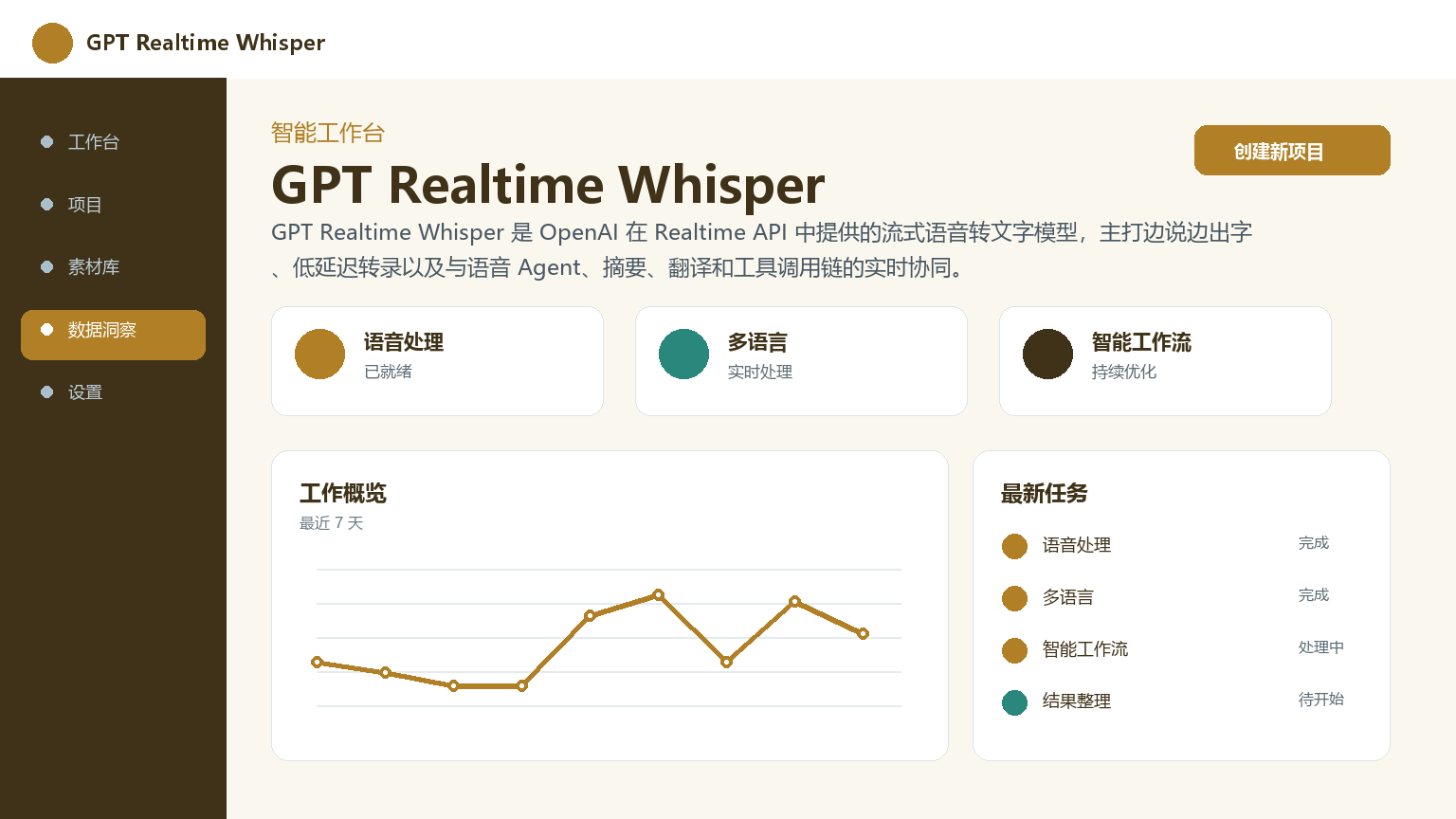
GPT Realtime Whisper is a streaming speech-to-text model provided by OpenAI in the Realtime API. It focuses on producing words while speaking, low-latency transcription, and real-time collaboration with voice agents, summarization, translation, and tool call chains.
GPTRealtimeWhisper
Core parameters and statistics
[Brief comment in one sentence]: It is not as simple as moving Whisper into a real-time scenario, but OpenAI has made "transcription results immediately enter the workflow" a default capability.
[Publicity Verification]: Officially defines it as streaming speech-to-text, emphasizing that people can transcribe when they speak. This promotion is believable because the entire official release is about redesigning the product around real-time voice links, rather than hard-packaging offline transcription into real-time functionality. The core pain point it hits is that traditional speech transcription must be recorded first and then recognized, causing subtitles, notes and subsequent actions to lag behind.
| Projects | Public Information |
|---|---|
| Release date | 2026-05-07 |
| Access location | Realtime API |
| Pricing | $0.017/minute |
| Suitable for links | Real-time subtitles, meeting records, customer service, medical, sales, voice Agent |
| Official capability description | Transcribe while speaking, low latency, and can directly enter business workflow |
| Data & Compliance | Supports EU Data Residency, covered by Enterprise Privacy Pledge |
Expert’s point of view: The real value is not “turning fast”, but “fast enough to directly trigger subsequent actions”. When the transcription results can be sent to summary, quality inspection, translation, to-do extraction and even tool invocation during the session, the positioning of this type of model is no longer ASR, but the entry layer of real-time voice workflow.
User and market recognition
OpenAI has not disclosed the number of independent users of this model, but it has been put into the official release mainline of Realtime API and launched together with GPT-Realtime-2 and GPT-Realtime-Translate, which itself is the strongest product-level endorsement. It’s not some fringe experiment, but one of three models in OpenAI’s real-time speech stack.
User and market recognition: The official release also clearly cited scenarios such as conferences, classes, broadcasts, events, customer service, medical care, sales and recruitment, indicating that its target customer group is not "developer developers", but to cover real high-frequency calls and voice interaction systems.
Publicity Verification: From the perspective of "whether it will replace all professional ASR systems", this proposition is too big; but from the perspective of "whether it can become the default transcription layer for real-time voice applications", it is already very attractive, especially for teams that are already on the OpenAI stack.
Hidden benefits: Companies used to split real-time transcription, summarization, translation and voice agents into multiple sets of services. Now if OpenAI is used originally, at least the integration complexity will be significantly reduced.
Cost advantage
The Free Truth: There is no free tier myth. The official price is US$0.017/minute. This price is very friendly for "real-time subtitles, customer service monitoring, and live transcription", but for long-term archiving scenarios of massive recordings, you still need to carefully calculate the number of minutes and concurrency peaks.
| Cost layer | Disclosure | What it actually means |
|---|---|---|
| C-side/individual | No independent consumer package | More suitable as a developer rather than an independent consumer app |
| Developer/API | $0.017/minute | Attractive for real-time voice products, easy to estimate with budget models |
| Enterprise | Enterprise Privacy Commitment EU Data Residency | Also look at concurrency, logging, retention and compliance policies when purchasing |
Hidden Cost: The real cost is not only in the number of minutes of recognition, but also in microphone quality, noise reduction, echo cancellation, transmission stability and post-processing links. Once the audio source is dirty, even the cheapest model will amplify errors into downstream systems.
Hidden benefits: Compared with the old link of "record first, then transmit and then recognize", it can bring the response rhythm of meeting notes, customer service quality inspection, real-time subtitles and voice agent to the same clock, which will directly shorten the business action delay.
Main functions
- Streaming real-time transcription: Continuously output text while speaking, instead of outputting the entire result after recording.
- Co-stack access with Realtime API: Can work with Realtime speech models, translation capabilities, and tool call chains.
- Continuous long audio recognition: suitable for long-term scenarios such as meetings, classes, live broadcasts, and call centers.
- The transcription results enter the process immediately: you can receive summaries, submit to-dos, perform quality inspection and keyword monitoring in real time.
- Multiple business scenario reuse: The release copy covers conference, customer service, medical, sales, recruitment and other applications.
Expert view: The most hidden synergy of this set of functions is that "transcription" is compressed into an intermediate state rather than an end point. The text it produces does not end after people read it, but is continued to be used by subsequent models and systems.
Model and version evolution
OpenAI's current public version is not a traditional semantic version, but a product milestone advancement, so it is more suitable to be understood in terms of release time and main capability lines.
Release main line
launch-2026-05-07: When the Realtime API new generation speech model was released, GPT Realtime Whisper was officially released, with a very clear positioning, which is low-latency streaming transcription.
Historical context
realtime-transcription-preview: Before the official release, OpenAI’s real-time speech main line has formed a unified direction around transcription, translation, and real-time speech reasoning. Although the detailed version number is not disclosed separately, it can be regarded as a milestone stage before this capability enters official productization.
Current Limitations: The official public page emphasizes capabilities and scenarios rather than detailed changelogs, so stability verification still requires running audio samples of the target scenario to confirm.
Technical advantages
GPT Realtime Whisper belongs to the [Basic Large Model/API Infrastructure] type.
Performance & Throughput: No official TTFT, concurrent cap RPM, or TPM numbers are disclosed; what is disclosed is that it is billed by the minute and is available as a real-time streaming transcription model for the Realtime API. Latency performance is officially regarded as a core selling point, but the specific figures are subject to official real-time documents and account limits.
Mechanics -> Effects -> Scenes:
Real-time streaming decoding: The effect is that subtitles, minutes and voice agents can move while listening without having to wait for the end of the sentence. Suitable for live subtitles, customer service and meeting minutes.
Collaboration with the OpenAI real-time speech stack: The effect is that transcription, translation, reasoning and tool invocation can more easily share a conversation context, which is suitable for cross-language customer service and task-based voice agents.
Enterprise Data and Privacy Commitment: Officially supports the EU Data Residency and incorporates the Enterprise Privacy Commitment, which is suitable for organizations with requirements for data geography and governance.
Adaptation boundary: It is most suitable for spoken workflows that are sensitive to real-time performance; it is not suitable to replace traditional high-volume audio transcription pipelines that pursue extreme offline batch processing costs or ultra-deep post-revisions.
How to use
OpenAI has clarified that the model can be used in the Realtime API and supports WebRTC, WebSocket or SIP related real-time links.
const session = {
  model: "gpt-realtime-whisper",
  modalities: ["audio", "text"]
};Note: The official release page has clarified the model name gpt-realtime-whisper and stated that it can be used in the Realtime API; the specific connection method, event format and session parameters are subject to the current version of the OpenAI Realtime API official document.
Typical access steps:
- Create a Realtime API session and specify the model.
- Continuously upload audio clips using WebRTC or WebSocket.
- Receive incremental text in the front-end or business system.
- Send text immediately to summary, to-do extraction, translation, QA or CRM recording.
Human-machine collaboration boundary: Low-risk scenarios can be highly automated; however, high-risk content such as medical consultation records, legal communications, and important sales commitments must still retain manual confirmation points.
Product Pricing
Public Price: $0.017/minute.
C-side/Individual: There is no separate consumer product pricing, and it is more suitable for embedding development capabilities into applications.
Developer/API: This is the easiest layer to bill, and per-minute billing is very friendly to live subtitles and meeting recordings.
Enterprise: The minute price must be calculated together with concurrency peak value, storage duration, log management, regional compliance, and voice post-processing.
The Free Truth: Cheap minutes do not equate to low total cost of ownership. As long as you connect it to customer service, conferencing and live broadcast systems, the real big head is likely to come from system engineering rather than identification itself.
Application scenarios
- Real-time meeting minutes: Texts can be written while the meeting is in progress, and to-dos and key decisions can be mentioned before the meeting is over.
- Live broadcast and classroom subtitles: Reduce subtitle delay, improve accessibility and real-time understanding experience.
- Customer service call quality inspection: Capture keywords, abnormal emotions and compliance issues in real time, no longer waiting for random inspections afterwards.
- Medical and Sales Records: Convert spoken interactions into structured systems faster.
Dimensionality reduction attack scenario: In scenarios where "the system starts working as soon as the audio comes in", its value is very straightforward.
Current Limitations: If the upstream audio environment is poor, multiple people are busy talking, or the domain terminology is extremely heavy, the real-time link will still have misidentification and correction costs.
Applicable people
- Real-time Voice Product Team: Requires linkage of subtitles, minutes, transcription and follow-up actions.
- Customer service and contact center platform: High requirements for call quality inspection and real-time assistance.
- Conference and Collaboration Product Team: Want to make voice recording and summarization a native capability.
Persuasion Scenario:
- People who only pursue the lowest offline batch transcription cost: The value of the real-time model is not the extreme low price, but low latency.
- Team without audio engineering capabilities: Echo, noise reduction, and device compatibility will directly affect the final effect.
- People who treat transcription results as 100% legal text: Human review must be retained for high-risk scenarios.
Summary and Outlook
The real highlight of GPT Realtime Whisper is to upgrade voice transcription from "organizing data" to "driving real-time business processes." Once the voice content can be recorded, translated, reviewed, and used the moment it is spoken, the product form of real-time transcription will be completely different from the traditional Whisper API.
[Procurement/Adoption Risk Assessment]: If the team has already used the OpenAI ecosystem, it will significantly reduce the assembly cost of real-time voice products; however, it still needs to focus on verifying the accuracy of target industry terminology, regional compliance, concurrency peaks, and downstream workflow fault tolerance before going online. What we should really focus on is not the price per minute, but "whether the entire voice service chain will be faster, more stable, and require less manual repair."
Related tools:  ElevenLabs, udio
Version Info
- GPT Realtime Whisper Launch :OpenAI officially announced the streaming transcription model in "Advancing voice intelligence with new models in the API" and included it in the list of models available in the Realtime API.
- Realtime Transcription Preview Milestone :Before its official release, Realtime API has formed a unified speech stack around speech models, translation and transcription; there is no official precise date yet.
User Reviews