 GPTRadar
GPTRadar is a lightweight AI text detection tool that focuses on identifying text content generated by ChatGPT and provides fast and accurate AI probability scoring.
GPTRAdar
Core parameters and statistics of GPTRadar
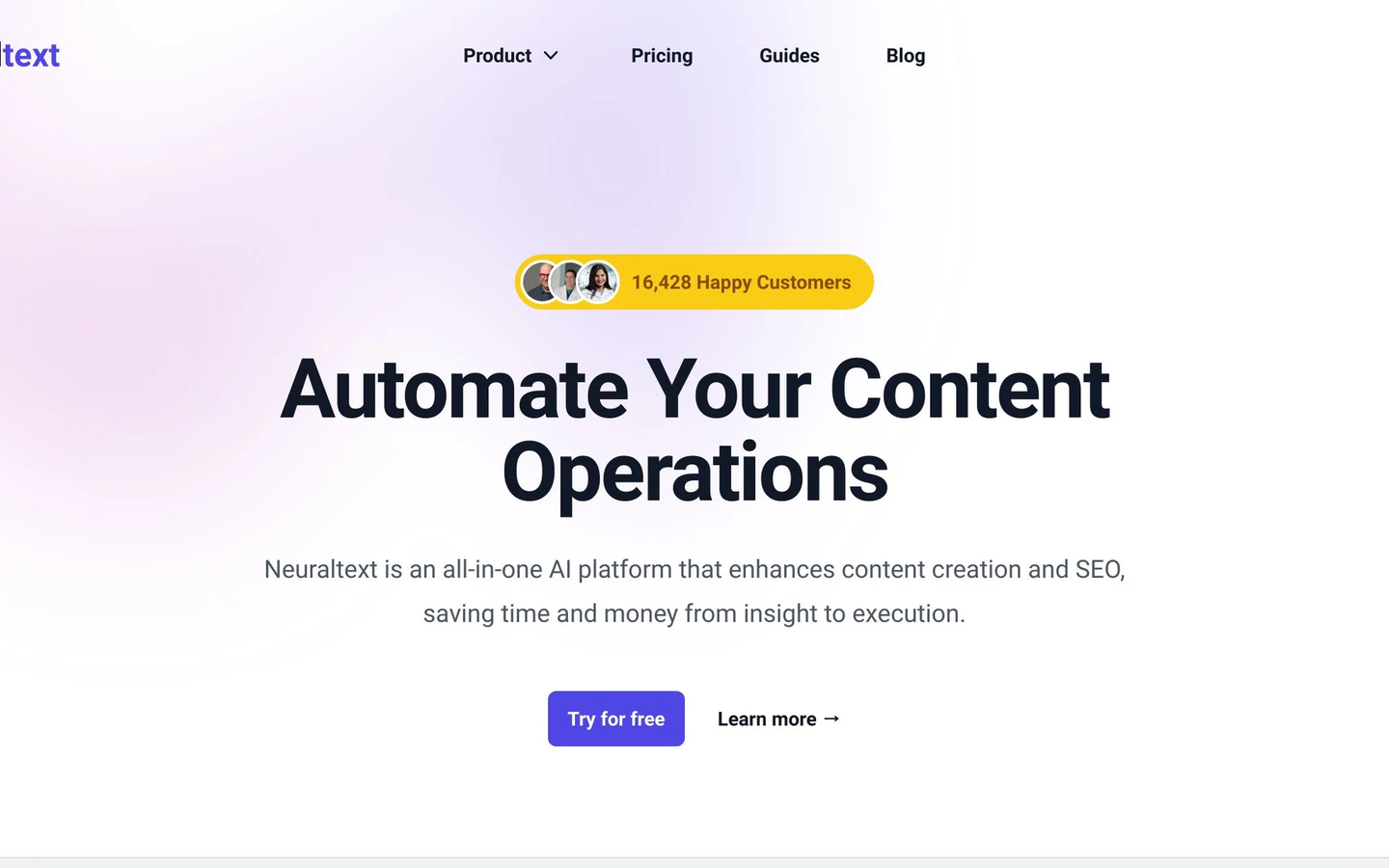
GPTRadar is an AI text detection tool that focuses on the OpenAI GPT series models and is operated by the American company Atmos Media (NeuralText team). Its official website, gptradar.com, now redirects to parent company NeuralText’s content marketing platform, but GPTRAdar remains available as a standalone detection module. The product is positioned as "lightweight, fast, and dedicated" and does not directly compete with multi-model detection tools (such as Originality.ai, Copyleaks) for coverage, but establishes differentiation in the recognition accuracy of GPT-generated text.
| Projects | Public Information |
|---|---|
| Official positioning | ChatGPT dedicated text detection |
| Attribution Company | Atmos Media (NeuralText) |
| Detection model coverage | GPT-3.5, GPT-4, GPT-4o, GPT-4.1 |
| Single detection limit | Maximum 15,000 characters |
| Detection speed | 3-8 seconds/time |
| Detection dimension | Overall AI probability + sentence-by-sentence color annotation |
| Output Format | Percent Rating + Red/Yellow/Green Highlighting |
| Free trial | No registration required, 5 times a day |
| Support platform | Web client |
| Latest version | v2.0 (2026-02) |
Detection capability boundary: GPTRadar does not detect text generated by other mainstream models such as Claude, Gemini, Llama, etc., nor does it support multi-language detection (English only). This focused strategy may make its recognition accuracy on GPT text better than that of general detectors, but it also means that users must use other tools if they need cross-model coverage.
Speed and Throughput: A single detection takes 3-8 seconds, which is the middle level of similar tools. Calculated based on the monthly average of 5,000 tests for the Pro package, the average daily processing time is about 165 times. The single waiting time is acceptable for light audit scenarios, but when processing thousands of texts in batches, the cumulative time-consuming may reach several hours, which is not suitable for real-time large-traffic audit pipelines.
Users and market recognition of GPTRadar
GPTRAdar's market information is highly fragmented. The parent company NeuralText publicly displays more than 16,000 paying customers and lists well-known companies such as eBay, Forbes, Ray-Ban, and Maersk as users of its content platform. However, the user scale and independent reputation of GPTRadar as an independent detection tool have not been officially disclosed.
Brand Attribution and Credibility: NeuralText (Atmos Media) was founded around 2020, focusing on AI content marketing and SEO tools, and has a certain reputation among content creators and SEO practitioners. As a detection component in its product matrix, GPTRadar relies on the parent company's technical foundation and enterprise customer resources, and is superior to purely individual projects in terms of supply chain stability - but this also means that the future iteration rhythm and development route of the tool completely depend on the parent company's product strategy, and there is a risk of being marginalized or merged into other modules.
Industry benchmarking: Compared with Originality.ai (multi-model detection, enterprise-level audit trail) and Copyleaks (cross-language, cross-model, code detection), GPTRadar's functional breadth is significantly narrower, but it may have an advantage in the detection depth of a single GPT series. There is currently a lack of third-party independent evaluation data to verify its claimed detection accuracy. When selecting a model, it is recommended to conduct a small sample comparative test on actual business texts.
Cost Advantages of GPTRadar
GPTRadar's pricing structure is a typical "free trial + subscription tier", with no API or enterprise privatization pricing, and overall coverage of C-side and light B-side scenarios.
C client/individual user: The free package includes 50 tests per month (after registration), and is limited to 5 tests per day if not registered. For individual writers or students who occasionally need to verify whether an article is generated by ChatGPT, the free quota is enough to cover monthly needs. After exceeding the Basic package ($9.99/500 times), the cost per inspection is about $0.02, which is at a low level among similar tools.
Team and Content Team: The Pro package ($29.99/month, 5,000 inspections) reduces the cost per time to approximately $0.006, which is suitable for content review teams with an average of 20-50 inspections per day. The Unlimited package ($99.99/month, unlimited) is suitable for batch review scenarios, but the monthly fee threshold is relatively high - as a pure web tool, the lack of API integration means that all detections need to be manually copied and pasted. In large-scale scenarios, the labor operation cost may exceed the tool subscription fee itself.
Developer/API Layer: GPTRadar does not provide an API interface, which is the most significant gap in its cost structure. For developers and companies that need to embed AI detection into their own systems (such as CMS release processes, work order systems, learning management systems), each detection relies on manual operations, which means that automated review pipelines cannot be realized, and the hidden labor cost is much higher than the subscription fee. Competitors Originality.ai and Copyleaks both offer APIs that cost in the $0.001-$0.005 range per call.
Enterprise/Private Tier: No private deployment options. For educational institutions or financial institutions where data sovereignty is sensitive, all texts must be sent to GPTRAdar’s cloud servers for processing, and data departure and privacy compliance issues need to be assessed individually.
Hidden Cost: As part of NeuralText’s product matrix, GPTRadar’s long-term availability depends on the parent company’s product roadmap. If NeuralText's strategic focus shifts entirely to SEO content generation, GPTRadar may cease to be updated independently - the continuity risk posed by such platform binding is easily underestimated in procurement decisions.
Main functions of GPTRadar
GPTRadar's functional design revolves around the minimalist link of "Detection -> Visualization -> Reporting" without stacking functions:
-
ChatGPT text detection: core capability. Receives text pasted by the user and outputs an AI generated probability score of 0-100%. The detection model covers GPT-3.5 to the latest GPT-4.1, but the official has not disclosed whether its detection engine is based on statistical feature analysis, watermark detection or a classifier model, so it is impossible to evaluate its adaptation lag to new models such as GPT-4.1. Acceptance focus: It is recommended to use 50 copies of known GPT-generated text and 50 copies of manually written text for comparative testing, and record the false positive rate (human text is judged as AI) and the false negative rate (AI text is judged as manual). Both indicators are considered usable if they are lower than 10%.
-
Sentence-by-sentence color annotation: The detection results mark each sentence in three colors: red (high probability AI)/yellow (medium probability)/green (low probability), helping users quickly locate suspected AI-generated fragments in the text. This visual design is more instructive than a single percentage score when it requires paragraph-by-paragraph review (such as editor review, teacher correction of assignments). Implementation Tip: The color threshold is defined internally by the tool, and users cannot customize the sensitivity. Therefore, for scenarios that require extremely low false negative rates (such as academic integrity review), even sentences marked green cannot be fully trusted.
-
One-click copy report: After the detection is completed, the complete report including AI probability and color marking can be copied with one click, making it easy to paste into emails, documents or review forms. This feature reduces the hassle of screenshots and manual notes in the multi-person collaborative review process.
-
Detection History: After registering an account, you can view past detection records, and support search based on text content and filtering by date. For content teams who need to review audit records periodically, the history feature provides a basic audit trail. Limitations: Only supports web viewing, no CSV/PDF export function, and limited portability of audit data.
-
Trial without registration: The test can be completed without registration, which lowers the threshold for occasional users (such as students checking the AI content of their homework). However, the unregistered status is limited to 5 times per day, and historical records cannot be saved.
GPTRadar model and version evolution
Continuous iterative updates, the latest version introduces performance optimization and new features. Historical version information can be viewed through the official release page. There is currently no complete public version evolution timeline.
Technical advantages of GPTRadar
GPTRadar's technical route is oriented toward "lightweight and practical" and does not pursue the ultimate upper limit of detection performance.
The focus bonus of the detection engine: Compared with general detectors that need to adapt to more than a dozen AI models at the same time, GPTRadar only needs to optimize the recognition of the OpenAI GPT series. The potential advantage of this "single category deep mining" strategy is that it can perform more refined feature extraction of feature patterns (such as token distribution, syntactic redundancy, logical consistency deviation) of GPT text under limited model size and computing resources. The price is that each OpenAI model update (such as the fine-tuning strategy change of GPT-4.1) may require simultaneous adjustments to the detection feature set.
Minimalist interaction architecture: The product does not have complicated dashboards, team management or workflow configurations. The core operations for users only have three steps: "Paste -> Detection -> View results". This minimalist design reduces the learning cost for non-technical users, but it also means a lack of advanced configuration options - no sensitivity thresholds can be set, no detection whitelists can be defined, and no webhooks can be linked with third-party systems.
Insufficient observability of engineering implementation: The official has not disclosed the specific technical details of the detection engine—whether it is based on n-gram statistical feature perplexity scoring, watermark detection, or based on fine-tuned classifiers. The inability to know its detection logic leaves users with a lack of understanding of model behavior when evaluating results. For example, if the detection engine relies heavily on the perplexity feature of the text, then manually polished GPT text, highly professional technical documents (the language pattern itself is close to the canonical output generated by AI) may produce a high false positive rate.
Technical impact of no API: This is the most obvious technical shortcoming. The lack of API means that GPTRadar cannot be embedded in an automated pipeline, and each detection requires a human operation in the browser. For organizations that need to scale, automate content moderation, this is not a technology option but a labor cost decision.
How to use GPTRadar
GPTRadar only provides a web portal and has no mobile applications, browser plug-ins or API interfaces. The usage is extremely straightforward.
Operating steps:
- Visit https://gptradar.com/ (currently redirected to neuraltext.com, but the GPTRadar detection module can be used directly in the corresponding page).
- Paste the text to be detected (within 15,000 characters) in the text input box.
- Click the Detect button and wait 3-8 seconds to view the AI probability score.
- View the sentence-by-sentence color annotation results and identify passages with high AI probability.
- Copy the complete report with one click when needed.
Entrance Description:
| Usage | Entry | Prerequisites | Daily Limits |
|---|---|---|---|
| No registration required | Direct detection of Web pages | None | 5 times/day |
| Register a free account | Use after creating an account | Email registration | 50 times/month |
| Paid Subscription | Upgrade to Basic/Pro/Unlimited | Paid Account | By Plan |
Usage Suggestions: For high-frequency users, it is recommended to register an account to obtain 50 free quotas per month and a small historical record function. For team scenarios, the Pro package (5,000 times/month) can be used by shared accounts among multiple members, but it lacks independent sub-account management and permission control - this means that all detection history is visible to all logins, and data isolation issues need to be paid attention to when using it with multiple members.
Product Pricing for GPTRadar
GPTRadar’s pricing structure is simple and straightforward: free for personal version + three levels of paid subscription, no API or enterprise customization plans.
| Package | Number of monthly tests | Monthly fee (USD) | Single cost | Suitable scenarios |
|---|---|---|---|---|
| Free | 50 times/month | $0 | — | Personal incident detection |
| Basic | 500 times/month | $9.99 | ~$0.020 | Freelance writer/blogger |
| Pro | 5,000 times/month | $29.99 | ~$0.006 | Content Team/Moderation Team |
| Unlimited | $99.99 | Fixed | Enterprise volume use |
Free version details: Limit of 5 tests per day without registration; after registration, you will get 50 free tests per month. The free quota is reset monthly and cannot be accumulated. For individual users who check 3-5 articles per week, the free quota is basically enough.
Cost-performance analysis of paid version: The Basic package ($9.99) costs about 2 cents per time. For individual users whose monthly testing volume is less than 500 times, the cost-effectiveness is reasonable. The Pro plan ($29.99) drops the cost per purchase to 0.6 cents, making it the dessert price point for team scenarios. The Unlimited plan ($99.99) is suitable for high-frequency users with more than 5,000 tests per month, but given the lack of API integration, the efficiency bottleneck of high-volume manual operations may discount the actual value of unlimited tests.
No API Pricing: GPTRAdar does not provide an API, so there is no token billing or call frequency control. This is a simplification for purely manual usage scenarios that do not involve system integration, but is a hard limit for any workflow that requires automation.
Application scenarios of GPTRadar
GPTRadar's "single detection + low threshold" feature determines that its application scenarios focus on three directions: manual review, scattered verification and educational preliminary screening:
-
Content Quality Review: Reviewers of social media platforms, content farms, and UGC sites use GPTRadar to quickly determine whether user-submitted content is ChatGPT batch-generated. A single detection takes 3-8 seconds, which is 3-5 times faster than manual reading and judgment. Cost reduction and efficiency increase: Assuming that one reviewer processes 100 pieces of content per day, using GPTRadar can compress the review time of each article from 3-5 minutes (manual reading judgment) to 10-15 seconds (paste + view results), and the daily processing volume can be increased to 300-400 articles. Human-machine collaboration boundary: AI detection results are only used as screening signals - content marked with high AI probability enters the manual review queue, low-probability content passes directly, and medium-probability content is sampled for review. The tool should not be used as a "one size fits all" judgment strategy, and it is recommended to set up manual confirmation points to handle dispute cases.
-
SEO and Outsourced Copy Quality Control: SEO consultants and content managers use GPTRadar to assess whether copy delivered by outsourced vendors relies too much on AI generation. Search engines have increasingly strict ranking policies for purely AI-generated content. Screening out content with high AI probability in advance can reduce the risk of search de-emphasis. Application Tip: It is recommended to use it in conjunction with human polish quality assessment - a piece of AI-assisted text that has been fully human-edited may still show a high AI probability in detection, but the content quality may not be up to standard, so the detection score should not be used as the only acceptance criterion, but as a signal that "additional attention is needed".
-
Education Academic Preliminary Screening: Faculty and academic integrity committees use GPTRAdar as a preliminary screening tool for the AI content of student work. Key Limitation: Educational settings have a very low tolerance for false positives - a single false positive can trigger unnecessary controversy over academic integrity. Therefore, GPTRadar is only suitable as the "first screen" in such scenarios. For assignments marked with high probability, manual comparison of writing styles and version history of the writing process are required, rather than making penalty decisions directly based on the detection results. Cost reduction and efficiency improvement: A teacher corrects 50 assignments every week. Using the tool for preliminary screening can reduce the proportion that needs focus from 100% to 10-15%, saving about 70% of manual inspection time.
-
Freelance writer self-check: Freelance writers use GPTRadar to self-check whether their copywriting contains paragraphs that are too "AI-flavored" before delivery, and proactively adjust before submitting to the client. This is a low-frequency, low-cost personal use scenario, which can be covered by the free package.
Applicable groups of GPTRadar
The functional grayscale of GPTRadar determines that it is not a "universal detector". The following three types of roles can get the most value from it:
-
Content Moderators and Community Moderators: Moderators who need to quickly determine whether large amounts of user-generated content contain AI content. GPTRadar's 3-8 second detection speed and sentence-by-sentence annotation capabilities directly match its workflow. Unsuitable Boundary: If the audit volume exceeds an average of 150 times per day and there are real-time requirements (such as immediate interception before content is published), the lack of API makes it impossible to embed the audit pipeline, and alternatives such as Originality.ai that provide APIs should be considered.
-
SEO Practitioners and Content Managers: Teams responsible for managing outsourced content supply chains need to evaluate AI content from the dimension of delivery quality. The Basic or Pro plans are cost-effective and suitable for teams with monthly inspection volumes in the 500-5,000 range. Unfit boundary: If the team needs to detect text of non-GPT models such as Claude/Gemini, or needs cross-language detection (such as Chinese, Japanese, Arabic), GPTRadar currently does not support these scenarios.
-
Educators: Teachers and academic administrators who need to initially screen student work for AI content. The free package can meet low-frequency usage needs. Unsuitable Boundary: Educational scenarios have requirements for the authority and legal traceability of test results - GPTRadar does not provide audit certificates or blockchain storage of test results, so it is not suitable as a formal basis for academic misconduct determination. At the same time, data privacy policies (text content uploaded to US servers) may trigger data export compliance reviews in educational institutions in some countries.
-
Unsuitable people: Development teams who need API integration, users who need cross-model detection (Claude/Gemini/Llama), users who need Chinese or other non-English text detection, compliance-sensitive enterprises that need privatized deployment, high-frequency audit scenarios that require batch processing (more than a thousand times per day). In these scenarios, the functional boundaries of GPTRadar will become efficiency bottlenecks or compliance risks.
Summary and Outlook
GPTRadar's core competitiveness lies in the "minimalist ChatGPT detection experience" - it does not try to be a universal AI detection platform, but to achieve the shortest process and the fastest start-up in the narrow gap of GPT series text recognition. For individual writers, content reviewers, or teachers who check dozens of articles every week, it is a sufficient and extremely low-cost aid.
Current main limitations: Narrow model coverage (only GPT series), no API interface, no multi-language support, no private deployment, and opaque detection technical details. The strategic focus of the parent company NeuralText may shift towards AI content generation, and GPTRAdar’s independent iteration power as a detection tool is questionable.
Follow-up observation points: Whether the API interface is opened to meet the needs of automated integration; whether it is expanded to multi-model detection such as Claude/Gemini/Llama; whether a browser plug-in is launched to achieve a convenient experience of "right-click detection on the page"; whether the parent company continues to release version updates to follow up on OpenAI's new models; whether it increases the credibility of detection results (such as reporting hash certificates).
Procurement and Adoption Risk Assessment: For individual users, the free package can meet light usage needs and there is no real risk. For teams and enterprises, it is recommended to position GPTRadar as an auxiliary preliminary screening tool rather than the only basis for judgment: before purchasing, use 100-200 known source texts (50% AI generated and 50% manually written) to test the false positive rate and false negative rate to confirm that the detection accuracy meets business requirements. If your business requires API integration, multi-model detection or data privatization, GPTRadar is currently not a suitable option. It is recommended to evaluate Originality.ai (providing API and enterprise-level auditing), Copyleaks (multi-model + multi-language + code detection) or open source solutions (such as GPTZero's API). In the scenario of academic integrity, it must be made clear at the institutional policy level that the detection tool is only a "preliminary screening signal" and not a "basis for punishment" to avoid legal risks.
Related tools:  originality.AI,
  GPTZero
How to use GPTRadar
- Web client: You can use it by visiting the official website and registering an account. Most functions do not require installation.
- API access: Provides RESTful API, developers can obtain the API Key and integrate it into their own applications.
Version Info
- GPTRadar v2 :Upgrade the detection engine, add GPT-4o and GPT-4.1 recognition capabilities, and optimize detection speed.
- GPTRadar v1 :The first version is online, supporting GPT-3.5/GPT-4 basic detection.
User Reviews