 GradGPT
Free
GradGPT
Free
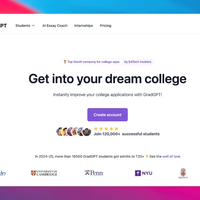
GradGPT is an AI-driven university application essay review and admission strategy platform that provides applicants with full-link support from essay feedback, school selection matching to admission profiling. By fine-tuning the large language model for admissions review scenarios, GradGPT can provide feedback on structure, content, and grammar from the perspective of admissions officers within minutes, helping users iterate on high-quality application materials. The platform has served 120,000+ students, and more than 16,500 users were admitted to T20 or above universities in the 2024-25 application season.

GradGPT
Core parameters and statistics of GradGPT
GradGPT is an AI-driven full-stack university application platform. Its core value lies in fine-tuning the large language model for the American university admissions review scenario, providing applicants with one-stop AI assistance from document review, school selection matching to admission profiling. According to the tool type classification (§3.3), GradGPT belongs to [Productivity/Business-side Application] - an end-to-end application assistance platform for C-end students, but its bottom layer relies on the reasoning and text analysis capabilities of large language models, and is indirectly related to the API infrastructure layer on the technical side.
| Projects | Public Information |
|---|---|
| Product Positioning | AI-driven University Application Document Review and Admission Strategy Platform |
| Core Competencies | Document AI feedback, school selection matching, admission portraits, application dashboard |
| Product Form | Web Application (SaaS) |
| Business Model | Freemium Subscription (Free / Plus Monthly / Plus Yearly) |
| Place of Belonging | US (Germany, where the company is registered) |
| Supported languages | English (the document language is mainly English) |
| Supported platforms | Web browsers |
| User scale | 120,000+ registered students |
| Admission results | 16,500+ users were admitted to T20+ universities in the 2024-25 application season |
| Team background | Co-founded by former Google and Microsoft Research engineers |
| Community Channel | Discord Community Blog |
| Latest major update | 2025-06-04 "The greatest AI college essay reviewer" |
| Free plan | Yes (limited trial) |
| Paid starting price | $12/month ($144 annually) |
Brief review in one sentence: GradGPT is not a general AI writing assistant, but an "AI review center designed specifically for college application scenarios" - from document feedback to admission data analysis, it attempts to use AI to simulate the review logic of the admissions committee, compressing the traditional process that requires 24-48 hours of consultant feedback into a few minutes.
User volume: The official website shows that 120,000+ students use it. In the 2024-25 application season, more than 16,500 users have been admitted to T20 (top 20) and above universities, covering top universities such as Harvard, Stanford, Yale, MIT, etc., which has verified the actual effectiveness of the platform in helping application materials.
Iteration Frequency: Since its launch in April 2023, there has been an average of functional-level updates every 1-2 months. It has gradually expanded from the initial SOP writing tool to a complete ecosystem including document editing, recommendation letters, admission portraits, and school selection matching.
Users and market recognition of GradGPT
GradGPT has established a high degree of user trust in the university application vertical field, and its recognition is mainly reflected through user reputation, community diffusion and industry media exposure.
User reputation and achievement verification: The official website displays reviews from many real admitted students, including feedback from users who have been admitted to prestigious schools such as Harvard, Stanford, Yale, Duke, UCLA, and Johns Hopkins. Several students mentioned that "GradGPT is a lifesaver when you cannot afford expensive consultants." One school counselor (Kelly W.) stated that after checking the quality of AI feedback on multiple essays, all students were asked to apply using GradGPT. An anonymous admissions dean commented: "AI-generated essays are a minefield, but using AI to get feedback? I'm all for it."
Industry Recognition:
- EdTech Insiders ranks GradGPT as "Top GenAI company for college apps"
- Selected in SaaSHub The Ultimate SaaS Database
- Get organic discussion and spread in the r/collegeresults community on Hacker News and Reddit
- Included in Futurepedia, Arktan, GenAI Map and other AI tool directories
- Entered the "Top 10 fastest growing SaaS tech" list
Community Ecology: GradGPT operates an active Discord community (discord.gg/ErCjpWEtTH), where users can exchange application experiences and obtain usage assistance. The Blog channel provides a large number of line-by-line scoring interpretations of supplementary documents for specific universities (such as Stony Brook, Haverford, Reed, etc.). These contents are not only SEO traffic entrances, but also channels for users to obtain free value.
Comparison with traditional consultants: College Essay Guy, Admit Hero and other track services on the market are mainly manual consultants, with a single consultation fee of $100-500/hour. Although GradGPT's AI solution cannot completely replace senior consultants' school selection strategies and interview coaching, its differentiated value of "instant feedback" has been clearly recognized by applicants - traditional consultant feedback takes 24-48 hours, while GradGPT only takes a few minutes and has no limit on the number of iterations (paid version).
Cost Advantages of GradGPT
Three-tier cost structure
GradGPT adopts Freemium tiered pricing, covering the complete path from free experience to in-depth use. The following is a breakdown of its true cost structure from the three dimensions of C-side individuals, developers and enterprises.
C client/individual users:
| Plan | Price | Core Rights | Applicable Stage |
|---|---|---|---|
| Free (free) | $0 | AI Counselor, Application Guide (limited trial) | Initial experience, single document trial |
| Plus annual payment | $12/month ($144/year) | All features: essay editor, school search, recommendation letter builder, essay topic coach, admissions portrait, school matching test | High-frequency use, multi-school application season |
| Plus monthly payment | $24/month (original price $35) | Same as above, flexible monthly subscription | Short-term sprint, temporary expansion required |
The truth about free: The free plan provides a limited trial amount, which is enough for users to upload 1-2 documents to experience the quality of AI feedback and determine whether it meets their needs before deciding whether to pay. The real value of the paid version lies in "unlimited iterations" - an essay may require 5-10 rounds of revisions during the application season, and the free quota is quickly exhausted.
Price to Value: Based on an annual payment of $12/month, the total cost for one application season (approximately 4-6 months) is $48-72. Compared to traditional application consultants who charge $100-500/hour for a single essay review or $3,000-10,000 for a full set of application coaching, GradGPT’s cost is only 1-5% of the former. Even compared with similar AI tools (such as Grammarly Premium, about $12/month, ChatGPT Plus, $20/month), GradGPT’s vertical scene focus gives it a higher input-output ratio in the application document scenario.
Fair Access Program: GradGPT provides free access to eligible students – including students receiving free or reduced-price school meals, students with Common App/SAT/ACT fee waivers, state wards, and students attending Title I schools. Qualified users can apply through [email protected], which to a certain extent alleviates the problem of resource inequality in application consultation.
API/Developer: Unexposed standalone API. GradGPT is currently positioned as a pure C-side product and does not provide API access or model fine-tuning services to developers.
Corporate/Privatization: Undisclosed corporate proposal. GradGPT does not offer volume licensing or private deployment for schools or educational institutions.
Hidden Costs:
- Learning Curve: The quality of AI feedback is highly dependent on the language clarity of the document. The Chinese expressions of non-native English speakers may affect the accuracy of AI’s understanding, requiring users to add human judgment based on AI feedback.
- Risk of over-reliance: If modifications are made in full compliance with AI recommendations, it may lead to document convergence and loss of personal characteristics. Admissions officers have publicly stated that "similar content generated by AI will be directly rejected."
- Data Privacy: Document content uploaded by users is stored on the GradGPT server. Although there is an official AI Policy and Privacy Policy, the data sovereignty of sensitive personal documents requires users to evaluate themselves.
Main functions of GradGPT
The functional system of GradGPT is designed around "full-process AI assistance from application preparation to material submission". The core functional modules are as follows:
- AI Document Review Engine: This is the core capability of GradGPT. After the user pastes the application document, AI provides line-by-line feedback on structure, content, and grammar from the perspective of admission officer assessment. The system identifies thematic consistency, holes in narrative structure, intensity of emotional expression and "red flags." Applicable tasks: rapid review and multiple rounds of iteration of the first draft of the document. The official claims that feedback can be returned within seconds, unlimited times (paid version).
- Admit Profiles: AI is based on tens of thousands of real admission data from the Reddit r/collegeresults section, and matches the admission results of students with similar backgrounds based on the user's GPA, SAT/ACT, extracurricular activities, professional intentions and other dimensions. Users can see which schools applicants with similar conditions to themselves were admitted/rejected. Applicable tasks: Formulation and adjustment of school selection lists to avoid blind impact or over-conservatism.
- College Match Quiz: Assess students' preferences for university size, location, academic atmosphere, cost, etc. through interactive Q&A, and recommend matching colleges with the best ROI from 46,146+ US programs. You can also have a real-time conversation with the AI Advisor on the left side. Applicable tasks: Narrow the scope of school selection and discover suitable colleges that have not been considered before.
- Letter of Recommendation Builder: Helps students and recommenders complete letters of recommendation in a structured way. Provides writing framework, key material tips and content optimization suggestions. Applicable tasks: Reduce the recommender's writing burden and ensure that the recommendation letter covers the core highlights.
- Common Data Set Query: Use Common Data Set data to view objective enrollment statistics such as admission rates, standardized score median GPA distribution and other universities. Applicable tasks: Data-driven school selection decisions, verifying the rationality of the school selection list.
- Application Dashboard: Centrally manage the application progress, deadlines, and materials lists of multiple universities, and submit
for a global view. Applicable tasks: Project management of multi-school applications to prevent missing critical deadlines.
[Expert perspective - synergy between functions]: The real value of GradGPT does not lie in how powerful a single function is, but in the data relationship between functions. Typical high-value links are: users narrow down the scope of target colleges through school selection matching test → verify their competitiveness in admission portraits → use AI document review engine to iteratively polish documents → confirm the hard threshold of target colleges through Common Data Set → application dashboard to unified manage the delivery rhythm. The core benefit of this partnership is the upgrade from "application by feeling" to "data + AI dual-driven application strategy". This is also a differentiated competitiveness that traditional consultants cannot replicate on a large scale.
GradGPT model and version evolution
Since its launch in April 2023, GradGPT has evolved from a single tool to a full-stack platform. The following lists the key version nodes in reverse chronological order:
2025
- "The greatest AI college essay reviewer" (2025-06-04): The largest AI review engine upgrade to date. It is speculated that the underlying model has been more in-depth fine-tuned for the university document review scenario, the scoring report dimensions are more refined, and sentence-by-sentence level feedback is supported.
- "Stuck wondering what to write," (2025-03-04): Launched Essay Topic Coach to help users get writing directions and topic suggestions at the stage of "stuck wondering what to write".
- "What are my chances of admission," (2025-01-24): The AI admission probability prediction function is online, which estimates the likelihood of admission based on user portraits and school historical data.
2024
- "Line-by-line essay coaching" (2024-10-08): Launches line-by-line essay coaching, conducts independent AI review of each sentence, marks structural issues, expression optimization and content suggestions.
- "Protecting Mental Health" (2024-10-01): A new mental health resource section is added to focus on the psychological pressure of students during the application season.
- "Common data set" (2024-09-16): Connect to Common Data Set to provide transparent query of each university's enrollment data.
- "Most advanced AI essay editor & coach" (2024-04-24): Comprehensively upgrade the AI essay editor, introducing richer review dimensions and interactive experience.
- "Common app essay builder" (2024-04-15): Supports writing the main Common App essay directly within the platform, instead of just uploading it for review.
- "Find similar student profiles" (2024-03-13): The admission profiling function is online, and the admission results of applicants with similar backgrounds are matched through Reddit admission data.
- "AI Counselor" (2024-02-20): AI counselor function, providing personalized application suggestions and strategic guidance.
- "Fresh new dashboard"(2024-01-31): The main interface has been completely revised to improve the application management experience.
2023
- "Building an AI copilot" (2023-09-01): Product positioning shifted from "clerical tool" to "AI copilot" and began to build full-process capabilities.
- "1500 monthly users and growing fast"(2023-05-15): The number of monthly active users reaches 1,500, indicating that the product has received preliminary approval in the early verification stage.
- "Commonapp essay prompt guides"(2023-05-02): Common App essay question guides are online to help students understand the requirements of each question.
- "AI SOP writer" (2023-04-16): The initial core function-AI personal statement writing tool is online.
- "Letter of Recommendation writer" (2023-04-12): The recommendation letter writing tool is launched simultaneously.
Version review
GradGPT's version evolution presents two clear main lines: one is the continuous deepening of AI review capabilities (from simple grammar checking to line-by-line tutoring to admission probability prediction), and the other is the ecological expansion from a single document tool to a full-stack application platform (school selection, recommendation letters, dashboards, data sets). As of July 2026, the official website has not yet disclosed specific large model version information (such as whether it is based on GPT-4 or a self-developed model), but judging from product iterations, its AI capabilities continue to be optimized in terms of training data accumulation and review granularity in vertical scenarios.
Technical advantages of GradGPT
The technical value of GradGPT does not lie in the universal capabilities of the underlying model, but in the product engineering capabilities of "deep coupling of universal large model capabilities with admissions review scenarios."
Scenario fine-tuning vs. general model: The LLM used by GradGPT is specifically fine-tuned for the college application essay scenario. Compared with general models such as ChatGPT and Claude, GradGPT's AI review logic is closer to the admissions officer's evaluation framework - it focuses not only on "whether the grammar is correct" and "whether the expression is beautiful", but "how many points this essay can score in the admissions committee's review scale." The "internal college rubrics" mentioned on the official website implies that its AI has an internal scoring system for the admission standards of different colleges.
Multi-dimensional review mechanism: AI review covers multiple dimensions such as structural integrity, theme consistency, narrative fluency, emotional appeal, uniqueness of content, and language standardization, rather than simple grammatical error correction. Judging from the screenshot of the scoring report displayed on the official website, the system will generate a radar chart similar to "Essay Score" and compare it horizontally with the essay scores of admitted students such as Harvard, Yale, and Stanford.
Continuous feedback of admission data: The Admit Profiles function continuously crawls and organizes real admission data from the Reddit r/collegeresults community. This data is fed back into the AI recommendation and evaluation logic - the user's school selection matching and admission probability prediction will continue to be optimized as the data set expands, forming a data flywheel.
Architecture link (deduction): User front-end (Web browser) → GradGPT API Gateway → LLM inference service (fine-tuned review model) → Multi-dimensional scorer (structure/content/grammar/sentiment) → Comparison database (admission portrait + Common Data Set) → Score report generation → Front-end rendering. The admission profiling module relies on offline data processing pipelines to be regularly updated from public data sources such as Reddit.
Performance benchmark (subject to official real-time performance): The official has not disclosed specific technical indicators, but it is deduced from the user experience: a complete review of a single document (500-650 words) is usually returned within 5-30 seconds; in continuous use scenarios with multiple rounds of iterations, the system can maintain a stable response speed. The unlimited number of times in the paid version means that the backend has sufficient inference capacity.
Technical differences with competing products:
| Comparative Dimensions | GradGPT | ChatGPT | Grammarly | College Essay Guy |
|---|---|---|---|---|
| Review perspective | Admissions officer review scale | General writing advice | Grammar and style | Human consultant experience |
| Review granularity | Line by line + global scoring | Paragraph level | Sentence level grammar | Full text discussion |
| Admission data association | Yes (portrait + data set) | None | None | Experience-driven |
| Feedback speed | seconds | seconds | real time | 24-48 hours |
| Vertical fine-tuning | Yes (application essay) | No | No (but with academic mode) | N/A (manual) |
| Price | $0-$24/month | $0-$20/month | $12/month | $100-500/hour |
How to use GradGPT
The usage path of GradGPT is very simple, completely based on the web browser and does not require the installation of any software.
Step 1: Visit the official website and register. Open https://gradgpt.com and click "Create account" or "Sign in" on the homepage. Email registration is supported and the registration process takes about 1-2 minutes.
Step 2: Upload or write the document. Enter the Essay Coach page (college-essay-editor), select the essay topic of the target university (such as "Why do you want to study at Stanford,"), and paste or write the essay content directly in the editor. The editor supports real-time word count statistics and will give a prompt when the word count is close to the upper limit.
Step Three: Get an AI Review. Click the "Review essay" button and the AI will return the review report within seconds. The report includes:
- Overall Rating: Percentage or rating system, compared with similar applicants
- Line-by-Line Feedback: independent review of each sentence, marking suggestions for improvement
- Structural Analysis: Evaluate whether the story line, beginning, and ending of the document are effective
- Content Review: Identify "red flags" (e.g. clichés, lack of specificity)
- Benchmarking data: Compare the quality of documents with those of admitted students
Step 4: Iterative modification. Optimize the document content based on AI feedback and resubmit it for review. Users of the paid version can make unlimited iterations, and it is recommended to complete 3-5 rounds of revisions on a document to achieve higher quality.
Step 5: Use accessibility features. During the application process, use other modules such as College Match Quiz, Admit Profiles, and Common Data Set as needed to assist in formulating and optimizing application strategies.
Recommended usage process: 2-3 months before the start of the application season, use College Match Quiz and Admit Profiles to make a preliminary school selection list → Complete the first draft of the main essay 1-2 months in advance → Use AI review for at least 5 rounds of iterations → Write supplementary essays for each target school → Conduct a final AI review before submission → If possible, ask a human consultant or teacher to do the final check. This process can shorten the document preparation cycle from the "weeks" level of the traditional consultant model to the "days" level.
Product Pricing for GradGPT
GradGPT uses a clear Freemium subscription model with a simple and transparent pricing structure.
| Plan | Price | Billing Cycle | Core Limitations/Benefits |
|---|---|---|---|
| Free (free) | $0 | Free forever | Limited trial: basic functions of AI Counselor and application guide; there is a limit on the number of document reviews |
| Plus Annual | $144 | Yearly ($12/month) | Unlimited all features: Essay Editor, College Search, LOR Builder, Admit Profiles, Match Quiz, Topic Coach |
| Plus monthly payment | $24 | Monthly | Same as above, flexible monthly subscription (original price $35, discount shown) |
Fair Access Policy: Students who meet low-income conditions (free/reduced-price meals Common App/SAT/ACT fee exemption Title I schools, etc.) can apply for free access through [email protected], indicating that the team has a clear value orientation in educational equity.
Refund Policy: The official FAQ mentions a refund/cancellation policy ("Is there a cancellation / refund policy,") with specific terms.
Hidden Cost Tip: Although the annual payment of Plus is equivalent to $12/month, it seems cheap, but please note: ① The annual payment requires a one-time payment of $144, which is an expense that needs to be planned for students with tight budgets; ② It is recommended to use the free plan to test whether the quality of AI feedback meets your own needs before deciding to pay; ③ After the new functions are launched, whether some advanced functions will be classified into higher price tiers shall be subject to official real-time announcements.
Application scenarios of GradGPT
The core application scenarios of GradGPT revolve around the full link of American university applications. The following three typical scenarios illustrate its actual implementation value.
Scenario 1: AI review and iteration of Common App main document
This is the most frequently used scenario for GradGPT. After students complete the first draft of the main essay, they upload it to the platform to obtain AI feedback from the admissions officer's perspective. Under the traditional model, students need to send their essays to an advisor or teacher, wait 24-48 hours for feedback, and are limited by the advisor's time, usually only allowing 1-2 rounds of revisions. GradGPT compresses this process to instant response and unlimited iteration, allowing students to independently revise their documents in the evenings or weekends.
Quantification of cost reduction and efficiency improvement (deduction): Taking a 650-word Common App main document as an example, the traditional consulting model requires an average of 4-6 days to complete 2 rounds of revisions (each communication + waiting 24-48 hours), and students actually invest about 8-10 hours of work. After using GradGPT, the first round of feedback can be obtained within 5 minutes, 5-8 rounds of iterations can be completed within 2-3 days, students actually put in about 4-6 hours of work, and the compression ratio is about 50-60%. More importantly, AI eliminates the time loss of "waiting for a response from the consultant", allowing document revisions to be fully synchronized with the student's schedule.
Scenario 2: Batch processing of supplemental essays
During application season, students typically write 1-3 supplemental essays for each of their target colleges. For example, if you apply to 10 universities, you may need to write 15-25 supplementary essays, each ranging from 150-400 words. GradGPT's AI review engine can quickly process batches of documents, helping students maintain quality consistency across multiple documents and avoid careless mistakes caused by fatigue. GradGPT Blog also provides a line-by-line scoring interpretation of each university's supplementary essays, which is both a writing reference and a quality benchmark.
Human-machine collaboration boundary:
- 100% automatable: grammar check, word count control, structural integrity verification, theme consistency check, basic red flag detection
- Manual confirmation required: The authenticity of the personal story of the document, the authenticity of the emotional expression, the accuracy of the cultural background details, and the matching between the AI suggestions and the student's personal style
- Strong labor management: final decision-making on school selection strategy, interview preparation, communication with admissions officers, and comprehensive judgment before final submission
Scenario 3: Data-driven optimization of school selection strategies
Many students and parents face information asymmetry when choosing schools - they don't know where their competitiveness lies, and they don't know which schools are "matching schools" and which are "sprint schools." GradGPT’s College Match Quiz and Admit Profiles modules help users make more rational school selection decisions through data analysis. Admit Profiles is based on real admissions data from Reddit r/collegeresults. Users can see which schools have admitted/rejected applicants with similar conditions (GPA, standardization, major, background). This is more valuable than simply looking at the median admission rate on the university's official website.
Applicable groups of GradGPT
GradGPT is not for all writers, and its value can only be maximized for specific groups of people and usage scenarios.
Applicable people:
- US undergraduate applicants (especially Common App users): GradGPT’s core audience. The AI review engine is specially optimized for the review logic of the American University Common App and supplementary documents, and is of greatest value to this group. Specifically, they include: high school students who need to frequently iterate their documents, transfer applicants, and users who apply to multiple universities at the same time and need to review them in batches.
- Students with limited budget who cannot afford traditional consultants: While traditional application consultants cost $3,000-10,000 for full services, GradGPT pays only $144 per year, making it a viable alternative for these students. The Fair Access Plan further lowers access barriers for low-income households.
- International applicants (especially non-native English speakers): GradGPT can help international students identify language expression problems and cultural context deviations in their essays, and reduce scoring disadvantages caused by language differences. Many internationally admitted students (such as Bahar from Turkey who was admitted to Yale) mentioned in their reviews that GradGPT made up for their lack of local application guidance resources.
- School Counselor (Counselor): The official website shows the evaluation of a counselor-after verifying the quality of AI feedback on multiple instruments, she asked all students to use GradGPT. For high schools with limited resources, GradGPT can serve as a job aid for counselors to help reach the needs of more students.
Does not fit boundaries:
- Users who do not need an in-depth one-on-one school selection strategy: GradGPT cannot replace the personalized school selection strategy, interview guidance and overall application planning of senior consultants. If the user's core need is "someone to help me keep an eye on the overall situation", traditional consultants are still a better choice.
- University application scenarios in non-English-speaking countries: GradGPT is currently only optimized for US university application scenarios. The degree of support for application systems in other countries (such as British UCAS, Canadian OUAC, and Australia) has not been disclosed, and it is not recommended to be used as the main tool.
- Scenarios that require highly customized original content: AI feedback may lead to document convergence. Admissions officers have made it clear that they will identify and reject documents that are "too AI-flavored." Users must maintain their personal characteristics while using AI feedback and cannot rely entirely on AI's modification suggestions.
- Users with strict requirements on data privacy: Document content needs to be uploaded to the GradGPT server for processing. Users who have strict requirements for personal data sovereignty or whose regions have strict data export regulations need to assess compliance risks.
Summary and Outlook of GradGPT
Core Competencies: GradGPT's core competitiveness lies in "deeply coupling the AI review engine with the university application scenario." It is not a simple shell of a general writing assistant, but is specially designed around the logic of the admissions committee at three levels: review perspective, scoring dimensions, and data support. 120,000+ users and 16,500+ T20 admission results show that its product value has been actually verified among the target population. Tiered pricing (free trial + low annual payment + fair access) opens up a path to "AI democratized application counseling" outside the traditional consultant market.
Current Limitations:
- Geographical Focus: Currently, it almost only serves American university applications, and does not provide enough coverage for the application systems of other countries.
- Manual work is missing: Services that require manual experience, such as interview coaching, in-depth discussion of school selection strategies, and transcript analysis, cannot be provided.
- Depth ceiling of AI review: Despite continuous optimization, AI is still not as good as senior human consultants in understanding non-linear narratives, cultural metaphors, personal emotional depth and other dimensions.
- Technical details are not transparent: Core technical indicators such as the underlying model, fine-tuning methods, and review accuracy are not disclosed. Users mainly rely on product experience rather than technical parameters to make judgments.
Follow-up observation points:
- Whether the application system will be expanded to support the United Kingdom, Canada, Australia and other countries
- Whether the AI review engine will introduce multi-modal capabilities (such as comprehensive analysis of activity lists, resumes)
- Whether there will be deeper integration with university admissions systems (e.g. Common App, Coalition App)
- Whether "human review" value-added services will be introduced based on AI feedback to form an AI+Human hybrid pricing model
Procurement/Adoption Risk Assessment: For individual users, the risk of GradGPT is extremely low - the free plan can fully experience the core functions, the payment threshold is low ($12/month), and qualified users under the fair access policy can obtain full access for free. The recommended adoption path is: first use the free plan to test the AI feedback quality of 1-2 documents, and then upgrade to the annual payment plan to complete the entire application season after confirming that it meets expectations. Key points that need to be verified include: ① Whether the scoring standards of the AI feedback are consistent with the admission logic of the target school; ② Whether there is an implicit upper limit at the execution level (such as the maximum number of requests in a single day) for the paid version "unlimited"; ③ The application response time and review standards for fair access. Overall, the trial-and-error cost of GradGPT is low at the current price point, but for users who rely on AI feedback as their only source of review, it is recommended to schedule at least one final human review (a single review by a counselor, teacher, or paid consultant) as a safety net for quality.
Related tools:  Khanmigo, quizlet
Version Info
- The greatest AI college essay reviewer :A major update in June 2025, launching the most advanced AI document review engine, supporting line-by-line document coaching and in-depth scoring reports.
- Line-by-line essay coaching :Launched a line-by-line document coaching function that supports independent AI analysis and improvement suggestions for each sentence.
- Common app essay builder :A new Common App document builder has been added to support writing and editing Common App main documents directly within the platform.
- Find similar student profiles :Launched the Admit Profiles function, which uses AI to match the admission results of students with similar backgrounds.
- AI Counselor launch :Launched the AI Counselor function to provide personalized application suggestions and school selection strategies.
- Letter of Recommendation writer :Launched a recommendation letter writing tool to help students and recommenders complete recommendation letters efficiently.
- Initial launch :There is no official precise date yet. The initial version of GradGPT is online, providing AI SOP writing and basic document feedback functions.
User Reviews