 Grammarly
Grammarly is the world's leading AI writing tool with more than 40 million users and 50,000 enterprise customers. Deep learning-based grammar, spelling, tone and style checks, combined with Grammarly GO's generative AI writing AI Detector, Humanizer and other agents, help individuals, teams and companies improve the quality and efficiency of English writing. Now it has joined the Superhuman platform, and the browser plug-in can be seamlessly integrated into any web writing scenario.
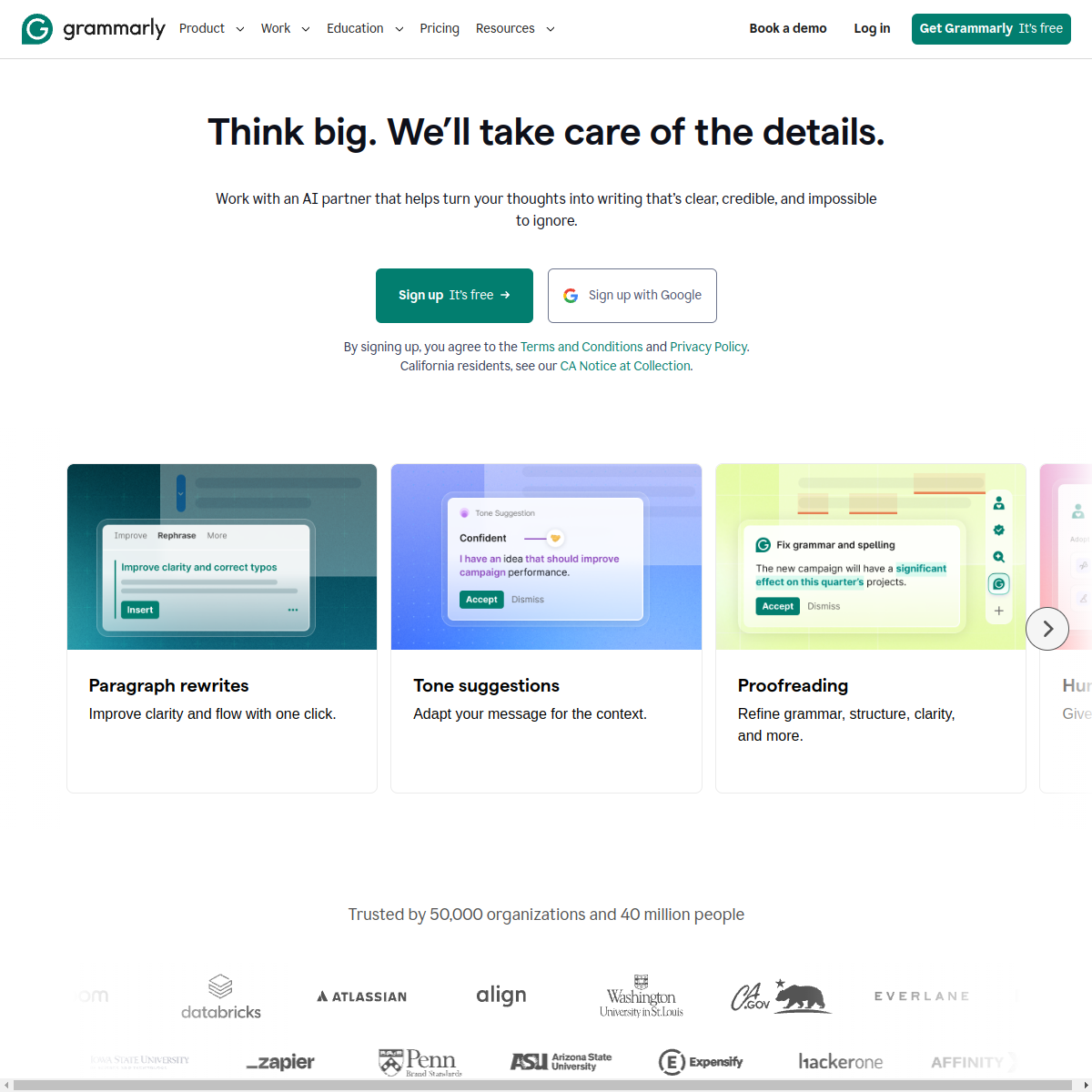
Grammarly — the world’s leading AI English writing assistant
Grammarly’s core parameters and statistics
Grammarly is the world's largest AI English writing assistance platform. After being merged into Superhuman in 2025, it completed the reorganization of its product line. The current core parameters are as follows:
| Parameters | Data |
|---|---|
| Global users | 40 million+ (including 50,000+ corporate organizations) |
| Company valuation | $13 billion (after Series E in 2021) |
| Date of establishment / Headquarters | 2009 / San Francisco, USA (founded in Kiev, Ukraine) |
| Product form | Free / Pro / Enterprise three-tier subscription |
| Core Competencies | Grammar/Spelling Check, Tone Analysis Grammarly GO Generative Writing AI Detector, Humanizer, Plagiarism Detection |
| Supported platforms | Web, Chrome/Edge/Firefox/Safari extension Windows/macOS desktop iOS/Android keyboard |
| Integration coverage | Gmail, Outlook, Google Docs, MS Word, Slack, LinkedIn, Zendesk and 500+ apps |
| Underlying model | Self-developed NLP engine + large language model (Grammarly GO) |
| Security Authentication | SOC 2, BYOK encryption (Enterprise), Confidential Mode |
A Data Flywheel Driven by Scale: The daily writing behavior of 40 million users provides continuous training feedback for Grammarly’s NLP models. Each time the user accepts or ignores a suggestion, the model is improving its contextual understanding. This positive cycle of "usage -> model accuracy -> user stickiness" is Grammarly's most difficult competitive barrier to be copied by competing products.
Platform coverage density is the key differentiator: The breadth of integrations with 500+ apps means users rarely have to leave their current writing context to get assistance. In contrast, most AI writing tools only provide independent editors or single-platform plug-ins. Grammarly’s “ubiquitous” strategy significantly lowers the barriers to use for users.
Grammarly’s users and market recognition
C-side market: The standard tool for English writing: Grammarly has 40 million+ users, covering 180 countries and regions. With over 10 million installations, the Chrome Extension Store has long topped the list of writing tools. The core user portraits focus on highly educated working people aged 25-44, mainly non-native English speakers. Grammarly is deeply embedded in the daily writing habits of these users - they subconsciously rely on it for real-time proofreading when writing emails, responding to Slack, and drafting documents.
B-side market: extending from personal habits to organizational compliance: 50,000+ enterprise organizations have deployed Grammarly, and its customers include Zoom, Databricks, Atlassian, Salesforce, BlackRock, Cisco, Expedia, Dell and other Fortune 500 companies, as well as 2,000+ universities. Grammarly's B-side adoption path is usually "employees use it first -> spontaneous promotion by the team -> unified procurement by the IT department." This bottom-up penetration model reduces the difficulty of corporate sales and also means that the user reputation of the product itself is strong enough.
ROI Quantitative Data: Grammarly’s officially disclosed customer cases show that organizations that deploy Grammarly save an average of approximately $5,000 per employee per year (17x ROI). Specific cases include: Databricks saves $1.4 million in editing hours per year (confirmed by engineer VP); Zoom content team saves $210,000 in the first 9 months; Indeed editing time is reduced by 50%; Frost & Sullivan speeds up the editing process by 3 times. Although these data are official cases, they provide reference anchor points for input-output estimation.
Industry status: Grammarly continues to receive high ratings in the "writing assistance" category on enterprise software evaluation platforms such as G2 and Capterra. Its biggest competitive barrier is not a single function, but the "brand is category" recognition accumulated over 15 years - in the field of English writing assistance, Grammarly has become synonymous with verbification.
Grammarly’s cost advantage: three-tier structure breakdown
C-side/individual user
| Plans | Price | AI Tips Quota | Core Differences |
|---|---|---|---|
| Free | $0 | 100 tips/month | Basic grammar spell check, tone detection |
| Pro | $12/month (annual payment) / $30 monthly payment | 2000 tips/member/month | Full text rewriting, tone adjustment, plagiarism detection AI Detector |
| Enterprise | Contact Sales | Unlimited Alerts | All Pro + BYOK, DLP, Confidential Mode, Custom Roles |
Real limitations of the free version: The free version only has 100 AI-generated prompts per month, which is usually exhausted within a week for daily business writing (3-5 emails + several documents per day). This means that high-frequency users will almost certainly need to upgrade to Pro. The free version is essentially a "high-precision trial funnel" - after users establish dependency through basic syntax checks, they will naturally convert to paying.
Developer / API
Grammarly offers an enterprise API (private self-service pricing), primarily for ISVs and large enterprises that need writing assistance embedded into their own products. API pricing requires contacting the sales team, and there is no public self-service billing standard. Hidden costs of API integrations compared to purchasing a SaaS subscription outright include: development integration cycles, compliance audits, and minimum consumption commitments.
Enterprise/Organization
- Pro (Team Edition): $12/member/month (annual payment), minimum order of 2 people. Includes 2000 AI tips/member/month, style guide, brand tone of voice, analytics dashboard.
- Enterprise: Customized quotation, including BYOK encryption, data leakage prevention (DLP), Confidential Mode, custom role permissions SCIM user management, audit log API, ROI reporting and other advanced management functions.
Input-output ratio calculation: Based on the annual Pro payment of $144/user, compared with the claim of "saving 20 days of editing time per year" in the official case, the daily cost per user is about $0.4, which is far lower than the labor cost of hiring a professional editor or reviewer. For positions that produce 10+ English documents per week, the annual fee for Grammarly Pro is typically less than the cost of 1 hour of professional proofreading.
Grammarly’s main features
-
Real-time Grammar and Spelling Check: 250+ grammar rule detection based on self-developed NLP engine, covering subject-verb agreement, tense errors, article usage, punctuation specifications, etc. Different from early rule engines, Grammarly can determine the misuse of "homophones" (such as there/their/they're) based on the semantics of the entire sentence, significantly reducing the false positive rate. Applicable scenarios: In any English input scenario, it will take effect immediately from email to paper.
-
Tone Detection and Adjustment: Analyze the tone signals conveyed by the text (confident, friendly, formal, urgent, optimistic, etc.) and give targeted adjustment suggestions. For business scenarios that require fine control of communication tone, this function is more practical than simple grammar checking to avoid customer relationship risks caused by inappropriate tone. Hidden linkage: The tone detection results are linked with the rewriting function of Grammarly GO. After the tone deviation is detected, multiple tone versions of alternative text can be directly generated.
-
Grammarly GO Generative Writing: A text generation function based on a large language model that supports operations such as drafting from scratch, rewriting and polishing, expansion/compression, and tone conversion. Pro users have a monthly quota of 2,000 tips. Expert view: The core difference of Grammarly GO is "generation is proofreading" - when generating text, it passes through Grammarly's grammar and style detection layer, and the output content has its own quality filtering, reducing the secondary process of "manual proofreading after generation". This is fundamentally different from the workflow of general models such as ChatGPT that require manual review after generation.
-
AI Detector: Identifies the possibility of AI generation in text and annotates specific passages. For educational institutions, content review and publishing industries, this is a necessary compliance function. Cooperation with Humanizer: After AI Detector detects high-risk paragraphs, it can call Humanizer with one click for humanized rewriting, forming a "detection -> rewriting -> re-detection" process.
-
Humanizer (AI anthropomorphic rewriting): Rewrite the mechanical text generated by AI into a more natural human writing style, retaining the original meaning but eliminating the "AI flavor". This is of significant value to users who use AI to draft content but need the final output to be "human-written" (such as academic writing, brand content).
-
Plagiarism Checker: Compare billions of web pages and academic databases to detect the risk of originality of content. Built-in in the Pro version, it is suitable for reviewing academic papers, published manuscripts and original content.
-
Team Style Guide & Brand Tones: Enterprises can preset unified writing standards (banned words, glossary, tone preferences) in the management background, and all team members will automatically follow them when writing. For companies with strict brand management, this is a key function to "code" the brand manual into real-time editing rules.
-
Reader Reactions: AI Agent simulates the target reader's emotional response to the text, helping the author predict the communication effect before sending. This is a cutting-edge function that pushes "writing assistance" to "optimization of communication effects". Currently, there are few benchmarks in the same category.
-
Seamless multi-platform integration: Maintain a consistent proofreading experience across 500+ applications through browser extension DOM injection technology. In terms of technical implementation, Grammarly needs to adapt specific DOM structure and editor behavior to each target platform, which is an extremely high engineering maintenance barrier.
Grammarly’s model and version evolution
Grammarly’s version evolution reflects the triple jump from “proofreading tool” to “AI writing platform” to “productivity agent”:
Proofreading company period (2009-2018)
- 2009: Grammarly was founded in Kiev, Ukraine. The initial product was an online grammar checker based on a rule engine + statistical NLP model.
- 2015: Chrome browser extension is launched, creating a product paradigm of "writing assistance everywhere". This decision proved to be the most critical turning point for Grammarly - from requiring users to actively visit the website to passively waiting for users to trigger on any web page input.
- 2018: The number of users exceeded 10 million, and AI-driven advanced grammar detection began to be introduced.
Enterprise and AI Transformation Period (2019-2022)
- 2019: Grammarly Business Enterprise Edition is released, introducing team collaboration functions (style guide, management backend SAML SSO) for the first time, and officially entering the B-side market.
- 2020: iOS/Android custom keyboard is launched, extending writing assistance to all system input scenarios on the mobile terminal.
- 2021: Completed US$200 million in Series E financing, valued at US$13 billion. Start laying out generative AI capabilities.
Generative AI + Platformization (2023-2025)
- 2023-03: Grammarly GO is released, and the generative writing function based on large language models is launched, marking the strategic transformation into an AI writing assistant.
- 2024: Continue to enhance Grammarly GO capabilities, introduce personalized writing style learning, and deep integration of Google Docs and Microsoft Word.
- 2025-03: The enhanced version of Grammarly GO supports team tone consistency guarantee and one-click document drafting. Premium and Business users enjoy unlimited AI quota. The actual official release page shall prevail.
Superhuman Era (2025-2026)
- ~2025-09: Grammarly merged into Superhuman platform (no official precise date yet). The product line is reorganized into three tiers: Free/Pro/Enterprise, and the original Premium is upgraded to Pro. Launched AI Detector, Humanizer, Reader Reactions, Citation Finder, AI Grader and other AI Agent ecosystems. The Enterprise version adds BYOK encryption, data leakage prevention (DLP), and Confidential Mode.
- 2026: The Superhuman platform continues to integrate Grammarly capabilities, and business management tools such as ROI reports and Effective Communication Score are launched.
Grammarly’s technical advantages
15-year data flywheel of self-developed NLP engine: Grammarly’s grammar detection model does not rely on a single general-purpose LLM, but a dedicated NLP engine trained on billions of real user writing data accumulated over 15 years. Its core advantage is that the detection accuracy of English grammar is much higher than that of general-purpose large models (the latter is good at generating but not good at "finding faults"), and the false positive rate is low enough for daily use. Effect: The vast majority of the "red underlines" users see every day are real errors rather than false positives. This is the basis for Grammarly to build trust.
Context-aware error correction mechanism: Grammarly's error correction is not word-by-word matching, but suggestions are given after understanding the entire sentence or even the entire paragraph at the semantic level. For example, it can distinguish between the different meanings of the same word in "I saw a bat in the cave" and "He swung the bat" and determine whether the spelling is correct based on the context. Scenario Value: This ability is especially critical in academic writing and technical documentation - dense technical terminology requires the correction tool to have domain semantic understanding rather than superficial spelling matching.
Generate-then-Proofread architecture: The generation process of Grammarly GO is not "LLM output -> user manual proofreading". Instead, after LLM generates text, it automatically passes through the quality filtering of Grammarly's grammar detection layer to ensure that the output content itself meets high writing standards. Engineering significance: This is equivalent to building a "quality gate" into the generation link, reducing the user's time between generation and release. Compared with the workflow of using ChatGPT to write content and then using Grammarly to proofread it separately, Grammarly GO merges the two steps into one step, significantly shortening the link length from writing to publishing.
Cross-platform DOM injection engineering barrier: Grammarly browser extension needs to achieve consistent text injection and interactive coverage in 500+ web applications with different architectures. The DOM structure and editor behavior of each target platform (Gmail, Google Docs, Slack, Notion, Zendesk, etc.) are different, and Grammarly needs to be adapted individually for each platform. Competitive Barriers: This engineering accumulation is Grammarly’s technical moat that is most difficult to be copied by competitors - even if other tools have NLP models with the same accuracy, it will be difficult to cover the same level of platform integration in the short term.
Security and Privacy Architecture: Grammarly promises not to sell user content, not to use it for advertising, and not to allow third-party service providers to use user data to train models. The Enterprise version additionally supports BYOK (bring your own key encryption), Confidential Mode (sensitive content is not recorded), Data Leakage Prevention (DLP) and audit log API. These compliance capabilities are a necessity for enterprise purchases and are a key differentiator for Grammarly from free or consumer-grade AI writing tools.
Grammarly usage entrance
Grammarly provides multi-entry coverage, and users can choose the most suitable access method according to their writing scenarios:
| How to use | Suitable scenarios | Core features | Cost |
|---|---|---|---|
| Browser extension | Daily web writing (email, social media, documents) | Automatically work in the text box of any web page, proofread in real time | Free / Pro |
| Desktop application (Win/Mac) | System-level text input monitoring | Covering non-browser scenarios (such as local Notepad IDE) | Free / Pro |
| Mobile keyboard (iOS/Android) | Full scene input on mobile | Replace system keyboard, proofread text messages, emails, social apps in real time | Free / Pro |
| Grammarly Editor (app.grammarly.com) | Long article writing, generative creation | Online document editor, supports all functions of Grammarly GO | Free / Pro |
| MS Word / Google Docs plug-in | In-depth editing of office documents | Native integration of Office / Google Docs toolbar | Free / Pro |
| Enterprise API | Enterprise self-developed product integration | Embedding writing assistance capabilities into own systems | Contact sales |
Typical steps:
- Visit grammarly.com to register a free account (supports quick login with Google/Apple account).
- Install the Chrome browser extension and it will take effect globally after completing the account binding.
- During daily writing, Grammarly automatically displays error correction marks below the text box (red = spelling/grammar errors, green = clarity suggestions, blue = tone/wording optimization).
- Click the mark to view detailed suggestions and accept or ignore them with one click. Pro users can use "Rewrite" to directly rewrite the entire text.
- When you need generative writing, open the Grammarly Editor or the Grammarly GO icon in any text box and enter the prompt words to generate text.
- Enterprise administrators configure style guides, brand tone, user permissions, and security policies in the admin backend.
Grammarly Product Pricing
Grammarly adopts a "freemium + tiered subscription" pricing system, which will be divided into three clear tiers after reorganization in 2025:
Free ($0/month): Includes basic grammar and spelling checking, tone detection, 100 AI-generated tips/month. The core value is to build users' habitual dependence on the real-time proofreading function. The quota of 100 prompts limits the frequency of use of generative writing - occasional use by light users is acceptable, but daily high-frequency writing will inevitably hit the upper limit.
Pro ($12/month, annual payment; $30 monthly payment): For individual users, unlocks full text rewriting, tone adjustment, fluency enhancement, plagiarism detection AI content detection (AI Detector), and 2,000 AI tips/member/month on the basis of Free. Annual payment is $144/year, which is equivalent to $0.39 per day. Hidden costs: The annual payment is locked for 12 months, and the monthly payment price is 2.5 times the annual payment ($30 vs $12). Grammarly strongly guides the annual payment through pricing leverage.
Enterprise (contact sales): For large organizations, it adds BYOK encryption Confidential Mode, data leakage prevention (DLP), custom role permissions SCIM user management, audit log API, unlimited AI prompt ROI reports, and dedicated customer success manager on the basis of Pro. Pricing is based on user scale and functional module customization.
Enterprise Procurement Recommendation: BYOK and DLP at the Enterprise layer are compliance necessities for regulated industries such as finance, medical, and legal; for general enterprises, Pro (Team Edition) has covered most collaboration needs (style guide, brand tone, analytical dashboard). It is recommended to first try Pro with a team of 50-100 people to verify ROI, and then upgrade to Enterprise as needed.
Application scenarios of Grammarly
1. English emails and cross-cultural communication in the workplace Non-native English professionals use Grammarly to detect grammatical errors and tone deviations in emails in real time. Quantitative deduction: A marketing manager who writes 10-15 English emails every day spends about 3-5 minutes manually proofreading each email. After using Grammarly, it is shortened to 1-2 minutes, saving about 30-45 minutes every day. Boundary Tip: Grammarly cannot replace understanding the email culture and recipient background - tone detection only provides a reference, and the final communication strategy still requires human judgment.
2. Guarantee of originality of academic papers and publications Graduate students and researchers use Grammarly’s grammar check and plagiarism detection features for a final quality check before submission. AI Detector gives early warning on paragraphs that rely too much on AI-assisted writing, and Humanizer can help adjust the expression of AI-generated content. Hidden benefits: Reduce the negative impression of reviewers caused by grammatical problems and indirectly increase the paper acceptance rate. Compliance Risk: Some academic journals have clear disclosure requirements for AI-assisted writing, and the use of Humanizer must comply with the AI use policy of the institution where it is located.
3. Unified management and control of corporate brand content Global marketing, customer service, and sales teams use Grammarly Business's style guides and brand tone features to ensure consistent language across all external communications. Cost reduction and efficiency improvement: A 50-person content team reduced cross-job review rework by about 30% after unifying the style guide - editors no longer need to correct terminology usage and tone deviations article by article. Human-machine collaboration boundary: The development and maintenance of the style guide (banned words, brand terms, tone preferences) needs to be done manually, and Grammarly is responsible for enforcing it rather than setting the rules.
4. Customer support team response quality improved When customer service teams use platforms such as Zendesk and Intercom to respond to customers, Grammarly detects grammatical errors and tone issues in real time to ensure that every response maintains a professional and consistent brand voice. Quantitative comparison: Before deployment, the customer service supervisor needs to randomly check 10-20% of the responses for quality review; after deployment, the team's overall writing quality trend can be viewed directly through Grammarly's analysis dashboard, and review hours are reduced from 5-8 hours per week to 1-2 hours.
5. Rapid output and quality inspection of content marketing Marketing teams use Grammarly GO to quickly draft social media posts, ad copy, and blog posts, then style the content with AI Detector and Humanizer. Workflow transformation: The traditional "draft -> editing and review -> modification -> final review" process has been simplified to "AI drafting + Grammarly proofreading -> manual final review" after Grammarly's intervention, compressing the content production cycle from 2-3 days to less than half a day.
Who is Grammarly suitable for?
- Non-native English speaking professionals: Grammarly’s core user group. Make up for shortcomings in English writing through real-time error correction and tone suggestions to improve professional communication skills in the global workplace. Please note before use: Grammarly only supports English, Chinese or other language writing scenarios will not benefit.
- College students and academic researchers: Use the three major functional combinations of grammar check + plagiarism detection + AI Detector to improve paper quality and originality compliance. Note: AI Detector may misjudge content that has been fully rewritten as AI-generated. The use of Humanizer must be confirmed not to violate the academic integrity policy of the institution where it is located.
- Content Creators and Bloggers: Use Grammarly as the last quality check tool before publishing to reduce the risk of low-level grammatical errors affecting the professionalism of your content. The Pro version of AI Detector can help identify the proportion of AI-assisted writing content, which is valuable to content creators who need to maintain a "human-written feel".
- Enterprise Marketing and Customer Service Team: The style guide and brand tone function of the Business/Enterprise version help companies maintain a unified external image. Suitable for organizations with more than 10 people who need cross-team collaboration on writing standards.
- IT & Compliance Administrators: Enterprise edition’s BYOK, DLP, Confidential Mode and audit logs meet the compliance requirements of regulated industries such as finance, healthcare, legal and more.
- Not suitable for people: ① Chinese or other non-English writers - Grammarly does not support non-English scenarios at all; ② Users who pursue a minimalist writing experience - Grammarly's real-time underlining and prompt bubbles may interfere with the Flow state of focused writing; ③ Users who have strong resistance to AI rewriting suggestions or require 100% original expression - Grammarly The essence of Grammarly is a suggestion engine, and the writing decision-making power remains with the user, but its interaction design encourages accepting suggestions, which may make users who focus on "autonomous writing" feel uncomfortable; ④ Users who need in-depth long article generation or creative writing - Grammarly
GO is more suitable for short text drafting in business scenarios, but is weaker than dedicated generation tools for long story creation or highly creative content.
Summary and Outlook of Grammarly
Core competitiveness: Grammarly’s biggest moat is not a single AI capability, but the trinity of “user scale + platform coverage density + brand recognition”. 40 million users provide a continuous data flywheel for NLP models, and the integrated coverage of 500+ platforms has established extremely high engineering barriers. The brand equity of "Grammarly" as a synonym for English writing assistance is difficult for competing products to challenge in the short term. After being integrated into the Superhuman platform, Grammarly has been upgraded from an independent writing tool to a core component of the productivity agent ecosystem.
Current limitations: ① Only supports English, and multilingual users cannot benefit - with the global trend of AI writing tools supporting multiple languages, this may be the most important limitation on Grammarly's growth ceiling; ② The depth and creativity of generative writing are still weaker than products focusing on text generation such as ChatGPT and Jasper - Grammarly GO is more suitable for "rewriting/polishing" in business scenarios rather than "writing long-form articles from scratch"; ③ AI Detector The false positive rate may cause controversy in academic scenarios - educational institutions are tightening their attitude towards AI detection tools, and Grammarly needs to carefully balance detection sensitivity and user trust; ④ The free version's limit of 100 AI tips/month is becoming increasingly strict, and the pressure for paid conversions may harm the user experience.
Procurement/Adoption Risk Assessment: For enterprises planning to deploy Grammarly, it is recommended to pay attention to the following key terms before signing the contract: ① Whether the data processing agreement of the API/Enterprise clearly promises "not to use customer content to train the model" - Grammarly officially states that user data will not be used for model training, but the Enterprise contract should be confirmed in writing; ② Whether BYOK and Confidential Mode cover all sensitive business departments - finance, legal and other departments may require a higher security level than the marketing department; ③ Whether the user management and permission system (SCIM, custom role Audit Log) meets existing IT compliance requirements; ④ It is recommended to pilot the Pro version ($12/month/person) with a team of 50-100 people first, and use 3-6 months to quantify the ROI before deciding whether to expand to the entire company; ⑤ Pay attention to the subsequent integration direction of the Superhuman platform - how long can Grammarly remain as an independent brand, and whether the functional direction changes. Product change notification clauses need to be agreed in the contract.
Related tools:  Notion AI,
  Jasper
Version Info
- Grammarly Pro + Superhuman integrated version :Grammarly was merged into the Superhuman platform, and the product line was reorganized into three tiers: Free/Pro/Enterprise. The Pro version adds new AI agents such as AI Detector, Humanizer, and Reader Reactions, and the AI writing quota is increased to 2,000 prompts/month. The Enterprise version provides BYOK encryption, data leakage prevention, and unlimited AI quota.
- Upgrade from Premium to Pro + Join Superhuman :Grammarly was integrated into the Superhuman platform, and the original Premium plan was upgraded to Pro, launching AI Detector, Humanizer, Reader Reactions and other agents, and the Enterprise version added the Enterprise level (BYOK, DLP, Confidential Mode). There is no official precise date yet.
- Grammarly GO officially released :The launch of Grammarly GO - a generative writing function based on large language models that supports drafting text, rewriting sentences, adjusting tone and expanding content based on prompts, marking Grammarly's strategic transformation from a pure proofreading tool to an AI writing assistant.
- Grammarly Business enterprise version is online :Launched the Grammarly Business version for enterprise teams, supporting centralized account management, team writing style guide (Style Guide), brand terminology dictionary, as well as SAML SSO and management backend to meet enterprise compliance and collaboration needs.
User Reviews