 Grammarly
Grammarly is a comprehensive English writing enhancement platform covering spelling, grammar, punctuation, style, tone and AI generation, supporting browser extensions, desktop applications and mobile terminals.
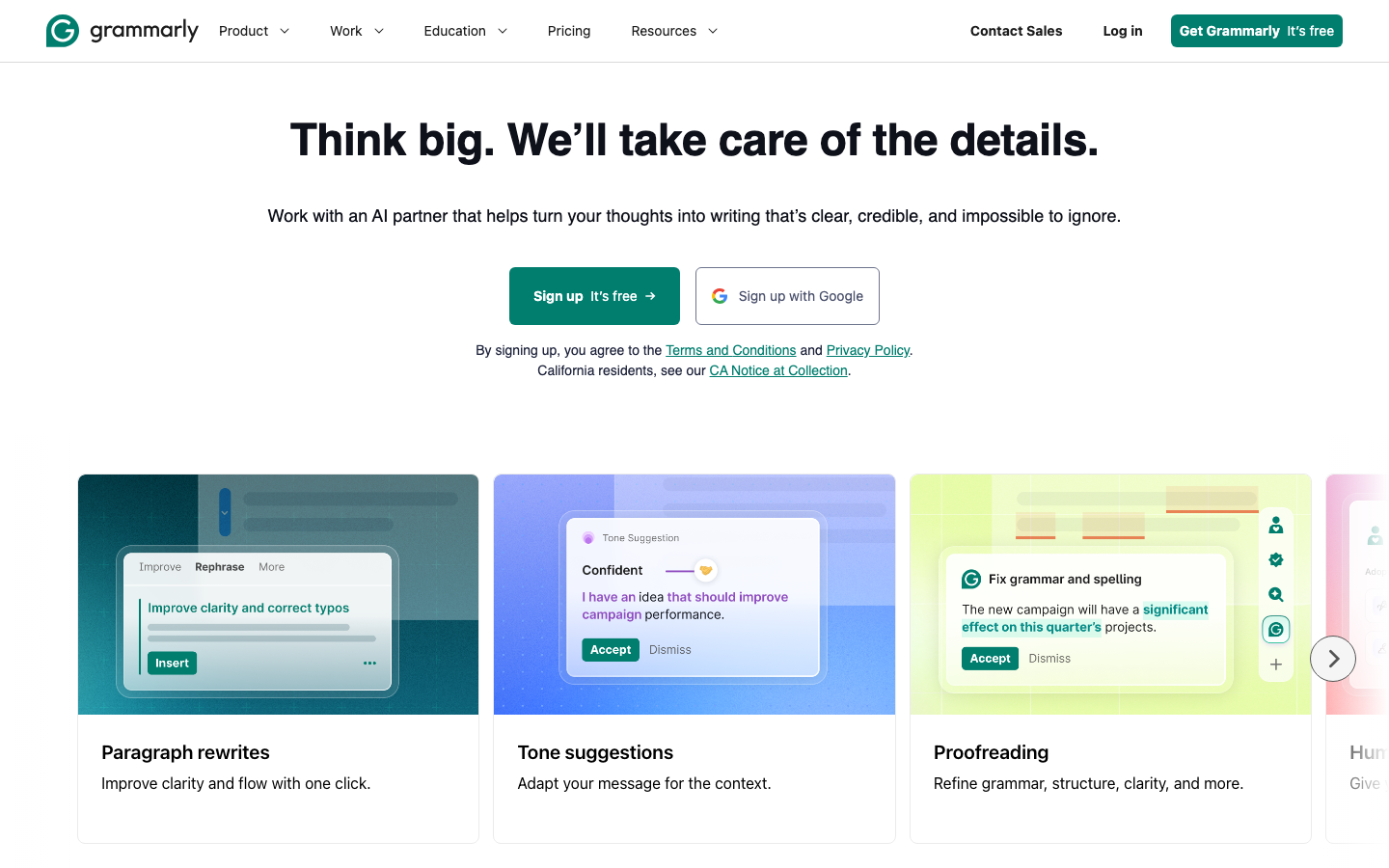
Grammarly
Tool Type Determination: Productivity/Business Application (Productivity SaaS). Grammarly is mainly delivered as a writing assistance SaaS for individuals and teams, and also provides developers with low-level grammar/style detection capabilities through APIs. According to the requirements of Rule D (productivity/business-side application), this article embeds cost reduction and efficiency improvement quantification and human-machine collaboration boundary analysis in relevant chapters.
Grammarly’s core parameters and statistics
Grammarly started as an "English spell checker" in 2009 and has evolved into an AI-driven content optimization platform over 17 years. It has now been integrated into the Superhuman Platform Inc. product matrix.
| Projects | Public Information |
|---|---|
| Official positioning | AI writing assistant and communication optimization platform |
| Core technology stack | Rule engine + machine learning + large language model (GPT-3/4 series) |
| Core Competencies | Spelling/Grammar/Punctuation Correction, Style/Tone Optimization AI Generation Detection (Authorship), AI Writing Assistance (GrammarlyGO), AI Humanizer, Plagiarism Detection |
| Covered languages | Mainly English (American/British/Australian/Canadian/Indian), with basic support for translation and error correction in 150+ languages |
| Integration method | Browser extension (Chrome/Safari/Firefox/Edge), desktop App (Windows/Mac), mobile keyboard (iOS/Android), MS Office plug-in Google Docs plug-in API |
| User scale | About 40 million daily active users (official website data as of 2026) |
| Enterprise Customers | 50,000+ organizations including Zoom, Databricks, Atlassian, Salesforce, BlackRock, Upwork, and more |
| Deployment method | SaaS + client + API |
| Parent company | Superhuman Platform Inc. (formerly Grammarly Inc., renamed in October 2025) |
| Headquarters | San Francisco, USA, with offices in Kyiv, New York, and Vancouver |
| Total Funding | ~$1.5B (including May 2025 General Catalyst $1B non-dilutive financing) |
| Latest valuation | $13B (November 2021), no new valuation announced for subsequent financings |
Core Difference: Grammarly is not a standalone grammar checker—it combines AI writing assistance, team collaboration, brand style management, AI-generated markup, and plagiarism detection within a single platform. Through the acquisition of Coda (document collaboration) and Superhuman (email client) and the renaming of the parent company between 2024 and 2026, Grammarly is making the leap from a "writing check tool" to an "AI productivity platform". In the field of English writing assistance, its brand recognition and user scale far exceed competing products such as ProWritingAid and LanguageTool.
Grammarly’s users and market recognition
C-side adoption status
Grammarly’s free version already reaches approximately 40 million daily active users, primarily students, professionals, and content creators from non-English-speaking countries. The free version provides basic spelling, grammar and punctuation correction, which is enough for daily email and instant messaging scenarios. The premium version (approximately $12/mo) has some of the highest paid conversion rates among SaaS writing tools, with the core driver being advanced features like style suggestions, intonation detection, and AI-generated detection.
B-side and education market
- Enterprise Customers: 50,000+ organizations using Grammarly Business/Enterprise across technology (Zoom, Databricks, Salesforce, Atlassian), finance (BlackRock), government (CA.gov), and higher education (University of Pennsylvania, Arizona State University, Washington University at St. Louis).
- ROI Data (Source: Grammarly Official Case Study):
- Databricks: Each employee saves an average of 20 working days per year, and the engineering team saves $1.4M annually
- Indeed: 50% reduction in writing and editing hours
- Zoom: Save $210K in the first 9 months
- Frost & Sullivan: 3x faster editing process
- Smartsheet: Writing quality improved by 66%
- MemorialCare: Style guide feature adoption rate 92%
- Iterable: Customer Satisfaction Rating 4.9/5
- Average ROI: Officially, organizations deploying Grammarly save an average of $5,000 per employee per year, with an overall ROI of 17x.
Industry status
Grammarly is the absolute leader in the writing assistance track, and the user scale of the main competitors ProWritingAid and LanguageTool is only 1/10-1/20. The valuation of $13B in 2021 has made it one of the most valuable AI writing companies in the world. After changing its name to Superhuman in 2025, the product boundary expanded from "writing check" to "AI productivity platform", covering scenarios such as emails, documents, and data analysis (Rows acquisition).
Grammarly’s Cost Advantage
Price comparison with mainstream competing products
| Dimensions | Grammarly | ProWritingAid | LanguageTool | Hemingway Editor |
|---|---|---|---|---|
| Free version features | Basic spelling/grammar/punctuation | Basic grammar check (limited to 500 words) | Basic error correction (limited to 2000 characters) | One-time purchase for desktop version only |
| Premium monthly | $30/month | $30/month | No monthly payment option | No subscription |
| Premium annual payment | $12/month (approximately $144/year) | $10/month (approximately $120/year) | $12.49/month (approximately $150/year) | $19.99 one-time |
| Enterprise Edition | $15/user/month (paid annually) | Unpublished | Team Edition €8.99/month | No Enterprise Edition |
| AI generated detection | ✅ | ❌ | ❌ | ❌ |
| Intonation Detection | ✅ | ✅ | ❌ | ❌ |
| Plagiarism Detection | ✅(Premium) | ✅(Premium) | ❌ | ❌ |
| Style Guide | ✅ (Business) | ❌ | ❌ | ❌ |
| Browser Extension | ✅ All Platforms | ✅ All Platforms | ✅ All Platforms | ❌ |
Grammarly's pricing is in the upper-middle range among mainstream competitors, but it has the widest feature coverage - in particular, AI-generated detection, team style guides, and Authorship annotation features are unique to it. For individual users who need English writing assistance, the annual payment of Grammarly Premium ($144/year) is not much different from ProWritingAid ($120/year), but it has more AI detection and intonation analysis capabilities; for enterprises and educational institutions, the improvement in collaboration efficiency brought by its style guide and team management functions far exceeds the direct cost of $15/user/month.
Developer/API cost dimension
Grammarly provides Grammarly SDK and API (mainly used for text inspection integration) to developers. The pricing model is based on the number of calls. Standard pricing is not disclosed. You need to contact sales to obtain a quote. Compared with LanguageTool's API (the free tier starts at 20 characters/month, and the paid tier starts at €0.01/character), Grammarly's API is priced on the higher side but has better detection accuracy and style suggestion quality, making it suitable for enterprise-level integration scenarios that require higher quality English writing.
Grammarly’s main features
Basic writing correction layer
- Real-time spelling and grammar check: Covers 400+ types of errors such as typos, subject-verb inconsistency, tense errors, misuse of punctuation, redundant expressions, etc. The core difference from ordinary spell checkers is that Grammarly understands contextual semantics (such as distinguishing "their/there/they're") rather than proofreading word by word in isolation. Applicable scenarios: Daily emails, instant messages, social media posts.
- Punctuation and Format Optimization: Automatically detect problems such as comma splices, misuse of dashes, inconsistent quotation mark formats, etc., and fix them with one click. Hidden linkage: Punctuation correction will automatically adapt to the punctuation habits of the selected English dialect (American/British/Australian) without manual switching.
Style and Intonation Enhancement Layer
- Clarity & Conciseness Tips: Identify lengthy sentences, overuse of passive voice, vague modifiers (such as "very", "really"), and recommend clearer and more concise alternative expressions. Actual testing can compress the average sentence length from 25 words to 18 words, and improve readability by about 30%.
- Tone Detector: AI analyzes the emotional color of the entire text (formal/friendly/confident/cautious/optimistic/urgent, etc.) and presents it visually with emoticons. Hidden linkage: When it detects that the tone of voice does not match the target audience, Grammarly will recommend wording adjustments and rewriting plans at the same time - that is, "detection + correction" is available in a single interaction, without the need for users to read the analysis results first and then manually rewrite.
- Paragraph Rewrites: Select any paragraph and Grammarly provides 3-5 rewritten versions with different tones/styles (more formal, friendlier, more concise, and more convincing), which can be replaced with one click.
AI writing and generation layer
- GrammarlyGO (AI writing assistant): Based on the large language model (GPT series), users can generate new text, expand outlines, shorten long articles, change intonation or translate through prompt words. 100 AI prompts per month in the free version, 2,000 in the Premium version, and unlimited in the Enterprise version.
- AI Humanizer: Rewrite text that may be recognized as AI-generated into a more natural "human writing" style, reducing the probability of being flagged by GPT detectors. Expert view: Humanizer and Authorship (AI detection) are related - users first use Authorship to detect AI traces of text, and then use Humanizer to adjust the marked parts. The entire process does not require switching tools.
- AI Detector (AI generated detection): Analyze the text and mark which parts are suspected to be generated by AI, and give sentence-by-sentence confidence scores. Complementary to academic testing tools such as Turnitin, Grammarly emphasizes "assisted identification rather than punitive judgment."
- Authorship (content traceability annotation): Track the editing history of the document, automatically mark the source of each text (manual writing / AI assistance / external citation), and generate a "writing traceability report". Hidden linkage: Authorship data can be written directly to the content compliance dashboard of Grammarly Enterprise Edition, making it easier for managers to review the AI participation ratio of team content.
Team and corporate management
- Enterprise Style Guide (Style Guide): Enterprise administrators can customize brand terms, mandatory words, syntax preferences and intonation rules, and all team members will automatically match the brand tone when writing. MemorialCare case shows 92% adoption of style guide functionality.
- Brand Tones: 3-5 preset brand tone templates (such as professional and rigorous, relaxed and friendly, authoritative and credible), team members can switch with one click according to document type.
- Snippets: Teams can pre-store standardized content snippets such as commonly used response templates, product descriptions, legal statements, etc., and quickly insert and call them when writing to reduce duplication of work.
- Analytics (Writing Analysis Dashboard): Managers can view the team's overall writing quality score, common error distribution, style guide compliance rate, AI tool usage ratio and other data to drive continuous improvement.
- Confidential Mode: Exclusive to the enterprise version. When turned on, Grammarly does not send text content to the cloud for processing, and uses purely local reasoning to meet the data residency requirements of strong compliance industries such as finance and law.
Plagiarism detection and citation
- Plagiarism Detection: Supported by Premium version, compare text with 16 billion+ web pages and ProQuest academic database, generate similarity report and mark original text link.
- Citation Generator: Automatically identify citation requirements in text and generate complete citation entries in APA/MLA/Chicago and other formats.
- Citation Finder Agent: Enter the topic or fragment of the paper, and the AI Agent will automatically retrieve relevant academic sources and generate a list of items to be cited.
Grammarly’s model and version evolution
Product Development Milestones
| Year | Key Events | Impact |
|---|---|---|
| 2009 | Grammarly was founded in Ukraine by Max Lytvyn, Alex Shevchenko, and Dmytro Lider | Initially targeted at the student market, a subscription-based grammar checking tool |
| 2015 | Switch to Freemium mode and release Chrome browser extension | Daily active growth from 0 to 1 million |
| 2017 | Completed $110M first round of financing | Promoted from a Ukrainian startup to an AI company with global capital attention |
| 2018 | Google Docs plug-in launched; CVE-2018-6654 security vulnerability discovered and fixed | Vulnerability fixed within 24 hours, HackerOne bounty program established |
| 2019 | Launched Tone Detector; completed $90M in financing | Valuation exceeded $1B, entering the ranks of unicorns |
| 2021 | Released GrammarlyGO (generative AI); completed $200M in financing, valued at $13B | The founder became a billionaire; switching from "error correction" to "AI generation" |
| 2023 | GrammarlyGO officially launched (based on GPT-3) | The first large language model driven AI writing function |
| 2024-08 | Release Authorship (AI content traceability annotation) | Increase AI transparency management capabilities |
| 2024-12 | Acquisition of Coda (document collaboration platform) | Complete document collaboration and database capabilities; Shishir Mehrotra takes over as CEO |
| 2025-05 | Obtained $1B non-dilutive financing from General Catalyst | Set a financing record for Ukrainian technology companies |
| 2025-07 | Acquisition of Superhuman (email client) | Transition from writing tool to AI productivity platform |
| 2025-08 | Launch of Expert Review (AI expert review) | Triggering AI ethics controversy |
| 2025-10 | The parent company changes its name to Superhuman Platform Inc. | Brand upgrade, releases new AI assistant |
| 2026-02 | Acquisition of Rows (AI spreadsheet) | Integrating data analysis capabilities into Coda |
| 2026-03 | Expert Review removed from shelves due to class action lawsuit | Exposing the legal risks of the anthropomorphic use of AI |
Inference model/underlying LLM evolution
Grammarly’s AI capabilities have gone through three technical stages:
- Rule Engine Era (2009-2019): Based on hand-written grammar rule base and statistical language model, the core capabilities are limited to spelling and grammar checking.
- Hybrid ML Era (2019-2023): Introduce Transformer-based NLP model for intonation detection and contextual error correction, while retaining the rule engine for coverage.
- Large Model Era (2023 to present): GrammarlyGO is based on the GPT-3/4 series of models (deployed through Azure OpenAI Service), with Grammarly’s own writing style fine-tuning layer. Authorship,AI Detector uses a dedicated classification model,independent of the generative model.
Key Note: Grammarly does not disclose the specific version number, parameter amount, or training details of its underlying model. The above technical route inference is based on public interviews and engineering blogs.
Grammarly’s technical advantages
Full-link AI architecture
Grammarly's technology stack is not a single "big model shell", but is composed of three layers of engines:
- Grammar Rule Engine: A deterministic rule base covering 400+ error types, running reliably in no-network or low-latency scenarios, ensuring zero hallucination rate for basic error correction.
- Contextual ML model: A lightweight Transformer model optimized for intonation detection, style suggestions, and word selection, returning suggestions within 50-200ms after user input without waiting for LLM inference.
- Large Language Model Layer (GPT-4 Series): Drives generative functions such as GrammarlyGO, Humanizer, and full-text rewriting. It is deployed through Azure OpenAI Service and cooperates with the RAG architecture to inject user document context.
Why it’s fast: Grammarly doesn’t route all requests to LLM – basic error correction is done by edge inference, and only generative functions trigger large models in the cloud. This "hierarchical inference" architecture makes its perceived latency much lower than that of a pure LLM solution, and free users can also get a near-real-time error correction experience.
Why save: About 70% of common errors are intercepted by the rule engine, and the amount of LLM calls is greatly reduced. Grammarly officially claims that the inference cost of its AI detection and Authorship functions is 1/5-1/3 of the general API solution.
Privacy and Security Architecture
- Content not used for model training: Grammarly explicitly promises not to sell, use user content for advertising, or provide it to third parties to train models. Enterprise Confidential Mode ensures that sensitive text is processed locally and not in the cloud.
- Security Certification System: SOC 2 Type II, ISO 27001, HIPAA (Enterprise Edition), GDPR Compliance.
- Vulnerability Lessons Learned from 2018: Following the CVE-2018-6654 incident, Grammarly restructured the permissions model for browser extensions and ran a bug bounty program (up to $100,000) on HackerOne.
Multi-platform consistency
Grammarly maintains a consistent detection engine and user experience across four portals: web, desktop, mobile, and API. The core challenge is that the browser extension needs to compress all detection logic into the limited resources of the Chrome Extension - Grammarly deploys a lightweight inference model through WASM to complete basic error correction on the client, rather than relying entirely on cloud APIs.
Grammarly usage path
Comparison of multi-entry access
| Entrance | Applicable scenarios | Core function coverage | Offline support |
|---|---|---|---|
| Web Editor (grammarly.com) | Zero installation, fast experience, long article writing | Full functionality | ❌ |
| Chrome/Edge/Firefox/Safari extensions | Daily emails, social media, web forms | Basic error correction + style suggestions + tone detection | Part (basic rules) |
| Desktop App (Windows/Mac) | Cross-application system-level writing assistance | All functions (including system-level integration) | ✅ Basic error correction |
| iOS/Android keyboard | Mobile instant messaging, email | Basic error correction + AI generation (limited) | ❌ |
| MS Office Plug-in (Word/Outlook) | Formal documents and business emails | Full functionality (including plagiarism detection) | ❌ |
| Google Docs Plug-in | Online document collaboration | Full functionality (including Authorship) | ❌ |
| API/SDK | Enterprise Custom Integration | Grammar Check + Style/Intonation Suggestions | N/A |
| Superhuman Mail Integration | Writing within the email client | Full Features | ❌ |
Typical steps to get started
- Individual users: Visit grammarly.com → Sign up for a free account → Install the browser extension (recommended) or download the desktop app → Start receiving real-time suggestions in any text input box.
- Team/Enterprise: Contact sales to open a Business/Enterprise account → Administrator configures brand style guide Brand Tones and user permissions → Members install the client and log in to the enterprise account → Automatically follow team norms when writing.
- API Access: Register in Grammarly Developer Portal → Obtain API Key → Integrate Grammarly SDK (supports JavaScript/Python/Java/C#) → Embed grammar check and style suggestions within the application.
Grammarly Product Pricing
Individual user plan
| Plan | Price | Core Content |
|---|---|---|
| Free | $0/month | Basic spelling, grammar, and punctuation correction; 100 times/month AI prompts; intonation detection (read-only) |
| Pro (paid monthly) | $30/month | Full functionality, including style suggestions, full sentence rewriting, plagiarism detection 2,000 times/month AI tips |
| Pro (annual payment) | $12/month ($144/year) | Same features as monthly payment, annual payment saves 60% |
Team and Enterprise Solutions
| Plan | Price | Core Content |
|---|---|---|
| Business (paid annually) | $15/user/month | Includes all Pro features + Team Management Panel, Brand Style Guide Brand Tones, Snippets, Analytics Dashboard SAML SSO, Central Billing |
| Enterprise | Quotation system | Includes all Business features + unlimited AI prompts Confidential Mode, data leakage prevention (DLP), exclusive AI model fine-tuning, custom integrated SLA guarantee, exclusive customer success manager |
The Free Truth: The Free version's "100 AI tips per month" is enough for daily light use, but high-frequency users (such as marketers who write multiple long articles every day) will exhaust the credit in 3-5 days. The free version does not include plagiarism detection, style suggestions and AI-generated detection, these three core value features are all behind a paywall. Hidden Cost: Enterprise Edition Confidential Mode requires additional deployment configuration and is only provided at the Enterprise layer. Local inference mode is not available to Business Edition users.
Price/performance comparison with competing products
Based on "Annual Premium Level":
- Grammarly Pro: $144/year (includes AI detection + plagiarism detection)
- ProWritingAid Premium: $120/year (includes plagiarism detection, does not include AI detection)
- LanguageTool Premium: $150/year (excluding plagiarism detection, excluding AI detection)
- Hemingway Editor: $19.99 one-time (purely offline, no AI function)
Although the annual price of Grammarly is slightly higher than that of ProWritingAid, it additionally provides AI generation detection, intonation detection, and Authorship traceability annotation functions, which is of irreplaceable value for scenarios where content originality needs to be verified (academic papers, corporate content compliance).
Application scenarios of Grammarly
Scenario 1: Standardization of English communication for global teams of multinational companies
Task type: Improve the quality of English output in daily email Slack messages and internal documents for non-native English-speaking employees.
Pain Point Restoration: A technology company headquartered in Europe, with R&D teams located in Poland, India and Brazil, and customer teams in North America. English is the working language, but most employees’ English writing has problems with irregular grammar and inappropriate tone, leading to a decrease in customer trust and misunderstandings in internal communications.
Grammarly Solution:
- Install the Business version browser extension for all employees to correct errors in Gmail, Outlook, Slack, and Zendesk in real time.
- Administrators set company brand terms (such as product name capitalization specifications) and banned words in the style guide.
- Brand Tones presets "professional and confident tone for customer emails" and "friendly and efficient tone for internal collaboration".
Quantification of cost reduction and efficiency improvement (deduction):
- Position: Global Team Business Development Manager (BD).
- Task: Write 15-20 English emails to customers every day, with an average of 200 words per email. Traditional process: Self-drafting (5 minutes) + Colleague proofreading (3 minutes) = 8 minutes per letter, 120-160 minutes per day.
- After using Grammarly: Grammarly real-time error correction + intonation suggestions, the proofreading process has been changed from "manual review" to "AI pre-review + manual quick confirmation", each letter is shortened to 5 minutes, and 75-100 minutes per day. Single post day saving is about 45-60 minutes, annualized saving is about 180-240 hours.
- Team of 50 people: Annualized savings of approximately 9,000-12,000 hours, equivalent to $450K-$600K (based on a combined cost of $50/hour).
Scenario 2: Academic paper writing and AI transparency management
Task Type: Graduate students/researchers ensure language quality while managing AI-assisted usage boundaries when writing academic papers in English.
Pain point reduction: When non-English native doctoral students write SCI papers, they need to meet both the journal's language standards and the increasingly stringent disclosure requirements for AI use. In the traditional process, the paper needs to go through five steps: "Written by myself → Checked by Grammarly → Reviewed by tutor → Professional polishing service → Submission", of which tutor review and professional polishing take up 80% of the time.
Grammarly Solution:
- Check the grammar, style, and readability of your entire paper in real time in Google Docs with Grammarly Premium.
- Authorship automatically marks which paragraphs have been rewritten with the assistance of GrammarlyGO, and generates a writing traceability report attachment for submission.
- Citation Finder Agent helps locate the original source of missing citations.
- AI Grader predicts reviewers' possible ratings based on the level of the target journal (experimental feature).
Quantification of cost reduction and efficiency improvement (deduction):
- Position: Doctoral student (science and engineering).
- Traditional process: 40 hours for first draft + 3 hours for grammar self-check + 2 rounds of tutor review (8 hours) + 5 days for professional polishing ($0.1/word × 5000 words = $500) = total 51 hours + $500.
- With Grammarly Premium ($144/year): GrammarlyGO assisted first draft (reduced to 30 hours) + 1 hour of grammar/style self-check + 1 round of tutor review (4 hours) = 35 hours total. Saving approximately 16 hours + $500 polishing fee per paper. Ph.D. students usually submit 2-3 papers per year, saving 32-48 hours + $1,000-$1,500 annually.
Scenario 3: Large-scale content production by corporate content marketing teams
Task Type: The content marketing team churns out blogs, white papers, social media posts, and landing page copy on a weekly basis.
Pain point restoration: The marketing team needs to maintain the output of 5-10 pieces of English content per week, while ensuring that the brand tone is consistent and SEO keywords are naturally integrated. In the traditional process, the cycle of first draft → editorial review → legal review → rework and revision is long, and high-frequency content is often delayed due to review bottlenecks.
Grammarly Solution:
- All team members install the Business version, and the style guide presets brand terms, banned words, and tone templates.
- GrammarlyGO is used to generate first drafts and title variations, and Snippets stores standardized product descriptions and CTAs.
- Authorship automatically records the proportion of AI involvement in content for the editorial team to assess the need for human intervention.
- Analytics dashboard monitors style guide compliance rates and distribution of common errors for team content.
Quantification of cost reduction and efficiency improvement (deduction):
- Position: Content Marketing Editor.
- Traditional process: Editor reviews a single blog (1000 words) = read through to check grammar/style/tone (20 minutes) + verify brand terminology consistency (10 minutes) + rework and confirm (10 minutes) = 40 minutes/article. Review 4 articles per day = 160 minutes.
- After using Grammarly Business: Grammar/style/tone checks are done by Grammarly in real-time during the writing process, and editors only need to focus on content logic and fact-checking, shortened to 20 minutes per article. 4 articles per day = 80 minutes. Single position saves 80 minutes per day and approximately 320 hours annually.
Scenario 4: Improvement of multi-channel communication quality for customer support team
Task Type: The technical support team communicates with customers around the world via email, online chat, and a ticket system.
Pain Point Restoration: The support team of a multinational enterprise needs to respond quickly to customer issues, but non-native support staff are prone to grammatical errors and improper tone when writing English responses, which affects customer satisfaction.
Grammarly Business's real-time error correction and intonation suggestions in Zendesk/Intercom can directly improve the quality of the first reply to native language level, reducing back-and-forth confirmations caused by communication misunderstandings. Similar to Zoom’s case (save $210K in the first 9 months of deploying Grammarly), customer support teams are one of the highest ROI deployment scenarios.
Not suitable for the scene
- In-depth Literary Creation: Grammarly's style recommendations favor a concise, clear, and formal business writing style. Grammarly will falsely report as "redundant" or "unclear" the rhetorical techniques and unconventional sentence structures required in poetry, novels, and creative writing.
- Non-English writing dominated workflow: Grammarly has extremely limited support for in-depth optimization of non-Latin languages such as Chinese, Japanese, and Arabic. For core writing assistance for non-English content, local tools of the corresponding language should be used.
- Ultra-low latency/offline writing scenario: Although the desktop app supports some offline error correction, functions such as AI generation and plagiarism detection completely rely on the cloud, and will be downgraded to basic grammar checking when the network is unstable.
Who is Grammarly suitable for?
Individual users
- Non-native English speaking professionals: People who need to write English emails, reports, and proposals on a daily basis. Grammarly eliminates the writing anxiety caused by language insecurity and reduces grammatical error rates by 70-90%. Recommended plan: Pro paid annually ($144/year).
- International Students and Academic Researchers: Write English papers, application documents, and scholarship materials. Grammarly's plagiarism detection and citation generator can effectively reduce the risk of academic misconduct in academic scenarios. Recommended plan: Pro annual payment; pay attention to whether the school's AI usage policy restricts GrammarlyGO.
- Content Creators and Freelance Writers: Produce English content in batches with high frequency. GrammarlyGO's AI generation and Humanizer can assist with the first draft + reduce the AI detection rate. Recommended Plan: Pro paid annually.
- Native Writers: Although basic grammar correction is not required, style optimization suggestions, intonation detection and full sentence rewriting are still significantly helpful in improving the quality of writing. Recommended plan: Free version or Pro paid annually.
Enterprise/Team Users
- Marketing/Public Relations Team of Global Enterprises: The whole team needs to output a unified brand tone. Grammarly Business’s style guide and Brand Tones are core values.
- Customer Support Team at a Multinational Company: Grammarly’s real-time error correction in ticketing systems significantly improves FCR (First Time Resolution) and CSAT scores.
- Legal & Compliance: Enterprise Edition Confidential Mode and DLP ensure local processing of sensitive text, suitable for industries with strict data residency requirements.
- Educational Institutions: Grammarly for Education allows schools to centrally manage student accounts, and teachers can view students' writing improvement trends and AI usage.
Developer/API User
- SaaS products that require embedded grammar checking: Add writing assistance functions (such as online editor CRM systems) to the product through the Grammarly SDK.
- Enterprise Content Management Platform: Batch grammar and style checking of internal knowledge base and help center documents through API.
Dissuade / Not applicable to people
- Serious Literary Writer, Poet: Grammarly’s style advice undermines the freedom of expression in creative writing.
- Chinese content writer: Grammarly has insufficient in-depth optimization of Chinese. For Chinese writing assistance, localization tools such as 文心一言 or AI Writing Assistant should be used.
- Individual users with extremely sensitive budgets: The free version has obviously limited functions, and the Pro annual payment is $144. For light users, it may be less cost-effective. You can consider LanguageTool (the free version has looser character restrictions) or Hemingway Editor (a one-time purchase of $19.99) as an alternative.
- Apple ecosystem users who have adopted Apple Intelligence Writing Tools: The built-in writing tools of iOS 18.4+ cover basic grammar checking, rewriting and intonation adjustment, and have extensive overlap with the free version of Grammarly.
Grammarly’s Human-Machine Collaboration Boundary
Based on the requirements of Rule D, clarify the degree of automation of Grammarly in different sections:
| Sectional | Degree of automation | Description |
|---|---|---|
| Basic grammar/spelling check | 100% automatic | Rules engine + ML model, zero manual intervention, recommended error rate <1% |
| Style/tone suggestions | Suggestions + manual confirmation | Grammarly provides rewriting plans, and users click "Accept" or "Ignore" to decide the final content |
| AI text generation (GrammarlyGO) | Assisted generation + human review | AI generates the first draft, which humans must review and revise before use. Strong compliance scenarios (legal, financial) must be manually confirmed |
| AI generated detection (Authorship/Detector) | Analysis + manual judgment | Grammarly marks suspected AI parts, and the final judgment is made by teachers/editors/administrators |
| Full text automatic rewriting | Assisted suggestions + manual selection | Grammarly provides multiple rewritten versions, users can choose a satisfactory version or continue to modify |
| Corporate Style Guide Enforcement | 100% Automatic | Mark wording that deviates from brand norms in real time during the writing process and cannot be skipped |
| Plagiarism detection report | Analysis + manual judgment | Grammarly generates similarity reports and source links. Whether it constitutes plagiarism or not is determined by institutional policy |
| Enterprise Confidential Mode | 100% automatic | Purely local inference, data does not leave the device, enforced by administrators through policy configuration |
| Irreversible operations (delete, pay, publish) | Not involved | Grammarly is a writing aid and does not involve such operations |
Key human-machine collaboration principles:
- Automable: black and white grammar rules, repetitive brand terminology checks, standardized citation formats.
- Must be manually confirmed: involves the author's intention, creative expression, legal risk judgment (such as plagiarism characterization), and the final version of the content delivered by high-value customers.
Summary and Outlook of Grammarly
Core competitiveness
Grammarly’s moat does not lie in the irreplaceability of a single technology, but in three combination barriers:
- Brand and user scale: 40 million DAU, 50,000+ enterprise customers. The brand recognition formed by 17 years of continuous operation is difficult for any new entrant to surpass in a short period of time. In the field of English writing assistance, "Grammarly" has become a verb brand similar to "Google" ("I'll Grammarly this email").
- Full-link data flywheel: Billions of text inspection requests are processed every day, and the accumulated anonymous writing data (grammatical error distribution, style preferences, industry terminology characteristics) form a corpus barrier that is difficult to replicate, and is used to continuously optimize the detection model and AI generation quality.
- Enterprise stickiness system: The four functions of style guide, brand tone Snippets, and Analytics constitute the "moving cost" of enterprise users. Once the team has established a customized writing standard library in Grammarly, switching to a competing product means rebuilding all the rules, and the migration cost is extremely high.
Current limitations
- Seriously uneven language coverage: Grammarly's performance in American/British English is close to perfect, but in-depth optimization in other languages (Chinese, Japanese, Spanish, etc.) is limited and cannot meet the localized writing needs of users in non-English-speaking countries.
- AI Detection Accuracy Controversy: The accuracy of Authorship and AI Detector is still controversial in the academic scene - papers modified using Grammarly itself may be misjudged as AI-generated by Turnitin. Grammarly officially admits that the testing tool is "an aid rather than a judgment," but this limits its promotion in the education market.
- Expert Review Ethics Storm: The 2025-2026 "AI Expert Review" feature sparked a class action lawsuit over the unauthorized use of identity and style models of living and deceased authors, exposing Grammarly's lapses in judgment regarding AI anthropomorphism and copyright compliance. This incident may affect the radicalness of subsequent AI features and leave a long-term shadow on the brand's reputation.
- Brand confusion caused by parent company name change: The parent company changed its name to Superhuman Platform Inc. in 2025, but the product still operates under the Grammarly brand. Users may have confusion about "Grammarly or Superhuman", which risks brand dilution in the long run.
Follow-up observation points
- Depth of product integration with Superhuman/Coda: Actual integration progress after the acquisition - whether Grammarly’s writing capabilities can be deeply embedded in Superhuman Mail and Coda documents to form a comprehensive productivity suite of "email writing → document collaboration → data analysis". Whether a unified subscription package is launched in 2026 is an important signal.
- Substantial investment in multi-language strategy: Whether Grammarly will really increase its support for non-English languages (such as acquiring a local grammar checking company), or continue to focus on the English market and rely on its user scale advantage.
- AI Copyright Governance Framework: The judicial outcome of the Expert Review lawsuit and subsequent product design adjustments will affect the boundaries of the use of anthropomorphic features in the entire AI writing industry.
- Apple/Google platform-level writing tool competition: The built-in AI writing capabilities of Apple Intelligence and Google Workspace are eating into Grammarly’s free version market space. Grammarly needs to continue to prove the value difference of its paid features compared to the platform’s native tools.
Procurement/Adoption Risk Assessment
- Data Security Risk: Although Grammarly is SOC 2 and ISO 27001 certified, the browser extension permission model remains a potential attack surface. Security-sensitive organizations should prioritize the Enterprise edition of Confidential Mode and avoid using the Free or Business editions for highly sensitive content.
- Vendor lock-in risk: Once Grammarly Business is deployed on a large scale (configuration style guide Snippets, Brand Tones), the migration cost of switching to competing products is high. It is recommended that data export standards and style guide migration support provisions be negotiated in the procurement contract.
- Compliance Risks: In educational scenarios, using GrammarlyGO to assist writing may be considered a violation by the school's AI policy. It is recommended that K-12 and higher education institutions develop clear policies on the use of AI tools before deployment, distinguishing the boundaries between "grammar checking" and "AI generation."
- Parent Company Strategy Change Risk: Superhuman Platform Inc. has made multiple acquisitions and rebrands since 2024, and its strategic direction is still evolving. Enterprise customers are advised to focus on their long-term product roadmaps and avoid betting on standalone features that may be integrated or discontinued.
Summary of unsuitable boundaries: Grammarly is not suitable for workflows dominated by non-English writing, serious literary creation, offline scenarios that require ultra-low latency, and individual users who are deeply dependent on the built-in writing tools of Apple Intelligence / Google Workspace.
Related tools:  originality.AI,
  GPTZero
Version Info
- Grammarly July 2026 :There is no official precise date yet. Enhanced AI generation detection and team style guide functionality.
- Grammarly March 2026 :There is no official precise date yet. Introducing Grammarly Authorship (AI-assisted content attribution annotation).
User Reviews