 Greenhouse AI
Greenhouse is the world's leading enterprise-level recruitment management (ATS) platform, famous for its "structured recruitment" methodology, and its AI capabilities cover resume screening, interview scoring, recruitment prediction and bias elimination.
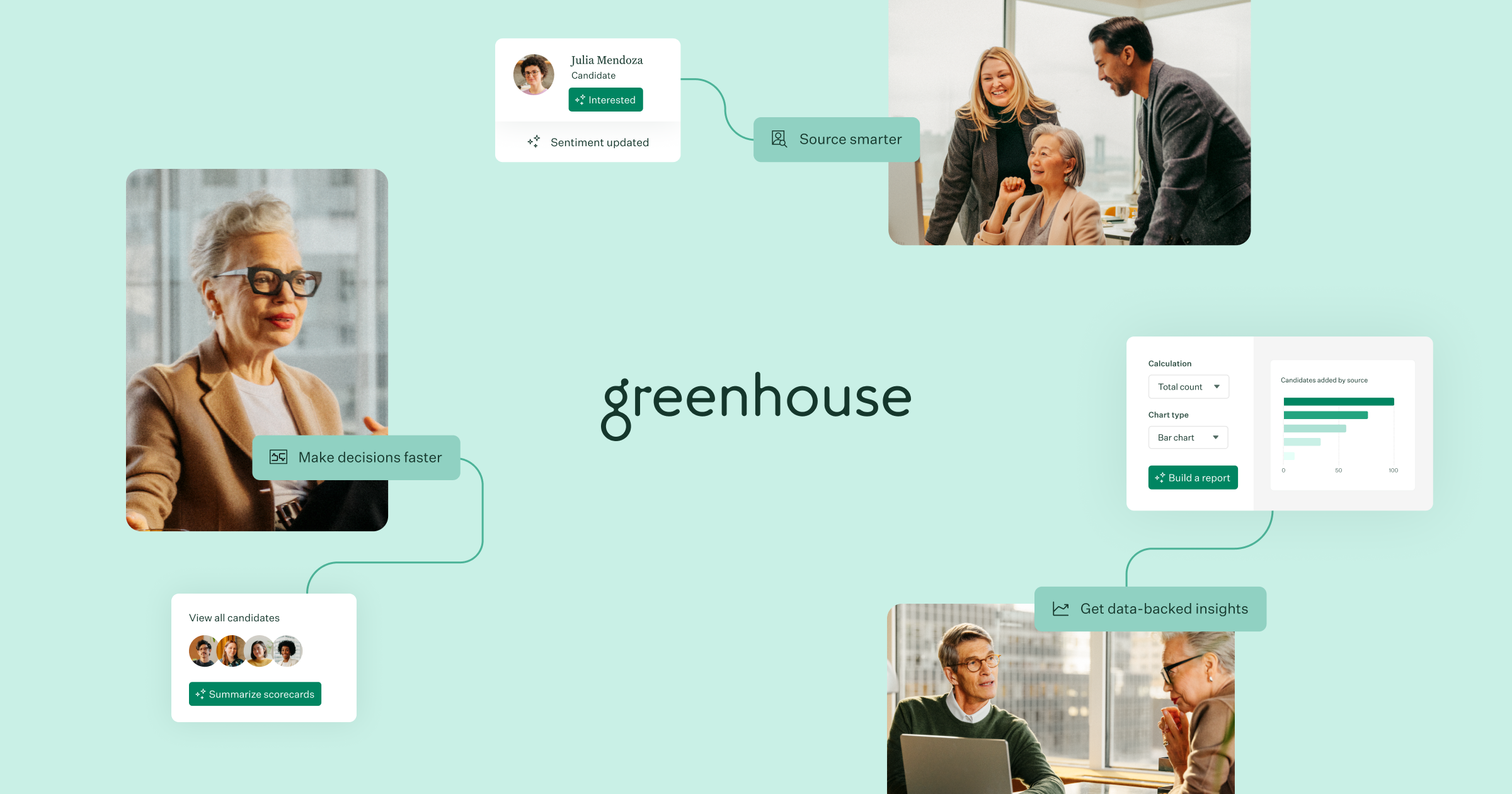
GreenhouseAI
Core parameters and statistics of Greenhouse AI
| Parameter item | Description |
|---|---|
| Product positioning | Enterprise-level structured recruitment management platform (ATS + AI enhanced) |
| Core AI capabilities | Resume intelligent sorting, interview scoring suggestions, recruitment bias detection, recruitment prediction analysis, candidate experience management |
| Number of customers served | 5,000+ corporate customers |
| Industry coverage | Technology, finance, medical care, retail, education |
| Deployment method | Public cloud SaaS |
| Data Security Certification | SOC 2 Type II, ISO 27001, GDPR, CCPA |
| Integrated Ecosystem | LinkedIn, Indeed, Slack, Zoom, Google Workspace, 400+ third-party applications |
| Market coverage | North America, Europe, Asia-Pacific 20+ countries |
| Founding Team | Daniel Chait (CEO) & Jon Stross (CTO), established in 2012 |
The core difference between Greenhouse and other ATS is the Structured Recruiting Methodology - instead of simply storing resumes, it defines a standardized recruitment process for the enterprise: scorecards, interview templates, decision criteria. AI makes intelligent enhancements on this basis to assist rather than replace recruitment decisions. This design philosophy determines Greenhouse's adaptability boundary: it is most suitable for organizations that already have a certain degree of standardized recruitment processes, rather than for small teams that build a recruitment system completely from scratch.
Users and market recognition of Greenhouse AI
Enterprise customer level: Greenhouse serves more than 5,000 enterprise customers, including Airbnb, Pinterest, Bank of America, Microsoft HubSpot, Datadog, Venmo and other leading companies in the technology and financial fields. The customer distribution is centered on North America (approximately 70%), followed by Europe (approximately 20%), and Asia-Pacific and Latin America combined for approximately 10%.
Industry evaluation: In Gartner's 2024 ATS Magic Quadrant, Greenhouse is in the Leaders quadrant and ranks in the top three in the execution capability dimension. In the Forrester Wave 2024 Enterprise Recruitment Platform Report, Greenhouse received the highest score in the strategy dimension and ranked in the top three in the product dimension. In the G2 selection, Greenhouse has maintained the Leader badge in the "Corporate Recruitment" category for multiple consecutive quarters, with a user satisfaction score of 4.3/5.
Market Impact: Greenhouse’s annual Hiring Success conference is the premier industry event in HR technology, with more than 5,000 attendees in 2025. Its Certified Professional certification system covers more than 10,000 recruitment practitioners, forming a talent ecosystem around the Greenhouse methodology.
Analyst Recognition Highlights: The Forrester report specifically pointed out Greenhouse's differentiated advantages in the dimensions of "candidate experience management" and "recruitment process structuring". Gartner emphasizes the bonus effect of its "bias detection" function in purchasing decisions in regulated industries. These reviews are highly consistent with Greenhouse's product strategy - it is not the ATS with the most features, but the deepest in both structured recruitment and fair recruitment.
Cost advantage: input-output logic of structured recruitment
Greenhouse’s cost structure needs to be broken down from three dimensions: C-side (recruiting team), B-side (enterprise procurement) and developers/integrators.
Cost at the recruitment team level: There is no charge for the basic use of Greenhouse to the individual interviewer, but the recruitment team needs to invest in process design costs - the structured recruitment methodology requires defining scorecards, interview templates and decision rules before the system goes live, a process that usually requires 2-4 weeks of professional service investment. For recruiting teams already familiar with Greenhouse, there are no additional licensing fees for day-to-day operations. Hidden costs: The cost of organizational change in process reengineering - allowing interviewers who are accustomed to free-style interviews to switch to standardized scorecards requires training and promotion, and the rejection rate directly affects the data integrity of AI scoring aggregation.
Enterprise Procurement Cost: Greenhouse does not disclose standard quotations, and pricing is tiered based on recruitment needs and functional modules. The following is the estimated range of industry research:
| Tier | Estimated annual fee (estimate) | Adaptation scale | AI function coverage |
|---|---|---|---|
| Starter | Contact Sales | 100-500 person business, basic ATS | Does not include AI module |
| Essential | $3,000-6,000/year | Recruiting 50-200 people per year | Basic process management, no advanced AI |
| Advanced | $10,000-30,000/year | Recruiting 200-1,000 people per year | Includes AI resume ranking, bias detection, and predictive analysis |
| Enterprise | Customized Quotation | Recruiting 1,000+ people per year | Full AI module + Privatization option + Dedicated customer success |
Compared to Lever (estimated starting price is $2,000-4,000/year) and SmartRecruiters (estimated starting price is $2,500-5,000/year), Greenhouse’s starting price is about 30-50% higher, but its structured recruitment methodology and AI bias detection have a clear premium in industries with high compliance requirements. Cost reduction deduction: For a technology company that recruits 200 people per year, after adopting the Advanced level, AI resume screening can reduce the workload of one recruitment specialist (estimated at $50,000/year), which is equivalent to an annual subscription fee of $10,000-30,000, and the ROI can be returned within 3-6 months.
API/Developer Access Cost: Greenhouse Harvest API is included in Advanced tiers and above, there is no separate public API pricing. Enterprises need to obtain API access credentials and call quota limits through enterprise contracts. For organizations that rely on custom integrations, this bundling model means that API capabilities cannot be purchased separately without subscribing to the full platform.
Implicit cost clauses in corporate contracts:
- Recruitment volume growth clause: When the actual recruitment volume exceeds the contract baseline, the fee will be adjusted incrementally when renewing the contract. Fast-growing businesses need to pay attention to budget flexibility.
- Implementation Service Fee: Standard implementation fee is usually 15-25% of the annual fee, including data migration, process design and team training. Data migration workload depends on the quality of the old system data, and complex migrations can take up to 8-12 weeks.
- Multi-Year Contract Discount: 3-year contracts typically receive a 10-15% discount, but flexibility in upgrading tiers is limited during the lock-in period.
Main features of Greenhouse AI
-
AI Resume Screening and Candidate Ranking: Based on the skills, experience, educational background and other dimensions in the job description, AI automatically parses each resume and gives a comprehensive ranking. Supports custom filtering rules - such as "must have more than 3 years of SaaS sales experience" or "give priority to candidates with backgrounds in competing companies". HR does not need to manually flip through hundreds of resumes. AI sorts them by matching degree and directly enters the interview decision-making stage. Implementation Tips: The granularity of filtering rules directly affects the quality of sorting - rules that are too broad will lead to a decrease in ranking distinction, and it is recommended to continue to optimize based on historical recruitment data; rules that are too detailed may prematurely exclude "potential" candidates, and manual review of candidate pools outside the Top 20% is required.
-
Structured Interview Score Card: AI automatically generates scoring dimensions based on the core competency requirements of the position, covering technical level, communication skills, leadership, cultural fit, etc. Each interviewer scores independently by dimension, and AI summarizes the score distribution in the background and automatically detects abnormal scores - such as the same interviewer's scores for all candidates are consistent, the score of one dimension is seriously inconsistent with other dimensions, and the score of a certain interviewer deviates from the team mean for a long time.
-
Recruitment Bias Detection Dashboard: AI continuously monitors the entire recruitment process data - from resume screening pass rate, interview invitation rate to offer acceptance rate, and conducts cross-analysis based on the candidate's gender, race, age and other dimensions. When it is detected that a group's pass rate at a specific node is significantly lower than the average, the system automatically sends an early warning. Technical mechanism: Chi-square test and Fisher's exact test are used to determine the statistical significance of differences, and false positives caused by sample size differences are automatically eliminated. Implementation Tips: The effectiveness of bias detection depends on the integrity and accuracy of HR system data. Existing biases in historical data may be identified by AI but cannot be automatically corrected, requiring manual intervention to adjust the process.
-
Recruitment Forecasting and Cycle Analysis: The forecast model is trained based on the company's historical recruitment data and outputs three types of prediction results - the probability of candidate acceptance of the offer (helping HR to determine whether to provide a Sign-on Bonus or accelerate the process), post-employment performance prediction (based on the correlation analysis of interview scores and on-the-job high-performing employee data), and identification of bottlenecks in the recruitment process (such as the structural fault of "the technical pass rate is high but the final pass rate plummets"). Human-machine collaboration boundary: The prediction results are used as a reference for decision-making rather than the decision itself. The final decision on offer distribution and salary negotiation must be approved and confirmed by humans and cannot be 100% automated.
-
Candidate Experience Management (CEM): AI analyzes candidate interaction data at each node of the recruitment process - email response time, waiting days for interview arrangements, feedback acquisition timeliness, and candidate NPS feedback. The system gives a comprehensive score of candidate experience and makes suggestions for improvement for low-scoring nodes, such as "The average waiting time from technical interview to final interview is 8 days, which is higher than the industry benchmark of 5 days. It is recommended to shorten the interview process or increase the frequency of communication."
-
AI Interview Question Recommendation: Based on job requirements and experience areas in the candidate's resume, AI automatically recommends situational and behavioral interview questions (STAR mode). The interviewer can directly select or adjust the interview questions in the scorecard to ensure the standardization and pertinence of the interview questions and reduce the randomness of "asking whatever comes to mind".
Greenhouse AI version evolution history
As a SaaS product, Greenhouse adopts a continuous release model. The following are traceable core capability milestones:
Capability Milestones
| Node | Time | Core Changes |
|---|---|---|
| Basic ATS online | 2012 (company established) | Basic abilities in job posting, resume management, and interview arrangement |
| Scorecard module | ~2014 | Introducing structured scorecards and interview templates, and taking shape of methodology |
| Harvest API Open | ~2016 | RESTful API launched, third-party integration ecosystem launched |
| Greenhouse Intelligence Preview | ~2022 | The first AI-powered recruiting analytics dashboard |
| Intelligent Platform 2025 | ~2025-06 | AI resume automatic screening ranking, recruitment prediction model LinkedIn Recruiter deep integration |
| Intelligent Platform 2026 | ~2026-04 | AI interview scoring suggestions, candidate experience analysis, and bias detection dashboard officially launched |
Version evolution characteristics
Greenhouse's version iteration follows the path of "digitizing the process first, then making it AI intelligent". Versions before 2022 focus on structured support for the recruitment process (scorecards, workflows, integrations). The Intelligence preview version in 2022 begins to introduce AI into the analysis layer. The Intelligent Platform version in 2025 is the first large-scale integration of AI capabilities - AI upgrades from "assisted analysis" to "active suggestions". The 2026 version further embeds AI into the interview process, achieving AI enhancement in the entire link from "resume → interview → decision-making".
Rollout strategy: Greenhouse adopts a progressive rollout approach for AI capabilities - first opening trials to customers in specific industries (such as finance and technology), and gradually expanding coverage after collecting feedback. This means there could be a delay of weeks to months in when AI features are actually available and versioned.
Greenhouse AI’s technical advantages
Integration mechanism of structured recruitment data model and AI: Greenhouse’s AI capabilities are not plug-in independent modules, but are built on structured recruitment data models. The data model of traditional ATS is resume-centric - storing resumes, marking status, and recording communication logs. Greenhouse's data model is centered around the "recruitment process" - each position corresponds to a set of scorecards, multiple rounds of interviews, multi-dimensional scoring and data-based decision-making criteria. AI operates directly on this model, realizing a causal chain in which "the degree of process standardization determines the upper limit of AI effects": the more standardized the process, the cleaner the data, and the more accurate the AI recommendations.
Statistical method for bias detection: The system performs stratified analysis on the pass rate of each stage of the recruitment funnel (resume screening → interview invitation → interview scoring → final interview → offer) by candidate group, and uses the chi-square test or Fisher's exact test to determine whether the difference reaches a statistically significant level (usually p < 0.05). This method is better than a simple "proportional comparison" and can automatically eliminate false positives of random fluctuations caused by small sample sizes. Applicable Boundary: When the sample size of a certain candidate group is less than 5, the reliability of the statistical test decreases, and the system will not give a significance judgment to avoid misjudgments.
Feature engineering of the prediction model: The input features used by the recruitment prediction model include - the scores and variances of each dimension of the interview scorecard, overlapping skills between candidates' resumes and high-performing employees on the job, the time spent in each stage of the recruitment process (number of days from submission to interview to offer), candidate source channels (LinkedIn/internal referrals/career fairs/headhunters), salary expectations and budget matching, and years of industry experience. The model uses gradient boosting trees (GBDT) as the main algorithm to provide interpretable feature importance rankings on medium-sized data sets of hundreds to thousands of historical records, helping recruiting teams understand "which factors most affect candidate acceptance rates or onboarding performance."
Integrated Architecture: Greenhouse collaborates with external systems through Harvest API and Webhook mechanisms. Harvest API covers RESTful CRUD operations on core objects such as candidates, positions, interviews, scorecards, and offers. Webhooks support real-time event notifications - such as "synchronizing to a Slack channel when a candidate's status changes" or "triggering an approval process after a new score is submitted." 400+ pre-built integrations cover mainstream tools such as LinkedIn Recruiter, Indeed, Slack, Zoom, Google Workspace, Okta, Workday, etc., reducing the engineering cost of interfacing with internal enterprise systems.
How to use Greenhouse AI
Web management backend: Greenhouse is mainly accessed through the Web. After logging in to the backend, the administrator completes operations such as job creation, scorecard configuration, interview arrangement, and report viewing. The interviewer enters the scorecard page via an email link to submit feedback. There is no need to install the client or have a Greenhouse account. Candidates submit resumes, view interview schedules, and receive offers through a branded portal.
Integrated access method:
| Access method | Applicable scenarios | Acquisition conditions |
|---|---|---|
| Web management backend | Daily recruitment management and process configuration | Management console included at all levels |
| Harvest API | Custom integration, data synchronization, report development | Advanced level and above, enterprise contract required |
| Chrome extension | One-click import of external resumes such as LinkedIn | Free installation, company account required |
| Slack integration | Interview reminders, scorecard submission, process update notifications | Built-in integration, management backend configuration |
| Mobile App (iOS/Android) | The interviewer submits ratings and views the schedule | Free download, company account required to log in |
Typical deployment and online process:
- Data Migration and Cleaning: Export candidate, position and interview data in the existing ATS system to complete data cleaning and field mapping. This phase typically takes 4-8 weeks, depending on the legacy system data quality and migration complexity.
- Process Design and Configuration: Work with Greenhouse Solutions Consultants to define scorecard templates, interview round rules, approval processes, and decision criteria. It is recommended to select 1-2 typical job categories (such as engineers, sales) to design first, and then promote it to the entire company.
- System integration: Configure pre-built integrations such as LinkedIn Recruiter, Slack, Google Workspace, etc., or connect your own HRIS and payroll systems through Harvest API.
- Team Training and Piloting: Recruiting team completes operational training and CERT certification. Select 1-2 positions that are being recruited to conduct a full-process pilot to verify data accuracy, process smoothness and AI suggestion quality, and then fully promote it after iterative optimization.
API Quick Start: Harvest API uses Bearer Token authentication, and the endpoint base address is https://harvest.greenhouse.io/v1/. Example request to get a list of candidates:
GET https://harvest.greenhouse.io/v1/candidates
Authorization: Basic <base64({API_KEY}:X)>
The API Key needs to be generated through the Greenhouse management backend, and is only accessible at the Advanced level and above. Detailed documentation can be found in the Greenhouse Developer Portal.
Product Pricing for Greenhouse AI
Greenhouse adopts a tiered subscription system and does not disclose standard quotations. All prices must be obtained by contacting sales. The following pricing information is estimated based on industry feedback and user reports. The actual price is subject to the official real-time quotation.
Tiered Pricing Structure:
| Paid dimensions | Description |
|---|---|
| Seat billing | Mainly charged based on the number of seats in the recruitment team (Recruiter), the interviewer does not occupy the seat |
| Function module gradient | AI bias detection and predictive analysis API access are classified as Advanced and above |
| Implementation and Service Fees | Standard implementation fees are typically 15-25% of the annual fee, including data migration and process design |
| Contract period | Most customers sign 1-3 year contracts, and long-term contracts can get 10-15% discount |
| Growth terms | When the actual recruitment volume exceeds the contract baseline, the renewal fee will be adjusted incrementally |
Pricing Attribution for AI Features: Greenhouse’s AI capabilities (resume ranking, bias detection, predictive analytics, interview scoring suggestions) are not billed separately but are included in the Advanced tier and above. This means businesses cannot purchase AI modules individually without upgrading their subscription tiers. For organizations that only need basic ATS functionality, AI modules can become a forced over-the-top purchase.
Price comparison with competing products (estimate):
| ATS platform | Starting annual fee (estimate) | AI capability pricing model | Data security certification |
|---|---|---|---|
| Greenhouse | $3,000-6,000 | AI included in Advanced+, not billed separately | SOC 2, ISO 27001, GDPR |
| Lever | $2,000-4,000 | AI as an add-on module paid annually | SOC 2, GDPR |
| SmartRecruiters | $2,500-5,000 | AI by usage or subscription tier | SOC 2, GDPR |
| Workday Recruiting | $10,000-50,000 | AI as part of an HCM suite | SOC 2, ISO 27001, HIPAA |
| iCIMS | $5,000-15,000 | AI functionality requires additional configuration | SOC 2, GDPR |
Free Trial and Evaluation: Greenhouse provides a limited trial demo with limited functions. It is mainly used for process experience and selection evaluation, and cannot be used for actual recruitment. It is recommended that enterprises focus on verifying the accuracy of AI resume ranking, the availability of bias detection reports, and the customization flexibility of scorecard templates during the POC stage.
Greenhouse AI application scenarios
-
Technology Company Batch Engineer Recruitment: For companies that recruit 50+ R&D personnel quarterly, AI automatically screens resumes, sorts by technology stack (Python/Go/Java, etc.) and project experience, arranges multiple rounds of technical interviews, and aggregates scores. Using structured scorecards has improved scoring consistency between interviewers by more than 30% and shortened hiring cycles from an average of 8 weeks to 4-5 weeks. Verification focus: Verify whether the AI resume sorting results are positively correlated with the interview pass rate to avoid implicit bias caused by AI's preference for candidates with specific educational backgrounds or working years.
-
Financial Institution Compliance Recruitment Audit: Strictly regulated industries such as banking and insurance require that the recruitment process be auditable, traceable, and unbiased. Greenhouse’s bias detection dashboard automatically records the entire hiring decision chain—from resume receipt, screening rationale, interview scoring, to offer approval—with each step time-stamped and decision-making rationale. AI-generated compliance reports can be submitted directly to regulatory review, reducing compliance audit preparation from days to hours. Human-machine collaboration boundary: Compliance reports are automatically aggregated by AI, but the data explanations and exception statements in the reports still need to be manually reviewed and confirmed by the compliance team and cannot be submitted 100% automatically.
-
Diversity and Inclusion (D&I) Goal Tracking: AI monitors the difference in pass rates of various groups (gender, ethnicity, age, etc.) in the recruitment funnel in real time and proactively prompts the risk of bias. The HR team can adjust recruitment strategies based on system warnings - for example, "It is found that the passing rate of female candidates in technical aspects is significantly lower than that of men. It is recommended to check whether there is implicit bias in the interview questions or whether the composition of the interviewers needs to be adjusted." Verification Points: D&I data analysis requires a sufficiently large sample size of candidate groups (usually 30+ per group). Statistical results may not be instructive in small sample scenarios, and over-interpretation should be avoided.
-
Campus Recruitment Season: Thousands of fresh graduate resumes are processed during the autumn/spring recruitment season, and AI automatically sorts and groups them by major, skill, and internship experience. The system supports sending interview invitations in batches, automatically assigning campus interview sessions, and uniformly recording interview feedback. The University Relations (UR) team can focus on information sessions and campus events, while backend affairs are automatically handled by AI. Quantitative deduction: For a school recruitment team that processes 5,000+ resumes for fresh graduates each year, AI automatic screening can reduce the need for 2-3 temporary recruiters, and the labor cost during the school recruitment season is reduced from about $30,000 to less than $10,000.
-
Executive/Key Position Recruitment: For C-level and VP-level positions, AI-assisted design of a customized evaluation process - special scorecards based on leadership dimensions, multiple rounds of 360-degree feedback integration, and cross-interviewer scoring calibration. Executive recruitment usually has a long cycle (3-6 months) and involves many review roles (Board CEO, HRVP, etc.). AI's process tracking function ensures that no details are missed and rights and responsibilities are transparent. Applicable Boundary: The sample size of executive recruitment is extremely small (usually 10-20 candidates per position), the statistical prediction effect of AI is limited, and more reliance is placed on human experience judgment. AI mainly focuses on process assistance and standardized records rather than decision-making assistance.
Applicable groups of Greenhouse AI
-
Recruiter & Sourcer: The most direct value group. AI automatically completes resume screening and ranking, freeing up more than 60% of resume screening time, allowing recruiters to focus on high-value aspects such as candidate communication, relationship management, and interview arrangements. Prerequisite: The team needs to accept the structured recruitment methodology and change the habit of "screening resumes based on feeling". For experienced recruiters who are accustomed to unstructured free screening, switching costs are higher.
-
Recruiting Operations and HRBP: With bias detection dashboards and process analytics reporting, HRBP can take a data-driven approach to assess recruiting team effectiveness, identify process bottlenecks, and quantify D&I progress. Prerequisite: You need to have basic data interpretation skills and understand basic concepts such as statistical significance, sample size limitations, and feature correlation. Otherwise, you may misinterpret the recommendations in the AI report.
-
Interviewer and Hiring Manager: The scorecard provides a standardized evaluation framework. Interviewers do not need to design interview questions themselves. The scoring dimensions generated by AI reduce the risk of "off-topic" or "missing evaluation dimensions". Interviewers can submit their ratings through an email link without logging into the system. Misfit Boundary: For interviews with extremely senior executive interviewers or in specific areas of expertise (such as cutting-edge AI researchers), a standardized scorecard may feel like it limits the flexibility to judge the depth of a candidate. It is recommended to set a balanced mode between "standardization" and "degrees of freedom" - allowing interviewers to add custom assessment dimensions in addition to the standard dimensions.
-
Compliance and Legal Teams: Bias detection and full-process audit trails are core tools for compliance teams. Greenhouse's complete decision chain records satisfy OFCCP (U.S. Federal Contract Compliance) and EEOC (Equal Employment Opportunity Commission) audit requirements. Prerequisite: The enterprise needs to have a clear compliance policy baseline. AI only provides detection tools and does not replace the professional judgment and final decision-making of the compliance team.
-
HR Technology/IT Integration Team: Through the Harvest API and Webhook mechanism, the IT team can integrate Greenhouse into the company's existing HR technology stack to achieve two-way synchronization of data with HRIS, payroll, and performance systems. Prerequisite: You need to have the ability to develop and maintain RESTful API, and you need to obtain Advanced level and above to access the API.
Not recommended/not suitable for the crowd:
- Small businesses (less than 50 people): When the annual recruitment volume is less than 20 people, it is difficult to support the return on investment of structured recruitment. Basic ATS tools (such as Freshteam, Breezy) or free plans can meet the needs, and the process complexity of Greenhouse is an over-purchase.
- Industries dominated by temporary/part-time workers: In recruitment scenarios with high frequency and low screening requirements (such as catering, retail stores, logistics and distribution), the process complexity of Greenhouse exceeds actual needs, and lightweight recruitment tools such as Workstream or Fountain are more suitable.
- Non-standard organization with extremely flexible recruitment process: If the recruitment process of each position in the company is completely different, there is no fixed scoring dimension, or the interviewer strongly resists standardized evaluation, Greenhouse's structured methodology may become a process burden rather than an efficiency tool.
Summary and Outlook
The core competitiveness of Greenhouse AI lies in the deep coupling of structured recruitment methodology and AI enhancement - it is not a simple AI-based resume database, but a full-link operating system from recruitment process definition to execution to optimization. AI's bias detection function is irreplaceable in the financial, insurance and government industries with high compliance requirements, and AI interview scoring suggestions and predictive analysis produce quantifiable efficiency improvements in batch recruitment scenarios.
Current Limitations and Uncertainties:
- AI capabilities are highly dependent on data quality: For organizations with incomplete recruitment data, biased historical records, or insufficient sample sizes (annual recruitment <100 people), the reliability of AI recommendations will be significantly reduced, and existing biases may even be amplified.
- The statistical validity of the prediction model in small-scale recruitment scenarios (annual recruitment <50 people) is questionable. Enterprises should not rely on AI predictions with high confidence and should rely on human judgment as the mainstay and AI suggestions as a supplement.
- Pricing is opaque and includes hiring volume growth clauses. Rapidly expanding companies need to set fee caps and growth rate baselines in contract negotiations to avoid losing control of their budgets.
- Localization support in the Asia-Pacific region (Chinese/Japanese/Korean interface, local job search platform integration such as 51job/BOSS direct recruitment, Chinese/Japanese/Korea compliance requirements) is weaker than that of the European and American markets. Companies in the Asia-Pacific region need to evaluate localization adaptation costs when selecting companies.
- The accuracy of AI interview scoring suggestions has not been independently evaluated by a third party or publicly benchmarked. Enterprises should verify the effect through internal A/B testing (AI suggestions vs. traditional interview scoring) before launching it on a large scale.
Procurement/Adoption Risk Assessment: For companies with annual hiring of more than 200 people, Greenhouse's input-output ratio is significantly better than a basic ATS. It is recommended to start at the Advanced level, select 1-2 recruitment teams for a 3-month pilot, and focus on verifying four core indicators: the positive correlation between AI resume ranking and interview pass rate, the operability of the bias detection report, the customization flexibility of the scorecard template, and the coverage of interviewer score submission. When negotiating the contract, focus on: fee caps and baseline setting for recruitment volume growth terms, API call quota limits and concurrency caps, clear definition of the data migration scope (which historical data needs to be migrated, and which can only be archived), as well as the data export format and transfer fees after the contract expires. For large enterprises with existing mature HCM systems (such as Workday, SAP SuccessFactors), it is necessary to evaluate the complexity of the integration of Greenhouse Harvest API and existing systems, especially the real-time and conflict handling strategies of HRIS bidirectional synchronization to ensure data consistency when multiple systems are parallel.
Related tools:
Greenhouse AI’s model and version evolution
Continuous iterative updates, the latest version introduces performance optimization and new features. Historical version information can be viewed through the official release page. There is currently no complete public version evolution timeline.
How to use Greenhouse AI
- Web client: You can use it by visiting the official website and registering an account. Most functions do not require installation.
- API access: Provides RESTful API, developers can obtain the API Key and integrate it into their own applications.
Version Info
- Greenhouse Intelligent Platform 2026 :Added AI-driven interview scoring suggestions, candidate experience analysis, and recruitment bias detection dashboard functions.
- Greenhouse Intelligent Platform 2025 :Introducing AI resume automatic screening and ranking, recruitment prediction model, and deep integration with LinkedIn Recruiter.
User Reviews