 Harmonai
Free
Harmonai
Free
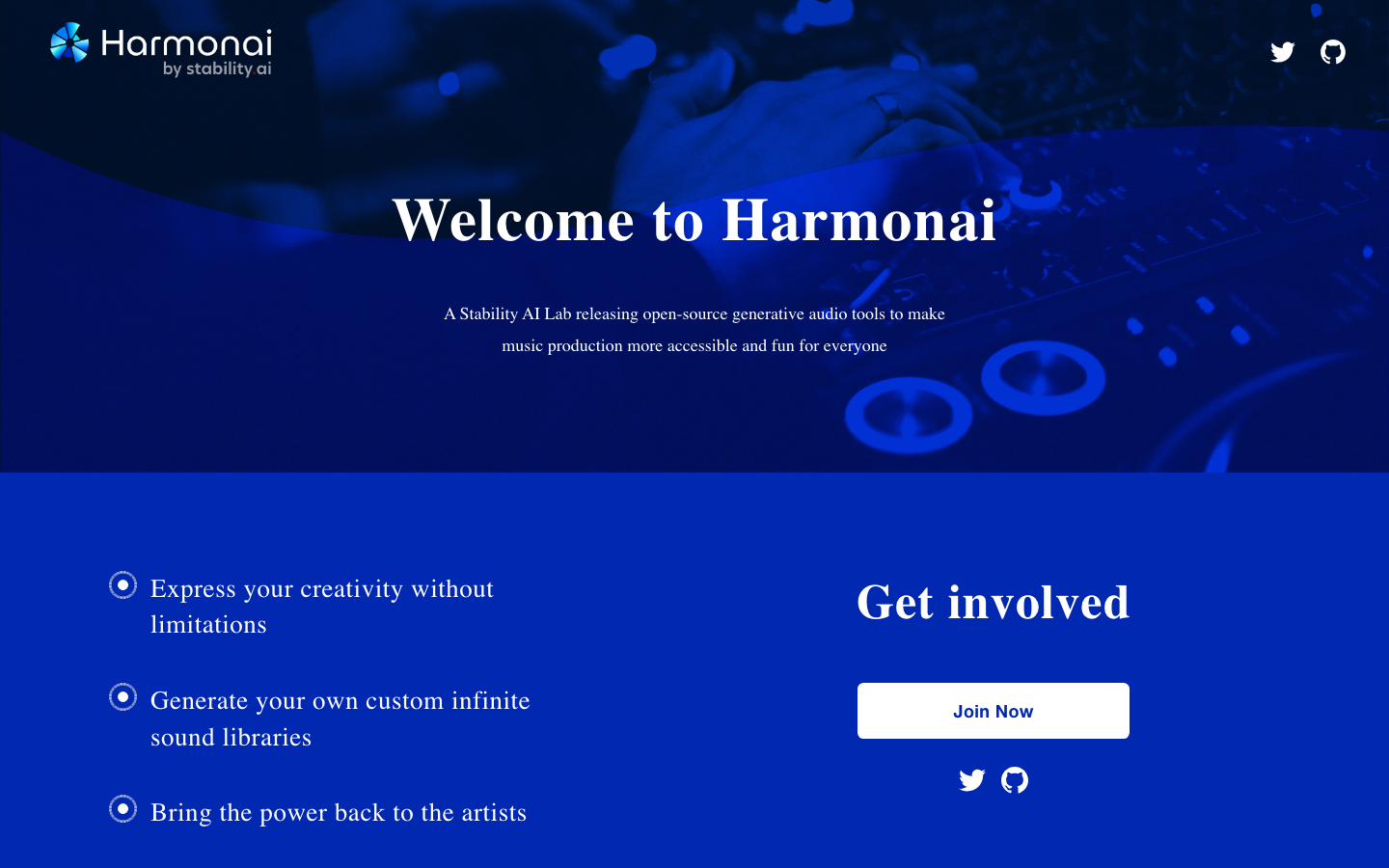
Harmonai is an open source AI music generation platform launched by Stability AI. Based on models such as Dance Diffusion, it provides text-to-music, melody generation and audio style transfer capabilities. It strives to democratize music creation, allowing users to generate and edit music for free.
Harmonai
Core parameters and statistics
Harmonai is an open source AI music generation laboratory under Stability AI. It uses the Dance Diffusion series audio diffusion model as its core asset and is positioned as "AI BY MUSICIANS, FOR MUSICIANS" - not a commercial music production tool, but an open source music generation infrastructure for developers and musicians. Its value lies not in providing a finished tool for one-click production, but in opening up the ability to train and infer audio diffusion models to the community.
| Projects | Public Information |
|---|---|
| Product positioning | Open source AI music generation laboratory (under Stability AI) |
| Core model | Dance Diffusion series (maestro, jmann, glitch, honk, unlocked) |
| Platform entrance | Web (harmonai.org), GitHub, Hugging Face, Discord |
| Place of Attribution | US (Stability AI Ltd.) |
| Open source license | MIT License (core repositories such as sample-generator) |
| Community size | GitHub 775 followers, sample-generator 1.1k stars / 173 forks |
| Hugging Face Models | 6 Public Models 1 Space, 32 Organization Followers |
| Latest model version | jmann-large-580k (updated on 2024-06-17) |
| Business model | Open source free + Stability Audio API commercial service |
Brief review in one sentence: Harmonai is not an "AI one-click music generator", but Stability AI's "music generation tool chain" that opens up all the training rights, reasoning rights and customization rights of the audio diffusion model - it is a powerful tool when used well, but it is just another Colab notebook when used poorly.
Type determination: Harmonai belongs to Type D (productivity/business application). Its main delivery form is an end-to-end audio generation platform for music creators and developers. At the same time, its open source model library and API form have the sub-type characteristics of Type B (basic large model/API infrastructure). The following chapters will respectively reflect Type D's cost reduction and efficiency improvement and human-machine collaboration boundary analysis in the "Technical Advantages" and "How to Use" chapters.
Harmonai’s users and market recognition
Harmonai’s market volume is concentrated in the open source AI music research circle and the independent musician community, rather than the mass consumer market. Its community structure presents a gradient distribution of "researchers > developers > music producers".
GitHub Ecosystem: There are 3 public repositories under the Harmonai organization. The core repository sample-generator received 1.1k stars and 173 forks, with 7 open issues and 2 pull requests, indicating that the community is active but not a large open source project. The repository's Dance Diffusion notebook (Colab version) is the most common entry point. oobleck (124 stars) and audio-diffusion-pytorch-fork (49 stars) are more targeted at research users.
Hugging Face Assets: Harmonai published 6 models (maestro-150k, honk-140k, unlocked-250k, glitch-440k, jmann-small-190k, jmann-large-580k) on Hugging Face, with 32 organizational followers. These models cover different checkpoints from 140k to 580k steps of training, with jmann-large-580k being the most recently updated model (2024-06-17). Created in November 2022, Dance Diffusion Space is one of the earliest public demo entrances.
Industry benchmarking position: In the field of open source AI audio generation, Harmonai has a direct or indirect competitive/complementary relationship with the following projects:
| Projects | Positioning | Open Source | Relationship with Harmonai |
|---|---|---|---|
| Harmonai | Stability AI Open Source Audio Lab | Yes (MIT) | Benchmarks |
| AudioCraft (Meta) | Open source audio generation framework (MusicGen, AudioGen) | Yes (MIT) | Direct competitor, with stronger Meta endorsement |
| Bark (Suno) | Text-to-audio generative model | Yes (MIT) | Complementary, focusing on speech rather than music |
| Riffusion | Spectrum diffusion + music generation | Yes | Similar technical routes and similar community sizes |
| Stable Audio (Stability AI) | Commercial audio generation API | No | The same parent company, Harmonai’s technical upstream |
Actual gold content recognized by the market: Harmonai's core influence comes from its first-mover status as "the first to verify the feasibility of the audio diffusion model in the open source community." When it was launched in late 2022, Dance Diffusion was one of the first publicly available music diffusion models, having a technical demonstration effect on subsequent AI music open source projects (such as Riffusion, an early inspiration for AudioCraft). However, the project's update frequency has dropped significantly since mid-2023. The last submission on GitHub has been more than two years ago, and community activity has shown a natural decline trend.
Harmonai’s cost advantage
Harmonai's cost structure presents a three-tier structure of "free open source tools + commercial APIs on a volume basis + self-deployed hardware costs". Which tier to choose depends on the user's technical capabilities and quality requirements.
C client/individual users: completely free but there are thresholds
The model weights and training code are open sourced under the MIT license on GitHub and Hugging Face, and individual users can download and run them at zero cost. The officially provided Colab notebooks (Dance_Diffusion.ipynb, Finetune_Dance_Diffusion.ipynb) allow users without GPU hardware to experience model training and inference through Google Colab free quota. But the GPU quota of the free version of Colab (~12-16 hours/month for T4) is quickly exhausted for training custom models, and upgrading to Colab Pro (~$10/month) is a hidden cost for most serious users.
API/Developer: Relies on Stability Audio commercial service
Harmonai itself does not provide a standalone API. If you want to use the audio generation capabilities of Stability AI through the API, you need to access the Stability Audio API (belonging to the Stability AI platform service). The pricing model is based on Credits: the Brand Studio platform provides 1,000 free Credits (trial), the Core plan $50/month includes 5,000 Credits, and additional Credits need to be purchased after the amount is exceeded. For high-frequency calling scenarios, enterprise-level customized Credits plan requires contacting the business.
Enterprise/privatized deployment: open source and low cost + self-operation and maintenance cost
Enterprises can directly fork Harmonai's MIT licensed warehouse for private deployment and customized training. The explicit cost is zero, but the implicit costs include: GPU computing power (recommended A100 40GB+ for training, at least T4 for inference), operation and maintenance manpower (model management, inference service orchestration, monitoring and alarming), and data preparation (audio data set cleaning and annotation). Estimating the monthly infrastructure cost for a medium-sized inference service (~1000 builds/day) is about $200-500 (cloud GPU instance), which is much lower than the equivalent call volume of a commercial API.
Three-tier cost structure comparison
| Usage level | Explicit costs | Implicit costs | Suitable scenarios |
|---|---|---|---|
| Personal/Open Source | $0 (Colab free version) | Colab Pro $10/month, learning curve | Experiment, learn, small-scale creation |
| API call (Stability Audio) | $50/month (Core plan) | Credits over-purchase, frequency control limit | Light commercial use |
| Enterprise self-deployment | $0 (MIT license) | GPU $200-500/month + operation and maintenance manpower | High compliance, large number of customization requirements |
Commercial Boundaries of Open Source License: The Harmonai core repository uses the MIT License, which has very few restrictions on commercial use - you can freely use, modify, distribute and use it for commercial purposes, as long as the copyright notice is retained. But please note: the model weights may be trained based on a specific data set. If the data set contains non-commercially licensed audio, there may be hidden dangers in the copyright chain of derivative works. It is recommended that enterprises check the licensing terms of training data before commercial use.
Main functions of Harmonai
Harmonai's capabilities are not limited to the single action of "text-generated music", but revolve around three functional lines of "training custom models → inferring to generate audio → fine-tuning and optimizing output".
-
Dance Diffusion model training: The core capability is not to provide ready-made models, but to allow users to train and generate models using their own audio data. The
sample-generatorrepository provides a complete training pipeline - from audio dataset preprocessing (waveform slicing, spectrum extraction) to diffusion model training (UNet + scheduler), to sample inference. Applicable tasks: Train a generative model specific to a specific instrument, a specific artist style, or a specific sound effects library. Acceptance concerns: Training stability and convergence speed are directly affected by the quality and size of the data set. It is recommended to start with 10-30 minutes of high-quality audio samples. -
Text-to-Music Generation (Inference): Convert textual descriptions (such as "Jazz Piano Solo") into raw audio output via the Dance Diffusion inference pipeline. In actual experience, the audio quality generated by Dance Diffusion is acceptable in terms of style matching, but it is significantly weaker than later commercial solutions (such as Stable Audio, Meta MusicGen) in terms of duration control, rhythm consistency, and sound quality purity. Applicable tasks: rapid inspiration prototyping, background sound material generation.
-
Audio style transfer and interpolation: On the trained model, latent spatial interpolation can be used to achieve a smooth transition between two pieces of audio, or the content of the source audio can be resynthesized in the target style. Applicable tasks: creating gradient sound effects, exploring mixing materials, and experimental sound design. Technical dependence: This function is highly dependent on the model's ability to represent the target style. The model's performance will drop significantly on styles with insufficient coverage in the training set.
-
Pre-trained model ready to use (Hugging Face model library): Harmonai released 6 pre-trained model checkpoints with different training step numbers on Hugging Face, covering from 140k to 580k steps. The 6 models are divided into three categories:
- maestro-150k: 11 downloads, basic universal model
- honk-140k, unlocked-250k, glitch-440k: specific style experimental models
- jmann-small-190k, jmann-large-580k: Jazz music focused models (580k is the latest)
Users can directly load these models for inference without having to train them from scratch. Acceptance concerns: The download volume of each model on Hugging Face is low (up to 18 downloads), indicating that the community adoption rate of the pre-trained model is limited.
-
Fine-tuning: The officially provided
Finetune_Dance_Diffusion.ipynbnotebook allows users to use custom data sets for incremental training based on the pre-trained model. It is the function in the Harmonai toolbox that is closest to actual production needs. After fine-tuning, the model can generate audio clips that are highly consistent with the style of the training set in 10-30 minutes. Implementation Tip: The fine-tuning effect is extremely sensitive to the quality of the data set - background noise, inconsistent volume, and short clips will all cause artifacts in the generated results.
Functional Synergy: The core value of Harmonai is not in a single point of functionality, but in the complete package of "training → inference → fine-tuning → retraining". Users can use pre-trained models to quickly verify the effect (inference), use their own data to fine-tune and optimize style matching (fine-tuning), and then use high-quality data to train new models from scratch (training) to form their own audio generation model library. Actual use of this workflow requires a certain foundation of Python and deep learning, and is not suitable for code-free users with a pure music background.
Harmonai’s model and version evolution
Harmonai's version evolution takes Dance Diffusion as the main line and has gone through three stages: "concept verification → model matrix expansion → platformization". All time nodes are subject to the public records of GitHub and Hugging Face.
Phase 1: Dance Diffusion Release (2nd half of 2022)
- Dance Diffusion initial release (~2022-09): Harmonai makes the Dance Diffusion model and
sample-generatorwarehouse public for the first time, providing Colab notebooks as a quick experience entry. This is one of the earliest open source audio diffusion models and has attracted widespread attention in the AI music community. - Hugging Face model released (~2022-11-03): Release
dance-diffusionSpace on Hugging Face, and upload 5 initial model checkpoints (maestro-150k, honk-140k, unlocked-250k, glitch-440k, jmann-small-190k) at the same time, all open under the MIT license.
Phase 2: Model Matrix Expansion (second half of 2022 to mid-2023)
- oobleck Open Source (~2023-06): Released the
oobleckrepository (124 stars), implemented open soundstream-ish VAE codec, and provided compression coding capabilities for downstream neural audio synthesis. Code based on PyTorch, MIT license. - audio-diffusion-pytorch branch (~2023-09): fork from
archinetai/audio-diffusion-pytorch(49 stars), maintaining the audio diffusion model infrastructure implemented by PyTorch.
The third phase: platform precipitation and business diversion (mid-2023 to present)
- jmann-large-580k update (2024-06-17):
jmann-large-580kmodel update on Hugging Face. This is the latest model release by Harmonai, indicating that the project is still maintained but the pace is extremely slow. - Stable Audio Release (2023-09): Stability AI launches the commercial audio generation product Stable Audio, which adopts the same diffusion technology route as Harmonai but greatly improves the model quality and product experience. Harmonai's role has since shifted from "core product" to "open source research lab."
- Project activity status: As of July 2026, the last code submission in Harmonai's GitHub repository has been more than 2 years ago, and Issues and PRs are in an open but no maintenance response state. Major community activity has been moved to Discord discussion groups and third-party forks.
Summary of version evolution
| Time node | Milestone | Type | Description |
|---|---|---|---|
| ~2022-09 | Dance Diffusion debut | Model release | The first batch of open source audio diffusion models |
| ~2022-11 | Hugging Face model is on the shelves | Model release | 6 pre-training checkpoints |
| ~2023-06 | oobleck open source | tool release | audio VAE codec |
| ~2023-09 | audio-diffusion-pytorch fork | tool release | PyTorch implementation branch |
| 2023-09 | Stable Audio Release | Commercial Diversion | Parent Company Commercial Audio Products |
| ~2024-06 | jmann-large-580k update | Model update | Latest model checkpoint |
Harmonai’s technical advantages
The technical foundation of Harmonai is the engineering implementation of Diffusion Model in the audio field. Its core innovation lies not in inventing a new architecture, but in migrating the successful experience of image diffusion to the audio domain, and in an open source form lowering the threshold for reproduction and customization of audio generation models.
Audio domain adaptation of diffusion model: Dance Diffusion adopts the UNet + scheduler architecture homologous to Stable Diffusion, but replaces 2D spatial convolution with 1D temporal convolution to adapt to the timing characteristics of the audio signal. The model performs forward noise addition and reverse denoising processes on the Mel spectrum (mel-spectrogram), and then uses the vocoder to restore the spectrum to an audible waveform. The advantage of this technical route is that it makes use of the proven engineering accumulation in the field of image diffusion (scheduler selection CFG guidance, DDIM accelerated sampling), but the disadvantage is that the spectrum representation itself will lose phase information, and the restoration of high-frequency details and transient response is limited.
Mechanism → Effect → Applicable scene causal chain
- Mechanism: By performing a diffusion/denoising process on the Mel spectrum, the model learns to gradually restore the statistical distribution of the target audio from pure noise.
- Effect: The generated audio is highly consistent with the training set in terms of overall style, spectral envelope, and rhythm pattern, but local timbre details (such as instrument overtone structure, spatial reverberation tail) are easily blurred, and clips longer than 30 seconds may appear repetitive.
- Applicable Scenarios: Suitable for scenes that do not have high requirements for timbre realism, but are sensitive to style diversity and generation speed (such as background atmosphere sound effects, inspiration drafts), and are not suitable for composition scenes that require precise control of each note.
Technical dividends of the open source strategy: Harmonai chose MIT licensed open source, which objectively established a "use it before you buy" technology verification funnel - users can verify the model effect locally with their own data before deciding whether to purchase Stability Audio's commercial services. The value of this strategy to Stability AI’s ecological moat is greater than the direct benefit to Harmonai itself. But open source also means that the model update rhythm is driven by community contributions and lacks the Roadmap certainty of commercial products.
Technical comparison with Meta AudioCraft
| Dimension | Harmonai (Dance Diffusion) | Meta AudioCraft (MusicGen) |
|---|---|---|
| Model architecture | UNet + DDPM scheduler (spectrum domain) | Based on EnCodec token + Transformer (audio token domain) |
| Generation quality | Spectral domain limitation, limited high-frequency details | Audio token domain, clearer sound quality |
| Controllability | Text description + latent interpolation | Text + melody conditional input |
| Inference speed | DDIM 50 steps about 5-10 seconds/5 seconds audio | Streaming generation, better real-time performance |
| Hardware Requirements | T4/Colab Runs | Recommended A100 |
| Community activity | Low (last updated more than 2 years ago) | Medium (Meta under ongoing maintenance) |
Engineering Pitfall Guide (from community practice feedback):
- Spectrum artifact problem: Dance Diffusion operates on the Mel spectrum, and common artifacts in the generated audio include "metallic sound" (caused by spectrum discontinuity) and "pop" (phase mismatch). Solution: Reduce the CFG scale during inference (3.0-7.0 range debugging is recommended), or use HiFi-GAN instead of the default Griffin-Lim in the vocoder stage.
- Training Stability Control: When training with your own data set, the model is prone to "overfitting collapse" after the number of training steps exceeds 200k - the generated results degenerate into mechanical replication of the training set samples. Solution: Introduce an early stopping strategy (monitor the loss of the verification set), use random spectrum mask enhancement, and control the number of repeated exposures of the data set.
- Duration and rhythm are uncontrollable: The duration of the audio generated by Dance Diffusion is fixed by the latent length, and the rhythm is implicitly determined by the statistical distribution of the training set, and cannot be precisely controlled through text prompts. Solution: Pre-generate several candidate audio clips and then manually screen them, or use post-processing tools (such as Ableton, FL Studio) for editing and arrangement.
How to use Harmonai
Harmonai provides three usage paths, corresponding to user groups with different technical capabilities.
Path 1: Colab notebook (zero threshold experience)
No local GPU required, just open a browser and run. Two official Colab notebooks are provided:
- Dance_Diffusion.ipynb: Pre-trained model loading → text condition generation → audio download. Perfect for quickly experiencing Dance Diffusion’s generative capabilities.
- Finetune_Dance_Diffusion.ipynb: Load pre-trained model → Upload custom audio → Incremental training → Stylized generation. Suitable for users who have customized needs for generated styles.
Operation steps: Visit the GitHub repository → click "Open in Colab" → connect to your Google account → select GPU acceleration during runtime → execute cells in sequence. The output is in .wav format and can be downloaded directly.
Path 2: Local Python context (development/research use)
# Clone repository
git clone https://github.com/Harmonai-org/sample-generator.git
cd sample-generator

# Install dependencies (Python 3.7+)
pip install .

# Train new model
python train_uncond.py --config defaults.ini

# Inference generation (you need to write your own inference script, refer to Colab notebook logic)
You need to manage the GPU driver CUDA version PyTorch and other contextual dependencies yourself. It is recommended to use conda for bounded isolation.
Path 3: Direct loading of Hugging Face model (developer API integration)
# Load Harmonai pre-trained model from Hugging Face
from diffusers import DiffusionPipeline
import torch

# Load maestro-150k model (Harmonai general base model)
pipe = DiffusionPipeline.from_pretrained("harmonai/maestro-150k")
pipe = pipe.to("cuda")

# Generate audio (need to customize prompt encoding and vocoder logic)
# Tip: The Harmonai model does not directly support text prompts and needs to operate in the spectrum latent space.
# For the complete inference process, refer to the sampling function in the Colab notebook
This path requires users to understand the use of diffusion model inference pipeline Mel spectrum encoding and decoding and vocoder, and is suitable for developers with a deep learning foundation.
Comparison of three usage methods
| Method | Technical threshold | Hardware requirements | Customization freedom | Applicable scenarios |
|---|---|---|---|---|
| Colab notebook | Low (only browser required) | Google Colab free T4 | Medium (adjustable parameters) | Quick experience, teaching demonstration |
| Native Python | Medium (Python + ML basics) | GPU (T4/A100 recommended) | High (full control) | Research, product integration |
| Hugging Face | High (diffusion model knowledge) | GPU + contextual configuration | High (model-level operations) | Developer integration, fine-tuning |
Harmonai’s Product Pricing
The pricing model is subject to the official real-time page. Usually a freemium or subscription system is adopted, basic functions can be used for free, and advanced functions or high-frequency use require payment.
Application scenarios of Harmonai
Harmonai's application scenarios are limited by model quality (which is significantly different from commercial solutions), but its open source and customizable features constitute differentiated value in the following three types of scenarios.
-
Inspiration prototyping tool for independent musicians: Although the audio generated by Harmonai has limited sound quality, it is far more efficient than traditional workflows in the "from scratch" stage of generating creative inspiration. Quantitative deduction for cost reduction and efficiency improvement: It takes an electronic music producer from a blank project to a usable 8-bar loop inspiration prototype. The traditional method takes 20-60 minutes (searching for sample packages, splicing and arranging, and adjusting effects). Using the Harmonai fine-tuning model can generate 5-10 candidate variants in 3-5 minutes, increasing the efficiency by about 5-10 times. But the rhythmic accuracy and timbral details of the resulting audio clips still need to be manually corrected in the DAW. Human-computer collaboration boundary: Inspiration generation can be 100% automated, but phrase arrangement, mixing and mastering, and finished product export must be completed by musicians.
-
Batch BGM generation for games/independent films: For independent developers with limited budgets, Harmonai's open source model can be used to generate a large number of "ambient-level" background music materials - forest ambient sounds, city night atmosphere, space ambient, etc. A single track of traditional outsourced BGM costs about $50-500/minute, while the material generated by Harmonai only costs GPU electricity. Quantitative deduction for cost reduction and efficiency improvement: A 30-minute game scene requires about 10 minutes of atmospheric soundtrack, and the outsourcing cost is about $200-500; by fine-tuning the proprietary model with Harmonai, 30 candidate clips can be generated in 2 hours and 10 minutes of usable material can be screened out, at a cost of about $2-5 in GPU computing power. Boundary of human-machine collaboration: Batch generation can be fully automated, but style consistency verification, emotional match evaluation with the game scene, and special sound effects (weapons, footsteps, etc.) still require manual intervention.
-
Education and Experimental Platform for AI Audio Research: Harmonai, as one of the earliest open source audio diffusion projects, has reference value in academic research and technical education scenarios. Researchers can quickly reproduce the audio diffusion baseline and understand the technical details of spectral diffusion based on its code. Implementation Tips: It is recommended to compare with newer baselines (such as Meta AudioCraft, Stable Audio papers) to avoid drawing conclusions based on outdated technical routes.
-
Brand exclusive sound effect library customization: Enterprises can collect brand-related audio materials (product sounds, advertising soundtracks, store background music), train exclusive sound effect generation models through Harmonai's fine-tuning function, and then batch generate sound effect materials with consistent styles. Quantitative deduction of cost reduction and efficiency improvement: A chain brand’s annual human planning cost for store background music is about 50,000 to 100,000 yuan (music director selection + copyright procurement). By automatically generating brand-style music through fine-tuning the model, the complexity of song selection can be shortened by 80%, but copyright compliance audits cannot be omitted. Human-computer collaboration boundary: Model training and batch generation can be automated, but the copyright chain review and compliance signature of each generated track must be completed by legal affairs.
Unsuitable scenarios: ① Commercial distribution scenarios that require publication-level sound quality (the sampling rate and signal-to-noise ratio of Harmonai's output audio are difficult to meet publishing standards); ② Composition scenarios that require precise control of each note/beat (the generated results of the diffusion model are statistical probability products and do not have MIDI-level editing accuracy); ③ "AI music factory" scenarios that require fully automatic unmanned intervention (the current model quality and stability are not sufficient to support fully automated production); ④ Real-time interactive scenarios that have strict requirements on generation speed (a single inference takes 5-10 seconds, and the delay is unacceptable).
Applicable groups of Harmonai
Harmonai's open source positioning and technical threshold determine that it is not a music generation tool that "everyone can use". The following three types of roles can find clear value points:
-
AI Audio Researchers and Algorithm Engineers: Harmonai’s core user group. The complete pipeline of the audio diffusion model (spectral extraction → diffusion training → sampling inference → vocoder synthesis) can be understood based on its code and used as a research baseline for improvement. Implementation Tips: It is recommended to also refer to updated technologies after 2023 (such as AudioCraft’s audio tokenization method and Stable Audio’s latent diffusion scheme) to determine which improvements are worth porting. Unfit Boundary: If the research goal is speech synthesis (TTS) or sound effect classification, Harmonai is not a suitable baseline and it is recommended to use specialized tools (such as Coqui TTS, Whisper).
-
Independent musicians and sound designers: Benefiting from Harmonai's customized fine-tuning capabilities, you can train your own instrument timbre model or style model. Suitable for electronic music, ambient music, experimental music and other genres that do not have high requirements for sound realism. Prerequisites: Basic Python running capabilities are required (only Colab notebook operation required), no deep learning background required. Unfit Boundary: Acoustic instrument players and classical music producers who have extreme requirements for timbre purity may feel frustrated when using Harmonai - the generated piano timbre may be mixed with digital artifacts. This cannot be solved by parameter debugging, but is a limitation of the model architecture itself.
-
AI education trainer and technology blogger: Harmonai's complete open source features and Colab reproducibility make it an ideal teaching case to explain "Application of Diffusion Model in the Audio Domain". Implementation Tips: It is recommended to teach Harmonai by analogy with the image diffusion model (Stable Diffusion) to help students understand the migration logic of the diffusion model from images to audio.
Not suitable for the crowd (clearly discouraged): ① Popular musicians who want to "generate music works that can be directly distributed with one click" - Harmonai's output quality is far from reaching the distribution standard, it is recommended to use Stable Audio or Suno AI; ② Music lovers with no code/no Python foundation - Harmonai's main entrance is Colab notebook and command line, without graphical interface support; ③ Enterprise users who need official technical support and SLA guarantee - Harmonai It is a community-driven open source project and does not provide any form of technical support commitment; ④ Interactive application developers who have real-time requirements for generation speed - a single inference delay of 5-10 seconds cannot meet the real-time interaction needs.
Summary and Outlook
As an open source audio laboratory under Stability AI, Harmonai occupies an irreplaceable position in the history of AI music development - it was one of the first open source projects to successfully migrate the diffusion model to the field of music generation, providing a basis for technical verification and community education for subsequent commercial products (Stable Audio, MusicGen). But looking back in 2026, its role has changed from "cutting-edge tool" to "historical legacy."
Core Competencies: A complete open source (MIT licensed) training and inference pipeline, allowing users to train custom audio generation models with their own data; Dance Diffusion, as the earliest open source audio diffusion model, has long-term retention value in technical education and academic citations; Colab notebooks lower the experience threshold for audio diffusion models.
Current limitations: The project activity is extremely low, the last code submission on GitHub has been more than two years, and Issues and PRs have not been maintained for a long time; the quality of model generation (sound quality, duration control, rhythm consistency) has been widely separated by commercial solutions and newer open source projects (AudioCraft, Stable Audio); a direct mapping interface from text prompt to audio is not provided, and the usage threshold is higher than that of latecomers; the community adoption rate of the Hugging Face pre-trained model is low (up to 18 downloads), indicating that the community prefers newer alternatives.
Follow-up observation points: Whether Stability AI will update the Harmonai repository or release an open source audio model based on the new architecture; whether the community fork will have an active maintenance branch (not yet observed); whether Harmonai will be merged or refactored with the open source components of Stable Audio.
Procurement and Adoption Risk Assessment: For individual learners and researchers, Harmonai's open source nature and historical value make it worthwhile as a learning and citation resource - zero-cost MIT license, reproducible, and no substantial risk. However, for teams that expect to put it into production, the following three points need to be carefully evaluated: ① Project sustainability risk - Harmonai has not been substantially updated for more than two years. If you rely on its code to build products, you need to bear subsequent compatibility maintenance and technical debt; ② Relationship with commercial products - Harmonai is Stability AI's strategic deployment of open source audio technology, but the main resources of the parent company have turned to Stable Audio and Stability Audio API, Harmonai The likelihood of getting major updates in the future is low; ③ Alternative Maturity - If the goal is production-level AI music generation, it is recommended to prioritize the evaluation of Meta AudioCraft (open source Meta, continuous maintenance, better sound quality) or Stable Audio (commercial products, reliable quality, technical support), and only choose Harmonai when you need the maximum freedom of customization or study the audio diffusion baseline. It is recommended that Harmonai be positioned as a "technical validation and knowledge accumulation tool" rather than a "production dependency".
Related tools:  ElevenLabs, udio
How to use Harmonai
- Web client: You can use it by visiting the official website and registering an account. Most functions do not require installation.
- API access: Provides RESTful API, developers can obtain the API Key and integrate it into their own applications.
Version Info
- current :Current version.
- launch :Product goes online.
User Reviews