 Helicone
Free
Helicone
Free
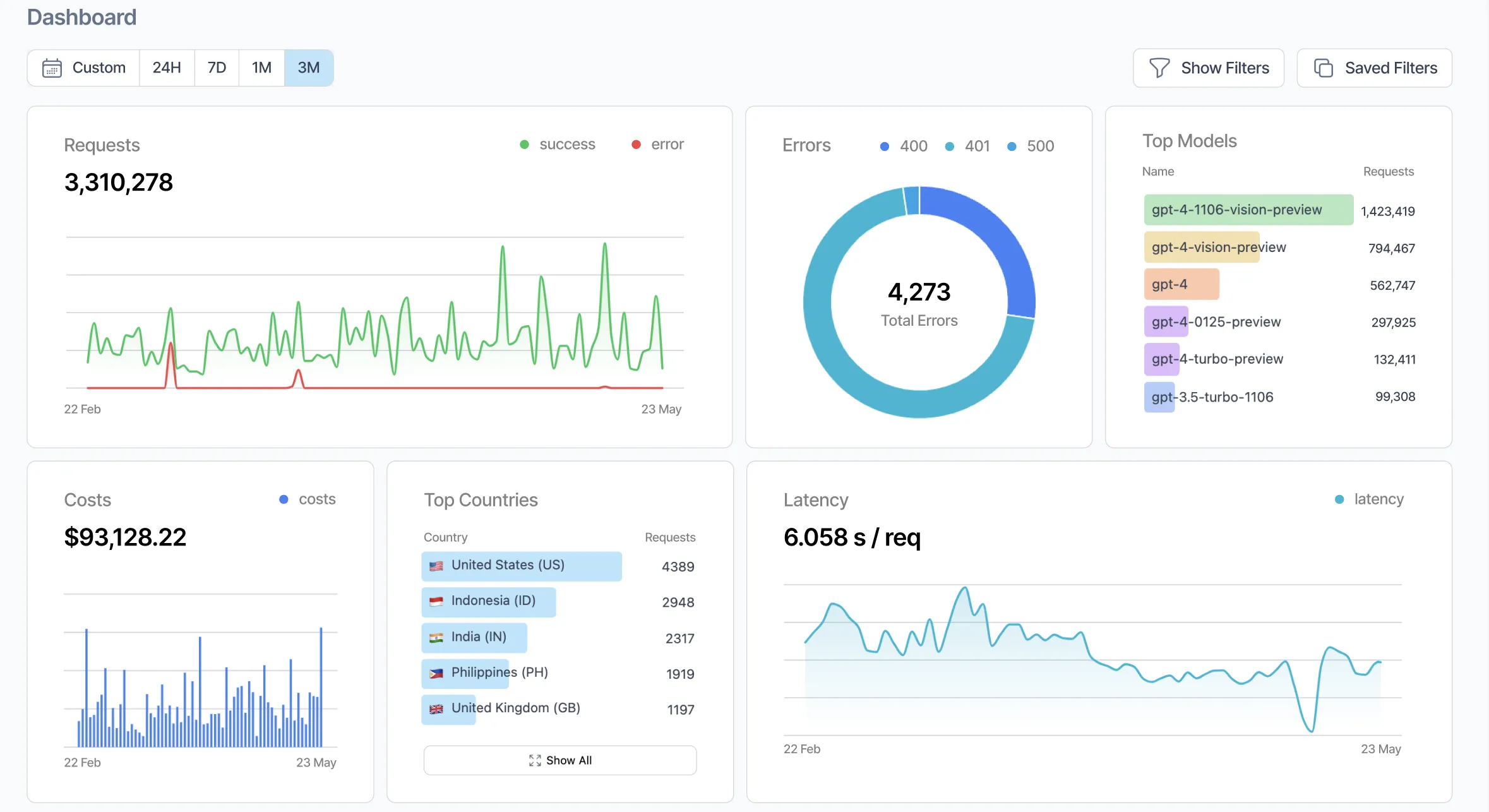
Helicone is an AI Gateway and LLM Observability platform for production-level LLM applications, covering OpenAI-compatible gateway 100+ model access, request logs, cost attribution Sessions, Alerts, Prompt management, caching, current limiting, self-hosting and enterprise governance.
Helicone
Core parameters and statistics
Helicone's product positioning is an integrated platform of AI Gateway and LLM Observability. The core task is not to train the model, but to provide a unified entrance, request-level records, cost attribution, routing, caching, current limiting, alarm prompt management and multi-step link analysis after the model is called into production. Platform Overview focuses on provider outage, debugging complexity, cost uncertainty and prompt management friction; Quickstart places the access method on OpenAI-compatible API and https://ai-gateway.helicone.ai.
| Projects | Public Information |
|---|---|
| Official positioning | AI Gateway & LLM Observability |
| Official website | https://www.helicone.ai/ |
| Document entrance | https://docs.helicone.ai/ |
| Cloud Gateway | OpenAI-compatible API, the example base URL is https://ai-gateway.helicone.ai |
| Model coverage | Documentation states that 100+ LLM models can be accessed through AI Gateway |
| Access mode | Helicone credits hosting provider keys, or bring your own provider keys for observability-only / BYOK |
| Open source main repository | Helicone/helicone, Apache-2.0 License |
| AI Gateway repository | Helicone/ai-gateway, GPL-3.0 License |
| GitHub community size | Helicone/helicone is 5,841 stars, 607 forks; Helicone/ai-gateway is 603 stars, 58 forks (verified on 2026-06-21) |
| Business status | 2026-03-03 The official blog announced that Helicone has joined Mintlify, the service remains online and enters maintenance mode |
Product Boundary: Helicone is more like the LLM calling control plane and observation layer. It does not replace underlying model suppliers such as OpenAI, Anthropic, Google, and Groq, nor does it replace vector databases, business applications, model training platforms, or complete APM systems. Its value usually appears in the stage where "real LLM requests have been made and troubleshooting, cost attribution and multi-model governance are required"; using it in pure demo or offline experiments will appear to be too heavy.
User and market recognition
Helicone’s public market signals come from three types of evidence: officially disclosed usage scale, open source warehouse activity, and acquisitions. The Helicone is joining Mintlify blog on 2026-03-03 stated that Helicone users have processed more than 14.2 trillion tokens, 16,000 organizations have used its LLM infrastructure, and helped track more than 33 million end users; the same announcement also stated that Helicone has been on Product Hunt #1 and said it has become a YC company The most used LLM observability platform in .
Open Source Approval: The Helicone/helicone repository is described as "Open source LLM observability platform" and the License is Apache-2.0; the Helicone/ai-gateway repository is described as an open source AI gateway and is released under an independent GPL-3.0 license. The two open source lines illustrate that Helicone is not just a closed SaaS, but also retains the foundation of auditability, self-hosting and secondary integration.
Enterprise Signal: The pricing page provides Team and Enterprise tiers, Team explicitly indicates SOC-2 & HIPAA compliance, Dedicated Slack channel, and Enterprise explicitly indicates Custom MSA, SAML SSO, On-prem deployment and Bulk cloud discounts. The signal here is that Helicone is targeted at organizations with compliance, permissions, and deployment requirements, but specific certificate scope, audit report SLAs, and data residency terms are still subject to enterprise contracts.
Uncertainty: Helicone’s undisclosed ARR, net revenue retention, current number of paying customers, customer mix by industry, availability commitments by region, and long-term commercial path after joining Mintlify. Since the official maintenance mode has been clarified, purchasing decisions should not only look at historical growth, but also focus on maintenance scope, migration support and Mintlify's subsequent integration plan.
Cost advantage
The cost advantage of Helicone does not mean that the underlying model is cheaper, but that it aggregates requests, models, users, sessions, business attributes and costs into the same data plane, reducing the hidden costs of multi-model applications in bill attribution, exception troubleshooting and repeated calls. How We Calculate Costs distinguishes between AI Gateway and non-gateway access: AI Gateway accurately calculates costs through Model Registry v2, while direct supplier access makes best-effort estimates based on open source cost libraries and 300+ model pricing.
C-side/Individual: Helicone does not provide chat subscriptions to ordinary consumers. Hobby’s free tier publicly includes 10,000 free requests, 1 GB storage, 1 seat and 1 organization, which is suitable for individual developers, small projects or early PoC verification request logs, cost dashboards and basic gateway capabilities.
Developer/API: Pro is $79/month, includes Hobby capabilities Unlimited seats, Alerts & reports, HQL, and is marked with usage-based pricing applies and 7-day free trial. For the development team, the main cost consists of the Helicone package, request volume/storage usage, underlying model bill and internal access maintenance; if Helicone credits are used, the document describes 0% markup, and the team still has to calculate based on the underlying supplier cost.
Enterprise/Private: Team is $799/month and includes 5 organizations, SOC-2 & HIPAA compliance, Dedicated Slack channel; Enterprise is Contact us and includes Custom MSA, SAML SSO, On-prem deployment and Bulk cloud discounts. Enterprise costs focus not just on monthly fees, but also include log retention, data-resident SSO/RBAC, private deployment, compliance materials, support response and long-term maintenance terms.
Hidden costs: Helicone will add a gateway or observation layer to the call link, and the team needs to maintain API keys, headers, request attributes, log fields, alarm thresholds, and fault degradation strategies. If only a single model is called and the traffic is very low, these governance costs may be higher than the benefits; when multiple models, multiple business lines, multi-person collaboration, and online failures become the norm, unified observation and routing will more easily offset the additional complexity.
Main functions
- AI Gateway: Access 100+ models through the OpenAI-compatible API, supports credits mode for managed provider keys, and also supports BYOK. Business code simply replaces the base URL and API key to get logs, costs, latency and error tracking.
- Provider Routing: Provider Routing will search for suppliers that provide the same model based on the Model Registry, giving priority to the user's own provider keys, then using Helicone managed keys, and routing and failover based on lower cost and availability.
- Requests and Custom Properties: Requests can be appended with metadata such as context, project, function, user or organization through headers for filtering, cost grouping, performance analysis and alarm triggering.
- Sessions: Sessions Use
Helicone-Session-Id,Helicone-Session-Path,Helicone-Session-Nameto organize multiple LLM calls, vector retrieval and tool calls into the same workflow trace, suitable for agent and complex chat process troubleshooting. - Alerts: Alerts covers indicators such as Error Rate, Cost, Latency, Total Tokens, Prompt Tokens, Completion Tokens, Prompt Cache Read/Write and Count, and supports Slack or email notifications.
- Prompt Management: Centrally manage Prompt templates, variables, versions, contexts and rollbacks, so that Prompt changes do not need to be released through application code every time.
- Caching and Rate Limits: The caching capability stores the complete LLM response in the Cloudflare edge network to reduce repeated requests; custom rate limits can control abuse and budget risks based on request count, cost, user or custom property.
- Self-hosting: Official documentation provides Manual Installation, Docker Compose, Kubernetes, and Cloud Deployment paths for teams that need private networks, custom deployments, or greater data control.
The key to these functions is not a single point list, but the relationship on the same request path: after the request enters the gateway, it can be routed, flow-limited, cached, recorded, tagged, billed, included in the session, alarms are triggered, and reused in subsequent prompts or model experiments. For production systems, this is closer to an operational AI infrastructure than scrambling logs and billing after the fact.
Model and version evolution
Helicone has three version lines: cloud platform, main open source warehouse and AI Gateway warehouse. The cloud platform focuses on continuous iteration and documentation capabilities. The open source main warehouse releases Docker image/platform version, and the AI Gateway warehouse promotes gateway capabilities with beta release. Since 2026-03 has entered maintenance mode, the version judgment should include both "still available, still repaired" and "new route shrink".
Main line status
Helicone Cloud / Platform (2026-06): The official website still provides login, registration, Pricing, Models, Stats, Docs and Changelog; the document sitemap still has multiple pages of update records from 2026-05 to 2026-06, covering Gateway, integrations, advanced usage, self-host and REST API.
Helicone joins Mintlify (2026-03-03): The official blog announced that Helicone was acquired by Mintlify and the team joined Mintlify; the service will remain online in the foreseeable future and enter maintenance mode. The maintenance scope includes security updates, new models, bug & performance fixes.
Helicone/helicone v2025.08.21-1 (2025-08-21): The latest GitHub Release of the main warehouse, used for open source platform/image release; there is v2025.08.21 on the same day, and v2025.08.20 on the previous day, which reflects that the warehouse uses date version numbers.
Helicone/ai-gateway v0.2.0-beta.30 (2025-07-21): The latest public release of the AI Gateway warehouse, continuing the v0.2.0 beta series, indicating that the gateway as an independent open source component has its own version rhythm.
Version relationship description
For users, Helicone's "latest capabilities" cannot just be based on a version number. Cloud capabilities are subject to docs and web pages, open source deployment is subject to Helicone/helicone release, and gateway components are subject to Helicone/ai-gateway release. After joining Mintlify, stability and security fixes are still the scope of official commitments, but the large-scale new feature route, commercial packaging methods and long-term support strategy should be confirmed with the latest official announcement.
Technical advantages
Mechanism: OpenAI-compatible gateway abstraction. Helicone centralizes multiple model calls into a unified base URL. The effect is that the application side can access logs, costs, routing, and fallback without greatly changing the SDK calling method. The applicable scenario is for teams that already have OpenAI SDK code and want to expand to multiple vendors such as Anthropic, Google, Groq, Vertex, OpenRouter, etc.
Mechanism: Request-level observability and attribute system. By requesting logging custom properties, user metrics, and sessions, Helicone puts a model call into user, organization, function, context, and workflow context. The effect is that costs and failures no longer remain in the realm of "a certain model becomes more expensive/slower", but can be attributed to specific business lines, user types or agent steps.
Mechanism: routing, caching, current limiting and cost control front-end. Provider routing handles provider availability and cost selection, Caching reduces duplicate requests, and Rate Limits limit budgets by number of requests or cents. The effect is that management actions occur on the request path, rather than manual accountability after the bill comes out; applicable scenarios are high-traffic product agent services and multi-tenant SaaS.
Mechanism: Open source vs. self-hosted path. Master repository Apache-2.0, Gateway repository GPL-3.0, plus Docker Compose, Kubernetes and cloud deployment documentation, allowing teams to check out implementations, deploy their own instances or run on corporate networks. The effect is that the security team has more audit points, but the cost is that the self-hosted team is responsible for upgrades, monitoring, backups and compliance configuration.
Mechanism: Prompt and evaluation workflows are close to production data. Capabilities such as Prompt Management, Scores, Datasets, Evals, Ragas integration, and more allow teams to turn real request samples into testing and improvement materials. The effect is that Prompt iteration is closer to the online distribution, rather than relying on only a small number of hand-made samples.
How to use
| Usage | Typical steps | Adaptation objects |
|---|---|---|
| AI Gateway | Register an account, generate Helicone API key, change the base URL of OpenAI SDK to https://ai-gateway.helicone.ai, and use the model name to initiate a request |
Development teams who want to use a unified API to access 100+ models and automatically obtain observation capabilities |
| Observability-only / BYOK | Configure your own supplier key in Provider Keys, or connect OpenAI, Anthropic, Azure, Gemini, etc. requests to Helicone according to the integration document | Teams who need to retain supplier accounts and billing relationships, and obtain logs and analysis at the same time |
| Sessions / Agents | Add Helicone-Session-Id, Helicone-Session-Path, Helicone-Session-Name in the request header, and organize multi-step calls according to the task tree |
Agent, RAG, multi-round customer service, complex workflow |
| Self-hosted | Choose Docker Compose, Kubernetes, Manual, or Cloud Deployment to deploy a Helicone instance and configure database, gateway, authentication, and observations | Organizations with data residency, private networking, or auditing requirements |
A typical pilot path can start with a low-risk but high-frequency LLM call: first connect to AI Gateway or observability-only, verify whether the request is fully recorded, whether the cost can be attributed by user/function and whether the P95/P99 delay is acceptable; then enable Sessions, Alerts, Rate Limits and Caching; finally, incorporate Prompt management Evals and enterprise permissions into the release process.
Acceptance focus: The pilot should quantify the error location time, cost anomaly detection time, unit session cost fallback hit rate, cache hit rate, alarm false alarm rate and log field complete rate before and after access. If these metrics don't improve, the problem may be with the prompt, product process, or model selection, not the gateway layer.
Product Pricing
Helicone's pricing page adopts four tiers: Hobby, Pro, Team, and Enterprise, and emphasizes usage-based pricing. The Pricing calculator on the page will estimate the monthly cost based on requests, tokens per request and storage; the specific unit price, excess requests, storage and credits rules will be updated with the page. Production procurement should be based on the real-time pricing page and contract.
| Solution | Disclosed price | Disclosed capabilities | Applicable boundaries |
|---|---|---|---|
| Hobby | Free | 10,000 free requests, 1 GB storage, 1 seat, 1 organization | Individual developer, prototype, low-risk PoC |
| Pro | $79/month | Everything in Hobby, Unlimited seats, Alerts & reports, HQL, 7-day free trial, usage-based pricing applies | Small teams that are going online or have real traffic |
| Team | $799/month | Everything in Pro, 5 organizations, SOC-2 & HIPAA compliance, Dedicated Slack channel, 7-day free trial, usage-based pricing applies | Companies working with multiple teams, requiring compliance signals and dedicated communication channels |
| Enterprise | Contact us | Everything in Team, Custom MSA, SAML SSO, On-prem deployment, Bulk cloud discounts | Large accounts, privatizations, organizations with complex procurement processes and legal terms |
C Client/Individual: Hobby’s free tier can cover basic experiments, but has limited data retention, storage, request volume and collaboration capabilities, making it not suitable for long-term production monitoring.
Developer/API: The true cost of Pro/Team is composed of the usage-based part of the package, underlying model consumption, and internal maintenance. The 0% markup of Helicone credits reduces concerns about “middleman markups” but does not exempt the model supplier from the token cost itself.
Enterprise/Private: Enterprise terms have undisclosed prices and focus on long-term commitments in Custom MSA, SAML SSO, on-prem deployment, data retention, compliance reporting, support response, and maintenance mode.
Application scenarios
- Production-grade chat with Copilot application observations: Track quality by request, user, model, time and error type, with core acceptance points being whether error localization time, latency trends and cost distributions are explainable.
- Multi-model gateway and supplier downgrade: Make unified calls and fallbacks among suppliers such as OpenAI, Anthropic, Google, Azure, Bedrock, Groq, etc. The core acceptance point is whether the service continues to be available when provider outage or rate limit occurs.
- AI Agent and multi-step workflow tracking: Use Sessions to connect the agent's planning, retrieval, tool invocation and final answer. The core acceptance point is whether the failed steps can be reproduced and whether the tool invocation can be audited.
- Cost governance and unit economic analysis: Use custom properties and sessions to map costs to features, customers, tenants, workflows or environments. The core acceptance point is whether the unit user, unit task or unit session cost is sustainable.
- Prompt iteration, experimentation and evaluation: Incorporate real samples into regression testing through Prompt Management, Scores, Datasets, Evals and Ragas integration. The core acceptance point is whether prompt changes can be rolled back, compared and replayed.
- Compliance or private deployment: Teams that need SSO, on-prem, SOC-2/HIPAA related materials or self-hosted paths can put Helicone at the model call entry layer, but they need to confirm data residency, log masking and access control boundaries first.
What these scenarios have in common is that LLM has become part of the online offering. If the team only does one-off scripts, short-term surveys or low-frequency internal tools, it may be easier to use the model supplier console and local logs directly; once multi-models, multi-tenants, cost attribution, incident response and compliance audits appear, the value of Helicone's platform will become more obvious.
Applicable people
- AI Platform Engineering Team: It is necessary to centralize the model supplier API key, fallback, current limit, cache, log and cost control into a unified entrance to reduce the need to reinvent the wheel for each business line.
- LLM Application R&D Team: Need to track requests, debug prompts, reproduce user problems, compare model effects, and convert online request samples into evaluation data.
- Product and Business Leader: Pay attention to the unit economics of AI functions, user experience fluctuations, error rates and model costs, and hope to judge whether to continue to expand a certain AI capability based on real request data.
- Security, Compliance and Operations Team: Focus on PII, Prompt injection, log retention SSO, on-prem, audit links and alarm responses, and need to establish control points at the model call entry layer.
The boundaries of incompatibility are also clear: teams that only do personal chat, only call a single model with very low request volume, have no online SLA, have no cost attribution requirements, have no log governance capabilities, or are unwilling to add any middle layer to the model call link, do not necessarily need Helicone in the short term. The maintenance mode after joining Mintlify also means that new purchases should be more careful to verify the long-term route, rather than making decisions based only on historical growth data.
Summary and Outlook
The core value of Helicone is to advance LLM applications from "callable models" to "observable, routable, controllable costs, repeatable, and manageable". It forms a relatively complete LLMOps infrastructure based on OpenAI-compatible Gateway, 100+ model access, request analysis Sessions, Alerts, Prompt management, caching, current limiting, self-hosting and open source deployment. It is especially suitable for teams that already have production traffic and require multi-model operations.
Current limitations also need to be taken seriously: After the official announcement of joining Mintlify in 2026-03, the Helicone service entered maintenance mode; the enterprise price SLA, certificate scope, data residency, long-term roadmap and Mintlify product integration methods are not fully disclosed; the version lines of AI Gateway, main platform and self-hosted deployment also need to be verified separately. For heavy enterprise purchases, the most critical uncertainty is not “if the feature exists” but rather future maintenance scope, support response, and contractual liability boundaries.
Implementation suggestions focus on progressive piloting: first connect a high-frequency but low-risk LLM link to quantify the log completeness rate P95/P99 delay, cost attribution accuracy, error location time and cache/current limiting effect; then extend Sessions, Alerts, Prompt Management and Evals to the core business. Before purchasing, enterprises should focus on confirming the usage-based billing caliber, data retention SSO/RBAC, on-prem deployment, support terms under compliance material maintenance mode, and the exit path for migrating from Helicone to self-built or other LLM observability platforms when necessary.
Version Info
- Helicone Joins Mintlify :The official blog of Helicone announced that it was acquired by Mintlify. The service remains online and enters maintenance mode, and continues to release security updates, new model bugs, and performance fixes.
- Helicone v2025.08.21-1 :The latest public version of Helicone/helicone official GitHub Releases continues the release of mirroring and deployment products of the open source LLM observability platform.
- Helicone AI Gateway v0.2.0-beta.30 :Helicone/ai-gateway Official GitHub Releases A recent open source gateway version for unified model access, routing and lightweight access.
User Reviews