 HelloMeme
Free
HelloMeme
Free
HelloMeme is an open source visual model project centered around portrait and expression-driven generation. It injects high-level semantic conditions and high-fidelity appearance conditions into the diffusion model through Spatial Knitting Attentions, supporting dual-line generation of images and videos.
HelloMeme
Core parameters and statistics
HelloMeme is not a lightweight web tool that “makes an avatar and changes expressions” in the traditional sense. It is more like a hybrid between a research project and a creative tool. Its most important value is to plug high-level semantic conditions and appearance details into the diffusion model at the same time, minimizing the problem of "the expression moves but the person no longer looks like it".
| Projects | Public Information |
|---|---|
| Official positioning | Integrating Spatial Knitting Attentions to Embed High-Level and Fidelity-Rich Conditions in Diffusion Models |
| Open Source License | MIT |
| Current mainline version | HelloMemeV3 |
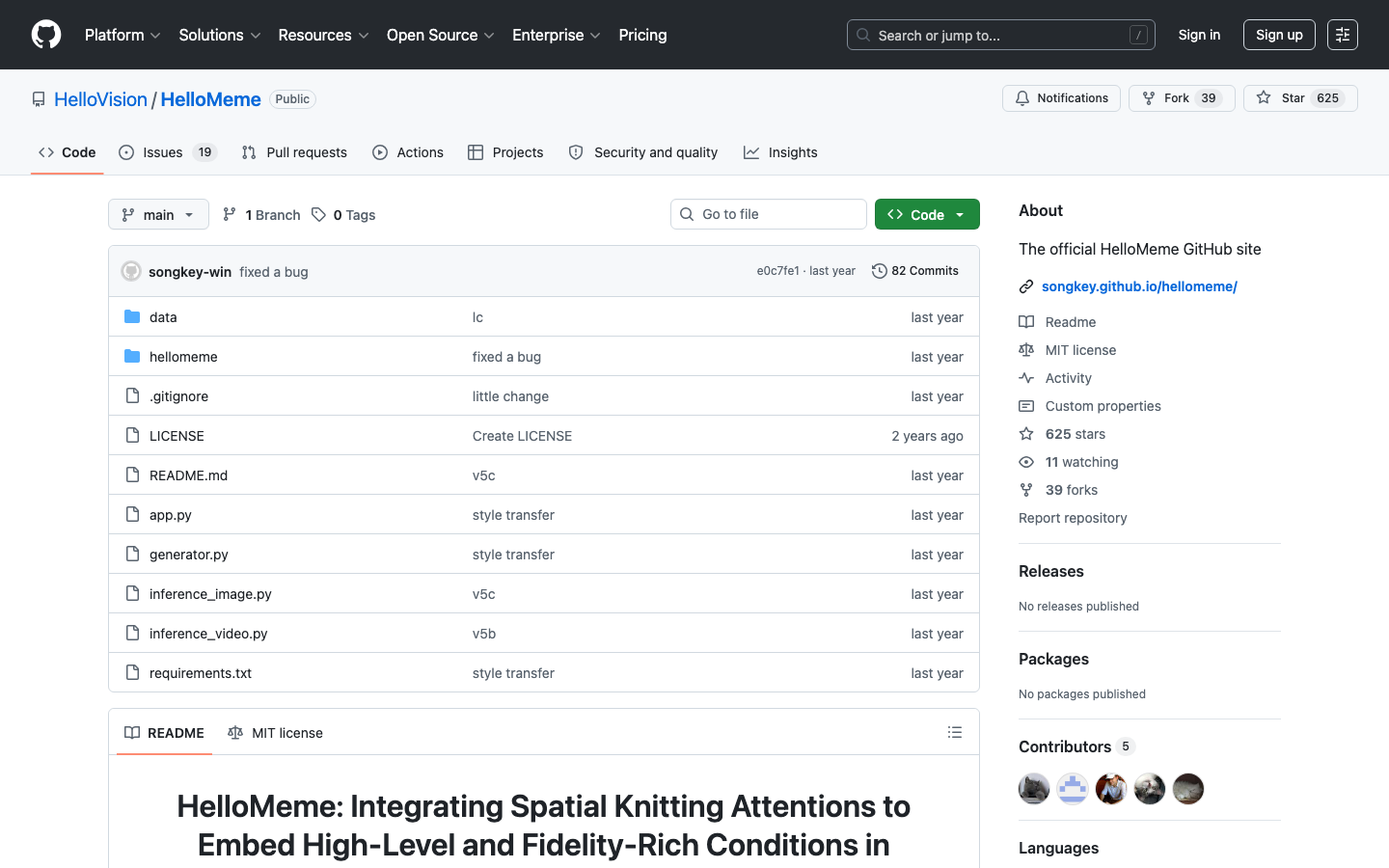
| Community size | GitHub about 625 stars, 39 forks |
| Generate route | Image generation, video generation |
| Supported forms | Python script Gradio App, ComfyUI, ModelScope Demo |
| Key modules | HMControlNet2, AnimateDiff related routes |
| Dependencies | PyTorch, FFmpeg |
A brief comment: It is not an independent consumer-level avatar app, but a portrait-driven generation base for visual creators and researchers.
Publicity verification: The official focus is on high-fidelity condition control and high-level semantic condition embedding. This statement is technically oriented and is not an empty talk like "style is more powerful". The change log continuously revolves around V2, V3, HMControlNet2, AnimateDiff and ComfyUI, which also shows that the team is indeed improving controllability and ease of use, rather than just making paper presentations.
User and market recognition
HelloMeme’s recognition comes primarily from the open source visual community rather than from a mass consumption platform. It attracts people who need to do avatar driving, expression transfer, character stylized video and experimental visual generation, rather than ordinary users who just want to upload selfies and produce pictures with one click.
Publicity Verification: The image generation and video generation processes it publicly displays are both in the paradigm of "reference image + driver image/driver video". This shows that the real problems it solves are character consistency and action drive, rather than generalized "generating a picture at will".
Market Signal: Although the number of stars is still at a medium scale, the project was quickly supplemented with ModelScope Demo, ComfyUI Manager keywords and Gradio app rewriting. This shows that it is trying to enter the creator workflow instead of just staying in the warehouse.
Boundary Judgment: It is more suitable for visual technicians and creators who are willing to debug, but not suitable for teams that want to directly complete commercial content production using mobile phones or browsers.
Cost advantage
HelloMeme’s core cost advantage is that “the code is free, self-buildable, and modifiable”, which allows creators and experimental teams to verify portrait-driven routes at low cost. But the real time cost still exists, especially in material preparation, action-driven selection, and parameter tuning.
| Cost Hierarchy | Disclosure | Real Meaning |
|---|---|---|
| C-side/personal | Open source and free, demo experience available | Suitable for creators with technical foundation |
| Developer/API | No independent commercial API pricing | You need to bear your own GPU, dependencies and deployment |
| Enterprise | No public enterprise package | The real cost lies in the content team and computing power configuration |
The Free Truth: Open source projects do not mean that finished-level production is free. Running image and video drivers, doing style testing, and adjusting driver materials often costs manpower and GPU time.
Hidden costs: FFmpeg, PyTorch, driver material quality, base model selection, video length and video memory usage will all affect usability.
Hidden benefits: For teams that need to re-test styles and test character consistency, open source allows them to avoid tying all workflows to a closed source SaaS and can keep experimental assets in their own hands.
Main functions
- Image-driven portrait generation: Use reference images and driver images to generate new expressions or stylized results.
- Video-driven generation: Use driver videos to drive character movements and expression changes.
- Gradio visual interface: lowers the operating threshold for users who are not pure code users.
- ComfyUI integration: It is convenient for visual creators to integrate it into the existing node-based workflow.
- Control module extension: Enhance controllability through HMControlNet2, AnimateDiff and other routes.
Expert View: Its real hidden linkage lies in the merging of research-level methods, ComfyUI commonly used by creators, and video-driven routes. In this way, creators do not have to choose between "good paper effect" and "workflow accessibility".
Model and version evolution
HelloMeme's version rhythm is very similar to a research-to-product project: each update is supplemented with "more controllable", "easier to access" and "more suitable for videos".
| Node | Date | Change focus |
|---|---|---|
| HMControlNet2 | 2024-11-14 | Enhanced conditional control |
| HelloMeme V2 | 2024-12-12 | Synchronize ComfyUI route |
| HelloMemeV3 | 2025-02-09 | Current mainline version |
Version Judgment: It does not rely on large and comprehensive platform functions, but continues to repair the two core issues of "controllability" and "creator access efficiency".
Technical advantages
According to the main delivery form, it is more suitable to be classified as a professional visual creation tool in [productivity/business-side applications]. Because what users get is not a general model API, but a portrait-driven generation system for specific visual tasks.
Quantified cost reduction and efficiency improvement: For teams that need to do emoticon packs, virtual character short videos, and avatar style experiments, the traditional process may require manual splicing of actions, expressions, and post-production between multiple software. HelloMeme can reduce the first round of draft generation from more than half a day to less than tens of minutes. This is an engineering deduction and not an official commitment.
Boundary of Human-Computer Collaboration: Material preprocessing, style drafts, and first-version expression videos can be highly automated; final character aesthetics, brand consistency, commercial material review, and street version screening must remain manual.
Mechanism to Effect: The significance of Spatial Knitting Attentions is to maintain high-level semantic control and appearance details at the same time, and reduce the problem of "the action is correct, but the character is off-kilter". This kind of causal chain is more convincing than the sentence "the effect is better".
How to use
conda create -n hellomeme python=3.10.11
conda activate hellomeme
pip install -r requirements.txt
git clone https://github.com/HelloVision/HelloMeme
cdHelloMeme

python inference_image.py
python inference_video.py
pythonapp.py
Use path: First run app.py to see the interaction, and then switch to inference_image.py or inference_video.py as needed. If the team already uses ComfyUI, it will be easier to connect the nodes directly.
Product Pricing
HelloMeme is currently delivered as open source and has no standalone commercial subscription price.
- Personal: Code is free, GPU and hardware costs are at your own expense.
- Developer: Suitable for secondary experiments and local integration.
- Enterprise: If you want to use it commercially, it is important to evaluate the quality stability, copyright, and internal review links.
Free truth: For pure creators, the biggest cost is not licensing, but trial and error.
Application scenarios
- Virtual character expressions and short video drafts: Quickly verify the effects of movement and expression migration. Using reference images + driver images, a set of expression packs or character short videos can be generated in a few minutes, which is much faster than modeling and rendering from scratch.
- Social media avatar and character content production: Suitable for high-frequency style testing. The operations team can use it to quickly switch between different character images and style templates without having to retrain the model for each style.
- Research and Visual Experiments: Suitable for evaluating condition control and character consistency routes. It is a reproducible open source baseline for teams working on portrait-driven and expression transfer.
Dissuade Scenario: A one-click commercial avatar platform that requires zero technical threshold; a scenario where brand-level videos need to be stably produced in batches but there is no human reviewer or post-production team.
Applicable people
- Visual Creator: Especially those who already use ComfyUI, can seamlessly plug into the workflow.
- AIGC R&D and Researchers: Suitable for researching conditional control routes, and the open source code can be freely modified and experimented.
- Technical positions in the content team: Suitable for internal creative verification and early-stage solution exploration.
- Independent Developer: Individual creators who need to generate virtual character avatars or expression materials.
Current Limitations: The project is more like a research-based creation tool and is still far away from a large-scale commercial finished product platform. GPU inference context construction and technical debugging are still necessary thresholds.
Summary and Outlook
The value of HelloMeme is not to turn the avatar tool into a fancy website, but to provide a relatively controllable portrait-driven generation route. This route is attractive for teams that value role consistency, action-drivenness, and workflow accessibility.
A more reasonable way to adopt it is to first use it for internal creative drafting and research verification, and then decide whether to enter the formal commercial workflow. The real risk is not whether the model is open source, but whether the output stability, aesthetic control and commercial review links can keep up.
Related tools:  Midjourney, stable-diffusion
Version Info
- HelloMemeV3 :The official changelog confirms that HelloMemeV3 has been released and gives a YouTube demo representing the current mainline version.
- HelloMeme V2 :Officially join HelloMeme V2 and synchronize code with ComfyUI route.
- HMControlNet2 module :Officially updated the control module HMControlNet2 to improve condition control capabilities.
User Reviews