 HELM
Free
HELM
Free
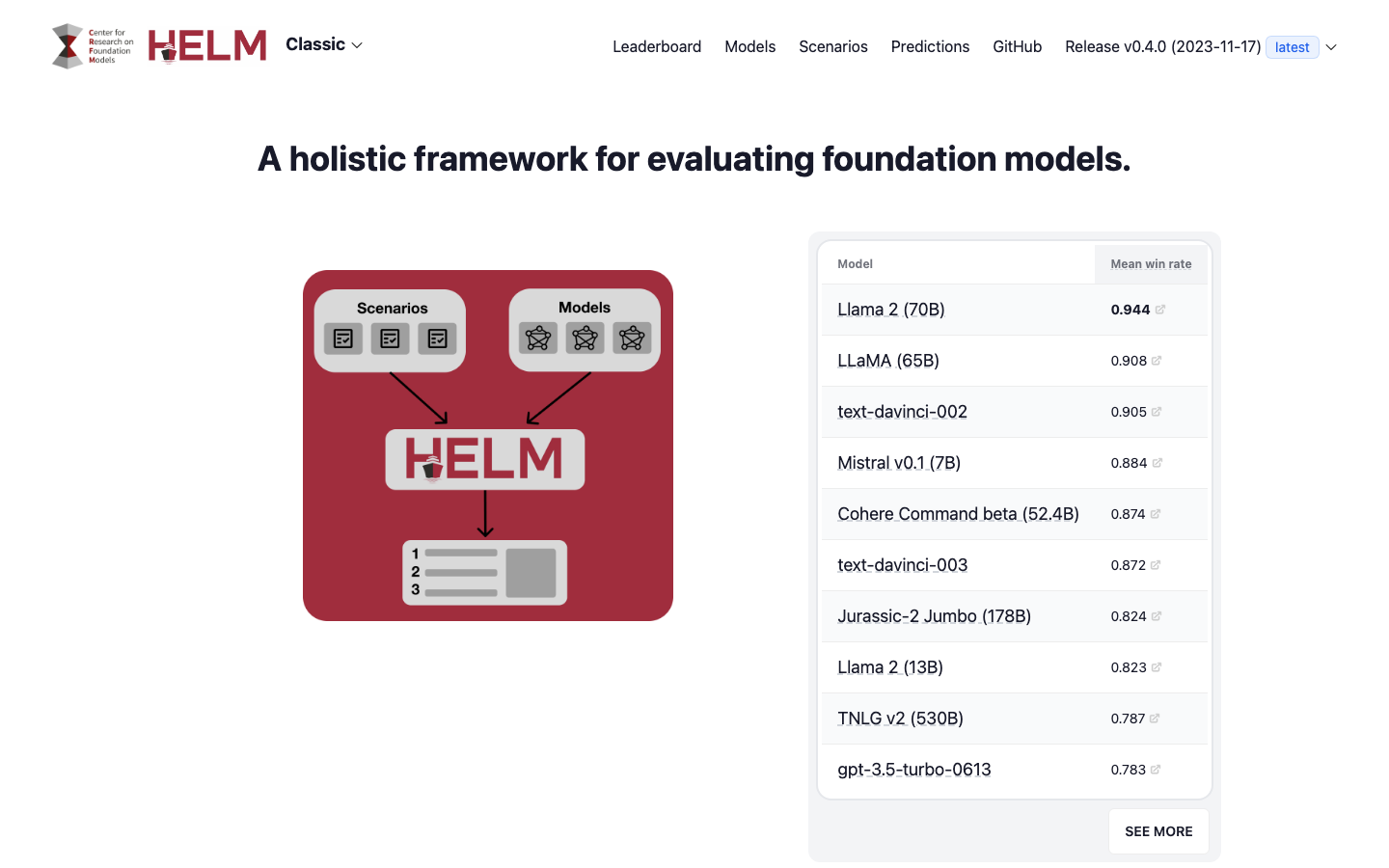
HELM (Holistic Evaluation of Language Models) is a large model overall evaluation system launched by Stanford University's CRFM. It emphasizes transparent and reproducible evaluation of language models under multiple scenarios and multiple indicators. It is one of the important model evaluation references in academia and industry.
Tool text
Core parameters and statistics
HELM (Holistic Evaluation of Language Models) is a large model evaluation system launched by the Center for Fundamental Model Research (CRFM) at Stanford University. Its core proposition is "holism" - not just looking at accuracy as one indicator, but systematically evaluating models under multiple scenarios and multiple indicators, and emphasizing that the evaluation process is transparent and reproducible.
| Projects | Public Information |
|---|---|
| Produced by | Stanford CRFM |
| Full name | Holistic Evaluation of Language Models |
| Evaluation concept | Overall evaluation of multiple scenarios and multiple indicators |
| Core emphasis | Transparent and reproducible |
| Output form | Evaluation list and results (continuously updated) |
| Place of Belonging | United States |
Overall evaluation value: A single indicator can easily conceal the true performance of the model. HELM provides a more comprehensive model portrait by covering multiple scenarios and multiple indicators (such as accuracy, robustness, fairness, efficiency, etc.). The specific dimensions are subject to the official one.
Transparent and Reproducible: HELM emphasizes the transparency and reproducibility of evaluation methods and results, which makes its conclusions highly credible in academic and industrial circles.
User and market recognition
HELM is one of the most influential large model evaluation systems in academia. Its recognition comes from the academic background and methodological rigor of Stanford CRFM.
Academic authority: As a research output of Stanford CRFM, HELM has high authority in evaluation methodology and is widely cited and referenced.
Industry Impact: HELM's overall evaluation concept has influenced the industry's understanding of model evaluation, promoting the shift from single indicators to multi-dimensional evaluation.
Prerequisites for use: HELM's evaluation covers common scenarios and indicators. For specific vertical business tasks, its conclusions are an important reference but not a sufficient basis. It still needs to be retested based on its own tasks.
Cost advantage
HELM, as a public evaluation system for academic institutions, is free to users and its methods are transparent.
- Public and Free: The evaluation results and methods are publicly available and serve as a free reference for model evaluation.
- Method Transparency: The evaluation process and indicators are made public, and the conclusions are reproducible, reducing uncertainty about the credibility of the results.
- Hidden costs: Before applying general evaluation conclusions to specific businesses, it is still necessary to retest based on your own data to avoid the misjudgment that "general leadership is the best business".
Main functions
Focusing on the "overall evaluation language model", HELM's capabilities include:
- Multi-scenario evaluation: Covers multiple types of task scenarios to provide a more comprehensive picture of model performance.
- Multi-index measurement: In addition to accuracy, multi-dimensional indicators such as robustness, fairness, and efficiency are included (subject to official standards).
- Transparent and Reproducible: The evaluation methods and processes are public, and the results can be reproduced and verified.
- Continuously update the list: Continuously incorporate new models and update results in the latest format, and derive lists for specific directions.
Specific evaluation scenarios, indicator definitions and coverage models are subject to real-time information from the official platform.
Model and version evolution
HELM is continuously updated in the latest form, and its evolution is reflected in the expansion of evaluation scenarios and updates to coverage models.
- System Release Phase: Stanford CRFM launches the HELM overall evaluation system and establishes a multi-scenario and multi-index method.
- Continuous expansion: With the development of large models, the evaluation scenarios will be expanded and evaluation lists oriented to specific directions will be derived.
It does not have a single software version number, and updates follow the model ecology, and the official platform shall prevail.
Technical advantages
The advantage of HELM comes from "holistic evaluation method + transparency and reproducibility + academic endorsement".
Comprehensive method: Overall evaluation of multiple scenarios and multiple indicators to avoid a single score from covering up differences in models in different dimensions.
Transparent and Credible: The evaluation methods and processes are disclosed and the results are reproducible, making the conclusions more convincing in the academic and industrial circles.
Continuous evolution: Continuously expand evaluation scenarios and coverage models as the model develops, maintaining reference value.
How to use
| How to use | Suitable for people | Features |
|---|---|---|
| Visit the evaluation platform | Researchers, selection team | View multi-scenario and multi-index results |
| Multi-dimensional comparison | Technical decision-makers | Compare models from multiple dimensions |
| Combined with own retest | Implementation team | Use business data for secondary verification |
Typical usage is: check the performance of the target model in multiple scenarios and multiple indicators on the HELM platform, make judgments based on the dimensions you are concerned about (such as robustness, fairness, efficiency), and then retest using real business tasks instead of just looking at a single ranking.
Product Pricing
The pricing model is subject to the official real-time page. Usually a freemium or subscription system is used, and basic functions can be used for free. Advanced functions or high-frequency use require paid subscriptions, and users are advised to evaluate the optimal solution based on actual usage.
Application scenarios
- Model Selection Reference: Compare candidate models from multiple dimensions to assist in technology selection.
- Research Benchmark: Provide a unified and transparent overall evaluation reference for research.
- Risk Dimension Assessment: Focus on dimensions such as robustness and fairness to assist in risk judgment.
- Industry awareness: Promote the industry to understand model performance from a multi-dimensional perspective.
Applicable people
- Researcher: Transparent and reproducible holistic evaluation methods are needed.
- Technical decision makers: When selecting models, they hope to evaluate the model from multiple dimensions instead of a single indicator.
- Teams focusing on AI risks: People who need to refer to dimensions such as robustness and fairness.
The less suitable situation is: only a quick judgment of the absolute performance of a certain vertical task is required. HELM's overall evaluation is more suitable for systematic reference. In the end, it still needs to be based on the retest of its own business data.
Summary and Outlook
The core value of HELM is to provide multi-scenario, multi-index, transparent and reproducible overall evaluation of large models. It is an important evaluation reference system for academia and industry. Its limitation is that the general evaluation may not completely match each specific business, and the conclusion needs to be combined with its own data and retested before being used for decision-making.
What is worth observing in the future is the expansion speed of its evaluation scenarios with new models and new modes, as well as the breadth of coverage of derivative lists. For users, it is recommended to use HELM as a reference for multi-dimensional selection and risk assessment, and then use real business tasks for final verification. For specific evaluation scenarios and indicators, please refer to the official platform’s real-time information.
Related tools:  Hugging Face, replicate
Version Info
- HELM current evaluation version :HELM continuously updates the evaluation results and coverage models in the latest form, and derives multiple evaluation lists for specific directions. It is not unified into a single software version number. Specific scenarios and indicators are subject to the official platform.
- HELM overall evaluation system released :Stanford CRFM launched the HELM overall evaluation system and proposed a method to transparently evaluate language models under multiple scenarios and multiple indicators. It will continue to expand evaluation scenarios and coverage models in the future. The specific time is subject to official information.
User Reviews