 Inbenta
Inbenta is a set of AI agents platform for enterprise customer service and knowledge governance. Its core selling point is not "the ability to chat", but through knowledge engineering, auditable retrieval and multi-model orchestration, it turns AI responses in regulated environments into a system that is traceable, manageable, and sustainably maintained.
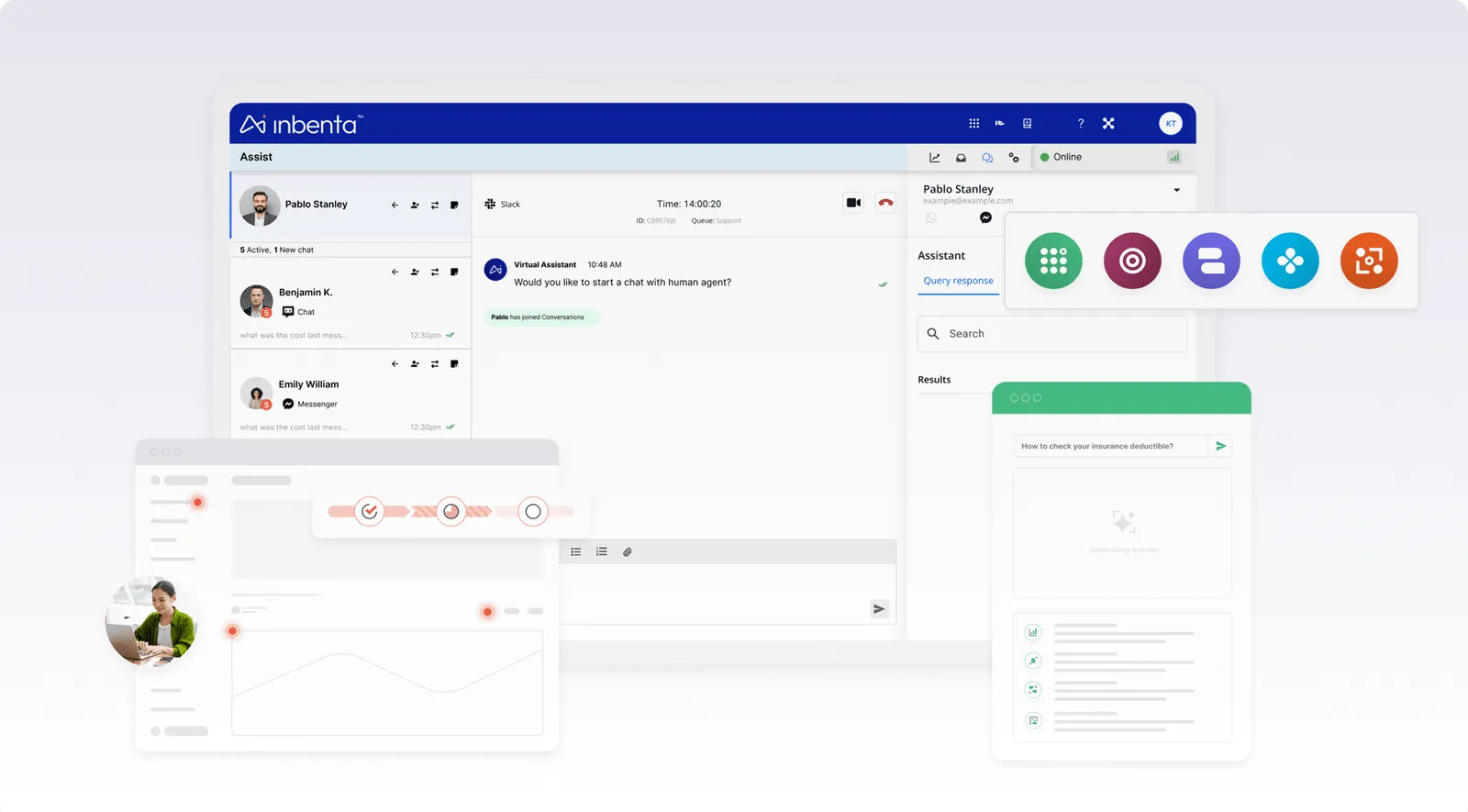
Inbenta
Core parameters and statistics
Main type: RAG / knowledge base / data center. Although the official website repeatedly emphasizes agentic AI, its real control surface lies in knowledge engineering, data ingestion, governance and traceable retrieval, rather than allowing models to be directly and freely generated.
| Projects | Public Information |
|---|---|
| Platform Main Line | Encore Agentic AI Platform |
| Company starting point | Founded in 2005 |
| Customer scale | 1000+ customers globally |
| Language skills | 100+ languages / Platform page emphasis 90+ languages optimized |
| Integration Ecosystem | 850+ pre-built integrations |
| Public effect | +75% faster deployment, +50% overhead reduction, +98% response accuracy |
| Core Methodology | Knowledge Engineering + AI Orchestration + Governed Response |
| Deployment positioning | For high compliance scenarios such as finance, medical care, tourism, e-commerce, etc. |
Brief comment in one sentence: Inbenta is not "making another enterprise chatbot", but selling a knowledge management base that allows customer service AI to be accepted by legal affairs, risk control and operations at the same time.
Publicity verification: The official website’s emphasis on “anti-hallucination” and “auditability” is not empty talk, because its core mechanism is indeed not to let LLM compile answers on the spot, but to let the knowledge engineering layer manage the answers first, and then retrieve and return them at runtime.
User and market recognition
Enterprise adoption: Officially disclosed that its services cover 1,000+ enterprises and support 100+ languages, and cited cases such as BBVA, Deutsche Bank, Samsung, FamilySearch, etc., indicating that it is not a proof-of-concept platform.
Business results: The official case page and articles give multiple sets of quantitative signals, such as +35% FCR, +50% OPEX reduction, +75% deployment speed, 84% escalation reduction and 10M+ annual query magnitude in some cases. These numbers are closer to the operational results that enterprises really care about when purchasing.
Adoption Boundaries: Inbenta's recognition comes from strong governance and high accuracy, not the most open space for model experimentation. If you are pursuing an extremely flexible generation experience, its "many rules" will seem heavy.
Cost advantage
C-side/Individual: There is no public package for individuals. It is a typical enterprise-level purchasing product.
Developer/API: What is officially disclosed is consumption-based pricing, which means billing based on actual usage rather than signing a large seat fee first. This reduces the initial financial friction for businesses to move from pilot to scale.
Enterprise / Privatization: The real value is not in “cheapness”, but in avoiding rework and shutdowns caused by hallucinations, lack of audits, and aging knowledge after AI goes online. For regulated industries, this hidden cost is often greater than the model call fee.
Hidden benefits/costs: If customer service AI is always stuck in compliance and knowledge maintenance from demonstration to production, Inbenta saves the cost of communication and rework within the organization; but if your team's knowledge assets are already messy, the initial investment in knowledge organization will not be small.
Main functions
- Multi-format data ingest: Supports the ingestion of websites, documents, audio and video, recorded phone calls and certified content.
- Knowledge Engineering: Automatically generate intents, draft answers, and structured tags during the ingestion phase instead of waiting for the model to be used at runtime.
- AI Orchestration: Coordinates models, tools, workflows and data sources to transform customer service AI from a single round of question and answer to a multi-step solution process.
- Governed Response: Returns an answer traceable to a specific source and version, supporting audit links.
- Continuous maintenance and monitoring: Continuous observation and write-back of missing knowledge, upgrade suggestions, language expansion and content drift.
Expert’s perspective: Inbenta’s hidden linkage lies in “organizing knowledge first, then arranging models and processes, and finally answering users.” The biggest difference between this and a bunch of LLM wrappers is that it makes anti-hallucination an architectural problem, not a prompt word problem.
Model and version evolution
Encore platform stage
The 2026 Encore is the clearest product line yet. It combines knowledge engineering AI orchestration, auditable response and multi-channel customer service capabilities under a unified platform name.
Kitization stage
Before Encore, Inbenta was delivered to enterprises with capabilities such as Chat, Search, Knowledge, Assist, and Learn, which were more like modular product groups rather than the current "unified control plane" narrative.
NLP starting point
The company was founded in 2005 and focused on NLP and customer service knowledge interaction in its early years, which explains why it is better at knowledge governance today rather than simply selling the latest model calls.
Technical advantages
Data Boundaries: Officially explicitly supports website, document, audio, video, recorded phone calls, and authenticated content ingestion, as well as authenticated content. For the parsing details of scanned PDFs, table images, and complex OCR documents, the official public page does not provide enough fine-grained instructions. Actual implementation requires separate verification of OCR and structuring effects.
Recall Pain Points: When multiple languages are mixed, industry terminology is dense, and documents are frequently updated, any enterprise knowledge base will face a decline in recall rate. The advantage of Inbenta is that it does intent, tagging and governed knowledge in the ingestion phase, but you should still focus on verifying Hybrid Search, metadata filtering, multi-language alias chunk strategy and rerank behavior before purchasing.
Security Compliance: Officials have repeatedly emphasized data isolation, full audit trail, role-based access to audit data, and adaptation to frameworks or requirements such as CFPB, EU AI Act, SOC2, HIPAA, etc. It should be noted that the public page places more emphasis on compliance mapping and architectural readiness, and the complete certification boundaries and contract terms still require business confirmation.
Data is not mixed for training: The official clearly states that each customer deployment will build a dedicated knowledge base, which will not be shared with other customers, nor used in the training of other customers. This is critical for financial, healthcare, and B2B SaaS.
How to use
| Stages | Goals | Key Actions |
|---|---|---|
| Knowledge acquisition | Establishing a governance base | Connecting websites, documents, recordings, and certification content |
| Knowledge Engineering | Improve answer traceability | Generate intents, tags, draft answers, and version rules |
| Orchestration and integration | Connecting to business systems | Connecting with CRM, ERP, contact center, and work order systems |
| Online monitoring | Control drift | Track accuracy fallback, escalation and gap |
Implementation path: Don’t pursue omni-channel autonomy from the beginning. The correct approach is to first pilot a regulated but clearly defined knowledge domain, such as credit card FAQ, policy self-service or internal support desk, and then gradually expand workflow autonomy capabilities.
Human-machine collaboration boundary: FAQ, policy retrieval, and standardized customer service guidance can be highly automated; manual confirmation points must be set up for high-risk approvals, abnormal customer complaints, fund operations, medical sensitive information processing, and legal exceptions.
Product Pricing
Public price structure: The official website only discloses consumption-based pricing and does not disclose unified package prices. The logic is that you pay according to actual usage, with no upfront cost, and the scale increases or decreases with usage.
Cost understanding method:
| Cost layer | Public information |
|---|---|
| Pilot | No upfront cost, start based on usage |
| Expansion | Prices will change as usage increases |
| Enterprise | Contact sales for organization-level quotes and compliance terms |
Procurement/Adoption Risk Assessment: Consumption billing lowers the threshold for piloting, but what enterprises really want to look at is not the “unit price”, but the total cost of knowledge collection, human-machine collaboration, system access, and compliance auditing.
Application scenarios
- Regulated Customer Service Center: Customer service scenarios that require traceable answers such as banking, insurance, medical and travel.
- Enterprise Search and Knowledge Assistant: Let employees or customers find accurate answers on a unified knowledge base instead of hitting probability generation.
- Agent Assist and multi-step workflow: Provide translation, sentiment analysis, response generation and work order collaboration for human agents.
Dimensionality reduction attack scenario: Most suitable for companies whose AI pilots have been unable to pass legal, risk control or knowledge maintenance hurdles.
Applicable people
- CX/Contact Center Leader: I hope to use AI to do real first-contact resolution instead of just deflection slogans.
- CISO/Risk/Compliance Team: Need a system where the source of answers can be checked, records can be exported, and permissions can be controlled.
- Enterprise Architecture and Knowledge Management Team: It is necessary to unify multiple systems, multiple languages, and multiple knowledge sources into one governance surface.
Dissuade/not applicable: Small teams, light customer service scenarios, and products that focus on creative generation and free Q&A do not necessarily require such a heavy knowledge engineering structure.
Not suitable for boundaries: If the organization does not have the ability to continuously manage the knowledge base, just buying a platform will not automatically solve the problems of outdated content, inconsistent caliber, and dirty data in the source system.
Summary and Outlook
The core value of Inbenta is not to "also have an agent", but to turn knowledge acquisition, knowledge engineering, retrieval and auditing, and multi-model orchestration into a production system that can be launched by enterprises. For finance, healthcare, travel, and large B2B SaaS, this “glass box” architecture is more important than being good at chatting.
The most interesting thing to watch in the future is whether Encore can continue to transform the advantages of knowledge governance into a lighter deployment experience, instead of only serving mature large enterprises. A more stable approach is to first use a single knowledge domain pilot to evaluate recall quality, audit link RBAC and update management, and then decide whether to expand to omni-channel autonomy; scanned OCR, complex form parsing, multi-lingual knowledge synchronization and contract-level compliance clauses are all risk points that must be independently verified before purchasing.
Related tools:  CrewAI,
  LangChain
Version Info
- Encore Agentic AI Platform :Inbenta will use Encore as the main line of its enterprise-level Agentic AI platform in March 2026, emphasizing 98% response accuracy, 75% faster deployment, and an auditable architecture with knowledge engineering as the core; there is no official precise date yet.
- Chat / Search / Knowledge / Assist / Learn platform stage :Before Encore, Inbenta had formed an enterprise customer service and knowledge management product suite of Chat, Search, Knowledge, Assist, and Learn; there is no official precise date yet.
- NLP and Conversational AI Starting Point :Inbenta was founded in 2005. It first focused on natural language processing and enterprise customer service knowledge interaction, and then gradually evolved into the current Agentic AI platform; there is no official precise date yet.
User Reviews