 Kimi
Free
Kimi
Free
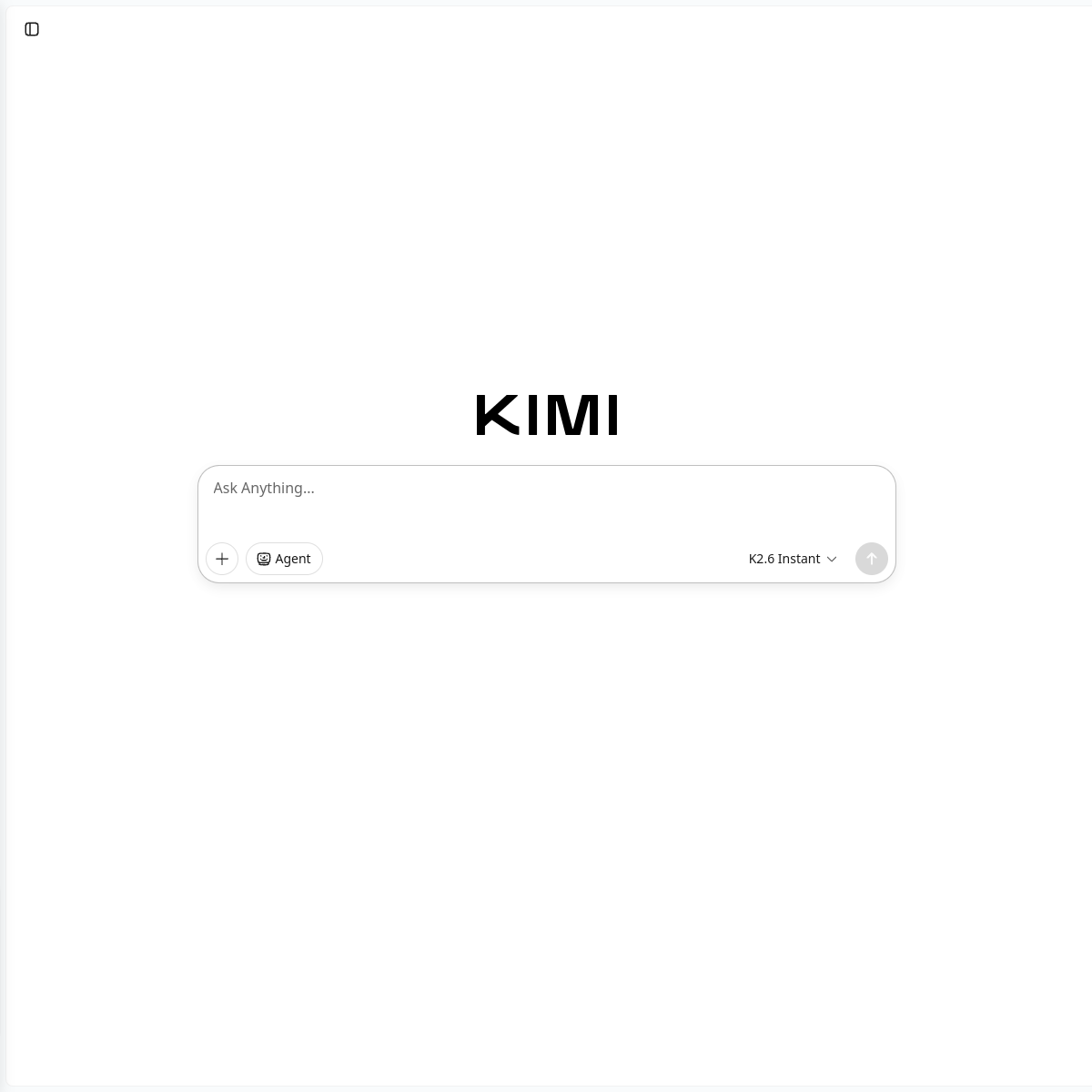
Kimi is an AI Chat assistant product launched by Moonshot AI. It takes long-context understanding, deep reasoning and multi-agent collaboration as its core capabilities, covering scenarios such as knowledge work, programming assistance, and in-depth research. The latest K3 flagship model supports 1M tokens context window, and forms a complete productivity solution with functions such as Agent Swarm and Deep Research.
Kimi
Kimi’s core parameters and statistics
Kimi's product positioning is unique among domestic AI assistants: starting from long context, it gradually builds a complete product matrix covering general dialogue, deep reasoning, programming assistance and multi-agent collaboration. The latest K3 flagship model pushes the capability ceiling to a new height, forming differentiated competition with  豆包 and Qwen .
| Dimensions | Key information |
|---|---|
| Product positioning | Long context AI assistant + multi-agent collaboration platform |
| Flagship model | K3 (1M tokens context) |
| Workhorse Model | K2.6 Instant (256k context) |
| Programming Specialization | K2.7 Code (256k contexts) |
| Core Competencies | Long document understanding, deep reasoning agent programming, multi-modal vision |
| Covering terminals | Web, iOS, Android, API |
| Product Matrix | Chat, Code, Work Beta, Slides, Sheets, Docs, Websites, Swarm, Deep Research |
| Place of Belonging | CN |
| Competitive range | Domestic high-capacity AI assistant and intelligent agent market |
Version Matrix Description: K3 is positioned as the flagship, oriented towards difficult reasoning and large-scale context tasks; K2.6 is the general main force, taking into account both cost and quality; K2.7 Code specializes in programming scenarios, and the three cover different efficiency and budget requirements. K3 is priced about 3-4 times that of K2.6 and is suitable for professional scenarios that require extremely high inference quality.
Kimi’s users and market recognition
Kimi has developed strong user awareness in long text processing scenarios and has rapidly penetrated into the enterprise-level API market.
C-side market: Kimi has established a reputation for tasks such as paper reading, report disassembly, and knowledge induction, and is favored by knowledge workers and heavy learning users. The product has evolved from a single conversation tool to a platform containing multiple productivity modules, and user stickiness has gradually increased.
B-side market: Kimi open platform has attracted millions of developers, and the cooperation ecosystem covers leading enterprises in multiple industries - Tencent Cloud CodeBuddy integrates Kimi K2 Thinking to provide code assistance capabilities; Jingtai Technology uses K2.5 to accelerate drug and material research and development; Keep uses Kimi's multi-modal capabilities to achieve real-time capture and feedback of fitness actions; AlphaEngine builds FinGPT Agent based on K2 Thinking, helping investment researchers reduce costs by 60% Business costs (subject to the company’s public cases). In addition, platforms such as Cursor, Windsurf, Vercel, Coze, Huawei, and Xiaohongshu have also been connected to the Kimi model ecosystem.
Industry Recognition: Kimi K2.5 ranks Top 2 in both the chemical literature benchmark RxnBench lists, keeping pace with top closed-source models such as Gemini-3 and GPT-5.2, forming a sharp lead over open-source models.
Kimi’s cost advantage
- C-side/Individual: Usually a free version is provided to experience the core functions, and high-frequency use requires a paid package subscription.
- API/Developer: Billed by call volume, suitable for development teams that can be flexibly integrated into their own systems.
- Enterprise/Privatization: Contact the business owner to obtain customized quotation and deployment plan. The specific price is subject to the official real-time pricing page.
Kimi’s main features
Kimi has evolved from a single conversation tool to a product system that includes multiple productivity modules. The core functions can be divided into four layers:
Dialogue and Reasoning Layer:
- Long context Q&A: K3 supports 1M tokens context window, which can process extremely long documents, complete code bases or complex conversation history at once, and maintain the stability of instruction following in long contexts.
- Deep Thinking Mode: K2 Thinking mode supports interleaved reasoning and 300-step tool calls, which is suitable for complex tasks that require multi-step reasoning and interaction with external information.
- Multi-modal understanding: Supports the input of pictures, documents (PDF/Word/Excel/PPT/TXT) and other formats, and performs content analysis, summary and multiple rounds of questioning.
Agent and Automation Layer:
- Agent Swarm (multi-agent cluster): Supports the creation of multiple AI agents to collaborate to complete complex tasks - such as building a Linux system, forking VS Code Web, managing 500+ paper libraries, etc., to achieve end-to-end automation from instructions to delivery.
- Deep Research: AI research assistant mode, automatically completes multi-source information retrieval, cross-validation and structured report generation, suitable for competitive product analysis, industry research, paper review and other scenarios.
- Scheduled Tasks: Supports the setting of periodic automated tasks to implement workflows such as scheduled information summary, monitoring reminders, etc.
- Kimi Claw (web scraping): Built-in web content extraction and structured processing capabilities.
Productivity Tool Layer:
- Kimi Work Beta: Online office suite covering document collaboration and project management.
- Kimi Code: AI programming assistant that supports code generation, refactoring, debugging and multi-step development.
- Slides / Docs / Sheets / Websites: Built-in AI-driven presentation, document, spreadsheet and web page generation tools to achieve an integrated workflow from content to delivery.
- Plugins (plug-in system): Extensible third-party tool capabilities.
API tool layer (built-in in the open platform):
- Web Search: Internet search tool, citing authoritative sources to ensure timeliness.
- Code-Runner / Quick JS: Python and JavaScript code sandbox execution context.
- Memory: Persistent storage of conversation history and user preferences.
- Excel/Fetch/Date/Convert/Base 64: Structured data processing and auxiliary toolset.
Expert View: Kimi's product system is not a simple stack of functions - long context is the basic pipeline, Agent capabilities are the execution engine, and productivity tools are the delivery terminals. A typical link can be: Deep Research research report generation → Kimi Work collaborative editing → Slides are automatically converted into presentations. The entire process is completed within one platform, eliminating the friction cost of switching between tools.
Kimi’s model and version evolution
Kimi's model iteration evolves around the path of "long context → deep reasoning → multi-modality → programming specialization → flagship enhancement":
| Version stage | Time | Iteration focus |
|---|---|---|
| Kimi First Edition | 2023-10 | Establish product differentiation with long context capabilities and open testing to users |
| Context enhancement period | 2024-03 | Context window expansion to adapt to scenarios such as papers, legal documents, long reports, etc. |
| K2 Series | 2025-11 | Introducing Thinking mode, the reasoning and coding task capabilities have jumped, and it supports 300 steps of tool calls |
| K2.5 | 2026-01 | Enhanced multi-modal understanding, breakthroughs in professional scenarios such as chemical literature and scientific research charts |
| K2.6 Instant | 2026-02 | Optimized response speed, supports visual/text dual mode, 256k context |
| K2.7 Code | 2026-04 | Programming specialization model, long context instruction compliance stability improvement |
| K3 flagship | 2026-06 | 1M context window, comprehensive improvement of capability ceiling |
K3 flagship model
K3 is Kimi's most powerful model to date. The 1M tokens context window gives it significant advantages in tasks such as ultra-long document analysis, large-scale code base understanding, and complex multi-round reasoning. The pricing is in the high-end range (output ¥100/MTok) and is aimed at professional scenarios with extremely high quality requirements.
Key capabilities highlights of K3:
- 1M tokens context window: Work with dozens of academic monographs, complete large code bases, or extremely long conversation histories at once. Maintaining the stability of instruction following and information retrieval accuracy in ultra-long contexts is the core difference between K3 and ordinary long context models.
- Agent Swarm deep integration: K3 is the underlying engine of Kimi Agent Swarm capabilities, supporting the creation of multiple AI agents to work together to complete complex engineering tasks - end-to-end automation from requirements analysis to code generation to test execution.
- Deep Reasoning Enhancement: K3 further optimizes the accuracy and efficiency of the reasoning link based on the K2 Thinking mode, reaching the highest level of the Kimi series in difficult reasoning tasks such as mathematics, logic, and code.
- Multi-modal understanding: Supports input understanding and analysis of multiple formats such as images, PDFs, Office documents, etc.
K2.6 / K2.7 Code main model
K2.6 and K2.7 Code share 256k context windows and the same pricing (output ¥27/MTok), making them the main choice for daily development and knowledge work. The difference between the two lies in the focus of tasks: K2.6 general dialogue and reasoning, K2.7 Code programming specialization.
Kimi’s technical advantages
Kimi’s technical competitiveness is reflected in three levels:
Long context engineering capabilities: Since its first generation product, Kimi has used long context as its core selling point. The reason why K3 expands the window to 1M tokens is the continuous engineering optimization of the attention mechanism and KV cache. The practical value of long context is not just to "pack more text", but to maintain the stability of instruction following and retrieval accuracy in ultra-long contexts - this is the key difference between Kimi and ordinary conversation models.
Thinking mode and tool calling: The Thinking mode introduced in the K2 series allows the model to perform internal analysis chain reasoning before answering, significantly improving accuracy in tasks such as mathematics, logic, and coding that require multi-step deduction. Coupled with the 300-step tool calling capability, Kimi can independently plan and execute complex tasks: search for information → execute code → read documents → comprehensive output, forming a complete Agent package.
Model matrix layout: Kimi did not pursue a single model to cover all scenarios, but built a hierarchical matrix of K3 (flagship), K2.6 (general), and K2.7 Code (programming). This strategy allows users to choose an appropriate model based on the value density and budget constraints of the task - K2.6 is used for daily question and answer to control costs, and K3 is used for critical reasoning and ultra-long documents to ensure quality.
How to use Kimi
| Entrance | How to use | Typical tasks |
|---|---|---|
| kimi.com | Direct dialogue + sidebar tool matrix | Long article summary, complex Q&A, in-depth study of Swarm multi-agent |
| Kimi App | Mobile access | Instant questions, voice interaction, document photo analysis |
| Open platform (platform.kimi.com) | API call + console management | Enterprise system integration, customized workflow |
| Kimi Code | Independent programming interface | Code generation, debugging, refactoring |
Typical workflow example: Upload or paste long text → Select Thinking mode for in-depth reasoning → Call Deep Research to supplement external information → Use Swarm multi-agent collaboration to complete complex tasks → Output the final deliverable through Slides/Docs.
API quick access example (taking Python as an example):
import openai # Compatible with OpenAI SDK

client = openai.OpenAI(
    api_key="<YOUR_API_KEY>",
    base_url="https://api.moonshot.cn/v1"
)

response = client.chat.completions.create(
    model="kimi-k2.6-instant",
    messages=[
        {"role": "system", "content": "You are a professional research assistant"},
        {"role": "user", "content": "Please analyze the core points of this industry report"}
    ],
    temperature=0.3,
    max_tokens=4096,
    stream=True
)

for chunk in response:
    print(chunk.choices[0].delta.content or "", end="")
The endpoint and model names are subject to official documents, and API Key needs to be created and recharged on the platform in advance.
Kimi’s Product Pricing
The pricing model is subject to the official real-time page. Usually a freemium or subscription system is used, and basic functions can be used for free. Advanced functions or high-frequency use require paid subscriptions, and users are advised to evaluate the optimal solution based on actual usage.
Kimi application scenarios
Academic research and paper analysis: The 1M context window can process an entire monograph or dozens of papers at one time, supporting chapter-level summary, key argument extraction, literature comparison, and citation relationship sorting. Researchers can shorten the time from "manual reading article by article" to the collaborative mode of "AI preliminary screening + manual verification".
Deep Research and Competitive Analysis: Deep Research mode automatically completes multi-source information retrieval, cross-validation and structured report generation. Investment research institutions can shorten the production cycle of industry analysis reports from days to hours (based on workflow deduction, unofficial commitment), and analysts focus on logical verification rather than information collection.
Software Engineering and Programming Assistance: Kimi Code and K2.7 Code models cover code generation, debugging, refactoring and multi-step development. The 300-step tool calling capability enables AI to autonomously complete the complete process from requirement understanding to code submission, which is suitable for scenarios such as automated test generation and legacy code modernization.
Multi-agent collaboration and automation: Agent Swarm supports the creation of multiple AI agents for division of labor and collaboration, which is suitable for complex project management, large-scale document production, system construction and other tasks that require multi-role collaboration.
Enterprise Knowledge Management: After accessing the API, enterprises can embed Kimi into internal knowledge bases, customer service systems, contract review and other scenarios. The case of Tencent Cloud CodeBuddy integrating Kimi K2 Thinking shows that Kimi has engineering value in terms of code assistance and R&D efficiency improvement.
Kimi’s applicable group
-
Students and Researchers: Need to deal with high-density knowledge materials, such as paper reading, literature review, and concept learning. K3’s 1M context window can cover the entire textbook or the preliminary screening of dozens of papers at one time. Unsuitable scenarios: Academic writing that requires strict citation format control still requires careful manual editing.
-
Analysts and Consultants: Need to quickly extract key conclusions from massive amounts of information. Deep Research can automate the first draft of industry research and reports, but the strategic judgment and data verification of the final deliverable must be manually confirmed. Unsuitable premise: In scenarios where information sources are narrow or there is too much non-public data, AI’s retrieval capabilities are limited.
-
Developers and Software Engineers: Kimi Code and K2.7 Code assist with code generation, debugging and refactoring. It is suitable for daily development and efficiency improvement, but security review and architectural decisions of production-level code still require manual responsibility. Not suitable for bordering: Organizations that have strict compliance requirements for code copyright need to confirm the ownership boundaries of AI-generated code.
-
Enterprise Team: Realize knowledge management, customer service automation, contract review and other scenarios through API integration. The enterprise version can meet data compliance and SLA requirements, but you need to verify the degree of data isolation, the feasibility of model fine-tuning, and the liability clauses in the contract before purchasing. Unsuitable scenarios: High-risk areas with zero tolerance for AI output errors (such as medical diagnosis, financial transaction decision-making) require a strict manual review mechanism.
Kimi’s summary and outlook
Kimi has established a unique positioning in the domestic AI assistant market: starting from the long context, it gradually builds a complete product matrix covering dialogue, reasoning, programming, multi-agent collaboration and productivity tools. The release of the K3 flagship model pushes the context window to 1M tokens, forming differentiated competitiveness in ultra-long document processing and complex reasoning tasks.
Current Limitations and Risks:
- K3's high pricing (output ¥100/MTok) limits its popularity in cost-sensitive scenarios. The actual cost-effectiveness needs to be evaluated based on cache hit rate and task requirements.
- Complexity caused by the rapid expansion of product function modules - users may face too many entrances and tool choices, and there is a learning cost for new users to get started.
- The free quota and speed limit strategy of API services for small and medium-sized developers are not fully disclosed. Developers need to confirm the actual usage restrictions with the platform before purchasing.
- There are still uncertainties in the compliance access of domestic large models in overseas markets, and companies involved in cross-border deployment need to evaluate data localization requirements in advance.
Follow-up observation points: The ecological penetration speed of the K3 series, the actual completion rate of Agent Swarm in complex engineering tasks, the customer retention data of enterprise-level API services, and the upper limit of Kimi's capabilities in the field of multi-modal and tool calling. For enterprises planning to purchase, it is recommended to start with pilot projects in non-core scenarios and use 1-3 months to verify the output quality and cost model before expanding to core business flows.
Comparison of competing products
| Comparison dimensions | The tool | Competitor A | Competitor B |
|---|---|---|---|
| Core Differences | — | — | — |
| Price | — | — | — |
| Target User | — | — | -- |
Kimi's How to use
- Web client: You can use it by visiting the official website and registering an account. Most functions do not require installation.
- API access: Provides RESTful API, developers can obtain the API Key and integrate it into their own applications.
Version Info
- K3 flagship model :K3 is Kimi’s most powerful flagship model to date, supporting 1M tokens context windows and designed for cutting-edge intelligent scenarios such as software engineering, knowledge work, and deep reasoning.
- K2.7 Code :K2.7 Code is Kimi's specialized programming model, which follows instructions more reliably in long contexts and completes programming tasks with a higher success rate. The context window is 256k. There is no official precise date yet.
- K2.6 Instant :K2.6 Instant is further optimized for long text understanding, complex reasoning and response speed, supporting visual and text input, thinking and non-thinking modes, dialogue and programming Agent tasks, with a context window of 256k.
- K2.5 multi-modal enhancement :K2.5 enhances multi-modal understanding capabilities and performs well in professional scenarios such as chemical literature analysis and scientific research chart understanding. There is no official precise date yet.
- K2 series :The K2 series introduces the Thinking mode, which significantly improves reasoning and coding task capabilities and supports 300 steps of tool invocation.
- Enhanced long context capabilities :The context window capability is further expanded to adapt to tasks such as paper reading, legal documents, and long report processing.
- The first version of Kimi is open :Kimi is open to users for testing and differentiates itself with long context capabilities.
User Reviews