 Kimi Linear
Free
Kimi Linear
Free
Kimi Linear is a hybrid linear attention architecture open source model launched by Moonshot AI. It is designed for high-throughput reasoning in 1M-level contexts. It can reduce KV cache usage by up to 75% and increase decoding speed by up to about 6 times.
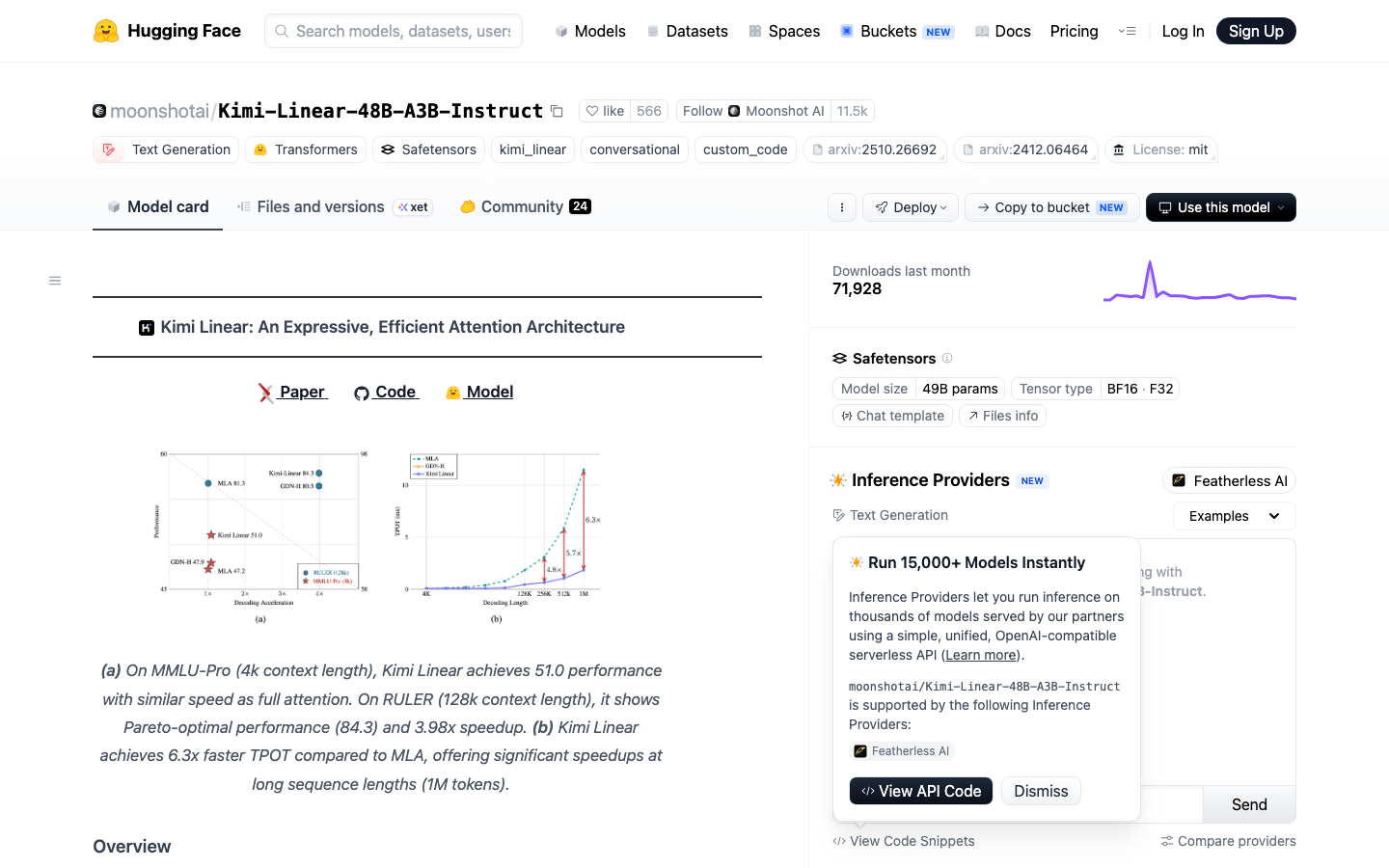
Full review of # Kimi Linear
Core parameters and statistics
| Project | Specifications |
|---|---|
| Product Positioning | Hybrid Linear Attention Open Source Long Context Model |
| Developer | Dark Side of the Moon (Moonshot AI) |
| Model parameters | 48B total parameters / 3B activation parameters (MoE) |
| Context length | 1M tokens |
| Open Source License | MIT License |
| KV cache savings | Up to 75% reduction |
| Decoding Speedup | Up to about 6x under long context |
| Ecological Support | Transformers, vLLM, fla-core |
Kimi Linear is an important open source contribution to Dark Side of the Moon at the model architecture level. Its core idea is to replace part of the traditional attention layer with linear attention, significantly reducing the resource consumption of long context reasoning without significantly affecting the quality of the model. In layman's terms - making large models faster and less memory-intensive when processing very long text.
Publicity verification: "KV cache usage is reduced by up to 75% and decoding speed is increased by up to 6 times" - these numbers are achieved under specific configurations and benchmarks reported in papers/technical reports. The actual benefits depend on the specific scenario of inference and the batch size: the advantages of linear attention are not obvious in short text scenarios, and the benefits are gradually amplified in long texts (>100K tokens).
User and market recognition
The Dark Side of the Moon was previously known for closed source models such as Kimi K2, and Kimi Linear is its rare open source architecture model. The 48B/A3B MoE scale makes it friendly for self-deployment scenarios - 3B activation parameters mean a single A100-80GB can run inference. The MIT license also leaves ample room for commercial use. In the field of long context models, its difference from closed-source solutions such as Google Gemini and Anthropic Claude lies in its openness and controllability.
The Dark Side of the Moon was previously known for closed source models such as Kimi K2, and Kimi Linear is its rare open source architecture model. The 48B/A3B MoE scale makes it friendly for self-deployment scenarios - 3B activation parameters mean a single A100-80GB can run inference. The MIT license also leaves ample room for commercial use. In the field of long context models, its difference from closed-source solutions such as Google Gemini and Anthropic Claude lies in its openness and controllability.
Publicity verification: "KV cache usage is reduced by up to 75% and decoding speed is increased by up to 6 times" - these numbers are achieved under specific configurations and benchmarks reported in papers/technical reports. The actual benefits depend on the specific scenario of inference and the batch size: the advantages of linear attention are not obvious in short text scenarios, and the benefits are gradually amplified in long texts (>100K tokens).
Cost advantage
| Dimensions | Description |
|---|---|
| Model Weights | MIT License, Hugging Face Free Download |
| Self-deployed inference | Need to bring your own GPU (A100-80GB single card can run) |
| API Service | Dark Side of the Moon does not provide a standalone API |
| Cloud Service Provider | It is expected that third-party inference platforms will be gradually connected |
FREE FACTS: Weights MIT is open source, but self-deployment requires a GPU. The 48B/A3B MoE architecture has significantly reduced the inference cost compared to dense models of the same scale (3B activation parameters vs 48B full parameters), but a smooth running experience still requires the investment of at least an A100-80GB or equivalent hardware. For individual developers, the monthly cost of renting a cloud GPU is about $500-1000.
Hidden benefits: For teams building their own long-context inference services, a 75% reduction in KV cache means that the same hardware can serve 4 times more concurrent requests, or handle 4 times longer contexts in the same request - these hidden benefits will translate into significant hardware cost savings in a continuously running service.
Main functions
- 1M contextual long text processing: supports millions of token-level contexts, suitable for scenarios such as long document analysis, complete code base understanding, and long-term conversation history processing. Compared to models with 128K or 200K contexts, Kimi Linear’s 1M context covers the vast majority of “can’t finish it in one go” tasks.
- 3:1 Hybrid Attention Architecture: Mixes Kimi Delta Attention (linear attention) and full attention MLA in a 3:1 ratio to strike a balance between information and computational efficiency. The pattern of 3 layers of linear attention + 1 layer of full attention is repeated many times throughout the text.
- Low KV cache inference: 75% lower KV cache means the same GPU memory can support longer contexts or larger batches. For scenarios that require high-throughput inference (such as concurrent dialogue systems), this is an engineering advantage that directly affects cost and latency.
- Open source ecosystem compatibility: Supports multiple inference frameworks such as Transformers, vLLM and fla-core, and developers can deploy models using their familiar tool chains.
Model and version evolution
Mainline release
- ~2026-06: Kimi-Linear-48B-A3B-Instruct open source in Hugging Face (MIT License).
Technical advantages
- Algorithm Optimization: Special optimization at the model or algorithm level has been carried out for the corresponding scenario to achieve a balance between response speed and result quality.
- Low-latency architecture: Adopts streaming or asynchronous processing architecture to reduce user waiting time and is suitable for high-frequency interaction scenarios.
How to use
- Download the model weights from Hugging Face:
moonshotai/Kimi-Linear-48B-A3B-Instruct - Load inference using Transformers or vLLM
- Support KDA kernel acceleration of fla-core
- Can be integrated into OpenAI-compatible inference service
Product Pricing
| Dimensions | Description |
|---|---|
| Model weights | Free under MIT license |
| Self-deployment | GPU required (A100-80GB single card can run) |
| API Service | Unpublished |
Application scenarios
- Million token document analysis: Analyze the entire technical document, complete financial report, and multiple rounds of customer dialogue history. From "segmented summary and then splicing" to "reading the entire text at once", the analysis quality is higher and cross-segment information will not be missed.
- Long Code Base Understanding: Load the entire project code base (hundreds of thousands of lines of code) into context at once for refactoring analysis, security auditing, or document generation. Kimi Linear's low KV cache makes this scenario feasible on consumer GPUs.
- Long chain reasoning and complex Q&A: Questions that require reading a large amount of information to answer - such as cross-reference of multiple contracts and in-depth analysis of long papers.
Dissuade scenario: If your application scenario is just a short text conversation (hundreds to thousands of tokens each time), the advantages of linear attention cannot be exerted, and the reasoning efficiency of conventional dense models is actually higher. The value of Kimi Linear is only fully realized in long text scenes.
Applicable people
- Long context application developers: Engineers who need to implement long text analysis or dialogue in their own products, Kimi Linear's open source license and low resource consumption are the preferred solution for self-deployment.
- Self-Hosted LLM Teams: Teams that are sensitive to API costs or need data privatization, leverage Kimi Linear's MIT protocol for commercial deployment.
- LLM architecture researcher: For researchers who focus on attention mechanism optimization, Kimi Linear's open source code and weights are an important reference for studying the practicality of linear attention.
Human-machine collaboration boundary: 100% automation: model inference and long text processing. Manual intervention is required: accuracy verification of long document analysis results and cross-validation of key information. Kimi Linear can help you find relevant information in 1M context, but the conclusions drawn from this information require human judgment.
Current limitations: The advantages of linear attention in short text scenarios are not significant; the community's adaptation to the fla-core KDA kernel is still in its early stages; deep integration with mainstream inference frameworks (vLLM, llama.cpp) needs to be improved.
Summary and Outlook
It provides competitive solutions in its field, and its core value lies in lowering the threshold for AI use in this field.
Current limitations: Some advanced features require paid subscription, and the free version has function or usage restrictions; specific technical details and performance benchmarks have not yet been fully disclosed.
Related tools:  Hugging Face, replicate
Technical advantages and capability boundaries
As an AI model and API product, Kimi Linear's core capabilities can be deeply understood through the following dimensions, which directly affect technology selection and implementation effects.
Inference Performance and Benchmark Performance The model’s reasoning performance is reflected in its performance on standard NLP tasks (text generation, code completion, semantic understanding, multi-turn dialogue, information extraction, etc.). It is recommended to conduct horizontal comparison through public benchmark test lists (such as MMLU, HumanEval, GSM8K, etc.), but please note that there may be a gap between benchmark test scores and actual business scenario performance. Key indicators that affect the actual user experience include: inference speed (Token/s or response delay, which directly determines the smoothness of the user experience), context window length (which determines the input size that can be processed at a time, affecting the complexity of the tasks that can be processed), and consistency of output quality (the stability of the results of multiple outputs of the same input, which affects the perception of reliability).
API Compatibility and Development Ecosystem The depth of API compatibility with mainstream development frameworks (LangChain, LlamaIndex, Semantic Kernel, etc.) directly affects the cost and cycle of integrated development. It is recommended to pay attention to the following integration dimensions: the coverage of language types supported by the SDK (whether mainstream languages such as Python, JavaScript, Go, and Java have official SDKs), streaming output support (SSE/WebSocket protocol compatibility), function calling and tool usage capabilities (whether it supports mapping model output to structured function calls), the flexibility of structured output (JSON mode), and the ability to integrate with enterprise-level infrastructure (VPC deployment, Private Link, unified identity authentication). Complete API documentation and rich code examples can significantly lower the entry barrier to development and reduce integration time and costs.
Deployment Flexibility vs. Cost Tradeoff Depending on data privacy requirements, latency sensitivity and usage scale, Kimi Linear can choose between cloud API calls or on-premises deployment options. The advantages of cloud deployment are zero operation and maintenance costs and elastic scalability, which is suitable for scenarios with large fluctuations in usage and rapid prototype development; local deployment provides complete data sovereignty and low latency (no network round-trip overhead), but you need to bear the cost of purchasing hardware such as GPUs and operation and maintenance manpower. It is recommended to use a monthly API call volume of 1 million times or a monthly fee of US$1,000 as a reference dividing line: below this threshold, cloud APIs have better cost-effectiveness and flexibility. After exceeding this threshold, the total cost of ownership of the self-deployment solution should be comprehensively evaluated, taking into account factors such as hardware depreciation, electricity, operation and maintenance manpower, etc.
Model selection and version strategy
For the selection of Kimi Linear series models, it is recommended to match the model capabilities of different versions according to specific usage scenarios. The large-parameter version performs better on complex reasoning and multi-step tasks, but has higher costs and longer delays; the small-parameter version can already provide satisfactory output quality in scenarios such as daily conversations and simple question and answer, and the cost is only a fraction of the large version. The recommended selection strategy is: use small and medium versions in standard scenarios to reduce costs, and only call large version models when complex inference tasks need to be processed. This hierarchical calling strategy can reduce the overall API cost by 40-60% without significantly affecting the output quality.
Version Info
- Kimi-Linear-48B-A3B-Instruct :The first public hybrid linear attention model, supporting 1M context, open source under MIT license.
- Kimi-Linear-48B-A3B-Instruct :First public version, MIT licensed, no official precise date yet.
User Reviews