 Kira Systems
Kira Systems is a leading AI legal assistant contract analysis platform with a machine learning-driven clause extraction engine as its core and is widely used in M&A due diligence, contract review and lease analysis scenarios. It was acquired by Litera in 2023 and became a key component of its legal technology ecosystem.
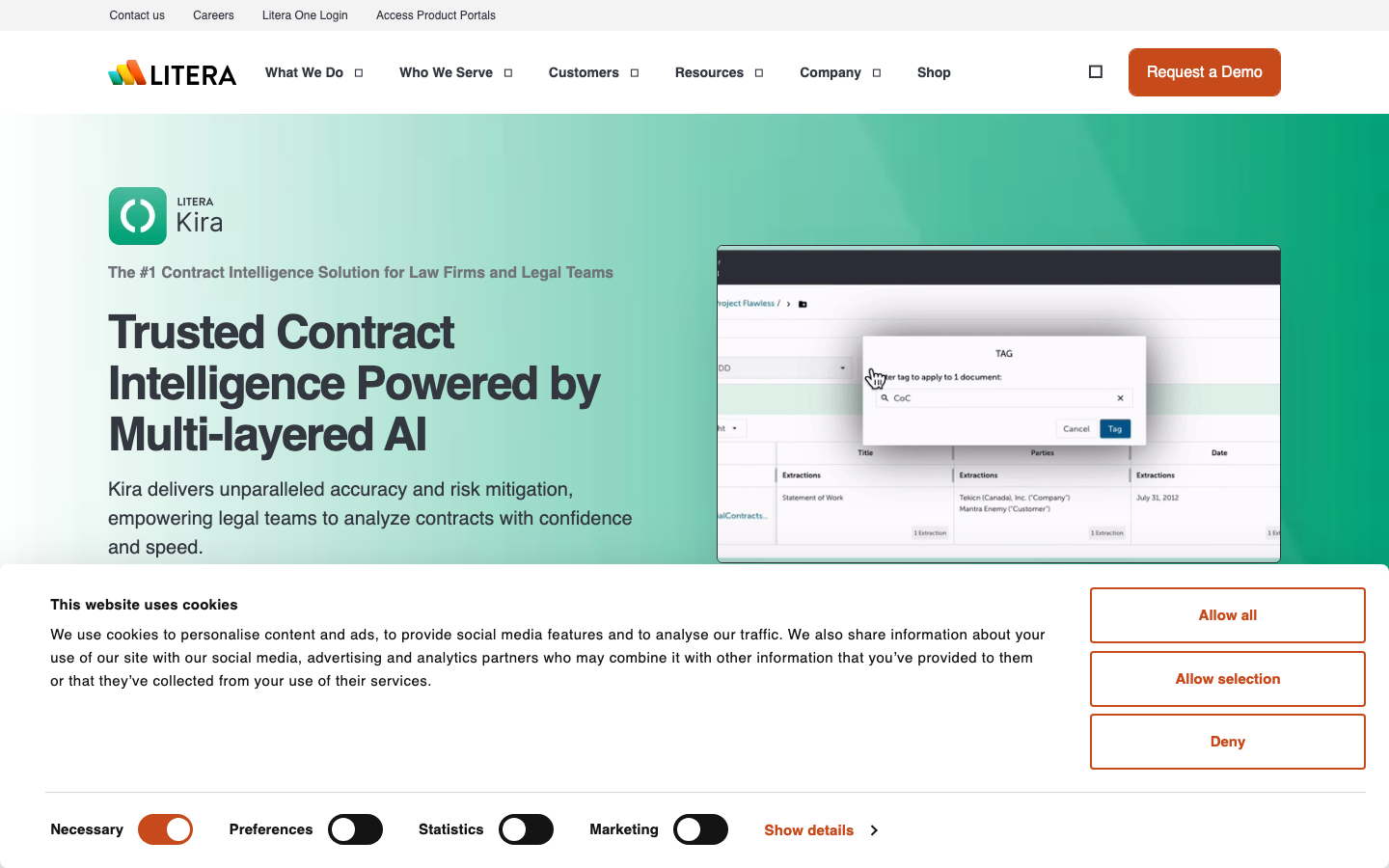
KiraSystems
Core parameters and statistics
Kira Systems is one of the first commercial products in the global legal technology field to apply machine learning to contract clause extraction. It is not a general AI assistant, but a specialized tool focused on "accurately extracting structured clause data from contract documents."
| Projects | Public Information |
|---|---|
| Official positioning | AI-powered contract analysis platform |
| Core Technology | Supervised Machine Learning (SML) + Rule Engine |
| Parent company | Litera (acquired in 2023) |
| Founding Team | Noah Waisberg (former lawyer), Alexander Hudek (AI researcher) |
| Service objects | Law firms, corporate legal departments, investment banks, consulting companies |
| Core capabilities | Clause identification and extraction, due diligence batch processing, lease analysis |
| Jurisdictions covered | Major global jurisdictions |
| Processing scale | Thousands of documents can be processed at a time |
| Support Platform | Web, API |
Market Position: Kira Systems is one of the pioneers in the AI contract analytics track. In the mid-to-late 2010s, it pioneered the ML contract analysis market with Luminance, eBrevia (later acquired by Donnelley), and others. Acquired by Litera in 2023, its capabilities complement Litera's documentation, transaction management and compliance tools.
User and market recognition
Kira Systems has established solid brand recognition in the global legal technology market, particularly as one of the de facto standards in the M&A due diligence space.
Enterprise Level Clients: Used by the majority of the top 100 global law firms, as well as the Big Four accounting firms and multiple investment banks. Its client base is highly concentrated in M&A transactions and legal due diligence scenarios.
Acquisition Verification: Litera’s acquisition of Kira Systems in 2023 reflects the trend of legal technology platform integration – integrating the best specialized tools into a comprehensive legal technology ecosystem.
Competitive Landscape: In the ML contract analytics track, Kira’s main competitors include Luminance (UK), eBrevia (US), and Seal Software (acquired by DocuSign). Kira’s strengths lie in the depth of its terms library and model accuracy verified by a large number of actual transactions.
Cost advantage
Kira Systems operates on an enterprise subscription model, with pricing based on a combination of user count and document processing volume.
- C-side/Personal: No personal version. Kira is strictly a product for institutions.
- Law Firm/Corporate Legal: Annual subscription contract, pricing is calculated based on user seats and annual document processing quota. Annual fees for mid-sized law firms typically range from tens of thousands of dollars. For details, please refer to the official real-time quotation.
- Large Deal Team: In large M&A projects, short-term (single-deal) licenses can be purchased or used on a per-project basis through a Legal Process Outsourcing (LPO) partner.
Hidden costs: The use of Kira requires upfront investment in clause library configuration and model training (for non-standard clauses). This part of the time and labor costs cannot be ignored. At the same time, the output results of due diligence still need to be reviewed by lawyers one by one. AI can only improve efficiency but not replace judgment.
Main functions
Kira's core capabilities revolve around "extraction of specific terms from documents" rather than the entire contract management life cycle:
- Smart Clause Extraction: Built-in more than 1,000 standard clause models (including merger and acquisition clauses, loan clauses, employment clauses, lease clauses, etc.), which can automatically identify and extract the text of specific clauses in the contract. Each clause model is trained with extensive manual annotation, and its accuracy is continuously verified.
- Custom clause model construction: Users can create a custom recognition model for non-standard clauses in their own business, use Kira's training tool to upload sample documents and mark target clauses. This capability allows Kira to adapt to the specific needs of different industries and transaction types.
- Batch due diligence workflow: Supports importing thousands of documents at one time, automatically analyzes according to the preset terms matrix, and generates a structured comparison table. Users can verify AI extraction results on a clause-by-clause basis within the platform and add comments and tags.
- Lease and Real Estate Analysis: Provides a dedicated analysis module for lease accounting standards (ASC 842/IFRS 16) to automatically extract key terms such as lease term, rent, and renewal options. Corporate finance teams and auditors rely heavily on this feature in this scenario.
- API integration and workflow embedding: Provides REST API to support embedding contract analysis capabilities into own systems or process management platforms, suitable for calling the Kira engine in existing document management and transaction management systems.
Hidden linkage: The real value of Kira lies not in the analysis accuracy of a single contract, but in the combination of "standard clause library + custom model + batch processing". During M&A due diligence, the buyer's legal team imported hundreds of target company contracts into Kira and quickly screened out contracts with clauses such as change of control, exclusivity restrictions, and material adverse changes through a preset "problem clause list." This process compresses a review that would have traditionally taken 3-5 junior attorneys 2-3 weeks into 1-2 days, while outputting a formatted comparison sheet that can be used directly in deal negotiations.
Model and version evolution
Relevant information has not been made public, please refer to the official real-time page.
Technical advantages
Term identification of supervised machine learning: Kira uses supervised machine learning (Supervised ML) instead of large language model (LLM) as the core technology. Each type of clause model is trained on thousands of manually annotated documents and can accurately identify the boundaries and key variables of clauses. The advantage of this method is that the output is stable and interpretable, but the cost is that adding new clause types requires a large amount of annotated data.
Structured conversion of clause data: Kira’s core technical value lies in converting unstructured contract text into a structured comparison data matrix. It can identify "differences in the expression of the same type of terms in different contracts" and normalize them into a comparable format. This is critical in M&A due diligence - the "change of control" clauses in 20 contracts may have completely different wordings, and Kira's trained model will recognize that they are substantially the same.
Visual analysis dashboard: Kira provides analysis reports and visual dashboards based on clause extraction results, allowing users to quickly grasp the risk distribution, clause deviations and abnormal patterns in the contract portfolio. This is particularly valuable for legal leaders who report to transaction committees or audit committees.
Advantages of integration with the Litera ecosystem: After being acquired by Litera, Kira’s analysis results can be seamlessly imported into Litera’s Compare (contract comparison), DocX (documentation) and Transaction Management (transaction management) tools. This is a significant integration benefit for law firms already within the Litera ecosystem.
How to use
| How to use | Applicable scenarios |
|---|---|
| Kira Web Platform | Use Kira's standalone web interface directly for document analysis and clause extraction |
| Litera integration portal | Call Kira analysis capabilities through the Litera unified platform |
| API integration | Embed the Kira engine into an enterprise's internal system or transaction management platform |
| LPO Partners | Using Kira on a per-project basis through legal process outsourcers |
Typical steps (M&A due diligence scenario):
- Create a new project on the Kira platform and upload the target company’s contract document set.
- Select the clause list to be extracted (standard clause library + custom clause).
- Kira’s ML engine automatically scans all documents, extracts matching terms and annotates their locations.
- Users can check the AI extraction results clause by clause within the platform and confirm or correct them.
- Generate terms comparison matrix and risk heat map, and export them as Excel or Word reports.
Product Pricing
Kira Systems has a fully enterprise pricing model with no public retail price:
- Law Firm Subscription: Annual seat-based license. Typically includes a certain number of active user accounts and an annual document processing quota. Documents that exceed quota are billed per page or per document. Annual fees for mid-sized law firms typically range from $30,000 to $80,000.
- Corporate Legal Department: Similar to law firm pricing model, but the document processing volume is usually larger. The Enterprise Edition may include additional compliance and lease analysis modules.
- API access: Billed based on the number of API calls or pages processed, suitable for enterprises that need to embed Kira capabilities into their own systems.
- Free Trial: Typically provides a free POC (proof of concept) project to verify Kira's analytical accuracy and applicability within a limited number of documents.
Application scenarios
- M&A due diligence: The core scenario. The acquirer's legal team conducts a systematic review of all major contracts of the target company and extracts key clauses such as change control, material adverse changes, exclusivity, and termination rights. Benefits: Condensing traditional 2-3 weeks of manual contract review to 1-2 days with better coverage and consistency than manual.
- Lease Portfolio Analysis and Accounting Standards Compliance: Corporate Finance and Legal teams use Kira’s Lease Analysis module to extract provision information required by ASC 842/IFRS 16 from hundreds of lease contracts. Benefits: Significantly shorten the lease data collection time in financial statement preparation and reduce audit risk.
- Loan Agreement Portfolio Review: Financial institutions use Kira to monitor financial commitment provisions, default provisions and collateral changes in loan agreements during periodic reviews of loan portfolios. Benefits: Upgrading from manual sampling review to systematic full coverage review.
- IP and Licensing Contract Review: In IP transactions or technology due diligence, review key restrictions in patent licensing, technology transfer and software licensing contracts. Benefits: Quickly identify core terms such as license scope, geographical restrictions, and exclusivity.
Applicable people
- M&A Lawyers and Transaction Advisors: Kira’s core user group. Processing the due diligence requirements of large volumes of contracts at a high frequency provides Kira with the highest return on investment.
- Enterprise Legal Contract Management Team: For the legal team responsible for daily contract review and compliance monitoring, Kira's batch analysis capabilities help move from reactive response to proactive management.
- Audit and Compliance Team: Especially for lease accounting standards compliance and loan portfolio monitoring scenarios, Kira's structured output directly serves financial statement preparation and regulatory reporting.
Not suitable for boundaries: Kira is not suitable for workflows that require contract negotiation and drafting support (which is what Contract Express or Luminance Draft are good at); it is not suitable for CLM scenarios that require real-time contract collaboration and approval flow (such scenarios are more suitable for Ironclad or DocuSign CLM); Kira's licensing cost and configuration overhead are not cost-effective for individual lawyers or small teams that occasionally review a small number of contracts.
Summary and Outlook
Kira Systems' core competency lies in its ML contract analysis engine that has been verified by a large number of actual transactions and leads the industry in terms of accuracy of clause identification and coverage depth of the clause library. The acquisition by Litera provides broader ecological support for the product, but it also means that the independence of the product roadmap is weakened.
Current limitations: The clause identification of the ML model is still "identifying known" - completely new types of clauses require manual annotation training, and lack the zero-sample inference capability of LLM; the unit price of large-scale document processing is based on the number of pages, and the cost cannot be ignored in ultra-large-scale due diligence; the product focuses more on "analysis" rather than "management", and is not suitable for teams that require complete contract life cycle management.
Procurement and Adoption Risk Assessment: It is recommended to first verify the accuracy of Kira’s terms extraction in a real transaction project through a free POC, especially for non-standard terms unique to your own business. Before purchasing, enterprises need to focus on confirming: whether the annual document processing quota matches actual needs, the amount of training effort required to build a custom model, and the evolution direction of Litera's product roadmap and data privacy terms after the acquisition.
Version evolution of Kira Systems
| Milestone | Time | Description |
|---|---|---|
| Kira Systems Founded | 2011 | Founded in Waterloo, Canada by Noah Waisberg and Alexander Hudek |
| Early ML term engine | 2012-2015 | Establishing core ML term identification model and training framework |
| Kira 7.0 | ~2022 | Improve the model architecture and expand the term library to 1000+ models |
| Litera Acquisition | 2023 | Acquired by Litera, integrated with documentation and deal management tools |
| Litera ecological integration | 2024-present | Continuous iteration, collaboration with Litera Compare, DocX and other tools |
Business process integration and ROI analysis
As a productivity tool for enterprises or professional positions, the true value of Kira Systems depends on the depth of integration with existing workflows and quantifiable efficiency improvements. The following is a systematic analysis from three core dimensions.
System integration and data interoperability The ability to interoperate with existing business systems is a key prerequisite for productivity tools to be integrated into workflows. It is recommended to focus on evaluating the following integration dimensions: the openness and documentation quality of the RESTful/GraphQL API (whether a complete API reference and SDK examples are provided), the support scope of Webhook event notifications (which business event types are supported for automatic push), the number and depth of pre-built integrations with common collaboration SaaS tools (WeChat Enterprise, DingTalk, Feishu, Slack, Notion, Jira, etc.), and enterprise-level identity authentication support (SSO/SAML/OAuth and LDAP/AD directory integration). Products that lack integration capabilities are easily isolated into information islands, which in turn increases the cognitive cost and operational friction for teams to switch between different tools.
Efficiency Quantification and ROI Estimation Methodology Before purchasing decisions, it is recommended to quantify the input-output ratio through a structured method: Step 1, choose 3-5 Standardized tasks that are frequently repeated and time-consuming in each team are used as test samples; in the second step, the average time consumption of a single task before and after tool intervention, first-time pass rate or error rate, and the number of links requiring manual intervention are recorded under controlled conditions; in the third step, the saved manpower time is converted according to the comprehensive cost of the position (salary, benefits, management sharing), and soft benefits (increased employee satisfaction, standardization of work quality, and improvement in response speed to core business) are superimposed to obtain a comprehensive ROI estimate. It is recommended to continue tracking ROI trends on a monthly basis, as the value of a tool usually increases over time as team proficiency increases and workflows are optimized.
Phase-based implementation strategy and risk control It is recommended to adopt a three-stage implementation path of "pilot verification-gradual promotion-continuous optimization". In the pilot stage (1-2 weeks), a single team or a single business scenario is selected for small-scale verification. The core goal is to verify technical feasibility and user acceptance, and establish preliminary usage specifications and success standards; in the promotion stage (2-4 weeks), after the pilot verification is passed, the coverage is gradually expanded, and standardized activation processes and training materials are developed; in the optimization stage (continuous), the workflow configuration is continuously adjusted based on actual usage data and user feedback, and more high-value application scenarios are explored. Clear quantitative key result indicators should be set at each stage to avoid blindly expanding the scope of use without data support.
Version Info
- Litera Acquisition Edition :Kira Systems was acquired by Litera and became part of its legal technology product line, with the product roadmap integrated with the Litera ecosystem.
- Kira 2026 Q2 Release :There is no official precise date for the continuous iterative version after integrating the Litera ecosystem.
- Kira 7.0 :Improved machine learning models, expanded clause library, enhanced API capabilities, and faster document processing. There is no official precise date yet.
User Reviews