 Kira Systems
Kira Systems is an AI-driven contract analytics and due diligence platform that uses machine learning to identify and extract contract terms, key data and risk information.
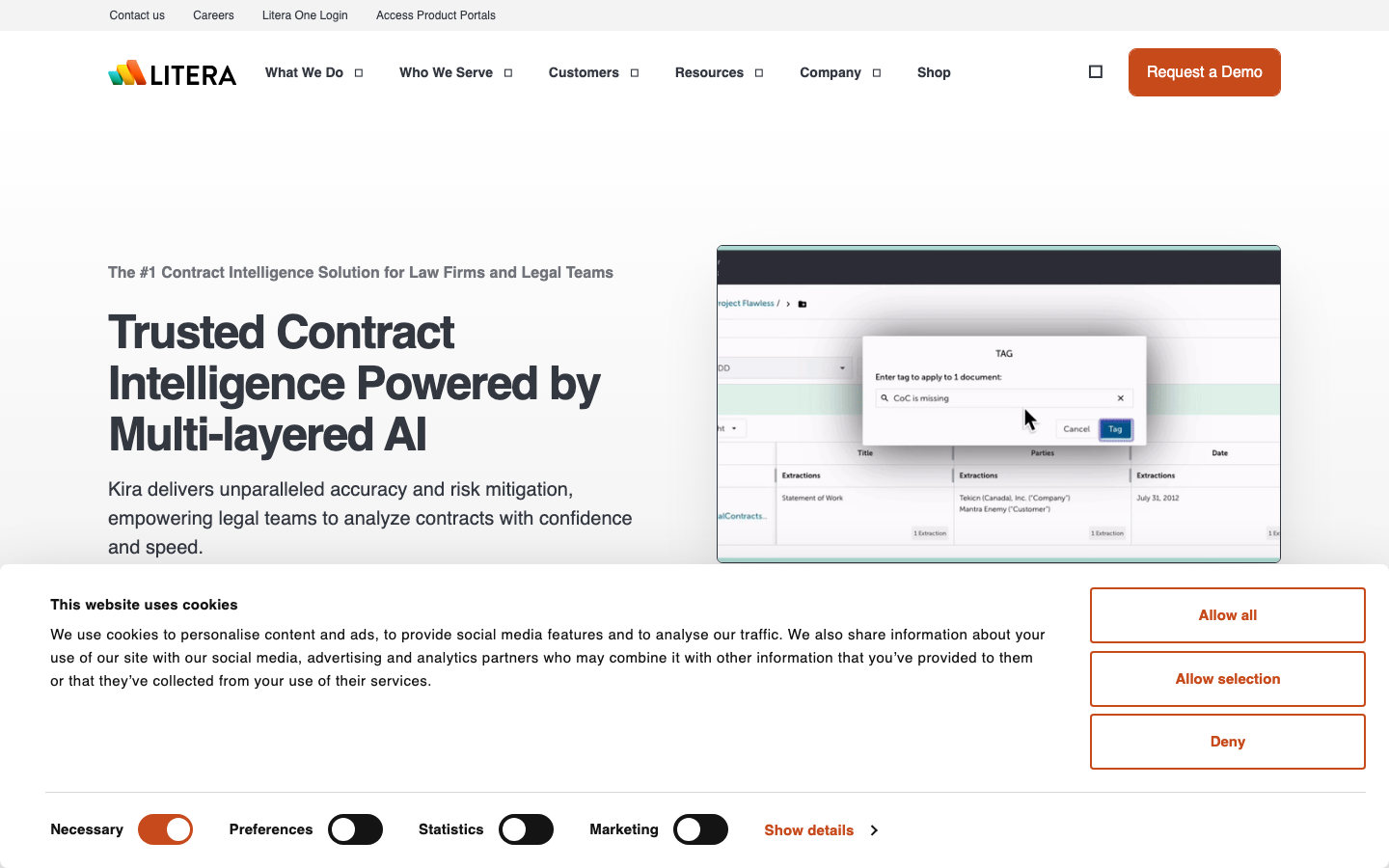
Kira Systems: AI contract analysis and due diligence platform
Tool introduction
Kira Systems is one of the first platforms in the global legal tech space to apply machine learning to contract analysis. Founded in Waterloo, Canada in 2011 by Noah Waisberg and Dr. Alexander Hudek, its core mission is to use AI to liberate lawyers from repetitive, massive contract reviews. It was acquired by electronic discovery (e-Discovery) giant Relativity in 2021. Litera acquired Kira from Relativity in 2023 and now operates as the core contract analysis module in Litera's product portfolio.
Brief review in one sentence: It is not a general chatbot, but a "clause extraction engine" rooted in legal practice scenarios - it is good at accurately extracting every clause you care about from mountains of contracts, turning lawyers from "page turning" to "decision-making".
Publicity Verification: The core selling point of Kira’s official promotion is “ML-driven automatic recognition of terms, covering 1000+ terms types”. This claim has been verified in industry third-party evaluations (including Relativity Fest user reports LegalTech independent evaluation) - its pre-trained model's recognition accuracy of common terms (indemnity, confidentiality, termination, governing law) is indeed among the first in the industry. However, it should be pointed out that a large number of the 1,000+ clause types are subdivided into variants (such as compensation clauses with different wordings), and highly non-standard contracts still require manual review.
Core functions
1. Clause Identification & Extraction
Kira's core engine uses a supervised machine learning model (trained on annotated contract corpus) to automatically identify more than 1,000 clauses and clause variations in contracts. Supported clause types include:
- Risk Clauses: Indemnification Clauses, Change of Control, Material Adverse Changes (MAC/MAE), Restrictive Covenants
- Obligation clauses: confidentiality obligations (Confidentiality), non-compete (Non-compete), insurance requirements (Insurance Requirements), reporting obligations (Reporting Obligations)
- Termination and term categories: Termination conditions (Termination), automatic renewal (Auto-renewal), notice period (Notice Period), early termination penalties (Early Termination Penalties)
- Financial Terms: Pricing & Payment, Most Favored Nation (MFN), Discounts & Rebates, Audit Rights
The processing flow is: Upload the contract (PDF/Word) → Automatically scan by the engine → Match the trained clause model → Extract matching text → Output structured summary and highlight annotation. Processing time per contract typically ranges from seconds to minutes, depending on document length and complexity.
2. Quick Study: Custom model training
This is the core feature that differentiates Kira from most competing products. Users (usually law firms or corporate legal departments) can use their own historical contract libraries to train customized clause recognition models based on Kira's pre-trained models.
- Training method: By annotating a small number of examples (usually 10-30 target clauses in contracts) through the UI interface, the engine automatically learns the specific expression patterns that the user is concerned about.
- Applicable scenarios: Industry-specific terms (such as licensing milestone payments in the pharmaceutical field, SaaS SLA terms in the software field), customary expressions of specific transaction parties, non-standard risk terms, etc.
- Iterative mechanism: Users can continuously add annotated data to improve model accuracy, and incremental updates of the model do not require retraining of the entire corpus.
3. Batch document processing and project management
- Large-scale parallel processing: Thousands of contracts can be uploaded at a time, and the engine will automatically process them in parallel, and will be notified via email/platform upon completion.
- Project Kanban: Organize document sets according to transaction or project dimensions, and support collaborative annotation, commenting and review by multiple people.
- Structured Export: Analysis results can be exported to Excel/CSV tables, with each clause as a separate column and each contract as a row to facilitate subsequent filtering, sorting and cross-analysis.
- Quality Check: Built-in consistency check (comparison of extraction results of the same type of clauses in different contracts) to assist reviewers in quickly locating abnormalities.
4. Visual analysis dashboard
- Term-level analysis: Count the frequency of occurrence, missing rate, and outlier distribution of various terms.
- Cross-contract comparison: Compare the differences in the expression of the same terms in the merger and acquisition contracts (such as compensation limit, duration).
- Risk Heat Map: Based on user-preset risk rules, automatically mark high-risk contracts and generate risk summary reports.
- Timeline View: For the historical contract library, the changing trend of terms is displayed according to the time dimension.
5. API and enterprise-level integration
Kira provides a RESTful API to support the automation of document inflow/reflow of analysis results with external systems:
- Document management platform docking: iManage, NetDocuments, SharePoint
- e-Discovery Platform: Deeply integrated with Relativity (highest level of integration due to historical acquisitions)
- Contract lifecycle management (CLM) system: can be connected to CLM platforms such as Salesforce and Agiloft
- Own system embedding: Enterprises can embed Kira analysis capabilities into internal workflows through APIs
Pricing strategy
Kira Systems uses Enterprise Subscription pricing and does not have a public quotation. The specific price depends on the following variables:
| Pricing Factor | Description |
|---|---|
| Number of user licenses | Billed by reviewer/administrator seat, usually minimum subscription of 5 seats |
| Document processing volume | Set ladder levels based on the number of contracts processed annually |
| Deployment method | SaaS hosting vs on-premises deployment (on-premises deployment is significantly more expensive than SaaS) |
| Initial configuration fee | Includes Quick Study model training, business rule configuration, system integration |
| Annual maintenance fee | Includes model updates, technical support, and version upgrades (accounting for approximately 18-22% of the license fee) |
Price reference range (Source: LegalTech industry research and public bidding information):
- Entry level (5-10 seats): Annual fee is about $50,000-$100,000 USD
- Medium deployment (20-50 seats): Annual fee is about $150,000-$300,000 USD
- Enterprise (100+ seats + on-premises): Annual fee is typically $500,000+ USD
The Free Truth: Kira does not have a free version or free trial, and only provides limited paid Demo/Pilot projects (usually 2-4 weeks, a confidentiality agreement needs to be signed). The threshold is extremely high for individual users and small teams.
Price comparison with competing products:
| Products | Pricing model | Starting annual fee (estimate) | Core differences |
|---|---|---|---|
| Kira Systems | Enterprise subscription, based on seat + processing volume | $50,000+ | The most profound term recognition, Quick Study is unique |
| Luminance | Enterprise subscription | $40,000+ | Supports 80+ languages, AI proactively detects anomalies |
| LawGeex (Docusign) | Billed by contract share | $30,000+ | Deeply bound to the Docusign ecosystem |
| Brainspace (Exterro) | Enterprise subscription | $30,000+ | Focus on e-discovery and visual analytics |
| Secret Tower AI Law | Mixed system (some free) | Free/¥10,000+ | Chinese legal scene, obvious price advantage |
Advantages and Disadvantages Analysis
Advantages
- Industry-leading clause recognition accuracy: After more than 10 years of training iterations, the pre-trained model covers the widest range of clause types, and the recognition accuracy of English contracts continues to rank first in third-party evaluations.
- Quick Study’s Differentiation Barrier: Allowing users to train custom clause models based on pre-trained models with a very small sample size (10-30 contracts), this capability is still scarce in the legal technology field.
- Mature enterprise-level delivery capabilities: Supports local deployment, single sign-on (SSO/SAML), role authority classification (RBAC), and audit logs to meet the IT compliance requirements of large law firms and multinational enterprises.
- Scaling advantages of batch processing: A single project can carry tens of thousands of contracts, and the quality consistency of the output structured form is better than manual work.
- Ecological blessing after acquisition: It was first acquired by Relativity and then by Litera, opening up a one-stop link from electronic discovery to contract analysis, and the investment in integrated technical resources is higher than that of independent competing products.
Disadvantages
- Extremely high price threshold: Starting annual fee is $50,000+, completely excluding individual lawyers and small law firms. Even mid-sized companies need budget approval, and the procurement cycle is usually 3-6 months.
- Narrow language coverage: The core model uses English contracts as training corpus, and has very limited support for non-English languages such as Chinese, Japanese, and Arabic. Chinese contracts either cannot be processed or require a large number of Quick Study annotations, and the input-output ratio drops sharply.
- High configuration complexity: Although the pre-trained model can be used out of the box, to truly adapt to the company's unique business (such as non-standard terms in specific industries), legal experts and project consultants are required to work together to complete model tuning. The initial configuration cycle is usually 4-8 weeks.
- Price Opaque: There is no public pricing page. Each inquiry requires repeated communication with the sales team, which increases the time cost and information asymmetry of procurement.
- Competing alternatives emerge: Contract analysis solutions (such as Robin AI, LinkSquares, Evisort) based on general large models such as GPT-4/Claude are rapidly catching up, posing challenges in flexibility and cost.
Applicable scenarios
Dimensionality reduction strike scene
- Large M&A Due Diligence: This is Kira’s classic ace scenario. In large transactions involving hundreds to thousands of contracts (such as the asset acquisition of a listed company, the acquisition of a PE target company), Kira can reduce the manual input of contract review from 10-15 people·weeks to 2-3 people·days. Especially for the three-dimensional cross-analysis of compensation clauses, change of control clauses, and material adverse change clauses, it is difficult to manually complete a consistent review of thousands of contracts in a short time.
- Existing Contract Portfolio Audit: The corporate legal department regularly (quarterly/annually) reviews the compliance status of all existing contracts to identify expired and non-renewed contracts, hidden automatic renewal clauses, and wording of clauses that violate the latest regulations. Kira’s batch processing capabilities allow manual audits that originally took a month to be reduced to just one week.
- Integrated Management of Lease Contracts: When retail chains and commercial real estate companies process hundreds of lease contracts scattered across various places, Kira can extract fields such as lease terms, rent adjustment formulas, renewal options, rent-free periods, etc. in batches, replacing manual entry one by one.
- Contract standardization promotion: When large enterprises promote contract template standardization, they use Kira to scan the existing contract library, identify deviations between actual contract terms and standard templates, and assist in formulating template improvement strategies.
Discourage/Inapplicable people
- Individual Lawyers/Small and Micro Law Firms: The annual fee of $50,000+ far exceeds their annual contract review business volume, and the return on investment is extremely low. It is recommended to use a lightweight alternative based on a common large model.
- Users with mainly Chinese contracts: Kira’s support for Chinese contracts is basically unavailable. If Chinese law firms or foreign-funded enterprises operating in China need to handle Chinese contracts, they should give priority to local solutions such as Secret Tower AI Law and Legal Angel.
- Users who need in-depth customized NLP analysis: If the need is not only to extract existing terms, but to perform deep semantic reasoning on the contract (such as determining whether a certain term constitutes "obvious unfairness"), Kira does not have this capability and needs to rely on general-purpose large models such as GPT-4.
- Budget Sensitive SMBs: Even with an annual contract review volume of 500-1000, Kira's annual fee may exceed the cost savings of replacing manual reviews. It is recommended to do a TCO (total cost of ownership) calculation first.
Boundary of human-machine collaboration
Kira clearly positions itself as an “auxiliary review tool” rather than a “replacement lawyer.” In actual workflow:
- 100% automatable: clause scanning, preliminary classification, cross-contract comparison, exception flagging, summary export
- Manual confirmation required: Legal interpretation and judgment of high-risk clauses, final characterization of non-standard clauses, formulation of negotiation strategies in integrated M&A transactions, and issuance of final legal opinions on compliance
Summary
Kira Systems is a benchmark product in the contract analysis track in the legal technology field. Its core value is anchored at the intersection of "accuracy of clause identification × scale of batch processing." After more than 10 years of model training and customer practice accumulation, its depth and breadth in identifying English contract clauses still constitute a significant competitive barrier - especially the Quick Study function, which allows large law firms and enterprises to continuously train customized identification models that adapt to their own business while retaining data sovereignty. This ability is rarely matched among competing products.
Sustainability Assessment of Core Competencies: Kira’s advantages are not unchallengeable. The rapid progress of general large models (GPT-4, Claude, etc.) in legal text understanding is compressing the living space of traditional special-purpose NLP models. But Kira's differentiation lies in its "engineering delivery capabilities" - not the "AI review" in the slogan, but the three dimensions of enterprise IT compliance (local deployment of RBAC, audit logs), batch processing stability (one-time processing of tens of thousands of contracts) and business process embedding (API/plug-in/ecological integration). For large law firms and corporate legal departments that review 5,000+ contracts annually, these engineering capabilities often carry more weight in procurement decisions than model accuracy itself.
Current core shortcomings: The price threshold is too high (excluding the small and medium-sized enterprise market), language coverage is extremely concentrated in English, and the uncertainty of the product roadmap after being acquired by Litera (the balance between the depth of integration with Litera's existing products vs. the speed of independent innovation) are the three main risk points.
Procurement/Adoption Risk Assessment: Kira is most suitable for two types of organizations - (1) Large law firms/corporate legal departments that handle more than 5,000 English contracts per year and already have supporting systems such as iManage/Relativity; (2) Governments/financial institutions that require on-premises deployment solutions and have higher data sovereignty requirements than cost sensitivity. For both types of organizations, Kira will remain the most mature option in 2-3 years. But for other types of users, it is recommended to prioritize lightweight alternatives based on general large models (such as Robin AI, LinkSquares, Evisort), or local solutions for the Chinese market (Secret Tower AI Law). When purchasing contracts, SLA indicators (availability ≥99.5%, clause identification accuracy baseline, number of annual model updates) should be locked in, and an annual price increase cap should be agreed upon to hedge the risk of supplier lock-in.
Efficiency improvement comparison
The following is an efficiency comparison deduction based on industry reports (Relativity Fest user case, Litera official white paper, LegalTech third-party research), and is not Kira’s official commitment value:
| Scenario | Pure manual review | Using Kira to assist | Efficiency improvement |
|---|---|---|---|
| M&A due diligence (1,000 contracts) | 10-15 people × 2 weeks = 200-300 man-hours | 2-3 people × 3 days = 48-72 man-hours | Reduce time by about 75-80% |
| Contract Portfolio Audit (5,000 contracts) | 5 people × 4 weeks = 800 man-hours | 2 people × 1 week = 80 man-hours | About 90% time reduction |
| Rental contract extraction (500 contracts) | 3 people × 3 weeks = 360 man-hours | 1 person × 2 days = 16 man-hours | About 95% reduction in time |
| Clause consistency check (200 contracts) | 2 people × 1 week = 80 man-hours | 1 person × 4 hours = 4 man-hours | About 95% reduction in time |
| Annual compliance review (full contract pool) | 6 people × 3 weeks = 720 man-hours | 2 people × 1 week = 80 man-hours | About 89% time reduction |
Hidden benefits: In addition to direct man-hour savings, the indirect value brought by Kira also includes - increased standardization rate of clause extraction (eliminating judgment bias between different reviewers), traceable audit trails (each extraction result can be traced back to the original text location), and cross-project knowledge reuse (Quick Study models can be continuously migrated and used in different transactions of the same enterprise).
Hidden costs: Early model configuration investment (4-8 weeks), team training cycle (1-2 weeks proficiency ramping), risk of manual review omissions due to overtrust in AI results (automation bias complacency bias).
Automation Boundary
Kira Systems’ automation capabilities are distributed in a “ladder-like” manner throughout the contract review workflow:
Can be fully automated with knots
- Document Parsing and OCR: Automatic recognition of PDF/Word formats, including scanned OCR (based on integrated OCR engine)
- Term positioning and highlighting: The pre-trained model automatically locates and highlights clause text paragraphs
- Structured Extraction and Collection: Write the extraction results into predefined fields and summarize them across documents into a unified table
- Abnormal Marking and Threshold Alarm: Automatically mark abnormal values based on preset business rules (such as automatic marking if the upper limit of compensation is lower than $1M)
- Version Comparison: Identification of differences in terms of different versions of the same contract
- Report Generation: Automatically generate summary reports, risk heat maps, and missing term sheets
Need semi-automation (AI assistance + manual decision-making)
- Interpretation of the legal meaning of the clause: AI can extract the text, but it cannot judge whether the clause constitutes a key risk in the current transaction - a lawyer is required to make professional judgment
- Qualitative classification of non-standard clauses: highly innovative clauses or rare expression structures, AI may not be able to accurately classify them and require manual annotation and inclusion in Quick Study for retraining
- Multi-clause cross-impact analysis: For example, the mutual impact between compensation clauses, insurance requirements, and liability ceilings requires comprehensive judgment by lawyers.
- Negotiation Strategy Suggestions: Kira can tell users that "the difference in compensation limit between the seller's contract and the buyer's contract is 2x", but will not give strategic suggestions that "should stick to 1.5x as the negotiation goal"
There are sections that cannot be automated (must be completed manually)
- Negotiation Strategy Decision: Which terms can be accepted for concession and which must be insisted on, which involves business judgment
- Issuance of final legal opinion: The final legal impact assessment of the contract on the enterprise must be signed by a licensed attorney
- Ultimate judgment on ethics and compliance: professional ethical judgments involving conflicts of interest, breach of confidentiality obligations, attorney-client privilege protection, etc.
- Irreversible operation confirmation: final signing, sealing and archiving of the contract
Security and Compliance
Data security architecture
Kira Systems provides enterprise-level protection at the data security level:
- Encryption system: Transport layer TLS 1.2+, static storage AES-256 encryption
- Deployment Selection:
- SaaS Multi-Tenant: Data is logically isolated from other tenants
- Single Tenant Cloud: (Private Cloud) dedicated instance, physically isolated
- Local deployment (On-Premises): completely runs within the customer's own infrastructure, and the data does not leave the enterprise boundary
- Authentication: Support SAML 2.0 / SSO / LDAP / Multi-factor authentication (MFA)
- Permission Model: Fine-grained RBAC, supports setting read and write permissions at the document level, project level, and function level
- Audit Log: All operations (document access, analysis requests, model changes, user logins) are recorded and traceable
Compliance Certification
- SOC 2 Type II: passed (annual audit, specific report can be obtained from Kira Sales)
- ISO 27001: covered by Litera Group certification (copy available on request)
- GDPR: Supports Data Processing Agreement (DPA), data can be hosted in the EU region
- HIPAA: Supports Business Associate Agreement (BAA), which can be used in scenarios involving protected health information (needs to be configured separately)
Data Usage Policy
- Model Training Data Boundary: Contract data uploaded by customers will not be used to train Kira public models or provide services to other customers. Training data for Quick Study models is only used within the customer tenant.
- Data processing location: stored in the United States/Canada/EU regions by default (depending on customer selection), cross-border data transfer needs to be agreed in the contract.
- Data retention and deletion: After the contract ends, data export and complete deletion can be arranged according to customer requirements (written confirmation is required).
- AI output cannot be used as the sole basis for decision-making: Kira’s terms of service clearly state that its AI analysis results cannot replace the professional judgment of a licensed attorney.
Integrated Ecosystem
Kira Systems' integration capabilities are designed around the closed design of "document inflow → analysis → result reflow":
Native integration (out of the box)
| Integration Object | Integration Type | Purpose |
|---|---|---|
| Relativity (parent company-level deep integration) | Two-way native integration | Call Kira analysis directly from the Relativity workspace, results flow back to Relativity fields |
| iManage | Plug-ins/Connectors | Launch Kira analysis directly from the iManage document library |
| NetDocuments | Plug-in/Connector | Connect with NetDocuments cloud document management system |
| SharePoint / OneDrive | Connectors | Support pulling contracts from SharePoint document libraries |
| Litera Suite | Integration within the ecosystem | Shared infrastructure with other Litera products (such as Litera Compare, Campaign) |
Open API integration
- RESTful API: supports full-cycle operations such as document uploading, analysis task creation, and result pulling.
- Webhook: Notify the upstream system through callback after the asynchronous task is completed
- API Authentication: OAuth 2.0 / API Key dual mechanism
- Typical integration scenario:
- Automatically push from enterprise contract management system (CLM) to Kira analysis, and the analysis results are automatically written back to CLM fields
- Embed Kira analysis buttons in deal management platforms (e.g. DealRoom, Merrill Datasite)
- Implement the automatic triggering process of contract expiration warning through API
Integration limitations
- No native Salesforce AppExchange application: Need to develop your own integration based on API
- No Zapier/Make public connector: Building automated workflows requires development resources
- No public SDK or Client Library: developers need to call the REST API directly
Implementation suggestions
Deployment decision framework
How Kira is deployed depends on your organization's data security requirements and IT infrastructure:
| Consideration dimensions | SaaS multi-tenant | Single-tenant cloud | On-premises deployment |
|---|---|---|---|
| Data Sovereignty Control | ⭐⭐⭐ | ⭐⭐⭐⭐ | ⭐⭐⭐⭐⭐ |
| Initial deployment cycle | 2-4 weeks | 4-8 weeks | 8-16 weeks |
| IT operation and maintenance cost | Lowest (manufacturer is responsible) | Medium (shared operation and maintenance) | High (customer's own operation and maintenance) |
| Model update frequency | Quarterly update | Quarterly update | On-demand synchronization |
| Annual Cost | Lowest | Medium | Highest |
| Recommended customer portraits | Small and medium-sized enterprise legal department | Financial institutions with data isolation requirements | Government/military industry/top law firms |
Team configuration suggestions
A typical successful Kira deployment team should include the following roles:
- Project Sponsor (Head of Legal Department): Ensures project goals are aligned with business needs
- Kira System Administrator (Legal Operations): Responsible for system configuration, user management, model training coordination
- Legal Expert (Senior Lawyer): Define clause identification templates, annotate training data, and review AI output quality
- IT Integration Engineer: Responsible for SSO configuration API integration, local deployment operation and maintenance (if any)
- External Consultant (Litera Project Team): Assist with initial deployment, model tuning, best practice transfer
Best Practices
- Start small and scale incrementally: Don’t push all contract types and all teams into the system at once. It is recommended to pilot 1-2 high-frequency due diligence projects to verify the accuracy and ROI before expanding horizontally.
- Establish "AI output quality baseline": During the pilot period, manually review each term extracted by AI and record the accuracy/recall rate. Establish baseline data within the enterprise for continuous monitoring of model degradation or improvement.
- Quick Study model requires double review by "legal experts + technical experts": The quality of the custom model is highly dependent on the quality of the annotated data. The annotation is completed by senior lawyers, but the annotation strategy (such as the balance strategy of positive samples/negative samples, the processing rules of boundary cases) requires the intervention of technical experts.
- Don’t Skip Human Review Yes: Even if the AI reaches 95% accuracy, in a legal scenario, the remaining 5% may just be the core risk terms of the deal. It is necessary to establish a three-tier quality control mechanism of "AI initial review → lawyer sampling review → full coverage review of high-risk contracts".
- Continuously update the clause library: Changes in regulations, evolution of industry practices, and the emergence of new types of transactions may cause the existing clause model to become invalid. It is recommended to review the types of terms covered by the model every quarter and supplement the annotation data in a timely manner.
- Work with Procurement to build an ROI profile: Record the hours saved each time Kira is used, deal progress accelerated, and risk events avoided. This data will be critical in next year's renewal negotiations and budget approvals.
Procurement/Adoption Risk Assessment
- Vendor lock-in risk: Kira's model and project data are stored in a private format. Migrating to competing products requires re-contract annotation and model training, and the switching cost is high.
- Risk of price increase on contract renewal: According to some customer feedback, Kira (including after the acquisition of Litera) has expectations of price increase when renewing the contract, and it is recommended to lock in the annual increase limit (e.g. ≤5%) in the contract.
- Alternative technology impact: The rate of progress of general-purpose large models such as GPT-4/Claude in the field of legal text analysis may narrow the accuracy gap with Kira in the next 2-3 years, and Kira's premium ability may be affected by then. It is recommended that when purchasing, pay attention to whether its differentiated capabilities (Quick Study, batch processing maturity, enterprise-level compliance) can continue to create value.
- It is recommended to sign a contract that contains an SLA: Clarify key indicators such as availability (99.5%+), clause identification accuracy baseline, model update frequency, technical support response time (such as response within 4 hours for P1 issues).
Main features of Kira Systems
- Core Processing Capabilities: Provides core AI capabilities in the corresponding scenarios to support users to quickly complete tasks.
- Multi-modal interaction: supports text input and result output, and some scenes support image or file upload.
- Workflow Integration: Can be embedded into existing workflows or linked with other tools through APIs to reduce context switching.
Application scenarios of Kira Systems
- Personal Creation: Quickly generate or process content to improve daily work efficiency.
- Team Collaboration: Unify workflow and reduce repetitive manpower investment.
- Enterprise-grade deployment: Embed capabilities into on-premises systems via API or private deployment.
Kira Systems’ Applicable Groups
- Individual Users: Content creators and knowledge workers who need AI assistance to improve their daily work efficiency.
- Developers: Technical teams who need to integrate AI capabilities into their own products or services through APIs.
- Enterprise: Organizations seeking to deploy AI at scale in their field.
Kira Systems’ technical advantages
- Algorithm Optimization: Special optimization at the model or algorithm level has been carried out for the corresponding scenario to achieve a balance between response speed and result quality.
- Low-latency architecture: Adopts streaming or asynchronous processing architecture to reduce user waiting time and is suitable for high-frequency interaction scenarios.
Core parameters and statistics of Kira Systems
Specific technical parameters (such as model size, context length, supported file formats, input and output restrictions, etc.) are subject to the official product page. It is recommended that users verify the latest technical specifications and system requirements before choosing to ensure that they match their own usage scenarios.
User and market recognition of Kira Systems
Gradually build user awareness in the field, and product capabilities are used by content creators and teams to improve work efficiency. Some industry users have incorporated it into their daily workflow. It is recommended to refer to the latest official disclosures for specific user scale and industry adoption rate data.
Kira Systems’ Cost Advantage
- C-side/Individual: Usually a free version is provided to experience the core functions, and high-frequency use requires a paid package subscription.
- API/Developer: Billed by call volume, suitable for development teams that can be flexibly integrated into their own systems.
- Enterprise/Privatization: Contact the business owner to obtain customized quotation and deployment plan. The specific price is subject to the official real-time pricing page.
Summary and Outlook of Kira Systems
It provides competitive solutions in its field, and its core value lies in lowering the threshold for AI use in this field. With technology iteration, products are expected to continue to improve in functional coverage and performance.
Current limitations: Some advanced functions require paid subscription, and the free version has function or usage limits; Specific technical details and performance benchmarks have not yet been fully disclosed, and it is recommended to fully verify them through trials before purchasing.
Kira Systems’ model and version evolution
Continuous iterative updates, the latest version introduces performance optimization and new features. Historical version information can be viewed on the official release page. There is no complete public version evolution timeline yet. It is recommended to pay attention to the official announcement to understand the rhythm of feature updates.
How to use Kira Systems
- Web client: You can use it by visiting the official website and registering an account. Most functions do not require installation.
- API access: Provides RESTful API, developers can obtain the API Key and integrate it into their own applications.
Product Pricing for Kira Systems
The pricing model is subject to the official real-time page. Usually a freemium or subscription system is used, and basic functions can be used for free. Advanced functions or high-frequency use require paid subscriptions, and users are advised to evaluate the optimal solution based on actual usage.
Version Info
- Kira Systems Latest :There is no official precise date yet, and we will continue to iterate the clause identification model and AI analysis capabilities.
- Kira Systems 2025 Update :There is no official precise date for the introduction of enhanced clause identification coverage and faster processing.
User Reviews