 Kling AI
Free
Kling AI
Free
Kling AI (Kuaishou Keling) is the world's leading AI video and image generation platform under Kuaishou. It is equipped with the Video 3.0 / Image 3.0 series of models and covers full-link creation capabilities such as Wensheng Video, Tusheng Video AI audio, digital people, and style conversion. Public data from the official website shows 60 million+ users and 600 million+ AI video generation, with an App Store rating of 4.7.
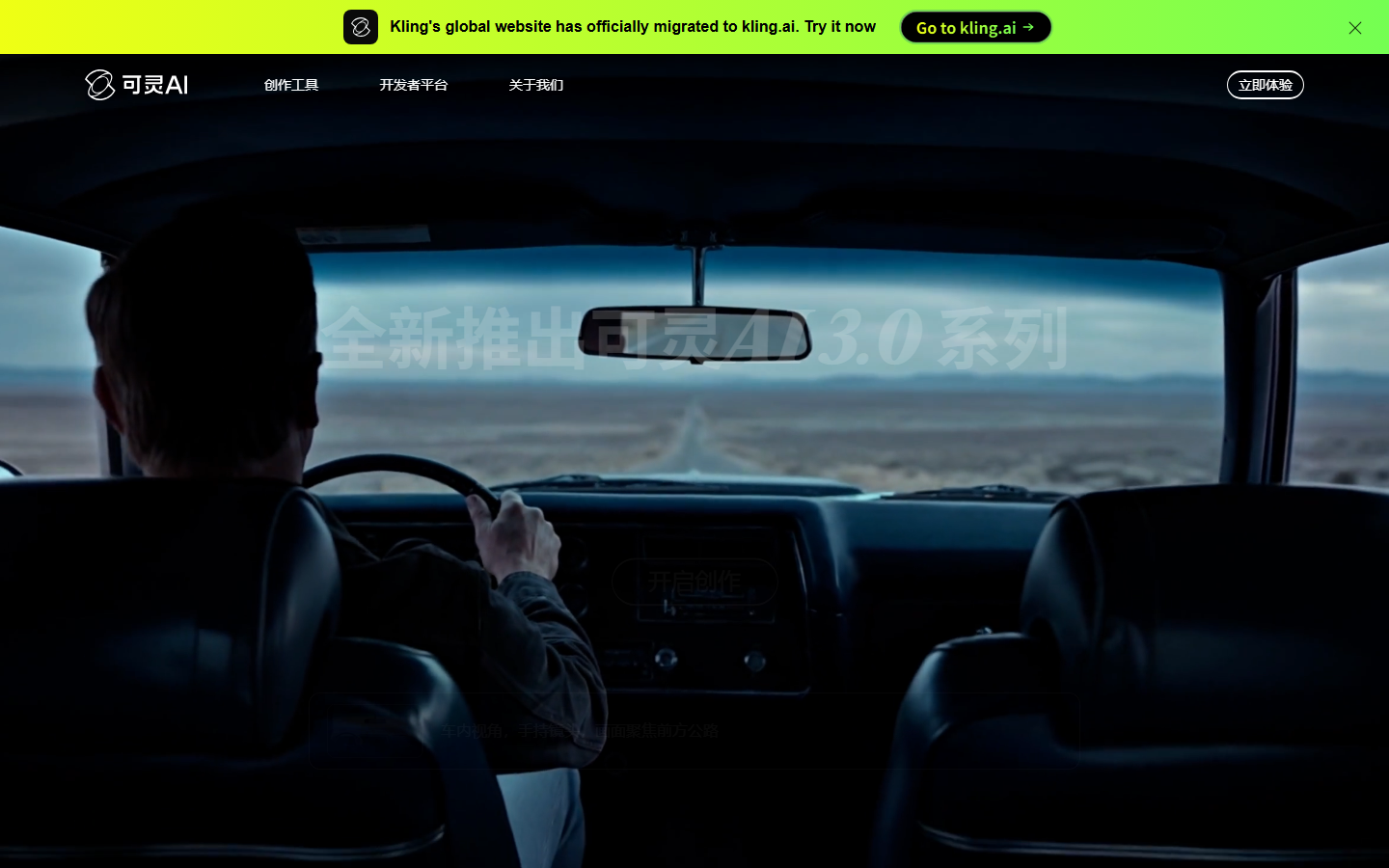
Kling AI (Kuaishou Keling)
Kling AI’s core parameters and statistics
Kling AI (commonly known as "Kuaishou Kling" in China) is Kuaishou's AI video and image generation platform for global creators. Its official positioning is not just a "Wensheng Video" tool, but a full-link AI creative studio covering video generation, image generation, audio synthesis, digital human, and style conversion. Public data from the official website shows: there are over 60 million users worldwide, the total number of AI videos generated has exceeded 600 million, and the App Store rating is 4.7★.
| Projects | Public Information |
|---|---|
| Official positioning | AI video and image generation creative platform |
| Core Technology Line | Video 3.0 / Image 3.0 / Omni / Kling O1 / Avatar 2.0 |
| Delivery form | Web, iOS, Android, macOS, Windows, API |
| Supported languages | Chinese, English, Japanese and other languages |
| User scale | 60 million+ (official website data) |
| Total video generation | 600 million+ (official website data) |
| App Store Rating | 4.7★ (official website data) |
| Output quality | Up to 4K resolution 15 seconds continuous generation |
| Underlying architecture | Native Audio native audio + multi-modal deep command analysis |
Why These Numbers Matter: 600 million videos generated means that the Kling model is validated at scale in real user scenarios, not just in the demo stage. 60 million users shows that it has crossed the early adopter stage and entered the mainstream user group. The score of 4.7★ is at the head level among tool applications and reflects the completion of the product.
Platform Coverage: Kling AI is one of the few AI video platforms that provides Web, iOS, Android, macOS, Windows desktop and API interfaces at the same time. The launch of the desktop client means that it is positioned not only as a lightweight trial tool, but as a formal productivity tool that can be embedded in professional creative workflows.
Users and market recognition of Kling AI
Kling AI's market recognition can be cross-verified from three levels: user scale data, community activity and industry citations.
User scale can be verified: The official website homepage directly displays 60M+ Users, 600M+ AI Videos Generated, and 4.7★ App Store Rating. These three indicators are continuously updated by Kuaishou officials on the public page. They are verifiable data by the first party and have high credibility. The 600 million videos generated are in the leading echelon among similar AI video platforms (compare the public data of competing products Runway, Pika, and Sora in the same period).
Creator Ecosystem: The official website displays evaluation feedback from multiple professional creators—including filmmakers, AI digital artists, and content creators from Fortune 500 companies—all giving 5-star reviews. One of the creators mentioned that "the first video generated using Kling AI received 22 million views," indicating that the quality of its generation has reached a level that can be commercially released.
Industry benchmarking position: Kling AI is one of the few globally competitive AI video platforms produced by Chinese companies. Its direct competitors include OpenAI Sora, Runway Gen-3/Gen-4, Pika, Luma Dream Machine, etc. Unlike these competing products, which are mostly from the United States, Kling has structural advantages in Chinese scene understanding, localization compliance and cost control.
Undisclosed information: Kuaishou did not separately disclose Kling AI’s revenue data, paying user ratio, or enterprise customer list. These data need to be obtained indirectly through third-party industry reports or Kuaishou’s earnings conference calls.
Cost Advantages of Kling AI
Kling AI's cost structure needs to be dismantled in layers, and different usage models correspond to completely different cost structures.
C client/individual user layer:
- Free Quota: The platform provides a free trial entrance, and you can generate videos after registration. Videos generated by the free version include platform watermarks and the output resolution is 1080p.
- Paid Subscription: The main value of the subscription package is to remove watermarks, upgrade 4K output, and increase monthly generation quota. The specific stalls and prices are subject to the real-time pricing page of the official website and have not been solidified in public documents.
API/Developer Layer:
- Kling AI provides an independent API platform (kling.ai/dev) to provide programmatic access to developers and enterprises. API billing is usually based on the number of calls (number of video generation/duration), and the specific unit price needs to be confirmed in the API console or during business negotiations. For content platforms, marketing SaaS or MCN agencies that need to generate videos in batches, API access is the real cost entity.
Corporate/privatized layer:
- Enterprise-level deployment plans (such as privatization, customized models, dedicated computing power) are not publicly explained on the official website, and must be consulted through business channels. For industries where data sovereignty is sensitive (e.g., finance, government, healthcare), privatization may be necessary, but the cost will be significantly higher than a SaaS subscription.
Cost reduction and efficiency improvement (taking new media operations as an example): The traditional short video production process involves script writing → storyboard drawing → shooting → editing → dubbing → color correction. The production cycle of a 15-second short video is usually 2-5 working days, and the labor cost is about 500-2000 yuan/video. After using Kling AI, the typical time from copywriting to video output can be compressed to 10-30 minutes, and the explicit cost is reduced to electricity bill + subscription fee. But please note: AI generation still requires manual screening and post-production fine-tuning at the current stage, and cannot completely replace the roles of directors and editors.
Kling AI’s main features
The core capability of Kling AI is not a single "Wensheng Video" function, but a complete tool matrix centered around the full link of video creation:
- Text-to-Video: Enter a text description, and the Kling model directly generates the corresponding video clip. Video 3.0 supports continuous output of up to 15 seconds and can include narrative logic for multiple shots in the same build.
- Image-to-Video: Upload a static image as a reference frame, and the model will "animate" it and continue the visual style. Suitable for product display, illustration animation and other scenarios.
- Video 3.0 Omni (omnipotent mode): Native support for multi-modal input mixing - understands text, images and audio commands at the same time, and the output video automatically matches audio rhythm and lip synchronization. This is the core differentiating capability of the Kling 3.0 series.
- AI Audio & Lip-Sync (Native Audio & Lip-Sync): Synthesize matching human voices or ambient sounds while generating videos, and drive precise lip synchronization of the characters in the picture. Supports multiple languages and accents, and can specify who is speaking in multi-role scenarios.
- Digital Human: Construct an interactive digital human image from a single photo or short video, supporting AI-driven expressions and body movements.
- Style Conversion (Restyle): Convert existing videos or images to a specified artistic style without regenerating the entire content.
- AI Special Effects: Provides post-production capabilities such as supplementary special effects and scene element adjustment, similar to an AI-driven "fine-tuning brush".
- Motion Control: Precisely control the movement trajectory of the lens (push, pull, pan, and follow), start and end frames, motion brush selection, etc., for users with a certain foundation in film and television production.
Implicit linkage effect: The above functions do not operate in isolation. For example, in Omni mode, users can first create the main screen through Vincent Video, then use Tusen Video to lock the character consistency, and finally configure multi-language narration through the native audio module - the entire process is completed in the same editor, without the need to export/import across software. This "inter-function synergy" is the core difference between Kling and pure "video generation API" products (such as the early Stable Video Diffusion).
Kling AI model and version evolution
Kling AI's model version lineage, named "Video + Digital", has evolved from 1.0 to the current 3.0, while maintaining the O1 (Inference Enhancement) and Avatar (Digital Human) sub-series in parallel.
Mainline release
- Kling Video 1.0 (~2024-09): The first public version of Kuaishou Kling, opening the basic capabilities of AI video generation to global users, supporting Wensheng videos and Tusheng videos.
- Kling Video 1.5 (~2025-04): Optimize the generation quality and speed, extend the video duration, and start to accumulate user feedback.
- Kling Video 2.0 (~2025-09): A major architectural upgrade, the introduction of multi-camera narrative capabilities, significantly improved video duration and consistency, and support for motion control.
- Kling Video 2.6 (~2026-02): Introduces switching between standard mode and professional mode, enhances lip sync and audio alignment, launches Motion Brush and other functions.
- Kling Video 3.0 (~2026-05): The latest main version. The architecture has been fully upgraded, and it natively supports multi-modal command analysis (text + picture + audio mixed input), achieving 15 seconds of multi-lens continuous output, character consistency locking Native Audio original sound synthesis and lip-synchronized 4K high-fidelity rendering.
Sub-series
- Kling O1: A reasoning enhancement model independent of the Video mainline, focusing on video generation of complex logical scenarios (such as causal relationship visualization, mathematics/scientific demonstrations), and oriented to educational and professional demonstration scenarios.
- Avatar 2.0: Digital life generation sub-series, constructing interactive digital human images from a single photo or short video.
Iteration rhythm judgment: Judging from the version number interval (1.0→1.5→2.0→2.6→3.0), Kling releases a major version update approximately every 4-5 months. The iteration speed is medium to fast in the AI video industry. However, the official has not disclosed the precise release date. The above dates are approximate values based on public information.
Technical advantages of Kling AI
Architecture upgrade - from single-modal to multi-modal native integration: The core technological innovation of Video 3.0 lies in the "native support" of the underlying architecture for multi-modal input, rather than the traditional serial path of "converting text first and then synthesizing video". The model understands text, images, and audio in the same latent space, which makes the temporal alignment of audio and pictures (such as accurate mouth shape matching when speaking) no longer requires a post-processing module, but is completed in the generation stage.
Character Consistency - Eliminating "AI Face Changing": This is one of the most difficult problems in current AI video generation. Kling 3.0 uses the "character lock" mechanism - after uploading leaflets or multi-angle reference materials, the model maintains the consistency of the character's facial features, clothing and body shape in consecutive frames, avoiding the common AI artifact of "the character changes his face every time the camera is cut".
15-second multi-shot narrative: Most AI video tools have a single generation limit of 3-5 seconds. Kling 3.0 raises this limit to 15 seconds and supports narrative structures that include multiple shots in the same generation (controlled through storyboards). This means that users can generate a complete short video clip at once instead of splicing it frame by frame.
4K resolution output: In the field of AI video, output resolution has always been a quality bottleneck. Kling 3.0 supports 4K output (requires Pro subscription), making its results directly usable in high-quality scenarios such as commercials and brand videos, not just social media content.
Engineering implementation considerations: Kling’s advantage lies not only in its model capabilities, but also in its productization level—it encapsulates the above complex capabilities into a clear function entrance (Creative Studio), and provides detailed graphic tutorials (Quick Start zone) for each sub-function, lowering the adoption threshold for professional creators.
Kling AI usage path
Kling AI provides multiple access paths to adapt to different usage habits and scenarios:
| Access method | Applicable people | Core uses |
|---|---|---|
| Web client (kling.ai) | All users | Complete creative studio functions, Wensheng video/Tusheng video/audio/digital person |
| iOS / Android App | Mobile Creator | Shoot + generate anytime, anywhere, support uploading album pictures |
| macOS/Windows desktop client | Professional creator | Independent window operation, suitable for heavy use scenarios |
| API platform (kling.ai/dev) | Developer/Enterprise | Programmatic video generation, integrated into own product process |
Typical web usage process:
- Visit kling.ai and register an account (supports login via email or social account).
- Select the creative mode in Creative Studio (Vincent Video, TuSheng Video Omni, etc.).
- Enter text prompts or upload reference pictures/videos, and adjust parameters (resolution, duration, style, exercise intensity, etc.).
- If audio is required, configure the speech type, language and content before generation.
- Click Generate and wait 1-3 minutes (depending on resolution and duration).
- Preview the results, re-adjust parameters and regenerate, or download and export.
API Access: Developers can visit kling.ai/dev to obtain API documents and keys. The API supports standard interfaces such as video generation task submission, status query, and result download. For specific endpoints and authentication methods, please refer to the official developer documentation.
Product Pricing for Kling AI
Kling AI's pricing adopts a Freemium+subscription tier model, covering ladder needs from personal trial to professional production.
Free Tier:
- Sign up and use it, no credit card required.
- There is a certain amount of free generation times per day.
- Free generation includes platform watermark, output resolution is 1080p.
- Suitable for light use for evaluating platform capabilities and non-commercial use.
Paid Subscription:
- Core upgrade points: remove watermark, unlock 4K output, increase monthly generation quota.
- Paid users enjoy faster build queue priority.
- The specific tier (monthly payment/annual payment) and price are subject to the official pricing page of kling.ai and are not fixed in public documents.
API Billing:
- Pay-as-you-go billing model for developers and enterprises.
- Billing is based on the duration or frequency of video generation, and different resolutions correspond to different unit prices.
- Independent from SaaS subscriptions, API calls do not consume web quota.
- Please refer to the official API console for specific rates.
Hidden Cost Tip: The actual single cost of AI video generation not only depends on the subscription fee, but also is affected by the "post-generation screening rate" - AI videos at the current stage usually require multiple generation and manual selection of the best results. This part of the time cost and trial and error cost is easily ignored in budget planning.
Application scenarios of Kling AI
-
Short video and social media content creation: the most direct application scenario. New media operators and content creators can use Wensheng Video to batch produce short video materials, and use the audio synthesis function to complete dubbing in one stop. The 15-second generation time just covers the core video length of Douyin/TikTok/Reels. Efficiency deduction: Traditionally, it takes about 1-2 hours to shoot a 15-second spoken video (setting + shooting + editing). Kling can compress the process to 5-10 minutes, but it requires manual screening and post-subtitle calibration.
-
E-commerce product display and advertising materials: E-commerce operators can convert product images into dynamic display videos through graphic videos, and use the text rendering function to directly generate advertising short films with brand copywriting. Video 3.0’s native text rendering capabilities ensure that brand elements are clearly readable in the generated video, eliminating the need for post-production overlays.
-
Film and TV pre-visualization and concept design: Independent filmmakers, advertising directors, and visual designers can use Kling to quickly generate storyboard previews or proof-of-concept videos. The multi-lens storyboard control capability enables it to be used in pre-rehearsals for professional film and television, significantly reducing communication costs before actual shooting.
-
Education and training and knowledge popularization: The Kling O1 sub-series is particularly suitable for teaching content that needs to show logical relationships (such as physical simulations, derivation of mathematical formulas, and reproduction of historical events). Educational institutions can use it to quickly generate teaching assistance videos without the need for a professional animation production team.
-
International Marketing and Localization: Native audio supports multiple languages and accents. Brands can generate English, Chinese, Japanese and other language versions of the same advertising content at one time. The digital human module can also project a virtual image corresponding to the culture. This is of practical value to the localized operations of overseas companies and global brands.
Applicable groups of Kling AI
-
Short video creators and new media operators: the core user group. Social media operation teams that require high-frequency output can use it as an "AI material engine", but they need to cooperate with manual topic selection and post-review.
-
Independent filmmakers and visual artists: Suitable for using AI video as a creative preview and inspiration exploration tool. Many professional creators expressed in feedback on the official website that Kling has been integrated into their daily creative processes. Not suitable for scenes: commercial advertisements that require precise control of every frame of the picture (still based on traditional CGI/real shooting).
-
E-commerce operations and brand marketers: Graphic video and text rendering capabilities are suitable for quickly producing product display and promotional materials. It is not recommended to completely replace professional photography - current AI videos are still limited in the performance of fine product materials (jewelry, cosmetics texture).
-
Education and Training Content Producer: Kling O1’s logic visualization capabilities are an underrated niche. Teachers and trainers can use it to generate concept demonstration videos instead of traditional PPT animation production.
-
Developers and enterprise integrators: embed AI video capabilities into their own products (such as marketing automation platforms, content management systems) through API access. Evaluate whether API latency and cost are appropriate for the scale of your business.
-
Not suitable for the crowd:
- Hand-drawn animators who require fine frame-by-frame control (should be generated using professional animation software rather than AI).
- Legal/compliance departments that are extremely sensitive to copyright ownership (the definition of copyright for AI-generated content is not yet clear in different jurisdictions).
- Users who need to run completely offline (Kling is a cloud service and does not support a purely offline version deployed locally).
Summary and Outlook of Kling AI
Core Competencies: Kling AI has established three levels of advantages in the field of AI video generation - ① multi-modal native architecture (Video 3.0's audio + video + text integrated generation capabilities are leading among similar products); ② engineering maturity (full platform coverage, clear tutorial system, commercially available 4K output quality); ③ Chinese ecological advantages brought by Kuaishou background (Chinese semantic understanding, Chinese compliance architecture, localized services).
Current limitations: ① The version date is not transparent - the official has not disclosed the precise version release timeline, and it is difficult to track the technical progress externally; ② The enterprise-level information is missing - the privatized deployment SLA guarantee, data security certification and other enterprise procurement essential items are not disclosed; ③ The pricing transparency is insufficient - the subscription level and API unit price need to be checked by the user after registration, and the "floor price" is not displayed on the public page, which increases the cost of selection and comparison; ④ AI Common problems in the video industry still exist - the consistency of complex scenes, compliance with physical laws, and the coherence of long video narratives have not yet been fully resolved.
Procurement/Adoption Risk Assessment: For individual creators, the free tier is sufficient for assessment with minimal risk. For enterprise purchases, it is recommended to first complete a small-scale pilot (1-2 weeks) through Creative Studio on the web side, and then purchase a subscription plan after confirming that the generation quality meets business standards. If API integration is involved, be sure to specify data usage terms (whether training data includes user-uploaded content) and SLA compensation mechanisms in the contract. Industries with strict requirements on data sovereignty need to proactively contact the business to confirm the feasibility of the privatization plan - the fact that the official website does not disclose this information does not mean that it is not supported at all. At this stage, it is not recommended to use it as the only video content production pipeline, but should be used as an "acceleration auxiliary layer" for traditional production processes.
Related tools: runway, pika
Version Info
- Kling Video 3.0/Image 3.0 :The newly upgraded architecture natively supports multi-modal deep command parsing and cross-task integration. Video 3.0 enables 15-second multi-camera continuous output, native audio and lip synchronization, and character consistency locking. Image 3.0 supports 4K-level high-fidelity rendering. There is no official precise date yet.
- Kling Video 2.6 :Based on 2.0, it enhances motion control and lip synchronization capabilities, and introduces standard mode/professional mode switching. There is no official precise date yet.
- Kling Video 2.0 :A major version upgrade that improves video length and consistency, and begins to support multi-camera storytelling. There is no official precise date yet.
- Kling Video 1.5 :The early mature version optimizes video quality and generation speed, laying the foundation for Keling's video generation capabilities. There is no official precise date yet.
- Kling Video 1.0 :The first public version of Kuaishou Keling opens AI video generation capabilities to global users and supports the basic functions of Wensheng Video and Tusheng Video. There is no official precise date yet.
User Reviews