 Kolena
Kolena is an AI data processing platform for enterprise document-intensive processes. It uses AI Agents to read PDF, Office, email, pictures, audio and other multi-format inputs to complete extraction, verification, templated output, system integration and auditable data processing automation.
kolena
Core parameters and statistics
Kolena's current product focus is to break down document-intensive business processes into runnable, verifiable, and integrable AI Agents. It is not a tool that only does OCR or a single question and answer, but forms an enterprise-level process platform around input file prompts, structured results, template output, permissions and auditing. For teams such as real estate, financial services, insurance, and banks that rely heavily on contracts, forms, emails, and review materials, Kolena's value lies in turning unstructured materials into verifiable data and reports.
| Parameters | Current capabilities |
|---|---|
| Product Positioning | Enterprise Document Workflow AI Automation Platform |
| Core Objects | Agent, Prompt, Run, Ground Truth, Validation, Workspace |
| Typical input | PDF, scanned Office documents, emails, tables, pictures, text, audio, compressed packages |
| Single run limit | Maximum 300 files 2 GB total file, 250 MB single file, 1,500 pages of content |
| Prompt attachment limits | Maximum 5 files per prompt, 5 MB each |
| Prompt file creation limit | Maximum single file size is 20 MB |
| Output method | Web result API JSON, Webhook, Word/Excel/CSV template PDF download |
| Integration portal | Amazon S3, Azure Blob Storage, Box, Email, Gmail, Google Drive, SharePoint, CRM, Webhook, API |
| Enterprise governance | User management, team, workspace, role agent-level permissions, audit logs, data retention IP whitelist SSO/SCIM |
| Security Basics | Data is not used to train AI models, US cloud data center storage, transmission and rest encryption |
These parameters indicate that Kolena is more suitable for the continuous process of "material enters AI processing, results are published, and the system writes back" rather than a one-time document summary tool. In particular, the single-run limit of 300 files, 2 GB, and 1,500 pages allows it to undertake heavy-load tasks such as batch due diligence, contract review, and insurance material analysis; the template output and integration capabilities can connect the results back to the team's existing Word, Excel, CRM, network disk, or data warehouse.
User and market recognition
Kolena's market recognition mainly comes from two directions: one is the automation of enterprise document processes, and the other is the engineering credibility accumulated by the early machine learning test platform. The main website focuses on industries such as Real Estate, Financial Services, Insurance, and Banking, and displays customer logos such as Gateway, Union Pacific, SFA Partners, and Prostar, indicating that the product is more focused on B-side procurement and industry solutions rather than general personal productivity applications.
From the perspective of the developer ecosystem, Kolena still maintains the kolena Python package. The package description defines it as a machine learning test platform client and is released under the Apache-2.0 license. This historical context is also meaningful for current AI Agent products: when companies use document agents, they often care not only about whether they can generate answers, but also about whether they can measure accuracy, save Ground Truth, compare validation results, and track access and data processing. Kolena extends these evaluation and governance elements to document automation scenarios, forming a threshold that distinguishes it from ordinary document parsing tools.
Cost advantage
The cost advantage of Kolena is not its low public price, but its ability to convert large batches of manual review, data entry, template filling, and cross-system synchronization into reusable agents. For real estate lease abstraction, insurance loss run analysis, bank compliance testing, etc., the real cost is usually manual review time, rework rate, lead time and audit trace costs.
| Solutions | Starter | Professional | Enterprise |
|---|---|---|---|
| Monthly Credit Limit | 800 | 1,800 | Customized Quote |
| User seats | 3 | 10 | Starting from 15, customizable |
| API and Python SDK | Support | Support | Support |
| Integration and template output | Support | Support | Support |
| Dashboard | Not included | Support | Support |
| Data Analysis and Web Search | Not included | Support | Support |
| Audit log Agent permissions, custom roles | Not included | Not included | Supported |
| Data Retention, Service User SSO/SCIM, Teams and Workspaces | Not Included | Not Included | Support |
If it is just a temporary extraction of a small number of documents, Kolena's platform capabilities may appear to be overweight; but when the team needs to stably process a large number of files, reuse templates, control access, export audit logs, and connect to existing systems, purchasing based on credit limit and seats is more likely to result in predictable costs than repeatedly building scripts, manual entry, and manual quality inspection.
Main functions
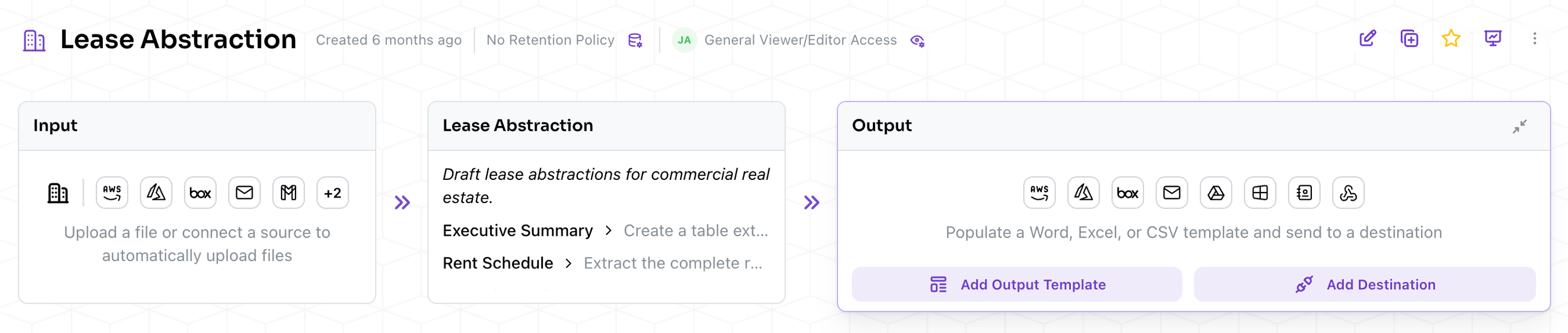
Kolena's main functionality revolves around the Agent life cycle. The user first creates an Agent, configures the input source and prompt, and then outputs the running results to the template API, Webhook or external system. Prompt is the core component of each Agent and is used to define how to read materials, extract fields, generate judgments, and form structured results.
| Function | Applicable tasks | Use value |
|---|---|---|
| AI Agent Orchestration | Multi-file, multi-step document processing | Fix review, extraction, generation and verification into a repeatable process |
| Prompt library and Prompt creation | Lease, due diligence, compliance, model filling | Reduce the cost of designing from a blank process |
| Ground Truth and Validation | Accuracy evaluation, result regression | Use known answers to check Agent output quality |
| Template output | Word report Excel model CSV data table | Retain original format, formula and report structure |
| Multi-source integration | Network disk, object storage, email CRM, Webhook | Let materials and results flow in existing systems |
| API and Python client | Programmatically submit files and read results | Suitable for batch processing, internal applications and data pipeline access |
| Permissions and auditing | Enterprise team collaboration, compliance tracking | Control who can access Agents and data, and record access behaviors |
The combination of these features makes Kolena more like a "document operating system" than a stand-alone AI plug-in. Teams can first validate the prompt in the web UI, then use the API to batch submit files, and finally write the results to Word, Excel, Google Drive, SharePoint, CRM, or internal webhook.
Model and version evolution
Kolena's version evolution can be divided into two lines. The first is the current Kolena AI Agents cloud product line, which is continuously updated around document workflow prompts, integration, template output and enterprise governance; the second is the kolena Python Client and Testing with Kolena documentation, which serves machine learning testing, fine-grained evaluation and model behavior tracking.
Currently, cloud products do not expose semantic version numbers, so they are suitable for recording in Cloud form in documents. Its key capabilities have been extended to objects such as Agent Run, Ground Truth, Validation, Usage Records, Access Logs, Workspaces, API Keys, etc., indicating that the product has further moved from "being able to process documents" to "being able to manage document AI processes." The latest public package version of the Python client is 1.69.0, which still retains the developer entrance to the ML testing platform; for enterprises, this reflects Kolena's product DNA in evaluation, testing, and traceability.
Technical advantages
Kolena's technical advantage comes from the combination of "document understanding + process orchestration + result evaluation + enterprise governance". Many document AI tools only focus on extracting fields or generating summaries. Kolena returns the Agent output together with metadata such as citations, confidence, reasoning, and validation results to facilitate review and auditing.
At the engineering access layer, Kolena provides Web UI, REST API, Python Client and Webhook. The API return structure contains Agent ID, Run ID, file list prompt sequence, status, result value and metadata, which allows the R&D team to embed Kolena into the internal system instead of having to manually download the results by business personnel. For security and compliance teams, capabilities such as data not being used for model training, cloud encrypted IP whitelisting, audit logs, and data retention SSO/SCIM reduce enterprise procurement resistance.
Another advantage is template output. Kolena can populate Agent results into Word, Excel or CSV templates while retaining the document's original style, formatting, formulas and macros. This is critical for scenarios such as financial models, lease summaries, due diligence reports, etc., because business teams often not only need data, but also need to adhere to existing delivery formats.
How to use
The typical usage path of Kolena is to first create the Agent in the Web UI, then use the sample file to debug the Prompt, confirm the output structure and verification standards, and finally access the API, integration or template output. For non-R&D teams, Web UI is more suitable for configuring Agents and checking results; for platform teams, API, Python Client, and Webhooks are more suitable for large-scale operations.
| Entrance | Suitable for the role | Typical actions |
|---|---|---|
| Web UI | Business Operations, Analysts, Compliance Team | Create Agent, configure Prompt, upload sample files, view Run results |
| API | Engineering team, data platform team | Upload files to Agent Run, query results, download templated output |
| Python Client | Data Science and Automation Team | Batch calls, reading logs, and accessing internal processing scripts |
| Integration | IT & Business Systems Leader | Connecting S3, Azure Blob, Google Drive, SharePoint, Email, CRM, Webhooks |
| Template output | Delivery and reporting team | Generate Word, Excel, CSV or PDF deliverables |
The recommended implementation rhythm is to first select a process with high frequency, clear boundaries, and high labor costs, such as lease abstraction loss run analysis or loan information review; use 20 to 50 representative materials to establish Prompt and Ground Truth; compare the output accuracy through Validation; and finally connect to object storage, email, or CRM to migrate the process from pilot to stable operation.
Product Pricing
Kolena uses a combination of organizational tiers and credit lines. Starter and Professional offer fixed monthly credits and seats, while Enterprise is geared towards more complex permissions, security and organizational governance needs. In the public level description, all levels support API, Python SDK, integration, template output and unlimited Agents; the real differences are Dashboard, data analysis Web Search, audit log agent-level permissions, custom roles, data retention SSO/SCIM, teams and workspaces.
When purchasing, you should focus on confirming four types of costs: The first is how many Agent Runs can be covered by the monthly credit limit; the second is whether the input file size, number of pages, and concurrent processes match the real business volume; the third is whether Enterprise is required to meet audit SSO, data retention, and fine-grained permissions; the fourth is the maintenance cost of internal process changes and review mechanisms after the template Webhook, CRM, or network disk integration is online.
Application scenarios
Kolena is best suited for teams with large amounts of unstructured material, fixed review rules, and strong delivery format requirements. Its industry scenarios focus on real estate, financial services, insurance and banking, but its underlying capabilities are also suitable for any enterprise process that needs to convert complex documents into verifiable structured results.
- Real estate and asset business: Processing lease abstraction, loan sizing, mortgage due diligence and quarterly lease audits, reducing the time for manually reviewing contracts, amending terms and entering forms.
- Financial services: Generate investment analysis PE fund modeling, risk assessment and accounting operation materials, organize multiple PDFs, forms and memos into reviewable model input.
- Insurance: Analyze loss runs, policy COIs, claims materials and underwriting data, and use structured results to support claims processing, risk profiling and underwriting reviews.
- Banking and Compliance: Handle loan package UCC filing, customer complaints, regulatory reviews and compensation processes, utilizing audit logs and permission controls to meet compliance team requirements.
- Internal operations: Connect emails, network disk files, and CRM objects to the Agent, allowing duplicate document review and data to be synchronized into the automated queue.
Applicable people
Kolena is suitable for three types of users. The first category is industry business teams, such as real estate asset management, insurance claims, bank compliance and financial analysis teams, who need to quickly obtain credible results from large amounts of material. The second category is enterprise IT, data platform and automation teams, who are responsible for connecting Agent to existing network disks, object storage CRM, Webhooks or internal applications. The third category is AI governance and QA teams, who care about Ground Truth, Validation, access logs, permissions, data retention, and result traceability.
The situations where it is not suitable are also clear: if the team only occasionally works on a few pages of documents, or if there is no fixed output format, no review standards, and no system integration requirements, Kolena's enterprise-level capabilities will be too heavy. It is more suitable for organizations that already have stable processes, clear fields, clear responsibilities, and large-scale processing volumes.
Summary and Outlook
Kolena's core competency is to advance document AI from "single-shot answer generation" to "enterprise-level automated processes." It supports complex input prompt orchestration, template output API calls, integration, permissions, auditing and data retention, and can serve industry teams that require accuracy, reviewability and stable delivery. At the same time, the evaluation capabilities left behind by early ML testing platforms and Python clients have given it greater engineering depth in validating Agent output, building Ground Truth, and managing regressions.
Follow-up observations will focus on three things: whether cloud Agents continue to enhance coverage of industry templates and preset prompts; whether enterprise-level auditing, permissions, and data retention capabilities are easier to configure; and whether Python Client is further integrated with the current document Agent product line. For teams preparing to purchase, the best starting point is not to replace the entire documentation process at once, but to choose a high-frequency, high-value, measurable accuracy process that allows Kolena to prove time savings, reduce rework, and enhance audit capabilities on a small scale.
Version Info
- Kolena AI Agents :The current product form of the main website focuses on enterprise document workflow AI Agents, supporting prompt orchestration, file upload API calling Python client, template output, integration, permissions, auditing, data retention and enterprise-level governance.
- kolena Python Client 1.69.0 :A public package version of the Python client for the Kolena machine learning testing platform, enabling code management of test data, metrics, and model evaluation workflows.
- Testing with Kolena :Developer documentation showcases Kolena’s early product capabilities for machine learning model testing, fine-grained evaluation, debugging, and regression tracing.
User Reviews