 Komo
Free
Komo
Free
Komo is a privacy-focused AI search engine that provides an ad-free, tracking-free search experience. It uses AI technology to understand search intent and generate answers comprehensively from multiple sources rather than traditional keyword matching. Komo places special emphasis on user privacy protection and does not establish user portraits.
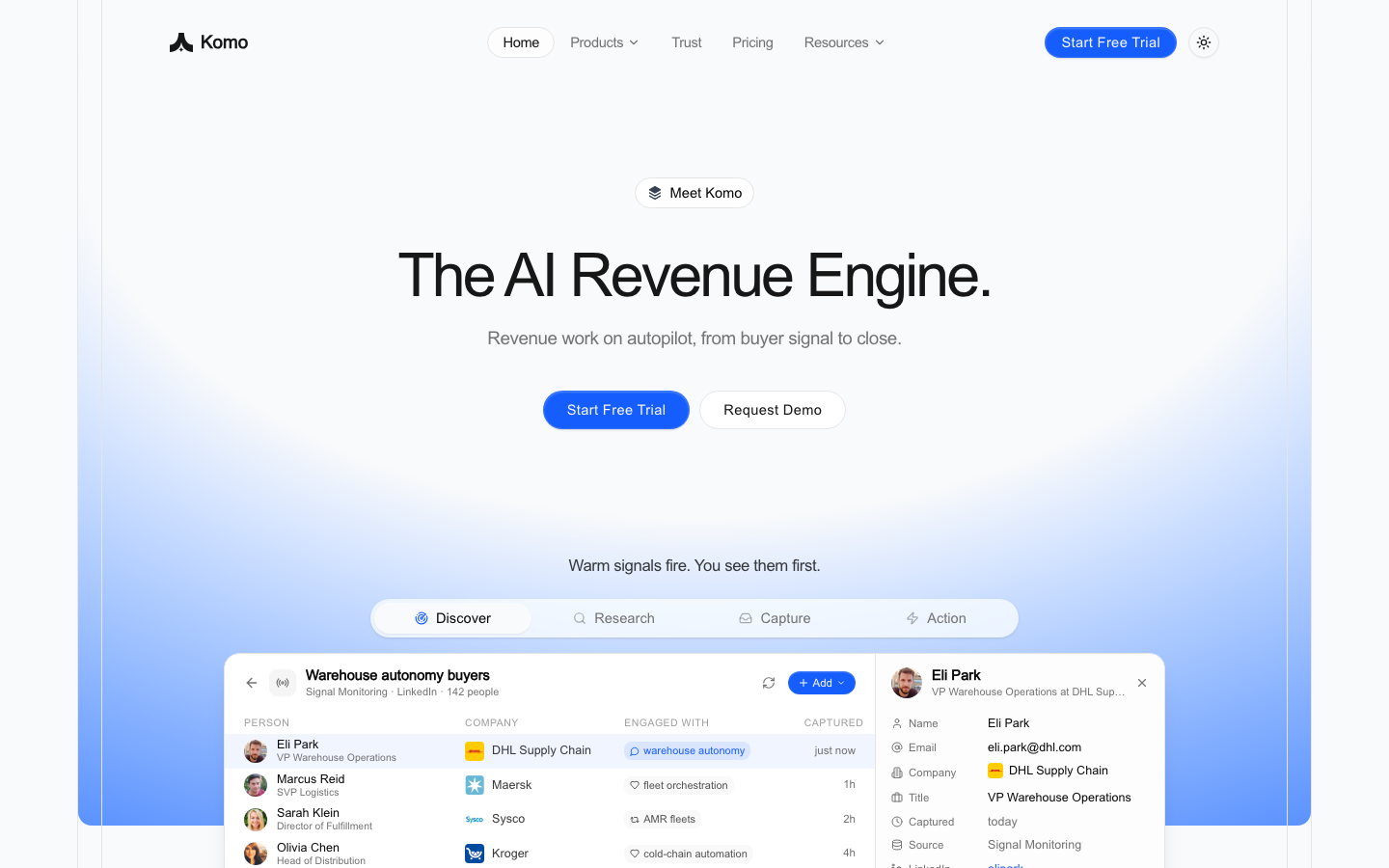
Komo
Komo’s core parameters and statistics
Komo is positioned as a "privacy-first AI search engine." It is not an improvement on Google, but a reconstruction of the search experience from the underlying logic - replacing keyword matching with AI and replacing user tracking with privacy protection. Its technology stack combines semantic understanding of large language models with real-time network indexing, trying to find a balance between "answer quality" and "privacy protection."
| Parameters | Data |
|---|---|
| Product positioning | Privacy-first AI search engine |
| Core technology | LLM semantic understanding + real-time network indexing |
| Search mode | Comprehensive natural language answer |
| Advertising Strategy | No Ads |
| User tracking | Do not track, do not create user portraits |
| Platform | Web |
| Home | US |
| Supported languages | English |
| Business Model | Free |
Brief review in one sentence: Komo is not a traditional search engine, but an "AI + privacy first" search experience - it does not track you, does not sell ads, and directly uses AI to integrate search results. But the price is that the coverage and timeliness of search results are still unable to match traditional search engines.
Positioning differences from similar products: Komo is located at the intersection of private search (DuckDuckGo) and AI answer engine (Perplexity). Compared with DuckDuckGo's privacy protection + traditional keyword search, Komo uses AI to directly generate answers, eliminating the need for users to browse links. Compared with Perplexity's AI answers + source transparency, Komo puts more emphasis on the promise of "not tracking users." But this differentiated positioning also means that it faces competitive pressure from two tracks at the same time - privacy search users may choose the more mature DuckDuckGo, while AI search users may choose Perplexity with higher answer quality.
Komo’s users and market recognition
Komo has a certain reputation among privacy-focused technology user groups, but its market popularity is orders of magnitude different from its leading competitors.
C-side awareness: Komo has gained attention in early technology communities such as Product Hunt and Hacker News, and its "no advertising, no tracking" value proposition continues to attract privacy-sensitive users after the Snowden effect. However, compared with Perplexity (valued at over $500 million in 2024, with tens of millions of monthly active users) and DuckDuckGo (average daily searches exceeding 100 million times), Komo’s user base has not been publicly disclosed, and it is speculated that it is in the early verification stage.
Industry Benchmarking and Competition Landscape: The "AI + private search" track where Komo is located is rapidly becoming crowded. Google has integrated AI Overviews into its search; Brave Search is launching AI summarization features with the same emphasis on privacy; DuckDuckGo is introducing AI answers with DuckAssist. In the context of giants increasing their investment, Komo's differentiation space is being compressed - its privacy commitment is no longer a unique selling point, and the quality of AI answers is limited by a smaller engineering team and training data size.
Missing third-party information: As of now, Komo has not publicly disclosed operating indicators such as user volume, search request volume, and financing amount. There is no financing record found in public databases such as Crunchbase, and it is presumed to be a self-funded independent project. This means that users need to maintain reasonable expectations for its long-term operational stability.
Komo’s cost advantage
Komo's free model poses zero-threshold trial appeal to C-end users at the current stage, but the sustainability of its cost structure needs to be examined under the dual constraints of "privacy protection + AI inference cost".
-
C client/individual user: completely free, no registration required. No ads means users don’t have to endure interruptions in their information flow, but “no tracking” also means Komo can’t cross-subsidize the cost of AI inference through ad revenue. In an industry context where Perplexity has launched a Pro subscription ($20/month), Komo’s completely free model is more like an early customer acquisition strategy. Whether it can be maintained in the long term remains to be seen.
-
API/Developer: No independent API or developer services are publicly provided. This limits Komo’s penetration into B-side and integration scenarios – compared with Perplexity (which provides APIs for developers to call) and Brave Search API (enterprise-level pricing), Komo is currently only for end users and lacks a starting point for ecological expansion.
-
Enterprise/Privatization: Not applicable. Komo's current product form is only a web application and does not provide enterprise deployment or privatization solutions. For users in industries where data sovereignty is sensitive (e.g. legal, medical, financial), this gap means they cannot use Komo within a compliance framework.
The truth about free: Komo's free is based on "uncommercialized entrepreneurial stage" rather than "sustainable business model design". While users enjoy zero-cost search, they also bear the risk that the product may be shut down due to capital chain issues. Deduction: For an AI search engine with 100,000 daily active users, if each search consumes an average of 5 seconds of GPU inference time, the monthly inference cost is on the order of thousands to tens of thousands of dollars - without the support of advertising revenue and financing, this cost depends entirely on founder funds or donations, and long-term sustainability is questionable.
Komo’s main features
Komo's feature set revolves around the three lines of "semantic understanding + comprehensive answers + privacy protection". The number of functions is small but comprehensive.
-
AI Semantic Search: Input a natural language question, Komo understands the search intent instead of keyword matching, and comprehensively generates answers from multiple sources. Use value: Compress the process of "looking through 10 links -> manually integrating information" in traditional search into "asking a question in one sentence -> getting the answer directly", which can save 60-80% of time in knowledge query tasks. Verification Tip: The comprehensive answer generated by AI may miss key details or introduce source bias. It is recommended to click on the source link for secondary verification in scenarios involving decision-making.
-
No ads, no tracking: No user data is collected, no user profiles are created, and no third-party trackers are used. Use value: User search history will not become the basis for advertising, and there is no need to worry about "after searching for A, the entire platform will push A-related advertisements". This feature is especially important for users dealing with sensitive information (such as medical symptoms, legal advice, financial status).
-
Multi-source comprehensive answer: The search results are presented in the form of summary paragraphs, and each fact point is marked with a source link. Usage value: Compared with the "link list + summary fragment" returned by traditional search engines, Komo's comprehensive answers have higher information density, which is especially suitable for lightweight research scenarios of "quickly understanding a topic". But it should be noted: the accuracy of the comprehensive answer depends on the AI's weight judgment on information from multiple sources. When information from different sources conflicts, the AI may choose the "majority view" and ignore the minority but valuable perspective.
-
Simple interface: Komo’s UI design is minimalist, and the search results page has no distracting elements such as sidebars, advertising spaces, and recommendation modules. Use value: With the reading experience as the core, the user’s cognitive load is low when obtaining information. This design philosophy has certain value in an era when attention is scarce, but it also means that Komo gives up the possibility of monetizing through "page dwell time" and "ad clicks".
-
Transparent Privacy Policy: The official statement clearly states that it does not track users, does not store search history, and does not share data with third parties. Value of use: Against the background of increasingly stringent privacy regulations such as GDPR and CCPA, Komo’s privacy policy is naturally compliant, and users do not need to worry about cross-border or secondary sales of data.
Komo’s model and version evolution
Komo’s version iteration information has limited disclosure. The following is based on verifiable public milestones.
Public version context
| Version | Date | Changes |
|---|---|---|
| Initial release | ~2024-09 | Product launch, providing basic AI semantic search and privacy protection functions |
| Current version | ~2025-06 | Continuously optimize search quality, source annotation accuracy and response speed |
Version Transparency Note: Komo does not publish detailed version release logs or update announcements. Unlike Perplexity (which releases feature updates monthly) and DuckDuckGo (which publicly blogs about version changes), Komo is more restrained in version communication. Users can usually only perceive updates through changes in actual product experience, lacking a reviewable release history. It is recommended that users judge the progress of functional iteration by comparing product performance in different periods.
Speculation on the direction of technological evolution
Based on the common evolution path of the AI search engine industry, Komo's possible subsequent iteration directions include: ① Introducing multiple rounds of conversation context memory, allowing users to continuously ask questions in the same conversation; ② Supporting multi-language search to expand the coverage of non-English users; ③ Enhance source visualization, and more accurately mark the original source of each fact point in the answer; ④ Introduce personalization options (with user authorization). The above is an industry deduction and is subject to actual official release.
Komo’s technical advantages
Komo's technical route is not to "reinvent the search engine", but to "use AI to transform a certain section of the search experience" - it does not build its own web index library, but relies on third-party search APIs or public web data as the underlying data source, focusing its core capabilities on the link of "semantic understanding -> information integration -> answer generation".
LLM-driven semantic understanding: Komo’s core technical capability lies in using large language models to parse the intent of user queries, rather than relying on traditional TF-IDF or BM25 keyword matching. This means that even if the user's question formulation is not precise enough (such as "Help me find the nearest AI-related conference"), the model can infer the user's true needs and recall relevant information. Mechanism -> Effect: Intent understanding ability improves the search error tolerance from "keyword exact matching" to "semantic approximate matching". Users do not need to master specific keywords to search for the desired content.
Technical implementation of privacy protection: Komo's no-tracking commitment is not a marketing rhetoric, but is reflected in the specific technical architecture - no user cookies are set, no IP addresses are recorded, no search history is stored, and no third-party analysis tools are used. Differences from competing products: DuckDuckGo also promises not to track, but its search results page still contains advertisements (based on keywords rather than user portraits); although Google's AI Overviews provides AI answers, user data and search behavior are still used in the advertising system. Komo's "No Ads, No Tracking" makes a more extreme trade-off between the sustainability of the business model and the determination to protect privacy.
Lightweight architecture trade-offs: Komo does not build its own large-scale web index, but relies on third-party search infrastructure or real-time crawling. This architectural decision reduces operating costs (there is no need to maintain hundreds of billions of web page indexes), but it also brings two limitations: ① The coverage and freshness of search results depend on the quality of the underlying data source; ② When the third-party search API is interrupted or limited, Komo's search quality may be affected. Applicable Boundary: This architecture is suitable for covering common knowledge problems, but it may not be as good as a self-indexed search engine on long-tail unpopular topics and real-time hot events.
How to use Komo
Komo currently only provides a single entrance to the web, with a very short usage path and zero learning cost.
Usage steps:
- Visit
komo.ai, no registration or login required. - Enter a natural language question (in English) in the search box.
- View the comprehensive answers generated by AI. The answers are presented in paragraph form, with key information accompanied by source links.
- Click the source link to jump to the source page for detailed information.
- New topics can be opened through new search queries - the current version does not support multi-turn conversation context memory.
Comparison with similar products:
| Entrance | Komo | Perplexity | DuckDuckGo |
|---|---|---|---|
| Web | ✅ | ✅ | ✅ |
| Browser Extensions | ❌ | ✅ | ✅ |
| Mobile App | ❌ | ✅ | ✅ |
| API | ❌ | ✅ | ✅ |
Usage restrictions: Komo supports English searches by default, and the quality of answers to non-English queries is significantly reduced. For users who need to search across languages, it is recommended to express the query in English and then use a translation tool to understand the results. At the same time, due to the accountless system, Komo cannot synchronize preferences or search history across devices - this is both an advantage of privacy design and a sacrifice of convenience.
Komo’s Product Pricing
Komo currently adopts a completely free pricing strategy with no different payment tiers.
| Dimensions | Komo | Perplexity Pro | DuckDuckGo |
|---|---|---|---|
| Free Credit | Totally Free | 5 Pro Searches Every 4 Hours | Totally Free |
| Subscription Price | None | $20/month | None |
| Advertising | None | No ads | Keyword-based advertising |
| Privacy Protection | Do Not Track | Default Do Not Track | Do Not Track |
| AI Search | Yes | Yes (Pro version is stronger) | Limited (DuckAssist) |
Deduction: Sustainability of the free model: In the AI search track, the inference cost of each query is a real "hidden cost". Perplexity insulates the cost of inference for heavy users from free users with a Pro subscription ($20/mo); DuckDuckGo subsidizes the search infrastructure with ad revenue. Komo has chosen the route of "no fees at all and no ads displayed", which makes it competitive in the user growth stage, but in the long term it may face two options: ① Introducing paid subscriptions, corresponding to unlocking more searches or advanced features (such as file upload analysis, longer context windows); ② Maintaining free but introducing non-intrusive revenue methods (such as donations, enterprise version licensing). Please refer to the official announcement for details.
Application scenarios of Komo
Komo has found its own applicable scenario at the intersection of "light knowledge query + privacy sensitivity", but its performance is limited in tasks that require depth, timeliness, or expertise.
-
Daily Knowledge Query: Suitable for quickly understanding a concept, fact or topic (such as "What is RAG in AI," "Explain quantum computing simply"). Work-hour reduction deduction: In the traditional keyword search mode, users need to browse 3-5 search result pages to piece together a complete answer, which takes about 5-10 minutes; Komo's AI comprehensive answer can compress this process to 1-2 minutes, increasing efficiency by about 80%. Verification focus: Accuracy and completeness of AI answers - For common knowledge points, Komo's performance is generally reliable; but for controversial or highly time-sensitive topics, it is recommended to cross-check multiple sources.
-
Privacy Sensitive Information Query: Suitable for searching query records that are inconvenient to leave in mainstream search engines (such as medical symptoms, mental health, legal issues, personal finance). Cost reduction and efficiency improvement: Under traditional search engines, users need to manually manage search history, clear cookies, and use privacy mode - Komo fundamentally eliminates these "management costs" and searches can be used immediately without any privacy concerns. Boundary of Human-Machine Collaboration: In sensitive scenarios, Komo's AI answers should be used as "preliminary information reference" rather than "a substitute for professional advice". Key decisions such as medical and legal decisions still require the intervention of professionals.
-
Quick Topic Research: Suitable for preliminary information collection on specific topics (such as technology selection comparison, travel destination research, product function overview). Cost reduction and efficiency improvement: Under the traditional model, researching an unfamiliar topic requires opening 10+ tabs, reading page by page, and manually organizing key points, which takes 30-60 minutes; Komo's multi-source comprehensive answer can provide a structured summary of the core points in 3-5 minutes. Key points of verification: AI answers may ignore niche but valuable sources of information. It is recommended to use Komo's answers as the "starting point for research" rather than the "only source of information".
-
Light learning and knowledge expansion: suitable for exploring new areas through question and answer format (such as "Difference between SQL and NoSQL", "How does blockchain work"). Value Point: Acquiring knowledge through conversational interaction has a smoother learning curve than reading Wikipedia pages. Limitations: The learning experience for non-English queries is significantly reduced, and Komo does not support follow-up questions or multiple rounds of dialogue, and cannot "step-by-step" understand a complex topic like ChatGPT.
Applicable groups of Komo
Komo's adaptability varies significantly among different user groups. Its "privacy first + AI search" value proposition is very attractive to some groups, but has limited value to others.
-
Privacy-sensitive individual users: the most suitable core group. If you have reservations about the privacy practices of mainstream search engines such as Google, and don’t want your search behavior to be used for advertising or user profiling, Komo provides a "zero-compromise" alternative. Not suitable for boundaries: If the timeliness and coverage of the search results are high (for example, you need to search for the latest news, real-time stock prices, sports scores and other dynamic information), Komo's underlying data source may not be able to meet the needs. It is recommended to use DuckDuckGo or Google.
-
Lightweight Knowledge Workers: Suitable for content creators, self-media operators, and junior researchers who need to quickly query concepts, definitions, and background information on a daily basis. Komo's AI comprehensive answers can quickly provide "sufficient" knowledge summaries, helping users quickly establish a basic understanding of a topic. Misfit Boundary: Professional researchers (e.g., academic paper writing, literature reviews) should not rely on Komo as their primary source of information—AI-generated comprehensive responses cannot replace peer-reviewed academic literature in depth and accuracy.
-
Technology Early Adopters: Technology users who are curious about new AI tools and willing to try non-mainstream search products. Komo’s minimalist design, promise of privacy, and AI search are a product experiment worth experiencing in their own right. Implementation Tips: As an early product, Komo's search quality and availability may fluctuate. It is recommended to use it as a "backup search" rather than a "main search".
-
Not suitable for the crowd: ① Users who need multi-lingual search (Komo currently mainly supports English); ② Researchers who need in-depth, continuous conversations (Komo does not support multiple rounds of context); ③ Users who need to search for highly time-sensitive information (news, hot events); ④ Users with extremely high search speed requirements (the generation delay of AI comprehensive answers is usually 2-5 seconds, which is much slower than the millisecond response of traditional search).
Summary and Outlook
Komo has found a clear but narrow niche in the search market with its differentiated positioning of "privacy first + AI search". Its core value proposition is clear and direct - no tracking, no advertising, AI gives direct answers - in the current industry context of "big platforms harvesting user data", this stance has irreplaceable appeal to specific user groups.
Current core advantages: ① Free use with zero threshold, no need to register to experience, and trial cost is zero; ② Minimalist interface + no advertising + no tracking, the search experience is clean and neat; ③ The information density of AI comprehensive answers to common knowledge questions is higher than that of traditional search snippets.
Current clear limitations: ① The coverage and timeliness of search results are weaker than traditional search engines, and long-tail and hot topics may not be retrieved or answered inaccurately; ② Only support the Web and English, which limits the user base and usage scenarios; ③ There is no multi-round dialogue, no account system, and no API ecosystem, and product depth needs to be expanded; ④ The long-term sustainability of the free model has not been verified, and users need to bear the risk of product shutdown; ⑤ As giants are increasing their focus on AI In the competitive environment of search (Google AI Overviews, Brave AI, DuckDuckGo AI), Komo’s differentiation space is being compressed.
Follow-up observation points: The next stage of Komo's development will depend on three signals: first, whether to introduce paid subscriptions or sustainable commercialization solutions to prove the long-term operation capability of its model; second, whether to expand to multi-language and multi-platform (Mobile App, browser extensions) to expand user reach; third, whether it can establish a perceptible differentiation advantage in the quality of AI answers, not just the single selling point of "privacy".
Acquisition and Adoption Risk Assessment: For individual users, Komo’s zero-cost nature makes it worth incorporating into the workflow as an “adjunct to everyday lightweight searches,” especially when dealing with privacy-sensitive topics. However, it is recommended to position it as a "supplementary search tool" rather than a "main search engine" - for important information needs, cross-validation with Google or DuckDuckGo is still required. For enterprises and developers, Komo currently does not provide APIs or enterprise-level solutions, and integration is not yet feasible. Before deciding to use it heavily, it is recommended to pay attention to Komo’s product iteration speed, commercialization progress, and operations team background. If there is no commercialization signal or user growth data within half a year, its long-term availability needs to be re-evaluated.
Related tools: perplexity, you-com
Version Info
- current :Current version.
- launch :Product goes online.
User Reviews