 landing AI
Landing AI is an enterprise-level AI document intelligence platform founded by Andrew Ng, a well-known scholar in the field. The core product is Agentic Document Extraction (ADE), which provides a complete set of REST APIs for document parsing, splitting, and field extraction based on visual models, covering document automation scenarios in industries with high compliance requirements such as finance, insurance, medical, legal, and logistics.
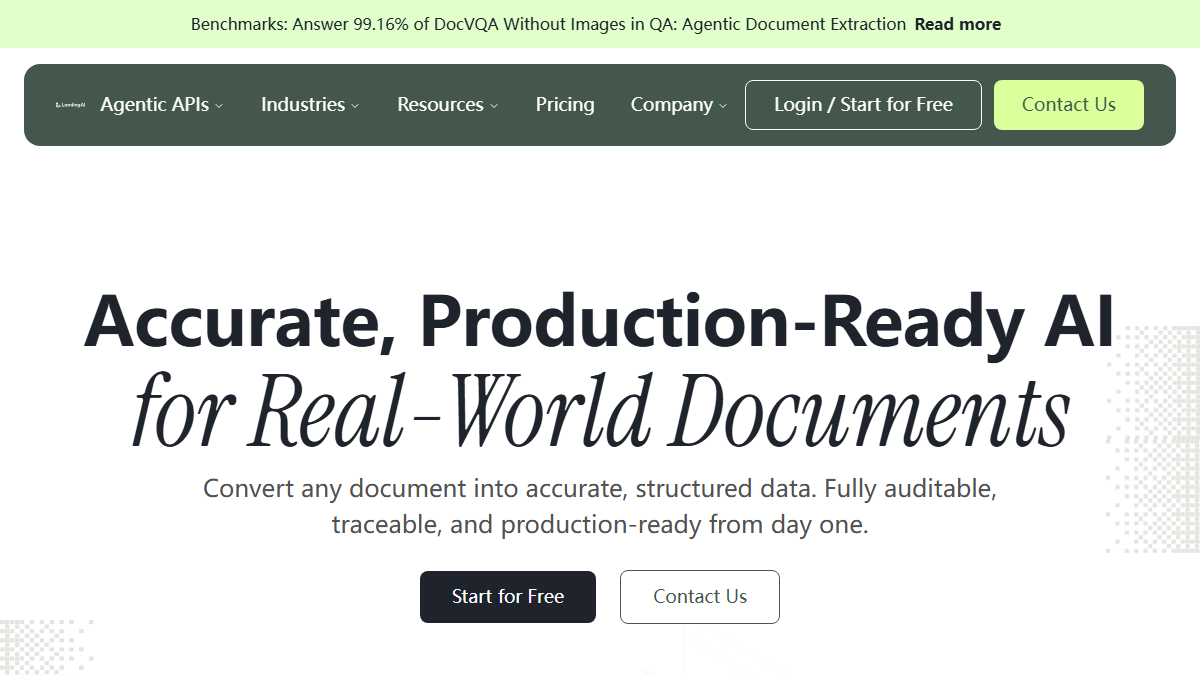
Landing AI in-depth review and usage guide
Core parameters and statistics
| Parameter | Value |
|---|---|
| Product positioning | Enterprise-level Agentic Document Extraction platform |
| Product form | REST API + Web Playground + Python/TypeScript SDK |
| Founder | Andrew Ng, co-founder of Coursera, founder of Google Brain, and former chief scientist of Baidu |
| CEO | Dan Maloney |
| Headquarters | Palo Alto, California, USA |
| Established | 2017 |
| Core Products | Agentic Document Extraction (ADE) |
| Licensing Model | Commercial SaaS + Private Deployment |
| Compliance Certification | SOC 2 Type II, GDPR, HIPAA (including BAA) |
| Supported platforms | Web, REST API, Python SDK, TypeScript SDK |
| Major Investors | Snowflake, Insight Partners, Intel Capital, AI Fund, Samsung Catalyst Fund, etc. |
| Number of enterprise customers | 50+ |
| Document volume processed | 1 billion+ images and documents |
| GitHub Organization | @landing-ai (33 repositories) |
| Core repository | landing-ai/ade-python (⭐1k+), landing-ai/vision-agent (⭐5.3k, deprecated) |
The core delivery form of Landing AI is API, and developers call ADE capabilities through the REST endpoint Python or TypeScript client library. The platform also provides a Web Playground for a code-free experience. Different from pure OCR + LLM solutions, ADE adopts a vision-first architecture to achieve higher parsing accuracy for unstructured data such as complex tables, mixed documents, and scanned documents.
User and market recognition
Enterprise Customer Matrix: The official website of Landing AI displays dozens of global enterprise customers including Barclays, Morgan Stanley, ABB, AbbVie, Foxconn, Toyota, Deloitte, Intel, AMD, Qualcomm, Thermo Fisher, Siemens Energy, etc., covering finance, insurance, medical, energy, legal, manufacturing, logistics and other industries.
Benchmark Case:
- Autyn (Loan Processing): Reduce loan document processing time from 2 hours to 2 minutes with 98% accuracy with ADE.
- GreenLite (Construction Compliance Review): Reduce plan review time by 50% in conjunction with the ADE Knowledge Graph.
- Eolas Medical (health technology): Build an Agentic RAG engine based on ADE to provide immediate and verifiable support for clinical scenarios.
- Fortune 100 Financial Institutions: Use ADE to automate customer due diligence and regulatory reporting.
Community and Open Source Ecosystem: GitHub organization @landing-ai has 33 public repositories, core library ade-python ⭐1k+, vision-agent (deprecated) ⭐5.3k. In addition, TypeScript SDK (ade-typescript) and multiple sample projects, auxiliary scripts and industry solution templates are provided.
Market positioning: Compared with general-purpose OCR (such as Tesseract, Google Document AI) or LLM-based parsing solutions, ADE emphasizes visual model priority + agent orchestration + full traceability, and has differentiated competitiveness in strict compliance industries (finance, medical, legal).
Cost advantage
Landing AI's cost model is divided into three layers, which are respectively oriented to user groups of different sizes:
C-side/individual developers: Provides Explore pay-as-you-go plan, purchase 100 Credits for $1, and new users will receive 1,000 free Credits for the first time. Each document processing consumes Credits based on the number of pages. No credit card required to start your trial. Small batch testing suitable for developer verification scenarios.
Developer/API call: The Team plan provides monthly Credits quota (please contact sales for specific prices), supports unlimited seats, higher frequency limits, and enhanced support. Ideal for teams with confirmed use cases who need stable SLAs and zero data retention (ZDR) options.
Enterprise/Private Deployment: The Enterprise plan offers pay-as-you-go or annual contracts, supports VPC deployment, on-premises deployment SLA guarantee, exclusive support for HIPAA/BAA compliance and zero data retention. The price requires business communication and is subject to the official real-time quotation.
Hidden cost considerations:
- Migrating from general OCR or open source solutions to ADE involves initial integration and Schema definition costs, but it can be exchanged for higher parsing accuracy and less later rework.
- For high-frequency and large-scale document processing scenarios, the cumulative cost of Credits mode needs to be evaluated in advance; the official has not disclosed the precise conversion ratio of Credits to the number of pages.
- The initial contract amount and service fees of the enterprise privatization deployment plan are not disclosed. You need to contact sales to obtain a quotation.
Main functions
- Parse: Convert variable documents to LLM-ready Markdown format, retain the layout-aware structure, support hierarchical output of text, tables, and pictures, and provide page coordinate-level reference coordinates for each information block. There is a section on document preprocessing for RAG pipelines.
- Split: Automatically split and classify PDF files containing multiple types of documents into independent sub-documents, supporting instance detection through repeated identifiers such as invoice numbers, dates, order IDs, etc. Suitable for batch processing of mixed documents.
- Extract: Extract specific fields from documents based on user-defined Schema, support flat/nested structure and array/multi-table extraction, automatically mark bounding box reference coordinates, and ensure audit traceability. From loan approval to compliance review, output structured JSON directly.
- Classify: Classify documents according to business rules, and work with Split to achieve complete document routing automation.
- Section: Divide the document into logical chapters according to the semantic structure, assisting the block retrieval of downstream RAG or knowledge management systems.
- Build Schema: Provides Schema definition tool, users can declare the required extraction fields and type constraints, and the platform automatically optimizes the extraction strategy accordingly.
Hide linkage effect
The core competitive barrier of ADE does not lie in the capabilities of a single API, but in the end-to-end collaboration of Parse → Split → Extract: Parse ensures the layout of documents is structured, Split solves the automatic diversion of mixed input of multiple documents, and Extract accurately obtains target fields under Schema constraints - the three together realize a seamless pipeline from "original document pile" to "structured data that can be directly entered into the business system". In conjunction with the Confidence Scoring mechanism, the system automatically marks fields with confidence lower than the threshold for manual review, forming a closed quality control.
Model and version evolution
Landing AI's product evolution extends from industrial vision to document intelligence, and has experienced a clear migration of technology routes:
Mainline release
- 2017–2024 (LandingLens era): The company started with the industrial vision quality inspection platform LandingLens, providing AI-driven surface defect detection solutions for the manufacturing industry. At this stage, visual model and data center capabilities were accumulated, laying a technical foundation for subsequent document AI.
- ~2025-06: DPT-1: The first-generation document processing technology stack is online, migrating visual model capabilities to document scenarios to achieve vision-based document parsing and structured output.
- ~2025-12: DPT-2: Introducing Agentic orchestration capabilities to support multi-step document processing workflow Schema-first field extraction, document splitting and classification.
- ~2026-06: DPT-3 (current): The latest architecture version, further enhances the accuracy of visual priority analysis and complex scene coverage, and improves the relationship between confidence scoring and manual review.
Candidate Verification
- vision-agent (⭐5.3k): An early open source vision agent project, now deprecated, and officially recommended to be migrated to ADE.
- agentic-doc (⭐2.4k): ADE's predecessor Python library, archived, new projects should use the
landing-ai/ade-pythonlibrary.
Technical advantages
Vision-first (Vision-first) Architecture: The traditional OCR + LLM solution is prone to losing layout information or creating hallucinations when processing complex tables and mixed multi-column documents. ADE uses a self-developed visual model to directly extract structured data from document images, retaining spatial context such as table levels and legend correspondences, significantly reducing error rates on complex documents.
Data-centric (data center driver): Unlike relying solely on model parameter optimization to improve accuracy, ADE has a built-in feedback loop—failure cases will be captured, audited, and systematically returned to the training data to continuously reduce the recurrence of similar errors. This mechanism allows enterprise customers' parsing accuracy to show an improvement curve over time, rather than stopping at the level at the time of initial deployment.
Agentic by design: A single parsing strategy cannot cover all document types. ADE uses the Agentic orchestration engine to automatically plan, decide, and validate each document until it reaches a preset quality threshold. This means that the system can adaptively handle different document forms, from standardized tables to irregular scans, without the need for manual configuration of parsing rules.
Compliance and Security Layer: SOC 2 Type II, GDPR, HIPAA (including BAA) certification, supports zero data retention (ZDR) option, and has three flexible options of cloud deployment, VPC deployment and local deployment, meeting the data residency requirements of strictly regulated industries such as finance and medical care.
How to use
Landing AI’s ADE platform provides multiple access methods:
1. Web Playground (code-free experience) Visit https://ade.landing.ai/home, upload documents to experience core functions such as Parse and Extract online, and verify product effects with zero code. Suitable for business professionals and first-time evaluators.
2. REST API call Directly integrated through the official REST API endpoint, supporting independent APIs such as Parse, Extract, Split, Classify, and Section. Detailed API reference documentation is located at https://docs.landing.ai/api-reference/parse/ade-parse.
3. Python SDK
The ade-python library is officially provided (⭐1k+, Apache-2.0 license), installation method:
pip install landingai-adePython calling example (subject to official documentation):
from landingai_ade import ADEClient

client = ADEClient(api_key="<YOUR_API_KEY>")
result = client.parse(document_path="invoice.pdf")
print(result.markdown)
4. TypeScript SDK
Officially provided ade-typescript library (⭐30, Apache-2.0 license):
npm install @landing-ai/ade5. API Key acquisition After registering a free account on the ADE platform (https://ade.landing.ai/home), you can generate an API Key in the console. Get 1000 Credits when you sign up for the first time.
Product Pricing
Landing AI uses a Credits system for billing, and is consumed based on the number of document pages:
| Solution | Target users | Billing model | Main features |
|---|---|---|---|
| Explore | Developer/Verification Stage | Pay-as-you-go ($1/100 Credits) | 1000 Free Credits, Standard Frequency Limits, Community Support |
| Team | Team | Monthly Credits Quota (Contact Sales) | Unlimited Seats, Higher Frequency Limits, Enhanced Support, Optional ZDR |
| Enterprise | Enterprise | Annual Contract (Contact Sales) | VPC/On-premises, Dedicated Support, SLA, HIPAA/BAA, ZDR |
Note:
- The above prices are based on US regional standards; EU regional prices are subject to official documents.
- Also available through AWS Marketplace.
- The specific terms of the enterprise contract (data retention period, processing volume commitment, SLA compensation limit) need to be verified item by item with the legal team before signing the contract.
Application scenarios
- Finance and Insurance (KYC for loan approval, regulatory reporting): Automatically extract key fields from bank statements, tax forms, insurance policies and other documents, shortening manual entry from hours to minutes. Verification focus: Verify the row and column alignment accuracy of ADE for tabular financial data and the recognition accuracy of numeric fields.
- Medical and Life Sciences (Medical Record Management, Clinical Documentation): Convert unstructured medical records, prescriptions, and laboratory reports into structured data to support clinical decision support systems and RAG Q&A. Key points to check: Confirm that HIPAA/BAA compliance is clearly agreed upon in the contract and how the ZDR option is actually configured.
- Legal and Compliance (Contract Review, Due Diligence Documents): Automatically extract and classify fields from a large number of contracts, judgments, and regulatory documents to assist the legal team in quickly locating key terms. Verification focus: Evaluate the stability of ADE in parsing legal terms and long documents with mixed columns.
- Logistics and Supply Chain (Bill of Lading, Customs Declaration, Invoice Processing): Automatically process batch documents such as shipping documents, customs declarations, purchase orders, etc. to accelerate supply chain data entry. Verification focus: Test the Split API's classification accuracy for mixed document packages (such as invoices + packing lists + bills of lading contained in the same PDF).
- RAG Pipeline Preprocessing: Utilizes ADE's Parse API to convert unstructured documents into Markdown format to provide high-quality chunked input to downstream vector databases. Verification focus: Compare the difference between the quality of Markdown output by ADE and the direct use of open source tools such as PyMuPDF/Unstructured.
Applicable people
- Data processing teams in the financial, insurance and medical industries: Faced with a large number of scanned PDFs and reports in different formats, ADE's visual priority parsing and confidence scoring mechanism can significantly reduce manual review costs. Prerequisites: Basic API integration capabilities and clear requirements for compliance terms (HIPAA, ZDR) are required.
- Enterprise IT & Automation: Building an Agentic workflow or RAG pipeline that requires a high-quality document parsing middle tier. ADE's Parse → Split → Extract pipeline can be directly embedded into existing automation systems. Precondition: It is necessary to evaluate the cost matching between the current document processing volume and the Credits mode.
- B2B SaaS Platform and ISV Developers: Platform vendors who need to embed document parsing capabilities in their products can use ADE's API and SDK to quickly integrate. Prerequisites: Pay attention to the API frequency limit and the SLA guarantee of the enterprise contract.
- AI application developers and data scientists: For developers who need to preprocess non-standard documents for model training or data pipeline construction, ADE's Python/TypeScript SDK provides a low-threshold access path. Prerequisite: 1000 free Credits is enough to complete a small-scale proof of concept.
- Not applicable scenarios: Scenarios that require purely offline, zero-cost open source solutions (such as non-high-frequency document indexing in internal knowledge bases); scenarios where document formats are highly standardized, parsing requirements are single, and audit traceability is not required (in this case, traditional OCR tools may be more economical); scenarios where there is a strong demand for Chinese documents and the response time of English team support is sensitive (the maturity of official support for Chinese documents needs to be confirmed).
Summary and Outlook
Landing AI's Agentic Document Extraction represents an important example of the evolution of enterprise-level document intelligence from "OCR + LLM patchwork" to "visual model first + agent orchestration + end-to-end auditability". Its core competitiveness lies in: the trinity Parse/Split/Extract pipeline realizes one-stop conversion from original documents to structured data, confidence scores and bounding box references provide underlying technical guarantees for compliance audits, and VPC/local deployment options meet the strict data residency requirements of finance, medical and other industries.
Current limitations and uncertainties: The depth of the platform's support for Chinese and East Asian language documents has not been fully disclosed; the specific exchange ratio of Credits to the number of pages has not been made transparent, and enterprises need to confirm the detailed billing model with sales before bulk purchasing; the specific value of the API frequency limit has not been disclosed in public documents, and high throughput scenarios need to be verified by actual stress testing; the starting price and delivery cycle of privatized deployment can only be obtained through business channels.
Procurement/Adoption Risk Assessment: It is recommended that medium and large enterprises proceed at the pace of "pilot project (1–2 document types + 3 months) → control acceptance (quantitative indicators based on accuracy, processing speed, and manual review rate) → phased expansion" to avoid large-amount contracts first. Before signing the contract, key points need to be checked: the regional terms of data processing and storage (especially for customers in the EU region), the specific implementation method of ZDR, the upper limit of SLA compensation, and the data migration guarantee terms when the manufacturer stops maintenance or significantly increases prices. For pure open source preference teams or standardized document processing needs, it is recommended to evaluate the ROI of alternatives such as Tesseract + LLM before making a decision.
Related tools:  Midjourney, stable-diffusion
Version Info
- DPT-3 (ADE Platform) :DPT-3 is the latest architectural version of Landing AI Agentic Document Extraction platform, which enhances vision-first document parsing capabilities and supports more complex tables, multi-page documents and multi-lingual document processing. The specific release date is subject to official documents.
- DPT-2 :Introducing Agentic orchestration capabilities to support multi-step document processing workflow and Schema-first field extraction. There is no official precise date yet.
- DPT-1 :The first generation document processing technology stack, document parsing and structured output capabilities based on visual models are online. There is no official precise date yet.
User Reviews