 Lavender
Free
Lavender
Free
Lavender is an AI writing tool that serves the sales team. It helps the team improve the quality and response rate of external emails through email scoring, personalized suggestions and Ora intelligent agents.
Lavender - In-depth tool analysis
Core parameters and statistics
| Parameters | Current public information |
|---|---|
| Tool type determination | Productivity/Business-side application (Rule D) |
| Judgment basis | The delivery form is an email coach and AI sales assistant for direct use by the sales team, rather than an open API or independent automation framework |
| Official website | https://www.lavender.ai/ |
| Core Products | Lavender Email Coach, Personalization Assistant, Manager Insights, Ora AI Sales Agent |
| Support Platform | Web, Browser Extension |
| Public integration threads | Google, Microsoft OAuth logins; Salesforce connections publicly visible on Ora page and CRM page |
| Compliance disclosure information | SOC 2 Type 2, GDPR, CCPA; use TLS for data transmission and AES for encryption at rest |
| Market Signals | Chrome Web Store Showing 20,000 Users 4.4/5 Rating 37 Ratings |
| Latest public version clues | Chrome extension 3.2.2, Chrome Web Store shows last updated on 2024-12-03 |
A brief review of Lavender: It is not a general-purpose AI writer. Instead, it splits "whether a sales email is worth sending" into four parts: scoring, modification suggestions, personalized materials and automated outreach, and directly embeds it into the email workflow most commonly used by sales teams.
Lavender's Tool Type Determination: It is closer to productivity/business-side applications than to the basic model or Agent framework. The reason is straightforward: What users buy is the results of email response rate optimization, team coaching and sales outreach processes, rather than an underlying platform that needs to orchestrate its own tool chain.
Lavender’s authenticity verification: The official core selling point is “helping sales write emails that are easier to respond to.” This is not pure marketing talk, because the public page can match at least three verifiable evidences: First, the Chrome Web Store clearly describes the product as an AI sales email coach; second, the official website and training page repeatedly emphasize the email score and the 90-point threshold; third, the Ora page has extended its capabilities to research, write, and send automated sales emails, not just a single copywriting polish.
User and market recognition
Lavender's market recognition: Its public market signals focus on "the daily installation rate of the sales team" and "whether the email coach can form repeated use", rather than the download list noise common in the large model industry. The Chrome Web Store page gave 20,000 users 4.4 points and 37 ratings, which shows that at least it is not a conceptual product that only relies on the official website to gain customers, but already has a stable browser extension distribution channel.
Lavender’s job focus: The official copy has long been centered around the words sellers, SDR, team manager, and reply rates, and has not been expanded to a broad and comprehensive positioning of “suitable for all knowledge workers”. This is a good sign, indicating that it knows its buying groups and core scenarios, and focuses on service sales and outreach rather than general writing.
Lavender’s public training system: The official website provides Lavender 101/201, Ora Group Sessions and weekly training entrances. This type of content essentially reduces the education cost after team deployment. For corporate buyers, this is more valuable than a simple functional page, because it implies that the product side knows that the real difficulty of the sales team is not just to generate content, but to implement unified writing methods, scoring standards and rewriting habits into the team.
Cost advantage
- C-side/Individual: Usually a free version is provided to experience the core functions, and high-frequency use requires a paid package subscription.
- API/Developer: Billed by call volume, suitable for development teams that can be flexibly integrated into their own systems.
- Enterprise/Privatized: Contact the business owner for customized quotation and deployment plan. The specific price is subject to the official real-time pricing page.
Main functions
Lavender’s Core Features:
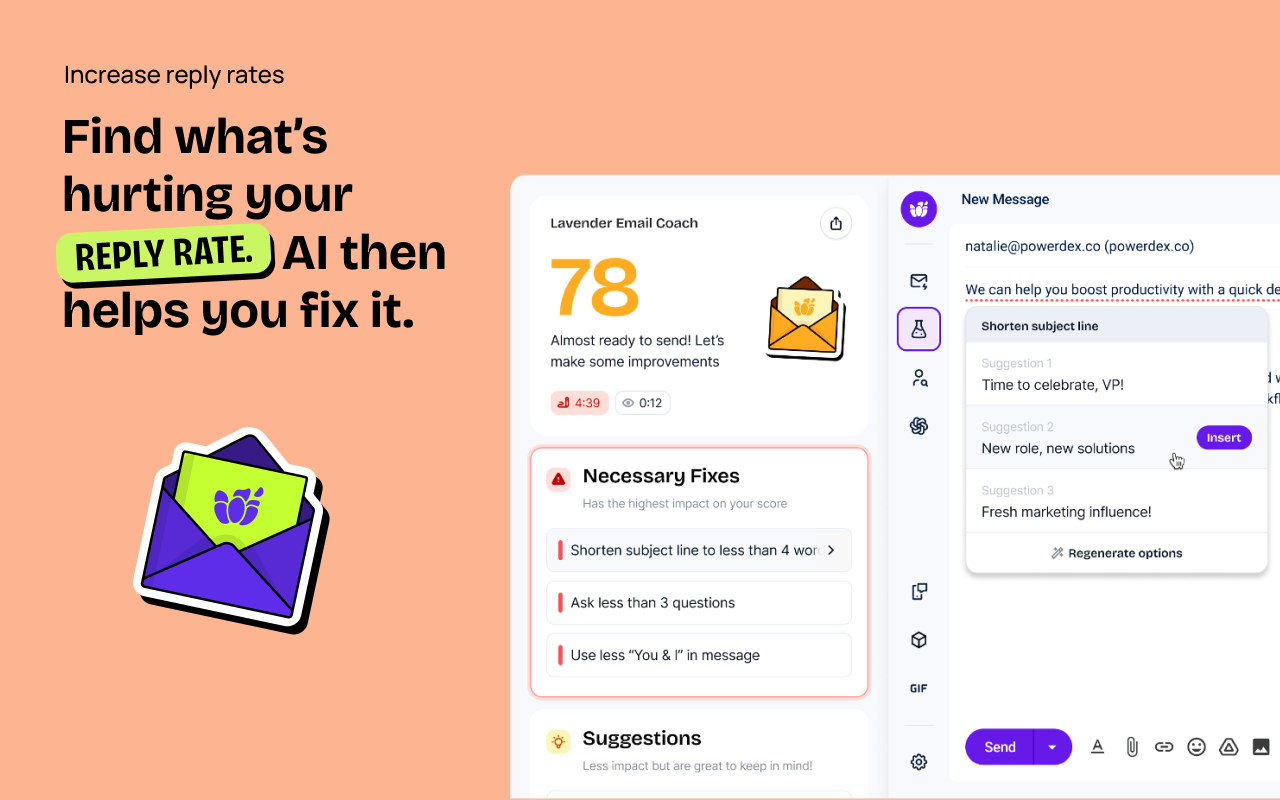
- Email Rating and Correction Suggestions: The Chrome Web Store page publicly states that Email Coach will rate the email and indicate the problem points that affect the response rate, such as too long subject lines, too many questions, and too many self-centered expressions.
- Personalization Assistant: Personalization Assistant will bring the prospect data to the mailbox or send it to the Internet to help sales write "why this customer, why now" more specifically.
- Team-level Data Coach: Official description managers can coach with data-backed insights, indicating that Lavender is not just giving tips to individuals, but trying to let managers see who in the team needs help, which writing methods are effective, and which actions have no ROI.
- Ora AI Sales Agent: The Ora page has advanced the product to "research, write, and send personalized and optimized sales emails automatically", and supports uploading lead lists, connecting to Salesforce, training agents, and giving instructions to agents.
- CRM Insights Backflow: The CRM page clearly says Enrich your CRM with Reasoned Research, indicating that Ora is not just outbound writing, but is also trying to push the research results back into Salesforce for sales prioritization and cold call warm-up.
Lavender's hidden linkage: The real value is not "helping you write a more fluent English sentence", but Email Coach, personalized suggestions, team insights and Ora are strung together into one package. Sales first learn how to write high scores in a single email, then managers use team data to solidify effective patterns, and Ora amplifies these experiences into batch lead processing. This synergy makes it more like selling an outreach operating system than a single point writing plug-in.
Lavender’s Free Truth: The public page does have a free entrance, but the high-value capabilities are clearly focused on Team Insights Salesforce connections and Ora online delivery. In particular, Ora's online price page has disclosed that it starts at US$500 per Agent per month, which means that truly large-scale automated outreach is not a "free AI email artifact", but a sales automation product with clear business costs.
Model and version evolution
Continuous iterative updates, the latest version introduces performance optimization and new features. Historical version information can be viewed on the official release page. There is no complete public version evolution timeline yet. It is recommended to pay attention to the official announcement to understand the rhythm of feature updates.
Technical advantages
Lavender's technical advantage: It does not win by "larger model parameters", but by relying on the structured constraints of sales email scenarios to turn AI into a more stable coach and executor.
Mechanism 1: The scoring system turns writing quality into actionable indicators. Email Coach will break down an email into adaptable items such as subject line, length, number of questions, self-centered expressions, and more. The effect is that sales don’t need to understand abstract writing theory, but rather know directly where response rates are being slowed down. The applicable scenario is SDR teams with high-frequency outreach and need to quickly iterate templates.
Mechanism 2: Personalized suggestions advance research to the writing interface. Officials emphasize bringing prospect data to inbox or wherever you send emails. The effect is that sales do not need to switch back and forth between LinkedIn, official website, news and CRM to find a piece of information that can be written into an email. The applicable scenarios are outbound teams with low to medium customer unit prices but need to be large-scale and personalized.
Mechanism 3: Ora uses ACI to do "reasoned research". The Ora page states Reasoning Powered by ACI, and splits the research objects into prospect, company, and market, and then combines 1st party and custom data. The effect is not to simply capture the web page summary, but to first screen the information and then output research conclusions suitable for sales actions. Ideal for scenarios where SDR/AE needs to prepare cold start outreach and cold call materials faster.
Mechanism 4: Team-level data is related. When email scoring, personalized recommendations, team insights and CRM backflow are connected, managers can unify "which sales write-up is good, which templates can make appointments, and which accounts deserve priority" into the same set of judgments. This feature is more difficult to replace with a general large model than single-point copywriting generation.
How to use
Typical usage path of Lavender:
- Install Lavender on the official website or Chrome Web Store, and log in using Google or Microsoft OAuth.
- First use Email Coach in a single email scenario to observe whether the scores, subject line suggestions, and body modification items are consistent with the team’s existing best practices.
- Then enable personalized assistance, pull prospect data into the writing interface, and verify whether it can stably provide effective materials of "why this customer, why now".
- If the team is already using Salesforce, then evaluate the Ora or CRM enrichment workflow and have sales upload the lead list or connect to Salesforce and test its research -> draft -> send link.
- Manual confirmation points must be set up when implementing at the enterprise level, especially automatic sending, batch contact and CRM write-back, to prevent the model from copying low-quality judgments on a large scale.
Lavender’s human-machine collaboration boundary: Email scoring, subject line suggestions, personalized lead sorting, and first draft generation, these steps can be nearly 100% automated; however, the first touch of high-value customers, batch automatic sending, brand compliance wording, and legal-sensitive industry outreach still require manual confirmation points.
Product Pricing
The pricing model is subject to the official real-time page. Usually a freemium or subscription system is used, and basic functions can be used for free. Advanced functions or high-frequency use require paid subscriptions, and users are advised to evaluate the optimal solution based on actual usage.
Application scenarios
Lavender’s dimensionality reduction strike scene:
- SDR High Frequency Cold Email Outreach: When you need to write a large number of first-touch emails continuously and want to control the bottom line of quality, scoring and subject line suggestions are the most direct.
- Personalized reach based on account research: When you need to quickly extract writable selling points from the three-layer information of prospect, company, and market, personalized suggestions and Ora's research links are more useful.
- Weekly coaching for sales managers: When the team needs to use unified standards to review writing quality, response rate and template effectiveness, Lavender's team insights are easier to manage than "letting everyone use a common large model".
- Salesforce team prioritization: Ora CRM enrichment page has publicly pushed reasoned research back to CRM, which has real value for account tiering and cold call warm-up.
Lavender's Scenario Boundary: If the team itself does little outbound, or the deal relies on complex long-term multi-threaded negotiations rather than the quality of the first email, Lavender's marginal value will decrease significantly.
Applicable people
Lavender is suitable for people:
- SDR / BDR: People who write a lot of first-touch emails every day will directly benefit from score feedback, subject line optimization, and personalized tips.
- Sales Manager and Enablement Team: Those who need to formulate "what email writing methods are effective" into team standards will pay more attention to data coaching and a unified scoring system.
- Sales Organizations Relying on Salesforce: Teams looking to connect lead research, account prioritization and email actions are better suited to evaluate Ora and CRM enrichment.
Lavender’s Persuasion Boundary:
- Non-Sales Writing Scenarios: It is not suitable for long-form content marketing, brand copywriting, customer service knowledge base, or serious business proposals.
- Extremely Strong Industry Compliance Team: Teams such as finance, medical, and legal that have extremely high requirements for external communication and traceability cannot regard Ora's automated sending as the default configuration.
- Companies without standardized outbound processes: If the team has not clearly defined ICP, email templates, follow-up cadences, and manual approvals, Lavender will only amplify the confusion.
Summary and Outlook
Lavender’s overall judgment: Its strongest point is not in “helping you write a smoother email”, but in breaking down sales outreach into a system that can be coached, quantified, and amplified in batches. Email scoring solves the problem of single email quality, personalized recommendations solve the problem of research costs, and Ora begins to undertake batch research and sending processes. This product line is continuous.
Uncertain items about Lavender: The official has not fully disclosed all packages, complete changelog, detailed delivery compliance mechanism and enterprise SLA, so deeper business judgment still needs to be based on the official real-time page and sales communication. In particular, the public page is not detailed enough for the overage fees, approval capabilities and failure rollback strategy after Ora goes online.
Lavender's procurement/adoption risk assessment: If the team just wants to use it to "send more AI cold emails" without manual approval, brand tone constraints and target customer stratification, it is likely to end up expanding low-quality automation; conversely, if the team already has a clear outbound process, unified ICP and CRM discipline, Lavender is more like an accelerator to productize sales best practices. A more prudent way is to pilot it with 1-2 SDR teams first to verify the response rate, meeting conversion rate and manager coaching efficiency, and then decide whether to expand to Ora's batch sending and CRM backflow.
Related tools:  Notion AI,
  Jasper
Version Info
- Chrome extension 3.2.2 :The public version of the Chrome Web Store continues email scoring, personalized recommendations, and team coaching capabilities.
- Ora AI Sales Agent online stage :The official Ora page has disclosed "Build for free" and online pricing starting from US$500 per Agent per month. There is no official precise release date yet.
User Reviews