 Leena AI
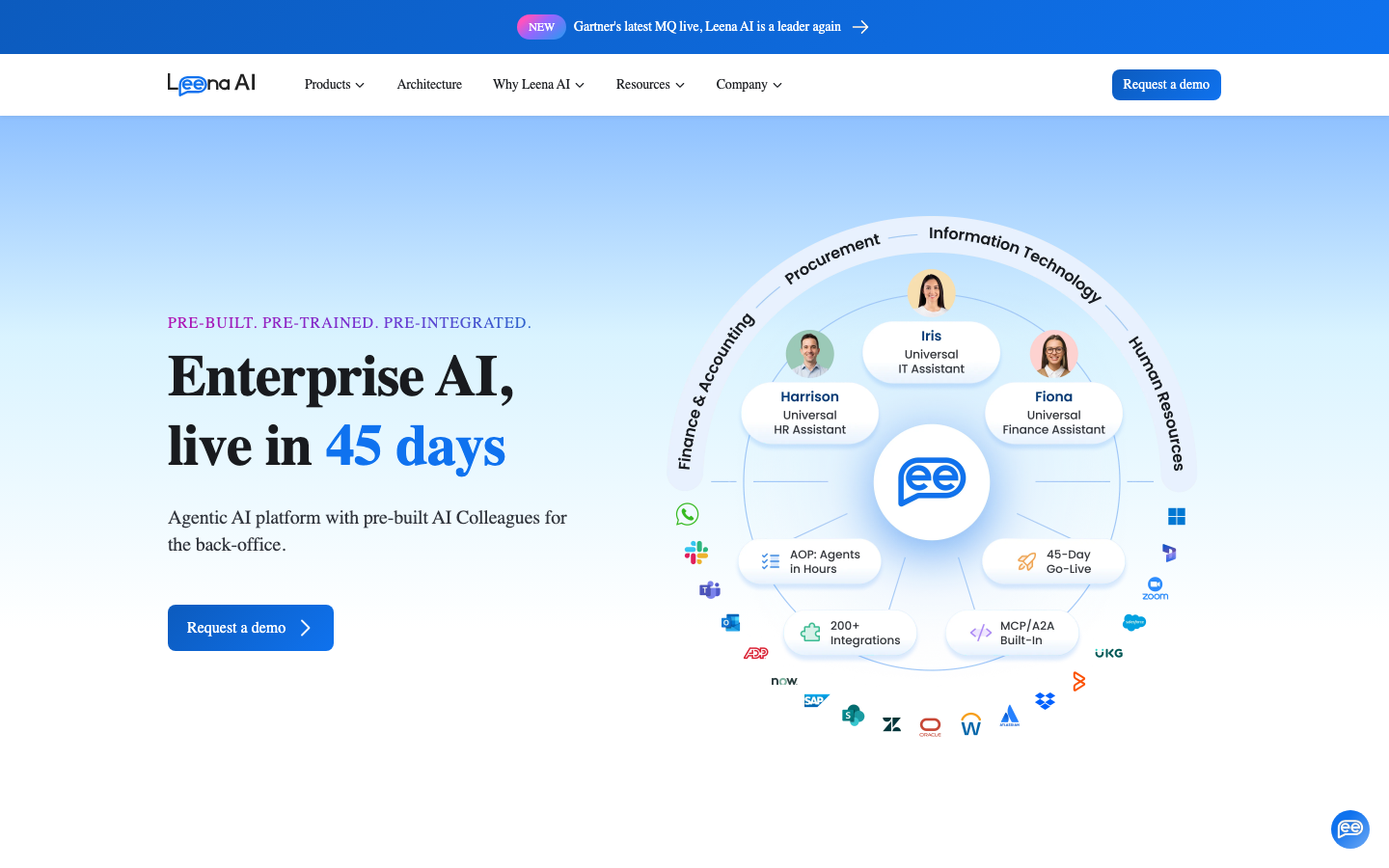
Leena AI is a leading enterprise-level Agentic AI platform with pre-built "AI Colleagues" covering back-end departments such as HR, IT, and finance. Serving 500+ companies such as Coca-Cola, Nestlé H&M, and MongoDB, covering 20 million+ employees. It supports rapid go-live within 45 days, 70%+ of work orders are automatically resolved, and Gartner has been in the leader’s quadrant for three consecutive years. The architecture supports MCP/A2A protocol and is pre-integrated with 200+ enterprise systems.
In-depth analysis of # Leena AI
Core parameters and statistics
| Parameter items | Public information |
|---|---|
| Product Positioning | Enterprise-level Agentic AI Platform (AI Colleagues for Back-Office) |
| Core Technology | Agentic AI + Knowledge Studio + AOP Studio + Context Graph |
| Delivery form | SaaS / Private deployment |
| Serving customers | 500+ companies, covering 20 million+ employees |
| Benchmark customers | Coca-Cola, Nestlé H&M, MongoDB, Etihad Airways, Panasonic |
| Online cycle | Claimed to be online quickly in 45 days |
| Work order automation rate | 70%+ work orders are automatically resolved |
| Return on Investment | Claimed to be 4-10 times ROI, saving $1M-$10M+/year in hard costs |
| Analyst Recognition | Gartner® Magic Quadrant Leader (3 consecutive years) |
| Security Compliance | SOC 2, HIPAA, ISO 27001, GDPR |
| Headquarters | New York, USA |
| Established | 2018 |
| Technical standards | Support MCP (Model Context Protocol) and A2A (Agent-to-Agent) protocol |
The product form of Leena AI is closest to the definition of "Agentic AI platform" among all HR tools - it is not just a chatbot or automation tool, but provides three pre-built AI colleagues (Harrison/HRS, Iris/IT, Fiona/Finance), each of which is pre-integrated with the enterprise system of the corresponding department, and can start processing work orders on the first day it goes online.
User and market recognition
- Large-scale enterprise customer base: Serving very large and well-known enterprises such as Coca-Cola (65K+ employees), Nestlé (275K+), H&M (155K+), MongoDB, Etihad Airways, Panasonic (230K+), etc. Customers span FMCG, technology, aviation, medical, retail, finance and other industries.
- Analyst recognition: Gartner Magic Quadrant for Agentic AI has been rated as a leader in the quadrant for three consecutive years and is one of Gartner's top recommended vendors in this field.
- Customer testimonial data: Coca-Cola CIO publicly stated that the work order resolution time has been shortened from 2 days to 6 hours, and the employee digital reach rate has reached 100%; the workload of a certain customer's tier-2 has been reduced by 3K-90K hours/year; the employee net promoter score (eNPS) has increased from +7 to +12 points.
- Security Compliance Lineup: SOC 2, HIPAA, ISO 27001 and other multiple certifications to meet the security requirements of regulated industries.
Cost advantage
C-side/Individual: Leena AI is not for individual users. Employees use AI Colleague services through internal corporate channels (Teams, Slack, mobile apps).
API/Developer: Undisclosed standalone API pricing. The platform supports the MCP/A2A protocol and can interoperate with other AI systems, but the API capabilities are mainly targeted at enterprise integration scenarios.
Enterprise/Private: Pricing is based on an enterprise annual subscription. Leena AI claims to provide a "one quarter payback" return on investment. Typical cost structure:
- Platform subscription fee: stratified by number of employees or volume of work orders
- AI Colleague License Fee: Each pre-built AI Colleague (HR/IT/Finance) may be billed independently
- Custom AOP development fee: If you need to build a non-standard process, professional service fees may be involved
- Private deployment surcharge: if deployed on customer's own infrastructure
Hidden Costs:
- Knowledge base migration cost: Although Knowledge Studio claims that "connections do not copy", knowledge sources scattered in SharePoint, Confluence, ServiceNow and other systems still need to be structured and annotated. The initial configuration workload depends on the quality of existing documents.
- Process Reconstruction Cost: AOP Studio allows describing processes in natural language, but actual implementation still requires the HR/IT team to sort out the existing SOP and optimize it into an AI executable format.
- Employee Adaptation Cost: Employees have changed from "submitting a work order and waiting for 2 days" to "asking an AI colleague for a reply within seconds". They need to change their habit of asking for help - some employees may still prefer phone or face-to-face consultation.
Main functions
- Harrison (HR AI colleague): A pre-built AI agent for the HR department, covering common HR scenarios such as on-boarding processing, benefit registration, leave application, salary inquiry, and policy answers. Deeply integrated with Workday, SAP SuccessFactors, Oracle HCM and other HRIS, it can directly read and write HR data. Core value: Reduce the time HRBP spends dealing with repetitive issues. Customer data shows that it can reduce tier-2 workload by 3K-90K hours/year.
- Iris (IT AI colleague): An AI agent for IT service desks, handling IT work orders such as password resets, software applications, equipment failure reports, and permission applications. Pre-integrated with ITSM systems such as ServiceNow and Jira. Core value: Reduce low-value repetitive work orders for the IT support team and automatically resolve 70%+ of IT requests before manual intervention.
- Fiona (Finance AI Colleague): An AI agent for the finance department that handles common issues faced by finance employees such as expense reimbursement inquiries, invoice status tracking, budget balance inquiries, payment cycles, etc. Pre-integrated with ERP systems such as SAP and Oracle Financial.
- Knowledge Studio (knowledge management): Connect the existing knowledge base of the enterprise (SharePoint, Confluence, Google Drive, ServiceNow, etc.), and uniformly index scattered knowledge sources into an AI-searchable knowledge graph. The "connection does not copy" design means that AI uses the permission control of the source file (file-level permission inheritance), without the need to configure additional security policies.
- AOP Studio (Agent Operating Protocol): Allows HR/IT/finance teams to describe business processes in natural language and automatically generate automation protocols that AI can execute. The core value is that "process owners (HR managers, IT managers) can configure AI colleagues themselves without raising engineering work orders."
- Observability & Governance: Complete AI behavior audit logs, role authority control, decision traceability, and policy fencing. Help CIOs ensure AI colleagues’ operations operate within compliance limits.
- Multi-protocol interoperability (MCP + A2A): Supports Model Context Protocol and Agent-to-Agent protocol, and can interoperate with other AI platforms and systems. Avoid vendor lock-in
——Customers can connect Leena AI to other AI systems that have been deployed.
Synergy: Knowledge Studio (knowledge layer) -> AOP Studio (process layer) -> AI Colleagues (execution layer) form a complete AI collaboration. The knowledge layer ingests content from existing systems, the process layer defines automation rules, and the execution layer interacts with employees and operates back-end systems. The three layers are updated independently of each other - updating the knowledge base does not require modifying the process definition, and modifying the process does not require redeploying AI colleagues.
Model and version evolution
2018-2020: HR chatbot takes off
- Founded in 2018 by Adit Jain and Mohit Thukral
- The initial product focuses on HR question and answer robots to automatically answer employees’ common HR questions.
- Begin to expand IT service desk scenarios around 2020
2021-2023: Platform expansion
- Expand from single HR scenario to multi-department (HR + IT) in 2021-2022
- Knowledge Studio will be launched in 2022 to solve the problem of knowledge source connection
- Entered Gartner Magic Quadrant for the first time in 2023 (named a Leader)
2024-2025: Agentic AI Transformation
- Upgrade to Agentic AI platform in 2024 and launch the AI Colleagues concept
- Launching AOP Studio in 2024 to support zero-code process automation
- The number of integrations will be expanded to 200+ enterprise systems in 2025
2026-present: full backend coverage
- Fiona (financial AI colleague) will be launched in 2026, covering the three backend departments of HR/IT/Finance
- Introducing MCP and A2A protocol support to enhance interoperability
- Gartner leader for 3 consecutive years
Technical advantages
Causal chain: Pre-integrated 200+ systems -> Online in 45 days -> Reduce the "Valley of Death" for enterprise AI projects
Leena AI's biggest competitive barrier is not the AI model itself, but its accumulated 200+ enterprise system integration libraries (including Workday, SAP, ServiceNow, Salesforce, Oracle, etc.). Each integrator (Connector) is not only API docking, but also includes an understanding of each system's data model, business logic mapping, and permission inheritance rules. This means that new customers do not need to start system integration from scratch - AI Colleague can start reading and writing after certifying the instance. This is the technical basis for its "45 days to go online" promise.
Causal chain: AOP Studio -> Natural language process orchestration -> Business team self-service configuration
The reason why most enterprise AI projects fail is that "AI experts don't understand the business, and the business doesn't understand AI." AOP Studio allows HR managers to directly describe the process in natural language such as "When an employee applies for annual leave, check the balance first. If the balance >= the number of days applied for, it will be automatically approved. Otherwise, it will be transferred to the manager for approval." The system will automatically parse it into an executable agreement. This eliminates the biggest bottleneck in AI project implementation—the cost of translation between business and technology.
Guide to engineering pitfalls:
- Direct impact of knowledge source quality on AI answer accuracy: If the knowledge source connected to Knowledge Studio has outdated, contradictory or incomplete content, the answer quality of AI colleagues will be directly affected. It is recommended to conduct a knowledge source audit before going online to mark outdated content and conflicting information.
- AOP exception path coverage: The normal process (Happy Path) described in natural language is relatively simple, but abnormal scenarios in actual business (such as approval chain breaks, system timeouts, data conflicts) need to be identified and defined one by one. When going online for the first time, it is recommended to start with a simple process and gradually add exception handling.
- Boundary test of permission inheritance: Leena AI emphasizes "inheriting source file permissions", but the permission models of different systems vary greatly - SharePoint's fine-grained permissions and ServiceNow's ACL rules may not be fully aligned. It is necessary to verify the consistency of permissions across systems in integration testing to prevent employees from seeing information they should not see through AI colleagues.
How to use
- Web client: You can use it by visiting the official website and registering an account. Most functions do not require installation.
- API Access: Provides RESTful API, developers can obtain the API Key and integrate it into their own applications.
Product Pricing
The pricing model is subject to the official real-time page. Usually a freemium or subscription system is adopted, basic functions can be used for free, and advanced functions or high-frequency use require payment.
Application scenarios
- HR Employee Help Desk Upgrade: Daily employee HR issues (annual leave balance inquiry, payslip download, policy consultation, onboarding guide) have changed from "submit a work order and wait 2 days" to "ask Harrison for a quick response". The Coca-Cola case shows that the resolution time was reduced from 2 days to 6 hours. It is suitable for any company with more than 1,000 employees and an HR team that handles a large number of repetitive issues.
- IT Service Desk Cost Reduction: Low-value IT work orders such as password resets, software installation requests, and equipment repair requests occupy a lot of time for the IT team. Iris can automatically handle 70%+ of IT requests, allowing the IT team to focus on complex problem solving and system optimization. It is suitable for organizations with a large volume of IT work orders and high team response pressure.
- Finance department employee self-service: Frequently asked questions for finance employees such as expense reimbursement policy inquiry, invoice status tracking, budget balance inquiry, etc. Fiona directly connects to the ERP system and can complete queries without opening SAP/Oracle. Suitable for financial shared service centers or financial departments of large enterprises.
- Cross-department unified AI portal: Employees do not need to distinguish between "HR issues, find the HR system, IT issues, find the IT system", and can handle all back-end department issues through one AI colleague portal. AI Colleague automatically identifies issue types and routes them to the corresponding departments and systems.
Applicable people
- CHRO/CIO of large enterprises: The top person in charge who needs to improve employee service experience and reduce HR/IT operating costs. Leena AI's ROI model (4-10x) and 45-day go-live commitment are attractive to management.
- HR Operations and Shared Service Center: The front-line HR operation team is a direct beneficiary of "Harrison", which can significantly reduce repetitive Q&A work orders and shift energy to strategic HR work.
- IT Service Desk Manager: Iris can handle 70%+ of IT work order automation, allowing the IT team to concentrate resources on high-value issues.
- Enterprise AI/Digital Team: The team responsible for evaluating and implementing enterprise-grade AI platforms. Leena AI's MCP/A2A compatibility and 200+ pre-integrations reduce the technical risk of AI platform selection.
- Not suitable for the crowd:
- Small businesses (<500 people): The threshold for subscription fees and deployment complexity is high, and the volume of work orders for small businesses is not enough to support ROI.
- Organizations with highly non-standardized HR processes: If the enterprise's HR/IT processes are extremely specific and change frequently, the configuration and maintenance workload of AOP Studio may continue to be high.
- Organizations that already have a complete ServiceNow/Microsoft ecosystem: If the enterprise is deeply bound to ServiceNow or Microsoft Copilot, it needs to evaluate the complementarity between Leena AI and the existing ecosystem rather than its substitution.
Summary and Outlook
Leena AI is a representative product in the field of Agentic AI in Enterprise. Its core difference from pure chat robot manufacturers lies in: pre-built AI Colleagues (Harrison/Iris/Fiona) + 200+ enterprise system pre-integration + AOP zero-code process orchestration. Gartner's leader rating for three consecutive years and large customer cases such as Coca-Cola have verified its enterprise-level delivery capabilities. Current limitations include: the product still uses work order processing as the core scenario, and has limited support for complex HR decisions (such as succession planning, compensation strategy design); although it supports the MCP/A2A protocol, the maturity of cross-platform collaboration still needs industry verification; pricing is opaque and on the high side.
Procurement/Adoption Risk Assessment: It is recommended to use the HR employee service desk as a pilot scenario, take 45 days to launch a department (such as the HR Shared Service Center), compare the average resolution time and employee satisfaction of the existing work order system, and verify the ROI within 3 months. The procurement contract needs to focus on: the specific list of systems covered by pre-integrated Connectors (confirm that the required systems are in the 200+ list), whether the customization depth of AOP Studio requires additional development support, data storage location and compliance certification scope (specific coverage of SOC 2/HIPAA/ISO 27001).
Related tools:
How to use Leena AI
| Entrance | Description |
|---|---|
| Web | Configure and manage AI Colleagues through the leena.ai management platform |
| Employee reach channels | Microsoft Teams, Slack, mobile App, Web Widget |
| Management backend | AOP Studio configuration Knowledge Studio management, observability panel |
| API/Protocol | Support MCP and A2A protocols to interoperate with other AI systems |
Typical implementation path:
- Requirements review (week 1): Determine the first batch of deployed AI Colleague (HR/IT/Finance) and target scenarios
- System docking (Week 2-3): Certify enterprise system instances and configure Connectors
- Knowledge Access (Weeks 3-4): Connect knowledge sources, do knowledge auditing and structured annotation
- Process Configuration (Week 4-5): Configure the first batch of automated processes using AOP Studio
- Pilot launch (week 5-6): Select 1-2 departments to trial run AI Colleague
- Comprehensive promotion: Optimize based on pilot feedback and expand to the entire organization
Version Info
- Leena AI Platform 2026-H1 :Added Fiona (financial assistant) AI Colleague, upgraded AOP Studio to support zero-code process automation, and introduced MCP/A2A protocol support. There is no official precise date yet.
- Leena AI Platform 2025-Q3 :Launched AI Colleagues Platform and AOP Studio to support custom AI colleague building. There is no official precise date yet.
- Leena AI Platform 2024-Q4 :Upgrade the Knowledge Studio knowledge management engine and expand it to integrate with 200+ enterprise systems. There is no official precise date yet.
User Reviews