 Lex
Free
Lex
Free
Lex is an AI writing tool for in-depth writing scenarios. It puts Ask Lex, Checks, version review, real-time collaboration Style Guides, Knowledge Bases and publishing in the same document. It is not a content machine that pursues batch generation, but more like an AI editing and writing partner embedded in a document editor.
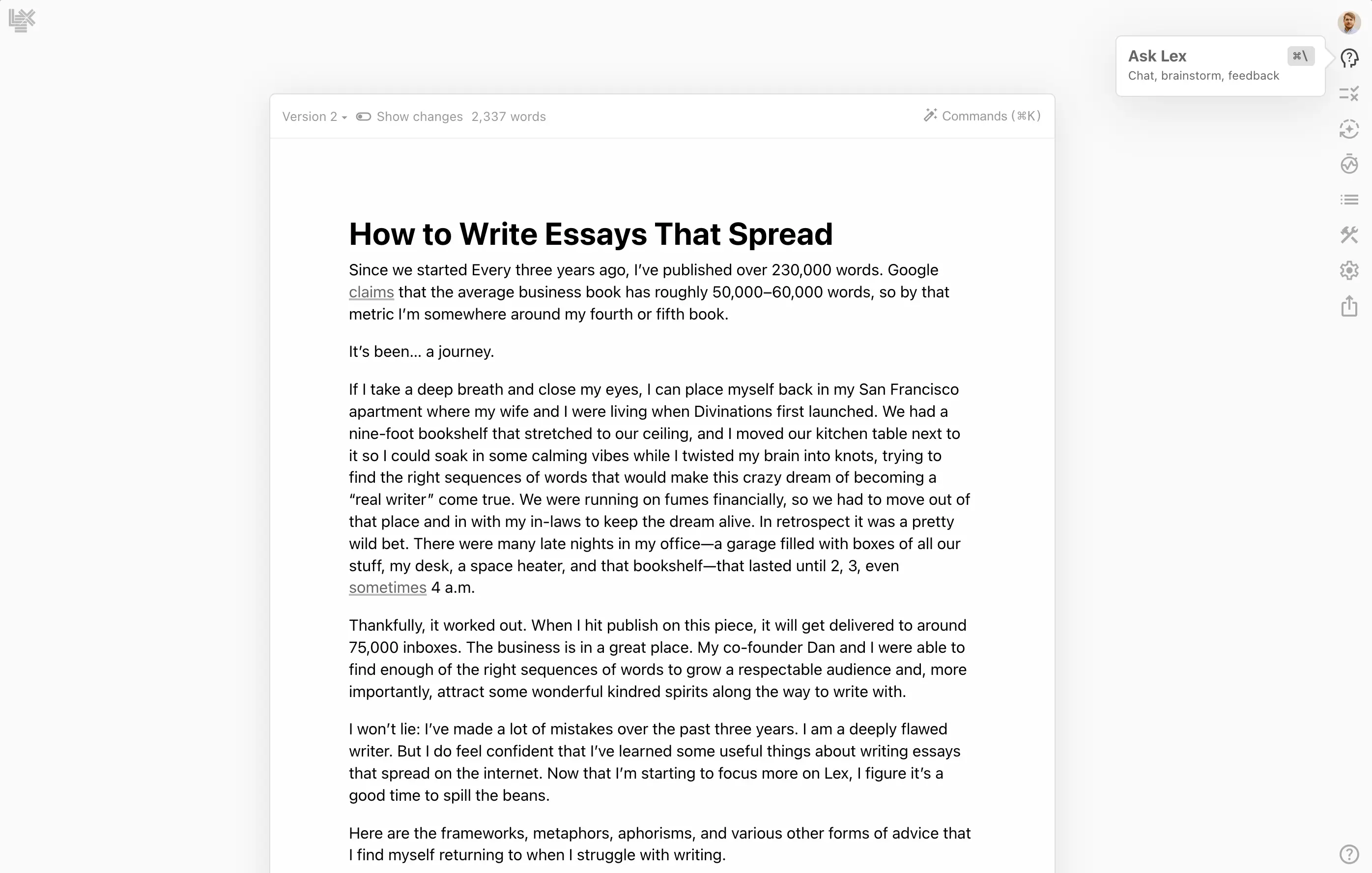
Lex
Core parameters and statistics
| Parameters | Official verifiable information |
|---|---|
| Product positioning | Collaborative documents, with powerful AI editing tools |
| Core writing skills | AI Feedback, Comments, Versions, Live Collaboration, Publishing, Commands, Title Ideas |
| Expand writing skills | Checks, Style Guides, Knowledge Bases, Prompts, Prompt Library |
| User scale | Loved by 300K+ writers |
| Team collaboration | Share and collaborate on documents for free; Lex Teams supports unlimited group use of folders |
| Privacy Commitment | User written content will not be used to train the model |
| Model source | OpenAI, Anthropic, TogetherAI enterprise APIs |
| Contact information | [email protected] |
A brief review: Lex is more like an AI editor for serious writers, rather than a generator that relies on one-click copywriting.
Publicity verification: The most important selling points of the official website are premium writing experience and helping you do your best writing. This positioning is credible. Rather than stuffing AI into documents as Easter eggs, it designs the entire writing process around revisions, feedback, versions, and style consistency.
User and market recognition
Lex's home page directly states 300K+ writers, which already shows that it is not just a small circle toy. What’s more interesting is that the users it shows are not all content marketers, but are used by novelists, journalists, product people, researchers, and screenwriters. This shows that what it really sells is “editing quality” and “smooth experience”, not just “helping you write faster.”
The brand endorsement page also displays the logos of Berkeley, BuzzFeed, Canva, Dropbox, Financial Times, Google, Harvard, Microsoft, NYT, Reddit, Stanford, Stripe, Yale and other organizations. This type of logo wall cannot be directly equated to a paying customer list, but it is enough to show that Lex has entered the field of vision of high-density writing and knowledge workers.
Cost advantage
| Cost layer | Official public information | What cost items you really want to look at |
|---|---|---|
| Free / Basic collaboration | Free document sharing and collaboration | Suitable for verifying editing experience, but high-end AI capabilities are limited |
| Lex Pro | The public FAQ clearly exists monthly subscription, you can apply for free trial, and refunds are supported | The public page does not currently display a clear amount, please refer to the real-time pricing page |
| Lex Teams | For unlimited group use of Lex folders | Team pricing to be communicated separately |
The Free Truth: Lex is not "completely free AI writing". The real value is in the premium AI models, priority support, and team collaboration enhancements, all of which hang on top of Pro/Teams.
Quantified cost reduction and efficiency improvement: There is a very typical cost signal in the long comments on the homepage. Users said that they have reduced the monthly fees for multiple writing and AI tools to one-third of the original. This number is user testimony, not an official price comparison, but it shows that the value of Lex comes more from "opening fewer tools" rather than just counting the token cost.
Hidden benefits/costs: If your writing really needs to go through brainstorming, line editing, structure check, version compare, and final polish, Lex can reduce the context switching back and forth between ChatGPT, Google Docs, Grammarly, and note-taking tools. But if you are just mass-producing SEO content, Lex’s delicate process will seem heavy.
Hidden Cost: The real cost of learning Lex is not in the buttons, but in the methodology. If the team does not establish style guides, knowledge bases, shared prompts and review boundaries, it will easily degenerate into "just use it as another chat box", which will directly weaken its value compared to ordinary documentation tools.
Main functions
- Ask Lex / AI Feedback: Provide feedback, rewrite brainstorming and research around the entire draft or selected text.
- Checks: Make line-level suggestions for brevity, clarity, grammar, readability and other items, more like in-depth editing than surface correction.
- Versions/Rewind: Supports version backtracking and manually named save points, suitable for serious writing and repeated polishing.
- Style Guides and Knowledge Bases: Let AI remember the team voice, goals, and background knowledge instead of interpreting the context from scratch every time.
- Live Collaboration and Publishing: Use links to collaborate, comment, and share read-only links, suitable for team co-writing and final delivery.
Expert’s View: The most interesting thing about Lex is that it does not use AI as a “writer” but as an “editor supercharger”. Ask Lex, Checks, Versions, and Knowledge Bases come together to form a more editor-in-the-loop writing workflow.
Model and version evolution
Lex does not expose semantic version numbers and is closer to a continuously evolving writing SaaS. The visible main line of evolution is the expansion from a single-person AI writing assistant to a more mature team collaboration writing platform.
| Milestones | Dates | Key changes |
|---|---|---|
| 2026-07 current snapshot | ~2026-07 | Public capabilities have covered AI Feedback, Checks, Style Guides, Knowledge Bases, Publishing, and Live Collaboration |
| Lex for Teams | ~2024-07 | Introducing team folders, shared prompts, context tags, and team usage narratives |
This trajectory shows that Lex’s focus has never been on “adding more generation buttons”, but on making AI truly serve revision-heavy writing. It becomes more and more like a documentation system designed around writing quality rather than content output.
Technical advantages
Main Type Judgment: The main delivery form of Lex is a productivity/business-side application, and the core is the writing workflow, not the underlying model platform.
The model is abstracted thin enough: The official clearly uses OpenAI, Anthropic, and TogetherAI enterprise APIs, which means that it treats the underlying model as the supply layer, and the real product differences remain in the editing experience, version system, and prompt/design choice.
Integration of AI and documents in place: The problem for most writers is not that there is no AI, but that the AI is in another tab. Lex embeds feedback, rewrites, and explanations directly into documents, reducing the friction of “copying a paragraph into the chat box and copying back again.”
Context assetization: Style Guides, Knowledge Bases, and Prompt Library allow teams to accumulate writing methods into shared assets, instead of each editor hiding his own set of prompts.
Human-machine collaboration boundary: Lex is very suitable for automating brainstorming, line editing, title ideas, style polish and first-pass critique, but when it comes to fact checking, legal risks, final brand expression, and academic accuracy, manual final review must still be retained. It's more like a senior editorial assistant, not the person who signs off on the final piece.
How to use
| Entrance | Applicable objects | Description |
|---|---|---|
| Web App | Individual writers, content teams, researchers | Start writing, collaborating, and accessing AI editing capabilities directly |
| Sharing / Publishing | Collaborators, readers | Comment, collaborate, or read-only view via shared link |
| Lex Teams | Teams and Organizations | Extend multiplayer use through folders, shared prompts, and context tags |
| Developer API | Developers who want to access capabilities | The about page is marked with simple API documentation |
Typical usage is to first write a draft in the document, then use Ask Lex for high-level feedback, Checks for line editing, Versions to retain key branches, and then use Style Guides and Knowledge Bases to fix the team's writing style. For writing-intensive teams, this is more convenient than the "documents on one side and chatting on the other" approach.
Product Pricing
| Packages/Capacities | Public Information | Description |
|---|---|---|
| Basic document collaboration | Free document sharing and collaboration | Suitable for trial writing and lightweight collaboration |
| Lex Pro | There is a monthly subscription, you can apply for free trial, and refunds are supported | The current public FAQ does not show a clear amount, please refer to the real-time page |
| Lex Teams | Supports unlimited group use of folders | Suitable for high-frequency team collaboration, price needs to be negotiated |
The pricing transparency of Lex is not as straightforward as that of tool-based SaaS, but the product route is very clear: you can experience the editor and collaboration for free first, and the payment points are mainly focused on advanced models and team use.
Application scenarios
- In-depth writing that requires repeated revision: such as long articles, research drafts, speeches, brand copywriting, newsletters, etc., are suitable for repeated polishing with Ask Lex + Checks + Versions.
- Team jointly maintains writing style: Through shared prompts, style guides, knowledge bases and team folders, the content written by multiple people will not be the same for everyone.
- High-quality text output for knowledge workers: When authors, researchers, marketing teams, and founders write memos, proposals, and essays, they all need "editing quality" rather than "batch generation."
Dimensionality reduction attack scenario: When the pain point of writing is "can't change, can't be straightened out, and always needs to be rewritten", Lex is very happy; when the pain point is just "hurry up and produce a few more articles", it may not be more suitable than a more radical content generator.
Applicable people
- Suitable for serious writers: Novel writers, journalists, researchers, marketing writers, founders and PMs will all feel its value more than ordinary copy generators.
- Suitable for small content teams and knowledge teams: especially teams that want to collaborate while retaining their personal voice.
- Suitable for people who want to complete writing and AI editing in one tool: It will be useful for people who don’t want to jump between multiple tabs.
Dissuade scenario: If your goal is to batch generate SEO short articles and spread content at low cost, Lex may be too refined and too slow. It is not for "being productive", but for "writing something well".
Not suitable for boundaries: If your goal is to batch generate SEO short articles and low-cost mass content, Lex may be too refined and too slow. It is not for "being productive", but for "writing something well".
Summary and Outlook
Lex’s core competency is to put AI in the right place in the writing process. It doesn't try to finish writing for you, but rather makes it easier for you to push a draft into a more mature version. For people who really value voice, structure, and revision, this is more useful than a purely stronger model.
[Current limitations]: The disclosure of specific amounts on the public pricing page is unstable, and the terms of the team version also need to be communicated separately; at the same time, Lex's current public information is more focused on writing experience and collaboration logic, rather than in-depth corporate governance or complex compliance commitments.
Its procurement/adoption risks mainly include three points. First, the transparency of public pricing is average, and it is best for the team to check with the sales or real-time page before budgeting. Second, Lex’s methodology can appear overly heavy-handed if the team is focused solely on content output rather than editorial quality. Third, AI feedback, no matter how good it is, is no substitute for fact-checking and final editorial responsibility. Think of it as a writing workbench rather than a ghostwriting tool, and it will be more effective.
Related tools:  Notion AI,
  Jasper
Version Info
- Lex current platform snapshot :The current public product form includes AI Feedback, Comments, Versions, Live Collaboration, Publishing, Commands, Title Ideas, as well as the Checks, Style Guides, Knowledge Bases, Prompt Library and other capabilities listed on the about page; there is currently no official precise version number and release date.
- Lex for Teams milestone :The public account "Announcing: Lex for Teams" introduces team folders, shared prompts, context tags and team collaboration methods; there is no official official release date yet.
User Reviews