 Lex Machina
Lex Machina is a AI legal assistant legal analysis platform under LexisNexis. It focuses on Legal Analytics® (legal analytics) and converts original court documents into structured litigation data. Its Protege AI assistant brings natural language query capabilities to legal analysis, covering judge behavior analysis, litigation trend prediction, damages benchmarking and party strategy insights.
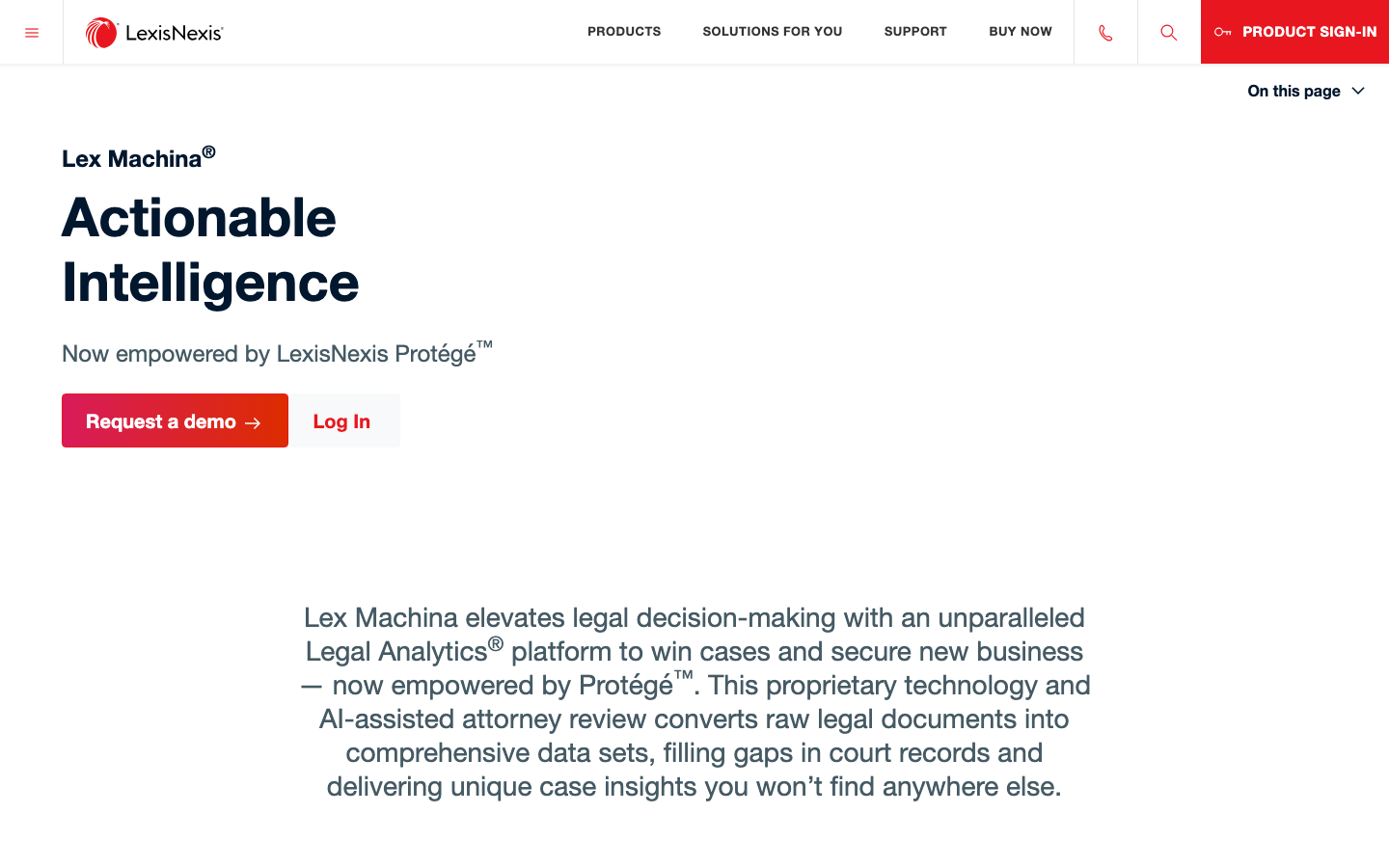
LexMachina
Core parameters and statistics
Lex Machina occupies a unique position in the legal tech market - it is not a "legal AI assistant" (like Casetext), nor a "contract analysis tool" (like Kira), but a "legal analytics platform." Its core value lies in transforming the court's original document data into structured, searchable litigation intelligence.
| Projects | Public Information |
|---|---|
| Official positioning | Legal Analytics® Platform |
| Parent company | LexisNexis (RELX Group), acquired in 2015 |
| Founded | 2010 (Menlo Park, California) |
| Core Products | Lex Machina Legal Analytics + Protégé AI |
| Data coverage | 45 million+ documents, 10 million+ cases, 8,000+ judges, 6,000+ expert witnesses |
| Court coverage | All 94 federal district courts, 13 circuit courts of appeals, PTAB, state courts |
| Client base | Used by 90%+ Am Law 100 law firms (according to official statement) |
| Support Platform | Web, API |
| Service objects | Law firms, corporate legal affairs, insurance companies, governments, law schools |
Legal Analytics’ unique positioning: Lex Machina does not offer “AI legal research” (which is the scope of Lexis+ AI), but rather “litigation data analytics”. Its value is not in helping lawyers find the right law, but in helping lawyers understand - "How has this judge handled similar cases in the past?" "What is the win rate for motions filed with this judge?" "What is the average damages for similar cases in this court?"
User and market recognition
Lex Machina has few direct competitors in the legal analytics market—it is the only commercial product that deeply structures federal and state court case data and delivers it as an analytics platform.
Client Coverage: Officially, more than 90% of the largest law firms (Am Law 100 and Law360 Pulse leaders) use Lex Machina. This level of coverage is unrivaled among legal analytics tools.
Industry Recognition: Winner of the 2025 LegalTech Breakthrough Award for "Legal Technology Data Solution Provider of the Year" and the 2025 CODiE Awards for "Best Data Analytics and Insights Solution."
Parent Company Advantage: As part of LexisNexis, Lex Machina has access to one of the RELX Group's largest global legal data resources, including complementary products such as Law360, CourtLink and Lexis+.
Cost advantage
Lex Machina is an enterprise-grade product priced for large law firms and corporate legal departments:
- C-side/Personal: No personal version, only available through institutional subscription.
- Large Law Firms: Annual subscription, priced by user seat. Looking at the pricing range for LexisNexis' other analytics products, annual subscriptions can range from a few thousand to tens of thousands of dollars per user per year. AI capabilities (Protégé) may be included as value-added modules or in top-tier plans.
- Enterprise Legal & Insurance: Enterprise-level subscriptions, typically packaged and priced by user pool and API quota. Pricing requires contacting LexisNexis sales team for a custom quote.
Hidden Cost: Lex Machina's analytical capabilities require users to have certain data analysis literacy - the output is data-driven, and how to interpret the data and transform it into litigation strategies requires experience and judgment. Training and learning curves are hidden costs, but LexisNexis offers comprehensive training resources.
Main functions
Lex Machina does not provide "contract drafting" or "legal research", but provides data analysis of the entire litigation life cycle:
- Judge Behavior Analysis: View each judge's ruling patterns, motion grant rates, case length, damages propensity, and appellate reversal rates in specific types of cases. Lawyers can understand the judge's trial characteristics during the case assignment stage and formulate targeted litigation strategies.
- Party Analytics: Analyze a party's historical performance in court - what is its winning rate as a plaintiff and as a defendant? Which law firms does it tend to use? What is its model of reconciliation? Corporate legal counsel can decide before litigation whether the case should settle or persist in litigation.
- Counsel Analytics: Evaluate competitor law firms’ performance in specific courts and before specific judges—their win rates, case lengths, damages ranges, etc. Directly assist law firms in bidding for new business and formulating strategies.
- Damages Analytics: Predict the likely range of damages in a specific type of case based on historical data from similar cases. Helps law firms and clients establish data baselines in settlement negotiations.
- Motion Metrics: Covers 40+ motion types, showing the historical ruling rate of each motion before different judges. Attorneys obtain data references when deciding whether to file a motion.
- Appeals Analytics: Displays the appeals court’s case hearing patterns, reversal rates and trial cycles. Help evaluate appeal possibilities and strategies.
- Class Action Analytics: Analyzes class action certification rates, settlement amounts, attorney fee awards, and class representative compensation.
- Protégé AI Assistant: A feature introduced in 2025 where users ask questions using natural language (e.g. "What are the median damages in patent infringement cases heard by Judge Smith in the Northern District of California between 2023 and 2025?"), and Protégé directly returns the analysis results without the need for
Users click through complex data panels.
Hidden linkage: The real value of Lex Machina is not in a single query, but in "continuous data feedback throughout the case life cycle." Lawyers use judge analysis to formulate strategies in the early stages of cases, motion analysis to evaluate the effectiveness of strategies in the mid-term, and damages data to verify the reasonableness of settlements/judgments after the case is closed. This data feedback is accumulated into the database to provide a more accurate baseline for the next case.
Model and version evolution
The relevant information has not been made public, please refer to the official real-time page.
Technical advantages
Data deep structured engineering: Lex Machina's biggest technical barrier is not the AI model, but the data engineering ability to "convert original court documents into structured data." Court PDF documents, electronic case files, and paper records require large-scale OCR, NLP entity extraction, and information normalization before they can be converted into analytical data for Lex Machina. After more than ten years of continuous investment, this data pipeline is difficult for any new entrant to quickly copy.
Proprietary AI + Attorney Review: Lex Machina uses its own AI model to analyze court documents, but key data points (such as damages, case verdicts) are also manually reviewed by a team of attorneys to ensure accuracy. This "AI + manual" quality assurance mechanism makes data analysis more reliable than purely automated solutions.
Entity and Relationship Graph: Lex Machina not only extracts data points, but also builds a graph of entity relationships between parties, law firms, attorneys, judges, and expert witnesses. This allows users to analyze "how did this expert witness perform before Judge Smith" - the kind of cross-entity correlation analysis that general-purpose AI cannot provide.
Specialized NLP for Court Data: The language and format of court documents are highly structured and full of specific terms (such as "ORDER GRANTING IN PART AND DENYING IN PART MOTION FOR SUMMARY JUDGMENT"), and NLP models trained by Lex Machina for this style can parse with higher accuracy than a general-purpose LLM.
How to use
| How to use | Applicable scenarios |
|---|---|
| Lex Machina Web Platform | Direct access to all analytical capabilities |
| Protégé AI Conversation | Query and analyze data with natural language |
| API integration | Embed analytics data into your own systems |
Typical steps (used by lawyers):
- Log in to the Lex Machina platform and select the analysis dimension (judge, party, law firm, expert, etc.).
- Use search or Protégé AI natural language queries to locate the required litigation data.
- View visual analysis results—trend charts, comparison tables, benchmark data, etc.
- Export analysis reports and embed them in case strategy memos or client presentation materials.
- Integrate with other LexisNexis products (Lexis+ AI, CourtLink) to obtain complete case intelligence.
Product Pricing
Lex Machina is priced through the LexisNexis Enterprise Sales System:
- Law Firm Subscription: Pricing based on number of users and required data range (Federal Court/Federal + State Court). Annual contract, pricing requires contact LexisNexis sales team for quote.
- Enterprise Legal/Insurance: Enterprise-level subscription, which typically includes broader user licensing and API access.
- Law Schools/Academic Institutions: Lex Machina offers an academic access plan at a different price than the commercial version.
Free Demo: LexisNexis provides free customized product demos. Users can make an appointment to experience the platform's functions before making purchasing decisions.
Application scenarios
- Litigation Strategy Formulation and Judge Analysis: Core Scenario. Litigators use Lex Machina immediately after accepting a new case to analyze the historical ruling patterns of the receiving judge—what is the probability that this judge will grant a motion for summary judgment? How long does it usually take for a case to go from filing to trial? What is the median time to reach a settlement before this judge? Benefits: Data-driven strategy development replaces "brain-based guesswork."
- New Business Bidding and Client Presentation: When law firms bid on new cases or secure client engagements, use Lex Machina to generate litigation analysis reports that demonstrate the depth of the firm's knowledge of judges, courts, and opposing counsel. Benefits: Obtain differentiated competitive advantages at the data level in bidding.
- Damages Benchmarking for Settlement Negotiations: In intellectual property, contract disputes, and personal injury cases, use Lex Machina to query historical damages data to establish a data baseline for settlement negotiations. Benefits: Damage expectations that were underestimated during negotiations, reducing the "slap on the head" settlement asking price.
- External Lawyer Management: Corporate counsel uses Lex Machina to analyze external law firm performance data—their win rates before specific judges in their jurisdiction's courts, average case costs, and disposal times. Benefits: Data-based external consultant performance evaluation and selection decisions.
Applicable people
- Commercial Litigation Lawyer: Lex Machina’s core user. Judge analysis, motion analysis and damages data translate directly into litigation strategy and cost estimates.
- Law Firm Business Development (BD) and Marketing Team: Use litigation analysis data and judge insights to write pitch documents and demonstrate the law firm's data insight capabilities in client presentations.
- Corporate Legal Leader: In-house counsel who manages the litigation portfolio, evaluates outside counsel performance and makes settlement/response decisions. Data analysis replaces subjective judgment.
- Insurance Claims and Litigation Management Team: Forecast litigation costs and assess compensation risks to develop more accurate reserves and settlement strategies.
Not suitable for the boundary: Lex Machina does not support contract analysis, document drafting or legal research - it is an analysis tool rather than a productivity tool; it is not suitable for teams that need to deal with electronic discovery or document review; the data is mainly based on US federal and state courts (historical reasons), and it has limited coverage of court data in jurisdictions outside the US; the price threshold is high, and it is not friendly to small and medium-sized law firms; it requires users to have the ability to interpret data, and is not suitable for lawyers who are unwilling or not good at making decisions at the data level.
Summary and Outlook
Lex Machina plays an irreplaceable role in the legal AI ecosystem - it is the only commercial platform that converts raw court data into structured litigation analysis at scale and can be used by lawyers on a daily basis. Unlike legal research AI (which answers "what is the law?"), it answers "what judges and lawyers do in reality." The value of this "real-life behavioral data" is complementary to legal text data.
Current limitations: The data mainly covers the U.S. federal and state court systems, and the degree of internationalization is very low; although Protégé AI introduces natural language queries, the richness of the underlying data and analysis dimensions still relies on the continuous processing of Lex Machina's engineering team; users who require in-depth legal research or contract analysis need to be used with other tools.
Procurement and Adoption Risk Assessment: For large law firms and corporate legal departments that frequently engage in commercial litigation, Lex Machina is a productivity tool with a clear ROI. It is recommended to first verify the value of analysis in 2-3 actual cases through free demonstrations of LexisNexis and connect it with the team's existing case analysis process. Businesses need to confirm before purchasing: whether the coverage of the required court and case types meets actual needs; whether Protégé AI functionality is included in the subscription or requires an additional fee; and the impact of API access on embedded internal systems. Procurement decisions should focus on the core question of "can this litigation data help us make better/faster case decisions?"
Version evolution of Lex Machina
| Milestone | Time | Description |
|---|---|---|
| Founded by Lex Machina | 2010 | Incubated at Stanford Law School in Menlo Park, California |
| LexisNexis Acquisition | 2015 | Acquired by LexisNexis (RELX) |
| State Court Expansion | ~2020 | Significant expansion of state court data coverage |
| Motion analysis release | ~2023 | Sports analysis function covering 40+ motion types |
| Protégé AI introduction | ~2025 | Natural language AI query assistant |
| Continuous iteration | So far | Expanding data sources and AI analysis capabilities |
Version Info
- LexisNexis Acquisition :Lex Machina was acquired by LexisNexis (RELX Group), gaining access to LexisNexis' vast data resources and customer channels.
- Protégé AI Integrated Edition :Introducing the Protégé AI generative analysis assistant, users can query legal analysis data in natural language, and further integrate the LexisNexis Protégé ecosystem. There is no official precise date yet.
- Lex Machina 2023 Edition :Enhanced state court data coverage and expanded motion metrics and damages analysis capabilities. There is no official precise date yet.
User Reviews