 Lexion
Lexion is an AI-driven contract management platform that focuses on contract storage, clause extraction and intelligent review, featuring minimalist operation and rapid deployment.
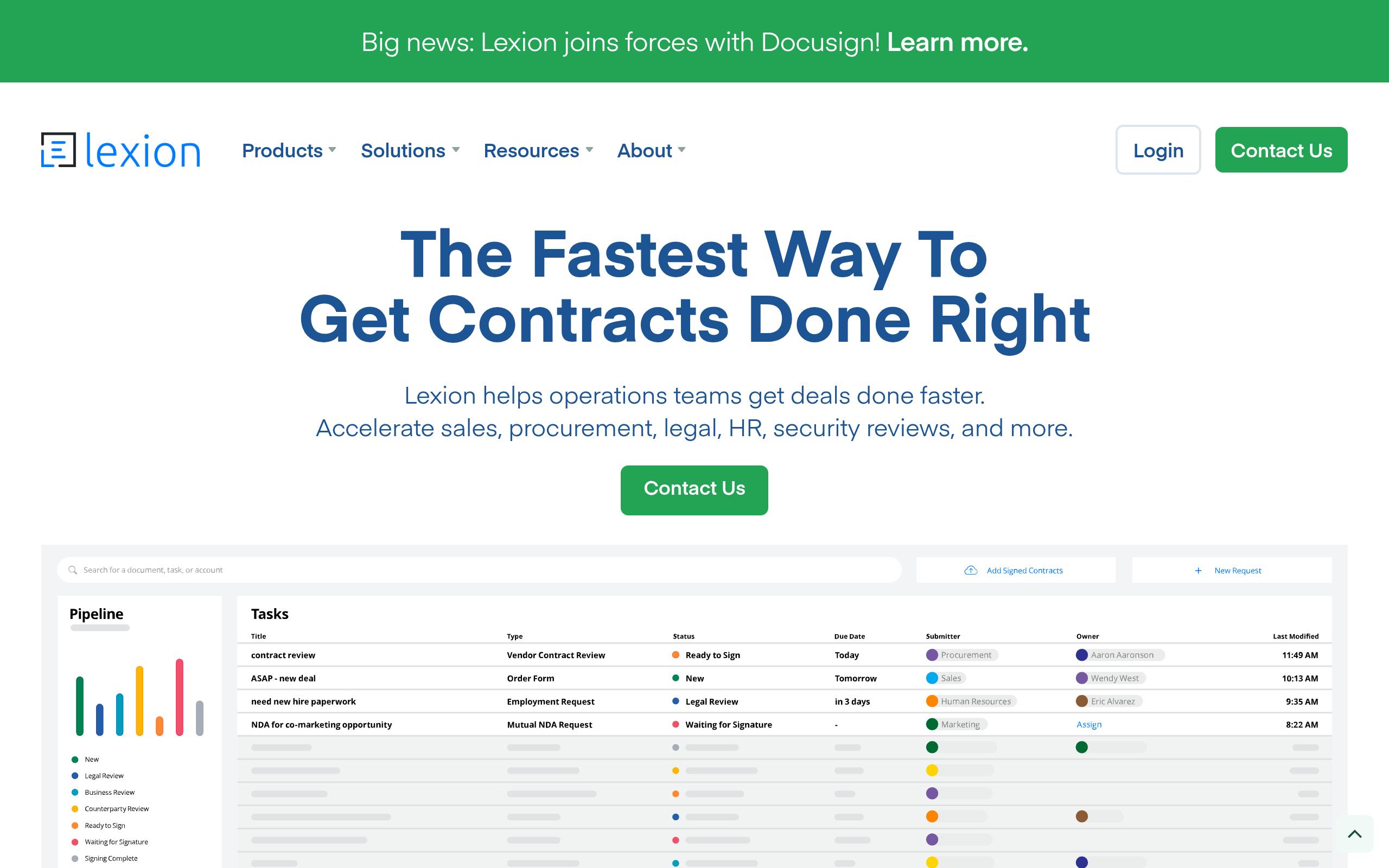
Lexion’s AI smart contract management platform
Core parameters and statistics
| Parameter | Value |
|---|---|
| Product positioning | AI-driven lightweight contract lifecycle management platform |
| Delivery form | SaaS Web application (Docusign IAM ecosystem) |
| Core users | Legal, sales, purchasing HR, financial IT |
| Core capabilities | AI term extraction, natural language search, code-free workflow, risk marking, email-driven collaboration |
| Deployment features | Email-driven, no training required, initial configuration completed in a few hours |
| Integration Ecosystem | Salesforce, HubSpot, Slack, Teams, Coupa, Docusign, HelloSign, Adobe Sign, SharePoint, Microsoft Word |
| Security certification | SOC 2 Type II, ISO 27001, AES-256 encryption TLS 1.2+, SSO (Okta/AD/Google) |
| Industry recognition | IA40 Winner 2022, G2 Fall 2023 Leader (7 items), CB Insights AI 100 2021, Capterra all five stars |
| Customer scale | Hundreds of enterprise customers (acquired by Docusign for $165M in 2024) |
| Source of AI technology | From Allen Institute for AI (AI2), the founding team comes from Microsoft, Google, Meta, and Amazon |
| Data volume processed | 100 million+ automatically extracted contract data points |
Keywords: Lexion’s core parameters reveal a positioning of “lightweight but with profound AI skills”. Unlike CLM platforms geared toward large enterprises, such as Ironclad and Icertis, Lexion’s differentiation lies in its low-friction deployment—an email-driven collaboration approach that allows cross-department users to participate in the contract process without logging into a new system. The AI gene from AI2 gives its term extraction capabilities a unique technical advantage among competing CLM products.
Lexion’s users and market recognition
- G2 2023 Fall Multiple Leader Certifications: Won a total of 7 honors including Leader, Momentum Leader, Best Estimated ROI, Most Implementable, Best Usability, Best Support / Enterprise, and Easiest to do Business With / Enterprise in the G2 2023 Fall report. Among CLM products of the same size, there are very few leaders who have achieved both ease of implementation and ROI.
- CB Insights AI 100 (2020, 2021): Selected on the CB Insights list of the world's most promising AI startups for two consecutive years, and ranked first in the "Most Promising AI Legal Technology Startups" in 2020.
- IA40 Winner 2022: Named to Innovation Alliance's IA40 (The 40 Most Innovative Private Companies) list, which focuses on technological uniqueness and commercial viability.
- Capterra Full Five-Star Reviews: All user ratings as of 2024 are five stars, extremely rare in the contract management software category.
- Docusign $165M Acquisition (May 2024): Docusign acquires Lexion for $165M all-cash. Following the acquisition Lexion will continue to operate independently and provide services to existing customers while integrating into the Docusign IAM (Intelligent Agreement Management) platform. This acquisition validates the technical value of Lexion’s AI capabilities—Docusign is not about acquiring customers (Lexion only has a few hundred enterprise customers), but about acquiring AI technology and teams.
- Customer Endorsement: Apptio's Director of Legal Operations commented that "Lexion helped us organize and analyze 10,000 commercial agreements in a short period of time" and Fox Factory's Deputy General Counsel said that "Anyone in the company can request a contract review by sending an email, and Lexion converts it into a task on the dashboard."
Keywords: Lexion's market recognition shows the triple verification of "academic pedigree + third-party evaluation + major manufacturer acquisition". Unlike other CLM competitors that rely on GA report (Gartner/Forrester) endorsement, Lexion's recognition is more biased towards technical authority (AI2 comes from CB Insights) and user experience (G2 seven-item Leader, Capterra all five-star). After the acquisition of Docusign, Lexion's long-term development path has changed from "independent CLM vendor" to "Docusign IAM's AI capability core".
Lexion’s Cost Advantage
C-side/individual users: Lexion does not provide independent products for individual users. Individuals or micro-teams that require contract management are better suited to manual management with Google Drive + or use free lightweight alternatives.
Business-end/medium and large enterprises: Pricing is a customized quotation mode (Custom Quote), and the billing dimensions include:
- Contract quantity: Billed based on the contract storage amount and the number of active contracts
- User seats: billed based on the number of active users
- Product module: Repository (warehouse), Workflow (workflow), AI Contract Assist (Word plug-in) can be purchased in combination
| Price benchmarking deduction: | Dimensions | Lexion (deduction) | Ironclad | DocuSign CLM |
|---|---|---|---|---|
| Entry price (annual payment) | ~$10K-20K/year | ~$50K+/year (Enterprise version is higher) | ~$30K+/year | |
| Core audience | Small and medium-sized legal teams, growing enterprises | Large and medium-sized enterprises, complex process organizations | Docusign existing user upgrades | |
| Implementation cycle | Hours to days | Weeks to months | Days to weeks | |
| Deployment Friction | Very Low (email-driven) | Medium (requires workflow configuration) | Medium (integrates with existing signature flow) | |
| AI depth | Strong term extraction/search (from AI2) | Strong workflow/multi-agent | Enhanced after combining with Lexion | |
| Electronic Signature | Integrated Docusign/HelloSign/Adobe | Native Ironclad Signature | Native Docusign |
Deduction Note: The above prices are deduced based on third-party estimates and public information on similar products, and are not officially committed by Lexion. The official real-time quotation shall prevail.
FREE TRUTH:
- Lexion does not offer a forever free or Freemium plan
- All usage requires contacting sales for demo and quotation
- After the acquisition of Docusign, Lexion may indirectly reach a wider user base through the Docusign IAM package, but the free quota is not disclosed at the independent Lexion product level
Hidden Cost Analysis:
- Migrating Stock Contracts: Although Lexion's AI can automatically handle the import of stock contracts, the OCR quality and field mapping of more than 10,000 contract packages still require manual sampling and calibration.
- Cross-department promotion costs: Email-driven design reduces learning costs, but for procurement, sales, HR and other departments to develop the habit of "processing contracts through Lexion", the legal department still needs to promote process changes
- Integration Maintenance: The integration of Lexion with CRMs such as Salesforce and HubSpot requires the IT department to complete OAuth configuration and data mapping, which is non-zero operation and maintenance.
Main functions of Lexion
1. Intelligent Repository
AI-driven contract storage center. Automatically read the uploaded PDF/Word contract, extract 40+ key clauses (compensation, confidentiality, termination, automatic renewal, change of control, etc.), and establish a full-text index. Supports folder-level directory structure organization and retains document hierarchical relationships. The same applies to existing historical contracts - no manual entry is required, AI automatically categorizes them after uploading.
Synergies: A warehouse is more than just a "place to store contracts". After the terms are extracted, it directly drives the three downstream processes of search, reporting, and early warning - search no longer relies on file names, reports automatically aggregate key terms for comparison, and early warnings automatically generate calendar reminders from text dates. One input triggers multiple outputs.
2. Natural language search (Intuitive Search)
Supports natural language queries such as "Show all contracts with automatic renewal clauses", "Which contracts expire in 2025", "What compensation clauses does supplier A have", and also supports structured filtering by party, clause type, date range, etc. The search results directly display the original text of the corresponding terms, without opening the contract one by one.
Synergy: Natural language search is related to term extraction - the more accurate the extraction, the more usable the search; the higher the search frequency, the easier it is for users to discover extraction deviations and provide feedback for correction. This is the core experience difference with Lexion compared to traditional CLM searches (which rely on filenames/tags).
3. Codeless workflow automation (Workflow Automation)
Core Highlights: Collaboration through email-driven approvals. Users do not need to log in to Lexion and send contract review requests directly from email → Lexion automatically creates tasks → assigns approvers according to preset rules → the approvers reply via email to complete the approval. Supports custom approval routing, conditional branches (such as automatic upgrade of approval levels for amounts > $50K), document template generation and signature initiation.
Synergy effect: Workflow and warehouse are two-way - after the workflow generates a signed contract, it is automatically archived to the warehouse, and the terms data in the warehouse can feed back the approval decisions of the workflow. This cycle reduces the problem of "manually filing the contract after signing it".
4. AI Contract Assist (Word plug-in)
Generative AI-based Microsoft Word plug-in that works directly during the contract review and drafting process. Features include:
- Automatically scan contracts for deviations from company standard terms and conditions
- Highlight potential risk areas (e.g. unilateral termination rights, unlimited liability)
- Modification suggestions based on company playbook
- AI generated justification for revisions
Synergy effect: The Word plug-in embeds AI capabilities into the tools most familiar to legal personnel, solving the multi-application switching problem of "download from Word → upload to Lexion → view analysis → return to Word for modification". This is one of the core technology assets that Docusign clearly highlighted in its acquisition.
5. Reporting and Analysis (Powerful Reporting)
With a built-in automated reporting engine, users can quickly generate customized reports (such as "All supplier contracts with automatic renewal terms" and "List of NDAs signed in 2024") by clicking on fields. After the report is saved, it will automatically update with new data and support team sharing and CSV/PDF export.
Synergy: The report is consistent with the data model for term extraction - there is no need to configure report fields separately, the structured term data already in the warehouse automatically becomes an optional dimension for the report. This is particularly efficient in the M&A due diligence scenario: upload the contract package → extract the terms → generate a clause difference comparison report, completing weeks of manual work within a few hours.
6. Deadlines and Alerts (Reminders and Alerts)
AI automatically scans key dates in all contracts (renewal deadline, termination notice period, price adjustment date), generates a unified calendar view, and sends reminders via email before the deadline to prevent passive renewal or liquidated damages due to forgotten renewal notice periods.
7. Lexion Q&A
Based on the natural language question and answer interface based on AI, users can directly ask "Does this contract contain compensation clauses?" "When will our contract with supplier A expire?", and AI will retrieve and give answers instantly from the warehouse. The Docusign acquisition announcement listed it as a key retained capability.
[Expert’s Perspective] Lexion’s functional design logic has a clear main line: terms data as the core, email as the interactive interface, and AI as the engine behind it. Unlike traditional CLM, which "completes everything within the system", Lexion deliberately lowers the requirement for users to "enter the system" - emails can initiate approvals, reply to comments, and complete signatures. This design philosophy of "not requiring users to change their working habits" gives it a natural advantage in cross-departmental adoption rates. But this also means: If corporate legal departments want deep customization of contract approval matrices, complex terms negotiation workflows, or two-way synchronization with ERP, Lexion may not be as flexible as heavier options like Ironclad.
Lexion’s model and version evolution
Lexion is a SaaS product of Docusign, and the version information is subject to the official announcement. The following is a summary based on public information:
Major version node
| Version | Time | Key Changes |
|---|---|---|
| v1.0 (Foundation Edition) | ~2019 | Core AI clause extraction engine released, supporting basic contract import and search |
| v2.0 | ~2024-01 | Introducing an improved version of AI clause extraction and risk marking functions to enhance search capabilities |
| v3.0 | ~2025-05 | Enhanced natural language search and batch contract import capabilities; technology integration begins after Docusign acquisition |
| Docusign IAM Fusion Edition | ~2025-2026 | Deeply integrated with the Docusign IAM platform, launching the AI Contract Assist Word plug-in Lexion Q&A |
Version evolution features
Lexion's version evolution has gone through three stages:
- 2019-2023 (independent polishing period): Focus on core capability verification of AI term extraction and search, accumulated processing experience of 100 million+ data points, and was continuously selected into CB Insights AI 100.
- 2024 (Acquisition Integration Period): Acquired by Docusign for $165M, product roadmap begins to align with Docusign IAM strategy. The Docusign announcement makes it clear that Lexion’s AI capabilities will be retained and enhanced while providing Lexion customers access to the IAM platform.
- 2025-2026 (Platform Integration Period): Lexion’s role as the AI engine of Docusign IAM is gradually clarified. Word plug-in and Q&A functions are the core delivery of this stage, marking Lexion's transformation from "independent CLM" to "AI layer embedded in the Docusign ecosystem".
Tips to existing customers: If an enterprise is interested in the lightweight features of Lexion as an independent CLM platform when purchasing, it needs to pay attention to the product evolution direction after Docusign integration - Lexion's independent brand interface and pricing model may be adjusted in the future.
Lexion’s technical advantages
AI lineage: NLP genes from the Allen Institute for AI: The three founders all met at AI2 (a non-profit AI research organization founded by Paul Allen), and major breakthroughs in the NLP field in 2018 (BERT, GPT) inspired them to apply the latest NLP technology to the contract field. Lexion's AI model is not packaged after purchasing a third-party API, but a vertical model that is trained in domain specialization based on a large amount of real contract data. The extraction experience of 100 million+ data points means that the model has accumulated certain scale barriers for semantic understanding of English legal texts.
Adoption Benefits from Email-First Architecture: This is Lexion’s most unique engineering decision—almost all interactions can be done via email. Architecturally, it is equivalent to using email as the "UI layer" to connect to Lexion's process engine. The employee sends a request to the designated email address → Lexion parses the email content → creates/updates the task → automatically routes approval → the approver emails the reply to complete the operation. This design greatly reduces the system friction of cross-department promotion. Wilson Sonsini Chief Innovation Officer commented that "(traditional CLM) is difficult for organizations to implement, and Lexion's innovative email-centric approach solves core barriers to adoption."
The difference between codeless workflow and email-driven: Lexion’s workflow engine allows legal teams to configure their own approval rules (without IT intervention), and the trigger point can be an operation within the platform or an email sent. The approver can directly fill in the comments in the body of the email, and Lexion will parse and write it back to the task record - this turns the traditional approval process that requires logging into the system into a daily email operation.
Enterprise-level guarantee of security compliance: SOC 2 Type II + ISO 27001 two-factor authentication, AES-256 encryption at rest + TLS 1.2+ transmission encryption, support for SAML 2.0 SSO (Okta, Google Workspace, Microsoft Active Directory), fine-grained permission control (contract level, folder level, read-write separation). For legal departments in regulated industries, these certifications can directly shorten the security due diligence cycle.
Integration breadth and API scalability: Pre-built integrations cover CRM (Salesforce, HubSpot), collaboration (Slack, Teams, Email), documents (SharePoint, Word), electronic signatures (Docusign, HelloSign, Adobe Sign), procurement (Coupa), and provide RESTful API to support custom docking. The integrated design follows the principle of "no information islands" - the full-link information of the contract from creation (CRM) → approval (email/collaboration) → signing (eSignature) → archiving (warehouse) does not leave Lexion's recording system.
How to use Lexion
The use of Lexion uses email and web interfaces as the core entrances, and does not provide independent mobile or desktop applications.
Typical usage process
Step 1: Contract into the database - Legal affairs can import contracts into Lexion in three ways:
- Email Forwarding: Forward contract emails to Lexion’s dedicated mailbox, and AI will automatically extract attachments and archive them.
- Direct upload: Log in to the web interface and drag and drop to upload PDF/Word files
- Integrated Import: Automatically sync after connecting to Google Drive, Dropbox, and SharePoint
Step 2: AI automatic extraction - After uploading, AI will complete the extraction of terms within a few minutes, generate structured data and build indexes. Users can ask questions directly in the search bar and get clause-level answers.
Step 3: Initiate approval/workflow - Send a contract review request via email, specifying the contract that needs approval and the approver. Lexion distributes tasks according to preset rules. The approver can complete the approval by replying via email.
Step 4: Electronic signature - After approval, the contract is sent to Docusign/HelloSign/Adobe Sign for completion of signing. After the signing is completed, it will be automatically returned for archiving.
Step 5: Monitoring and Reporting – Set deadline reminders. Generate compliance reports or clause analysis reports through point-and-click reporting tools.
Entrance method
| Entrance | Description | Applicable Scenarios |
|---|---|---|
| Web side | https://app.lexion.ai/login | All management operations (upload, search, reporting, configuration) |
| Send to the work email bound to Lexion | Initiate approval, reply to comments, and submit the process | |
| Slack / Teams | Send and receive notifications and tasks through Bot integration | Daily collaboration and quick approval |
| Microsoft Word | AI Contract Assist plug-in | Contract drafting and review |
| API | RESTful API | Custom integrations and automation |
| Salesforce / HubSpot | CRM Integration | Sales Contract Auto-Initiation |
Tips for getting started quickly
- Priority Activation Email Integration: Bind the legal department’s contract processing email to Lexion and immediately gain the ability to “forward and archive”
- Import 50-100 representative contracts: Test the accuracy of AI clause extraction and verify that business requirements are met before full deployment
- Configure 3-5 approval routes: Start configuring workflows from the most commonly processed contract types (NDA, MSA), and gradually expand to complex scenarios
- Set critical date alerts: Scan existing contracts for automatic renewal clauses that are about to expire and verify the timeliness of reminders
Product Pricing for Lexion
| Dimensions | Description |
|---|---|
| Paid model | Custom Quote, annual subscription |
| Billing dimensions | Contract quantity + user seats + product module combination |
| Core modules | Repository (warehouse), Workflow (workflow), AI Contract Assist (Word plug-in) |
| Free Trial | No public free trials or Freemium plans available |
| Entry Price (Deduction) | Approximately $10,000-20,000/year (based on third-party estimates, unofficial data) |
| Electronic signature | Additional purchase of Docusign/HelloSign/Adobe Sign subscription required |
| Post-acquisition impact of Docusign | In the long term, it may be bundled with Docusign IAM packages, and independent pricing may be gradually adjusted |
Advice to purchasers: Since Lexion prices are not public, it is recommended to ask for a complete quote for Repository + Workflow + AI Contract Assist when enquiring, and confirm whether the integrated connectors (especially Salesforce and Email Workflow) are included in the base fee. If your business is already using Docusign eSignature, ask the Docusign sales team about Lexion combo offers with existing contracts.
Application scenarios of Lexion
Scenario 1: Contract digitization for small and medium-sized legal teams
- Task type: Centrally store thousands of PDF contracts scattered in mail/shared folders and build a searchable contract library
- Operation path: Forward the contract email to Lexion → AI automatically extracts terms → Natural language search to locate any contract
- Actual benefits: From "document accumulation" to "intelligent retrieval" in one step, there is no need to establish a complex contract classification system before using it.
- Verification focus: OCR recognition accuracy and clause extraction quality of non-English contracts (such as Chinese and Japanese PDFs)
Scenario 2: Quick review of M&A due diligence contracts
- Task type: The due diligence team receives hundreds to thousands of contract packages from the target company and needs to identify abnormal terms and high-risk matters in a short period of time
- Operation path: Batch upload contract packages → Lexion automatically extracts key clauses → Generate clause difference comparison report → Highlight abnormal clauses (such as unilateral termination rights, change of control clauses)
- Actual benefits: The traditional "team review one by one and manual registration" (a few weeks) is shortened to "upload → report" (a few hours), saving 80%+ of preliminary screening manpower
- Deduction Note: Based on benchmarking in similar scenarios (Ironclad customer cases show similar efficiency improvements), not an official commitment from Lexion
Scenario 3: Daily legal contract Q&A and compliance inquiries
- Task type: Legal personnel need to frequently answer queries such as "Does a certain contract contain a compensation clause?" "When does supplier A's contract expire?"
- Operation path: Enter the natural language question directly in the Lexion search bar → AI retrieves the corresponding terms from the warehouse → Displays the original text and answers
- Actual benefits: The average query time is shortened from 10-15 minutes (open the file to find the corresponding terms) to less than 1 minute
- Boundary of human-machine collaboration: AI answers are for internal reference only, and external legal opinions or formal compliance reports must still be manually verified by lawyers
Scenario 4: Contract renewal warning and cost control
- Task type: The enterprise has a large number of SaaS and supplier contracts with automatic renewal terms, and additional costs are incurred every year due to forgetting the renewal deadline and passively renewing the contract.
- Operation path: Lexion AI automatically scans all contracts to identify renewal/termination dates → Generate calendar view → Push email reminders before the deadline
- Actual benefits: From the high-occurrence omission mode of "relying on artificial memory + calendar marking" to a systematic early warning, it is estimated that unnecessary automatic renewal costs can be reduced by 50%+
- deduction explanation: This data is the industry average optimization level for similar contract management scenarios. The specific effect depends on the quality of the contract data and the company's follow-up mechanism.
Scenario 5: Efficient approval and signing of sales contracts
- Task type: The sales team needs legal personnel to quickly review standard contract terms (NDA, MSA, SOW) to avoid approval from becoming a transaction bottleneck
- Operation path: Sales submits a contract review request through Salesforce or email → Lexion automatically routes to the corresponding legal department → The approver responds via email to complete the approval → Sign the contract
- Actual benefits: Fox Factory's deputy general counsel reported that "anyone can request contract review by email" and the approval cycle has been reduced from days to hours.
- Not suitable for borders: Complex cross-border transaction contracts (involving multiple jurisdictions, multiple languages, and multiple rounds of negotiations) still require deep manual intervention.
Applicable groups of Lexion
Suitable people
- Small and medium-sized legal teams (1-15 people): core suitable group. For teams that haven’t deployed CLM yet or haven’t deployed CLM due to cost/complexity, Lexion’s email-driven design makes cross-department collaboration zero-barrier. Customer cases such as Fox Factory and Apptio verify the suitability of such scenarios.
- Legal Operations for Growing Enterprises: Rapid business development has led to a surge in contract volume (from hundreds to thousands of contracts processed annually), which requires automated clause extraction and search capabilities rather than complete CLM process control.
- Organizations looking to test the waters of AI contract management in a low-risk way: Without the need for long implementation cycles and expensive consulting fees, the actual value extracted by AI terms can be quickly verified with a small number of contracts before deciding whether to expand.
- Existing Docusign users: If your enterprise is already using Docusign eSignature, Lexion provides AI enhancements as part of the IAM platform to smoothly gain term extraction and natural language search capabilities.
Not suitable for people
- Large legal departments (50+ people) that require complex negotiation workflows: Lexion’s workflow depth is not as deep as that of enterprise-level CLM platforms such as Ironclad and Icertis. If the enterprise requires fine-grained clause-level permission control, multi-round negotiation version management, and structured approval matrix, Lexion’s current capabilities may not be enough.
- Requires multi-language contract processing (especially Chinese, Japanese, Korean): Lexion's AI model uses English contracts as the main training data, and the accuracy of clause extraction and user experience of non-English contracts (especially scanned PDFs) have not been publicly verified. If the company mainly handles Chinese-English bilingual or non-English contracts, it is recommended to use real contract samples for accuracy testing first.
- Teams who only need e-signature functionality: Lexion does not provide a stand-alone eSignature service and must be used with Docusign/HelloSign/Adobe Sign. In such scenarios, it is more efficient to use Docusign or DocuSign CLM directly.
- Zero budget or very small team (1-3 people): Lexion does not provide a free version, and the entry price is estimated to be about $10K+/year, which is not cost-effective for individual entrepreneurs or micro teams.
Summary and Outlook
Three Pillars of Core Competencies:
- AI lineage: A domain-specific NLP model derived from AI2, with clause extraction capabilities verified by 100 million+ data points, and the most solid AI technology endorsement among all lightweight CLM solutions.
- Email-first minimalist design: No need for users to change their working habits - email initiation, email approval, and email archiving. This design principle directly addresses the biggest pain point of traditional CLM: cross-department adoption.
- Docusign Ecological Portal: After being acquired by Docusign, it has obtained the traffic and endorsement of the enterprise-level IAM platform, which also means that Lexion will gradually become the core technology layer of Docusign’s AI capabilities.
Current Limitations and Uncertainties:
- Functional depth ceiling: Lexion is currently better at "contract storage + clause extraction + simple approval", but there is a gap with enterprise-level CLMs such as Ironclad and Icertis in terms of negotiation workflow, fulfillment monitoring, and complex approval matrices. If an enterprise's contract management needs upgrade from "digitalization" to "full-process intelligence" in the next 2-3 years, Lexion's current functional depth may not be enough.
- Docusign Integration Risk: After acquisition, Lexion will serve the Docusign IAM strategy long-term. There is uncertainty about the independence of independent brand interfaces, pricing models and feature roadmaps. The purchaser should clearly define the protection terms for subsequent product iterations and withdrawals in the contract.
- Non-English contract support is not transparent: For users in the Asia-Pacific market, Lexion lacks public information on the accuracy of clause extraction in Chinese, Japanese, Korean and other languages. Users who speak English outside of China need to verify it themselves.
- Procurement friction caused by non-disclosure of pricing: Similar to Ironclad (which also does not disclose pricing), buyers need to go through the sales process to obtain a quotation, which is not friendly enough to the procurement efficiency of small and medium-sized teams.
Purchasing and Adoption Recommendations:
- Use first and then use: Conduct a clause extraction test on 50-100 real English contracts to evaluate whether the accuracy meets business needs. The focus of the test should include: high-frequency key clauses such as compensation clauses, confidentiality clauses, automatic renewal clauses, termination clauses, and change of control clauses.
- Start from the warehouse: First use Intelligent Repository to complete contract digitization, confirm that daily searches and reports are available, and then gradually enable Workflow automation processes. Phased deployment reduces risk and accumulates evidence of internal use.
- Follow the Docusign IAM roadmap: Since Lexion is now part of Docusign, it is recommended to understand the future release plan of Docusign IAM before purchasing to ensure that the evolution direction of Lexion's capabilities is consistent with the mid- and long-term needs of the enterprise.
- Confirm data residency and compliance requirements: If the industry (finance, medicine, government) in which the enterprise is located has strict data residency requirements, the data storage location and processing compliance terms need to be specified in the contract.
Version Info
- Lexion AI Platform v3 :Enhanced natural language search and batch contract import functions. There is no official precise date yet.
- Lexion AI Platform v2 :Introducing AI clause extraction and risk marking functions. There is no official precise date yet.
User Reviews