 Libraire
Free
Libraire
Free
Libraire is an AI-driven personal library and reading summarization platform that supports the conversion of books and documents into summaries in multiple formats (minimal summary, standard narrative, detailed chapters, executable suggestions, custom goals) by pasting text, uploading PDF, or entering the author of the book title, and further generates video insights, audiobooks, and dual-hosted podcasts. All abstracts are saved in a private library and support multi-language translation and Markdown export.
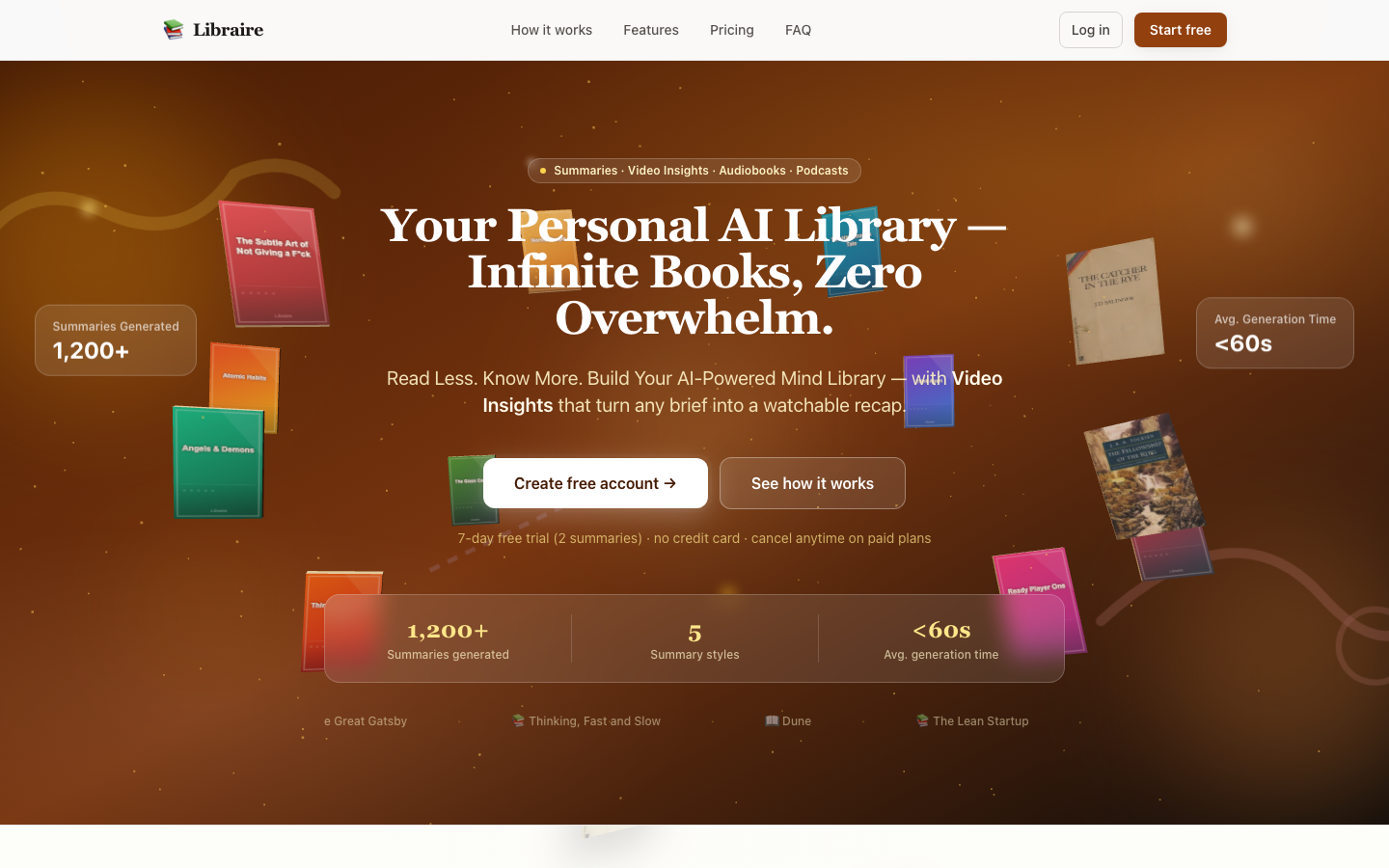
Libraire: AI-powered personal library and intelligent summarization platform
Core parameters and statistics of Libraire
Libraire is positioned as an AI-driven personal library and reading summary tool (category: productivity/business application). Its core value lies in quickly converting book PDF and text content into structured knowledge summaries, and further deriving them into multi-modal consumption forms such as video and audio.
| Projects | Public Information |
|---|---|
| Product Positioning | AI Personal Library – Transforming books into summaries, video insights and podcasts |
| Core capabilities | Multi-format input → 5 summary styles → Multi-modal output (text/video/audio) |
| Product form | Web application (browser access) |
| Business model | Free trial + monthly subscription (Stripe payment) |
| Home | US |
| Supported languages | en-US (abstract can be translated into Spanish, French, German, Japanese and other languages) |
| Online time | ~2026-07 (no official precise date yet) |
| Pricing range | $0 (7-day trial) → $19/month (Pro) → $25/month (Growth) |
| Number of abstracts generated | 1,200+ (public data on product page) |
| Average generation time | <60 seconds (public data on product page) |
| Number of summary styles | 5 (minimal bullet points, standard narrative, detailed chapters, actionable suggestions, custom objectives) |
| Input method | Paste text, upload PDF (intelligent chunking to process long documents), enter book title + author (AI-assisted search) |
| Export format | Markdown, clipboard copy, direct printing |
| Multi-modal output | Video insights (AI dubbing + animation), audio books (TTS reading), dual-hosted podcasts |
Positioning Interpretation: Librare is not a traditional note-taking tool or bookmark management tool, but a "reading consumption post-processing engine with AI as the core". Its core assumption is that most people "forget what they read" not because they don't work hard, but because they lack a system to transform reading into knowledge assets that can be retrieved, reviewed, and re-consumed. Libraire solves the "extraction" problem through multi-style summarization, the "review" problem through video/audio, and the "accumulation" problem through private libraries.
Users and market recognition of Libraire
Libraire is on the fast-growing track of AI knowledge management and reading summarization, and belongs to the field of AI-assisted reading and knowledge management along with Readwise Reader, Shortform, Blinkist, Notion AI, and Mem. Compared with these competing products, Librare’s differentiation lies in:
- Multi-modal output: Not only text summaries, but also the same summary can be converted into video insights (short videos with dubbing and animation), audio books (TTS read in chapters) and dual-hosted podcasts (AI generates discussion conversations between two hosts), covering consumption preferences in different scenarios.
- Five summary styles: from minimal points to detailed chapters, to executable suggestions and customized goals, covering the full spectrum of needs from "quickly judging whether it is worth reading" to "in-depth mastery of the content".
- Input flexibility: Paste text, upload PDF and enter book title + author in three ways to adapt to different reading habits.
Product page public data shows that 1,200+ snippets have been generated, with an average generation time of <60 seconds. Evaluations from different professional users such as Educator, Founder, Designer, etc. mentioned positive feedback such as "Chapter-based output saves a lot of time for reading groups", "PDF upload + chapter-based output reduces the processing time of dense non-fiction books", "Clean Markdown export makes users really willing to look back at the summary".
Specific indicators such as the total number of users, the number of paying users, and the number of corporate customers are subject to official disclosures. As the product is in its early stages (~2026-07 launch), market data is still accumulating.
Differences in positioning from competing products:
| Dimensions | Libraire | Readwise Reader | Shortform | Blinkist |
|---|---|---|---|---|
| Core Scenarios | Personal Book/PDF Summary + Multimodal Output | Highlight Management + Read Later | Nonfiction Book In-Depth Summary | Book 15-Minute Summary |
| Input method | Paste/PDF/book title search | Browser extension/import | Own library | Own library |
| Output variety | 5 text styles + video + audio + podcast | Highlight review + notes | Chapter summary + guidance | Audio + text summary |
| Video Insights | ✅ | ❌ | ❌ | ❌ |
| Custom Summary Goals | ✅ | ❌ | ❌ | ❌ |
| Pricing | $19-25/month | $8-13/month | $15-20/month | $15-20/month |
Libraire’s cost advantage: using a subscription system to cover in-depth reading needs
C client/individual user
Libraire adopts a three-tier pricing structure for individual users with different reading intensity:
- Free Trial: $0, generate 2 abstracts within 7 days, experience core abstract styles (3 types) and PDF upload function, no credit card required. Suitable for early adopters and light evaluation.
- Pro Plan: $19/month, 15 summaries per month, unlocks all 5 summary styles + custom targeting mode, supports all export formats, and provides email priority support. Suitable for deep readers who read 3-4 books or long articles every week. Calculated based on a single abstract, the cost is approximately $1.3/article.
- Growth Plan: $25/month, 25 summaries per month, adds priority queue, dedicated customer support and early access to new features on top of Pro. Ideal for knowledge workers and small teams who have a lot of reading input every day. Calculated based on a single abstract, the cost is approximately $1.0/article.
FREE FACTS: The core limitations of the free trial are "2 total snippets" and "3 snippet styles only." For new users who just want to test the quality of the summary, 2 is enough to complete the evaluation. But once you develop the habit of "using Libraire to process reading content", the monthly quota of 15-25 items may be too tight for high-frequency readers - reading a non-fiction book every day already requires 30 items/month. Heavy users may need to use other tools or wait for the official launch of a higher limit plan.
Hidden benefits: Librare's long-term value is reflected in "knowledge compound interest". Each abstract becomes part of one's intellectual assets, rather than fragments of information that are discarded after reading. When you need to review a certain concept or find a key argument in a book you've read, you don't need to search or flip through the book again. You can search directly in your own private library. This "process once, permanently retrievable" model has a very high return on time for professionals who read 50+ books a year.
API/Developer
As of July 2026, Librare does not expose a separate API for developers. The /health endpoint of the product page indicates that a backend health check mechanism exists, but no public API documentation or SDK is provided. If developers need to integrate summary capabilities into their own systems, the official follow-up release shall prevail.
Enterprise/Privatization
Libraire has not disclosed enterprise plans or private deployment options. The team collaboration function is covered in the Growth plan ("Dedicated account support"), but enterprise-level capabilities such as team management, permission control, and data isolation are not clearly stated. Enterprise procurement needs to contact [email protected] to confirm the customized plan.
Main functions of Libraire
Libraire is designed around the function of "input → processing → output → accumulation". Each section has multiple options to adapt to different scenarios.
-
Three flexible input methods: support pasting text fragments, uploading PDF files (intelligent chunking to process long documents), input book title + author for AI-assisted retrieval. Applicable tasks: No matter where the reading occurs (browser Kindle, scanned paper book), the content can be sent to Libraire for processing. Expert view: The combination of these three input methods covers more than 90% of digital reading scenarios - web pages or e-books can be pasted, paper books or scanned copies can be uploaded as PDF, and classic books can be directly searched for book titles. Input knotty zero friction is a key driver of frequency of use.
-
Five summary style switches: minimal summary (5 bullet points, 30 seconds to judge whether it is worth in-depth), standard narrative (smooth paragraph summary, suitable for sharing or book reports), detailed chapter (analysis chapter by chapter, retaining core ideas and argument structure), executable suggestions + action items (refining ideas into implementable matters), custom goals (after specifying the reading goal, AI organizes the summary around the goal). Applicable tasks: The same book can be quickly scanned with a very brief summary, and then switched to detailed chapters for in-depth digesting when you are interested. Expert View: Style switching does not require re-uploading content. This design implements the concept of "process once, consume multiple times" - the same book "Thinking, Fast and Slow" can be listened to 5 minutes of brief summary while commuting, and detailed chapters can be exported when writing a book review.
-
Video Insights: Generate short videos from any summary with one click, including AI dubbing and animation, converting text into watchable video summaries. Supports in-browser preview, MP4 download and sharing. Applicable tasks: Convert book summaries into short video content that can be shared on social media, or used as a visual aid for team knowledge sharing.
-
Audiobook: TTS voice reads the summary in chapters. You can choose different timbres and adjust the playback speed. Applicable tasks: "Audio reading" while commuting, exercising, doing housework - listen to book excerpts like a podcast.
-
Podcast mode (Podcast): AI automatically rewrites the summary into a dual-host discussion script (hosts Alex & Jordan), and then dubs it segment by segment to form an audio like a book club conversation. Applicable tasks: Review the core content of books in a more relaxed and conversational way, suitable for users who prefer "listening to people talking about books" rather than "reading summaries".
-
Multi-language translation: Translate the completed summary into Spanish, French, German, Japanese and other languages, retaining the Markdown structure. Translation results are cached by language, and you can switch between original and translated text instantly. Applicable tasks: Compare translation comprehension when reading books in a non-native language; or prepare multilingual knowledge summaries for international teams.
-
Private Library: All abstracts are saved in a private space exclusive to the user, and support searching by title and filtering by style. Even if you cancel your subscription, existing summaries will be retained permanently. Applicable tasks: Accumulate personal knowledge assets over a long period of time and form a retrievable "second brain".
-
Real-time Progress Tracking: Displays real-time stages during the summary generation process - Extraction (parsing content) → Summary (LLM generated draft) → Polishing (quality calibration) → Delivery (readable and exportable). Applicable tasks: For long documents or complex processing, users can always understand the progress instead of facing a blank loading page.
Libraire’s model and version evolution
Libraire will launch its first public version around July 2026 and is currently in the early stages of the product. The product page does not disclose specific information about the underlying AI model (the FAQ mentions "Which AI model powers Libraire," but the answer content is not expanded on the accessible page). The official document shall prevail.
Version context:
- 2026-07 (~2026-07): The first public version of Librare 1.0 is online. Core functions: five summary styles PDF upload (intelligent chunking), three input methods, private library Markdown export, multi-language translation, audio books, podcast mode, video insights. The pricing system is established (free trial/Pro/Growth).
This product operates as a web application and has no public client version number, GitHub repository or update log. Functional iteration is mainly based on online updates of the product side, and there is no "version release" rhythm in the traditional sense.
Libraire’s technical advantages
Libraire's technical architecture is designed around a "multi-stage AI processing pipeline + multi-modal output engine" rather than a single LLM call:
Text processing pipeline: The input content goes through four stages: extraction (Parse & chunk content) → summary (LLM generates draft) → polishing (Quality pass & polish) → delivery (Ready to read & export). Each stage is handled by an independent processing module, forming an "extraction-generation-quality inspection-output" cycle similar to an industrial assembly line. The advantages of this pipeline design are: long documents can be intelligently divided into blocks and processed in parallel, the LLM call in the summary stage focuses on content understanding rather than format splicing, and the quality is calibrated in the polishing stage to reduce "AI smell".
Multi-modal output engine: The same summary text can be fed into different generation pipelines - video pipeline (convert chapters into screen sequences + TTS dubbing + motion synthesis), audio pipeline (paragraph TTS + voice speed change + timbre selection), podcast pipeline (rewrite the summary into a dual-host dialogue script + role-based TTS dubbing). This "once processing, multi-form distribution" architecture avoids the content cost of repeated processing.
Privacy and Security by Design: The FAQ clearly states that user content is not used for AI model training ("Your content never trains our models"), and the PDF will not be persisted after processing. Summary data is only visible to the user himself. The Privacy Policy Cookies Policy and Terms page is available in the footer of the site.
Engineering Adaptation Boundary:
- Special content formats: Non-fiction books, long business/technical/self-help articles, and key point extraction from academic PDFs. Content that is clearly structured works best.
- Content formats that we are not good at: Fictional literature (the aesthetic interpretation of novels/poems relies on humanities understanding, and AI summaries may lose literary value), highly technical professional papers (the quality of conversion of non-text formats such as mathematical formulas, code blocks, chemical structural formulas, etc. depends on the underlying LLM capabilities), multi-language mixed documents (the current translation function processes the target language independently, and cross-language mixed content may cause sentence fragmentation problems).
How to use Libraire
Libraire provides services in the form of a web application, without the need to install a client or configure the environment. The complete usage process is as follows:
Step One: Registration and Free Trial Visit https://libraire.ai → click "Start free" → create an account (no need to bind a credit card) → automatically get a 7-day trial period (2 summary credits).
Step 2: Enter content There are three ways to get content into Libraire:
- Paste text: Copy chapters or fragments from the book and paste them directly into the editor.
- Upload PDF: Supports PDF file upload, and intelligently processes long documents in chunks (including scans/electronic versions of the entire book).
- Book title + author search: Enter the title and author of a known book, and AI will assist in retrieving the content from training knowledge.
Step 3: Choose summary style Choose from five styles: Minimal Highlights (5 bullet points), Standard Narrative (paragraph style), Detailed Chapters (chapter-by-chapter analysis), Actionable Advice + Action Items, Custom Objectives (e.g. "What does this book say about leadership?").
Step 4: Wait for AI processing Real-time progress tracking shows the current stage: Extract → Summary → Polish → Deliver. Average processing time <60 seconds.
Step 5: Consumption and Export Once your abstract is complete you can:
- Read in your browser
- Generate Video Insights and download MP4 with one click
- Listen in audiobook mode (select tone, adjust speed)
- Generate dual-hosted podcasts and play them
- Export to Markdown or copy to clipboard
- Translated into multiple languages
- Switch summary style and regenerate at any time
Step Six: Manage Library All abstracts are automatically saved to a private library. You can search by title and filter by style. Excerpts are retained permanently after the subscription is cancelled.
Usage comparison with competing products:
| Comparison | Libraire | Readwise Reader | Shortform |
|---|---|---|---|
| Registration threshold | 7 days free, no credit card required | 14 days free, credit card required | 5 days free, credit card required |
| Input method | Paste/PDF/book title | Browser extension/import | Own library |
| Multi-modal output | ✅ Video + Audiobook + Podcast | ❌ | ❌ |
| Export format | Markdown/Clipboard/Print | Markdown/CSV | Markdown |
| Custom Summary | ✅ Custom Goal | ❌ | ❌ |
Libraire product pricing
Libraire uses a clear monthly subscription system, handles payments through Stripe, and supports cancellation at any time and prorated refunds:
| Plan | Price | Summary Quota | Summary Style | Priority Processing | Support Level | Applicable People |
|---|---|---|---|---|---|---|
| Free trial | $0 (7 days) | 2 total | Core 3 types | Standard queue | Community | Early adopter evaluation |
| Pro | $19/month | 15 items/month | All 5 + Custom | Standard Queue | Priority Email | 3-4 book readers per week |
| Growth | $25/month | 25 items/month | All 5 + customization | Priority queue | Dedicated support | Knowledge workers/small teams reading daily |
Billing Rules:
- All paid plans come with a 7-day satisfaction guarantee – full refund if not satisfied within 7 days of subscription.
- The monthly quota does not accumulate and carry forward (the number of unused summary items in the current month does not roll over to the next month).
- After the subscription is cancelled, existing abstracts are permanently retained in the library. The account will return to the free trial period rules (the amount is consistent with the trial period).
- Upgrade, downgrade or cancel at any time through the Stripe Customer Portal without contacting customer service.
Hidden costs of content consumption: Based on the Growth plan of 25 summaries per month, if the user reads and processes 1 book per day, the monthly quota of 25 summaries can cover most scenarios. However, for scenarios where the same book needs to be output into multiple styles (for example, minimal summary + detailed chapters + video insights each consume one credit), the actual number of books that can be processed will be reduced. The product page does not specify whether style switching/regeneration consumes credit, which needs to be verified in the trial.
Application scenarios of Libraire
-
In-depth reading management: Send 3-5 non-fiction books, industry reports, and long articles read every week to Libraire to generate summaries and save them to a private library. Deduction scenario: Product managers read competitive product analysis and industry trend reports every week. In the past, it took 6-8 hours of intensive reading and note-taking. After using Libraire, the investment can be shortened to 1-2 hours (uploading + selecting style + reading summary). The remaining time focuses on intensive reading and practical application of key chapters. Quantified cost reduction and efficiency improvement: reduced from 6-8 hours per week to 1-2 hours (deduced value, subject to personal usage habits), saving about 75% of reading and organizing time.
-
Research data organization: After researchers or graduate students collect a large number of PDF papers and reference materials, they use Libraire to generate structured summaries in batches. Deduction scenario: During the literature review stage, it used to be necessary to switch between PDFs and manually record key points. Libraire's PDF upload + detailed chapter style can automatically extract the core arguments, methods and conclusions of each paper and search them by topic in private libraries, increasing the efficiency of data organization by 3-5 times. Quantified cost reduction and efficiency improvement: The time required to compile 3-5 paper abstracts per day is reduced from 2-3 hours to 0.5-1 hour (deduced value).
-
Sharing within the knowledge team: Team leaders generate summaries + video insights of important books and reports and share them in the enterprise Slack/Feishu group. Deduction scenario: Weekly team reading or knowledge sharing meeting. In the past, everyone needed to read by themselves and then discuss. Libraire's video insights feature converts summaries into short 3-5 minute videos that teams can quickly watch and then discuss during meetings, turning "read first and talk later" into "watch first and talk later." Quantified cost reduction and efficiency improvement: From 2-3 hours per person reading in advance, it is shortened to 5 minutes to watch the video summary + 30 minutes of targeted discussion (deduction value).
-
Podcast-style commuting learning: Convert summaries into podcast mode or audiobooks and listen to them while commuting, exercising, or doing housework. Deduction scenario: Commute 40 minutes a day and used to just listen to music or random podcasts. Libraire's audiobook and podcast modes allow users to "listen to books" and transform fragmented time into effective knowledge input.
Human-machine collaboration boundary:
- 100% automatable: full-text summary generation after content input, multi-modal output conversion, multi-language translation, library archiving. These steps do not require human intervention and can be completed independently by AI.
- Human intervention required: Verification of the accuracy and completeness of the summary (for content in professional fields, AI may miss key details or misinterpret arguments), internalization and application of knowledge (AI provides summaries but cannot replace the reader's active thinking and critical understanding), compliance review involving commercial confidential content (uploaded PDF content must comply with corporate data security policies).
Applicable groups of Libraire
- Knowledge workers and in-depth reading enthusiasts: People who read 30+ books every year and need a system to manage their reading output and accumulate knowledge assets. The multi-style summarization and multi-modal output provided by Libraire allow reading to change from "consumption" to "accumulation". Prerequisite: Be accustomed to reading content in digital format (webpage/PDF/e-book) and have a stable reading rhythm.
- Product Managers, Consultants and Analysts: Need to read a lot of industry reports, competitive product analysis and professional books, and need to quickly transform key points into shareable knowledge materials. Libraire’s Video Insights feature is perfect for turning book summaries into team-sharing material. Precondition: Accept the possible risk of information loss in AI summaries, and the key content still needs to be returned to the original text for verification.
- Researchers and Graduate Students: Processing large volumes of academic PDFs and references requires automated abstract extraction and data organization tools. Libraire's PDF upload + detailed chapter style can be used as an aid to your literature review. Prerequisite: The AI abstract is not a substitute for intensive reading, especially the sections involving methodological details and data analysis.
- Content Creators and Educators: Need to extract material from books for lesson preparation, writing, or content production. Libraire's multilingual translation feature is helpful for creating multilingual educational content. Prerequisite: It is necessary to verify the professionalism and educational suitability of the AI summary to avoid passing inaccurate information to students.
Not suitable for boundaries: Librare is not suitable for the following people - ① Readers who mainly read paper books and are unwilling to digitize (Libraire's core input is digital content); ② Readers who pursue intensive reading of the original text word for word and do not accept any form of "second-hand extraction" (the essence of AI summary is the reconstruction of the original text and cannot replace the integrity and aesthetic value of the original text); ③ Professional scholars who need in-depth literary criticism or philosophical thinking (AI Limited depth of analysis of literary value, metaphor, style); ④ Enterprises that are highly sensitive to data privacy and do not allow any third party to process document content (although Libraire states that the content is not used for model training, the upload processing itself involves data flow).
Summary and Outlook of Libraire
Positioned as an "AI personal library", Libraire has taken a differentiated path in the reading summary track - it is not satisfied with just being a "text summarizer", but further develops summaries into video insights, audio books and podcasts, covering the three knowledge consumption scenarios of "watching, listening and chatting". The design of five summary styles + custom objectives covers a complete spectrum of reading needs from "quick screening" to "deep absorption". The low barrier to entry for a free trial (7 days, no credit card) reduces user evaluation costs.
Core Competencies: ① The multi-modal output capability is the richest among reading summary tools at present, and the combination of video + audiobook + podcast has no direct competitive benchmark; ② The input terminal supports book title search, and summary can be generated for known classic books without preparing the original text, which lowers the threshold for use; ③ Privacy commitment (the content is not used to train the model PDF and is not stored persistently) increases the basis of user trust.
Current limitations: ① The product is in an early stage, and the function iteration speed and stability need to be verified; ② There is no public API or enterprise version, which limits team collaboration and system integration scenarios; ③ The objective evaluation data of the underlying AI model information and summary accuracy is missing, making it difficult for users to make quantitative comparisons before purchasing; ④ The monthly summary quota (15-25 items) may be insufficient for high-frequency readers, and a pay-as-you-go replenishment mechanism is not provided; ⑤ Batch uploading and batch processing are not supported, and document-by-document processing is not friendly enough for users who have accumulated a large number of PDFs.
Procurement/Adoption Risk Assessment: Individual users can adopt the "try now and pay later" strategy - use the 7-day free period to complete 2 complete summaries, focusing on evaluating: ① Whether the quality of the AI summary meets professional needs (especially the depth of understanding of industry terms and complex arguments); ② Whether the summary generation speed is stable in actual use <60 seconds; ③ Whether style switching and regeneration consume additional monthly credits. Enterprise users need to verify the following terms before purchasing: ① Compliance of data processing (whether the uploaded content involves corporate confidential information, and whether the "content is not used for model training" in the privacy policy is confirmed in the form of contract terms); ② Service availability guarantee (currently there is no public SLA or uptime commitment); ③ Data export and migration capabilities (ensure that all summary content can be exported in a standard format after the subscription is terminated). Taken together, Librare has clear practical value in personal in-depth reading management scenarios, but team/enterprise-level application scenarios need to wait for product maturity and compliance systems to be further improved.
Related tools:
Version Info
- Libraire :There is no official precise date yet. The first public version offers 5 summary styles, video insights, audiobooks and podcasts.
- Libraire :There is no official precise date yet. In the initial version, core features include PDF upload, five summary styles, video insights, audiobook and podcast modes, multi-language translation, private library and Markdown export.
User Reviews