 Literal AI
Free
Literal AI
Free
Literal AI is a AI training model and LLMOps platform launched by the Chainlit team. Its core covers production log Trace tracking Prompt version management, data set experiments, online evaluation and team collaboration. Official documents show that the Literal AI cloud service has been scheduled to stop being available on October 31, 2025, so it is more suitable for inclusion as historical LLMOps tools, migration reference, and self-hosting/data export materials.
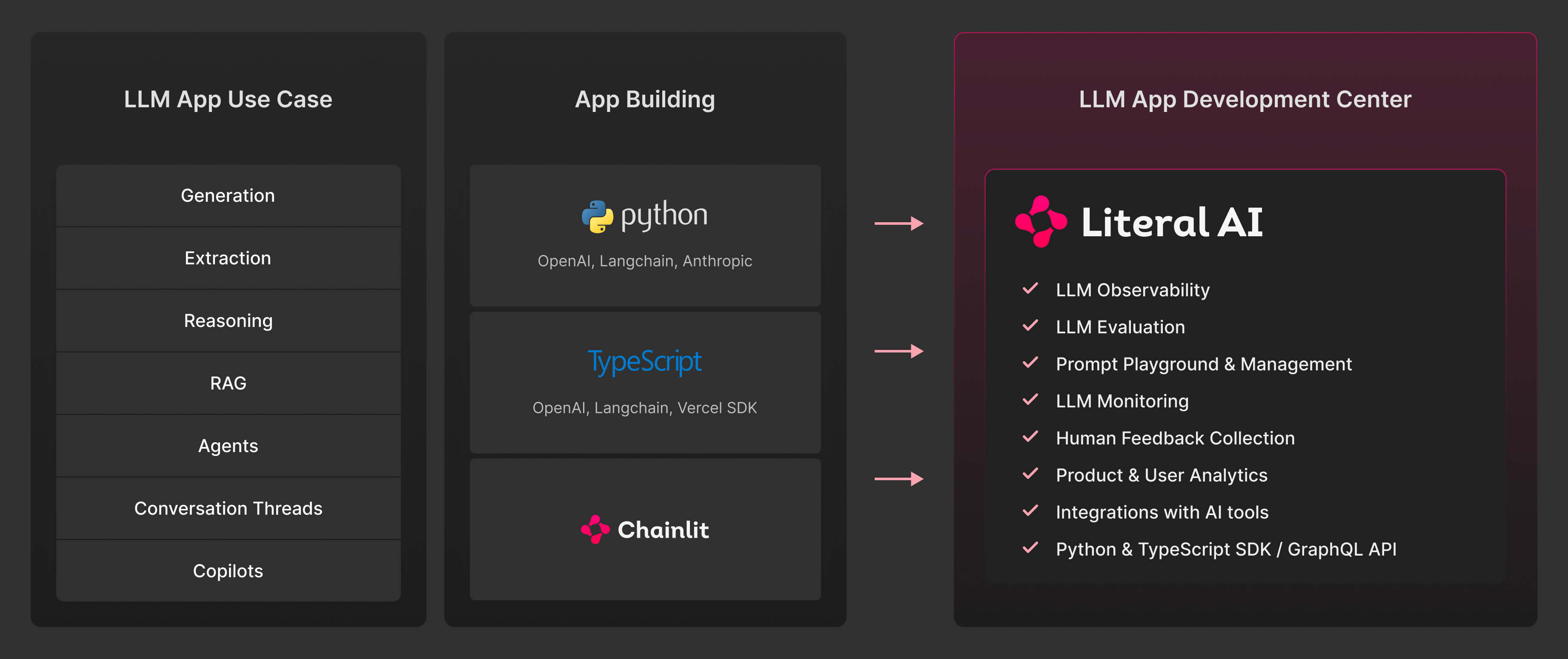
Literal AI tool text
Core parameters and statistics
| Project | Current Public Information | Description |
|---|---|---|
| Product Type | LLMOps / AI Observability Platform | Covering Log Trace, Evaluation Prompt Management and Analysis |
| Core users | AI engineering teams, product teams, domain experts | Quality controls for production-grade LLM applications |
| Main entrance | Official website and official documents | The official website is literalai.com, and the current stable information is concentrated at docs.literalai.com |
| SDK | Python SDK, TypeScript SDK | Supports code burying, log reporting, Prompt pulling and evaluation data operations |
| Integrated ecology | OpenAI, LangChain/LangGraph, LlamaIndex, LiteLLM, Mistral, Vercel AI SDK, etc. | Official documents list multi-class framework and model service integration |
| Delivery method | Cloud service, self-hosted enterprise version | The cloud service has entered the outage and migration stage, self-hosting requires enterprise authorization |
| Latest public platform version | 0.2.1-beta | Released on 2025-03-28 |
Literal AI's product granularity is very engineering: it splits an AI application run into levels such as Generation, Step, Run, Thread, etc., and then overlays objects such as Score, Dataset, Experiment, and Prompt Version. This structure makes it more like a “quality database” for AI applications than a traditional BI dashboard.
User and market recognition
The official migration guide mentions that Literal AI has been used by several companies for LLM observability, but does not disclose the full customer list, revenue scale, or number of active users. The document also explains the reason for discontinuing operations: Although both Chainlit and Literal AI have helped many AI projects, the team failed to form enough differentiation to support sustainable revenue in a highly competitive market.
This piece of information makes Literal AI’s market picture clearer: it addresses real needs, but the track it’s on is already highly crowded. LangSmith, Langfuse, the OpenTelemetry ecosystem, model gateways and cloud vendor monitoring capabilities all compete for similar budgets. For the tool catalog, the value of Literal AI is not only "can it continue to be used", but also it shows the typical capability combination of LLMOps products in 2024-2025.
Cost advantage
- C-side/Individual: Usually a free version is provided to experience the core functions, and high-frequency use requires a paid package subscription.
- API/Developer: Billed by call volume, suitable for development teams that can be flexibly integrated into their own systems.
- Enterprise/Privatization: Contact the business owner to obtain customized quotation and deployment plan. The specific price is subject to the official real-time pricing page.
Main functions
The first layer of capabilities of Literal AI is logs and traces. Developers can record a single LLM call or the complete running process of an Agent or Chain, including tool invocation, retrieval, embedding, rearrangement, generated result token usage, delays, errors, and attachments. The official Logs document uses Generation, Step, Run, and Thread as core semantics, which is very critical for troubleshooting complex Agent behavior.
The second level capability is Prompt Management. Teams can create Prompt Templates in the Prompt Playground, manage parameters such as variables, model suppliers, and temperatures, and gradually release new Prompts through versions, difference comparisons, and A/B Testing. Its value lies in allowing product and domain experts to participate in Prompt iterations while retaining traceable and rollable production records on the engineering side.
The third level capability is Evaluation. Literal AI supports Human Score, LLM-as-a-Judge, online assessment rules, experiment scores, and dataset regression testing. It divides the evaluation objects into LLM Generation, Agent Run and Conversation Thread, allowing the team to observe quality indicators at different levels such as hallucination, toxicity, task completion and user satisfaction respectively.
Model and version evolution
Continuous iterative updates, the latest version introduces performance optimization and new features. Historical version information can be viewed on the official release page. There is no complete public version evolution timeline yet. It is recommended to pay attention to the official announcement to understand the rhythm of feature updates.
Technical advantages
The advantage of Literal AI is not in “stronger models” but in “turning model calls into observable, comparable, and repeatable engineering objects.” For production applications, prompts, models, search context, user input, tool calls, output and feedback are usually scattered in log systems, databases, tables and manual annotation processes. Literal AI converges this information into a queryable structure.
| Technical Dimension | Literal AI’s approach | What it means to the team |
|---|---|---|
| Trace modeling | Generation, Step, Run, Thread layering | Can clearly see the intermediate steps and time-consuming in an Agent execution |
| Prompt life cycle | Creation, version, difference A/B Testing, production tracking | Reduce the risk of uncontrollable Prompt changes |
| Evaluation concept | Score, Scorer, Online Eval, Experiment | Let quality judgment shift from subjective experience to repeatable indicators |
| Data assets | Dataset, export, experimental samples | Precipitate online samples into regression testing and optimization materials |
| Integration method | Python/TypeScript SDK is integrated with mainstream LLM frameworks | Conveniently integrate existing AI applications instead of rewriting business code |
Compared with the solution that only looks at API gateway logs, Literal AI puts more emphasis on AI semantic objects. For example, the Prompt version can be bound to a specific Generation, Dataset can be precipitated from the production log, and Score can be superimposed on Run or Thread. These are contents that are difficult to express naturally on ordinary logging platforms.
How to use
- Web client: You can use it by visiting the official website and registering an account. Most functions do not require installation.
- API Access: Provides RESTful API, developers can obtain the API Key and integrate it into their own applications.
Product Pricing
The pricing model is subject to the official real-time page. Usually a freemium or subscription system is used, and basic functions can be used for free. Advanced functions or high-frequency use require paid subscriptions, and users are advised to evaluate the optimal solution based on actual usage.
Application scenarios
Literal AI is suitable for RAG application quality monitoring. It can record intermediate steps such as retrieval, rearrangement, and generation, and link answer relevance, context relevance, hallucination risk, and user feedback to the same running record, making it easier for the team to locate whether the problem comes from the retrieval prompt or the model itself.
It is also suitable for agent and automated process debugging. Complex Agents often contain multiple rounds of tool calls and intermediate decisions. Literal AI's Run/Step/Waterfall/Trace views can help teams identify time-consuming exceptions, tool failures, repeated calls, or context transfer errors.
In Prompt collaboration scenarios, Literal AI can help product managers, domain experts, and engineers work in the same version system. Business personnel can verify the vocabulary and output style, the engineering team is responsible for access, grayscale and rollback, and the evaluation data provides a basis for whether to release a new version.
Applicable people
Literal AI is most suitable for teams that have already launched real LLM applications and are beginning to encounter problems such as confusing quality regression prompt versions, difficulty in reproducing online problems, and scattered evaluation samples. For these types of teams, observability and evaluation are not nice-to-haves, but the infrastructure to continuously release AI capabilities.
It is not suitable for individual users who just want to experience the chat model, nor is it suitable for pure operation teams without engineering access capabilities. The core value of Literal AI relies on SDK burying points, log structure design, evaluation indicator definition and team process cooperation. Without these prerequisites, the platform will become a complex but empty backend.
Since the official cloud service has been announced to be out of service, it is not recommended that new projects in 2026 rely on Literal AI Cloud for long-term production. A more reasonable approach is to refer to its object model and process design, and choose an alternative platform that is still maintained, or export the data of historical projects and migrate it.
Summary and Outlook
It provides competitive solutions in its field, and its core value lies in lowering the threshold for AI use in this field.
Current limitations: Some advanced features require paid subscription, and the free version has function or usage restrictions; specific technical details and performance benchmarks have not yet been fully disclosed.
Related tools:  Hugging Face, replicate
Literal AI’s core positioning and current status
Literal AI is an LLMOps platform for production-level LLM applications. Its official positioning focuses on three things: observability, evaluation, and analytics: recording the calling process of online AI applications, putting prompts, models, user feedback, and evaluation results into the same workbench, and helping the team determine whether a change makes the system better or worse.
It is not a general chatbot, nor a simple prompt editor, but an AI application quality platform used by engineering teams, product teams, and domain experts. Typical objects include RAG, Agent, customer service Copilot, internal automation assistant, multi-modal LLM call, etc.
It should be noted that the official Migration Guide clearly states that Literal AI will cease operations and the service will be available until October 31, 2025. Therefore when included in 2026, it should not be understood as a cloud service still suitable for long-term procurement by new teams, but more suitable as a LLMOps product case, historical tool catalog, self-hosting/export documentation and migration roadmap reference.
Literal AI cost and deployment boundaries
The official documentation of Literal AI once provided a free trial entrance to the cloud, and explained that self-hosting is an enterprise version capability, and you need to contact the team to obtain authorization and private image warehouse access. Self-hosted information shows that it can be deployed to Azure, AWS or a manual Docker environment and pointed to the self-hosted instance through the API URL in the SDK.
At present, cost judgment and outage status must be looked at together: cloud services are not suitable as long-term dependencies for new projects; existing data and Prompt assets should be exported first; if you are still studying its architecture, you should use documents, open source peripheral materials and self-hosting instructions as a reference, rather than defaulting to a complete commercial purchase.
| Usage path | Cost shape | Suitability | Risk |
|---|---|---|---|
| Cloud service | There was a free trial entrance | Historical project export, data verification | Official announcement of service until 2025-10-31 |
| Enterprise self-hosting | Enterprise authorization and private mirroring | Research on existing deployments and transition before migration | Need to confirm authorization, mirror availability and maintenance subjects |
| Migration replacement | LangSmith, Langfuse, OpenTelemetry, etc. | New or long-term maintenance projects | Need to remap log prompts, Datasets and evaluation objects |
Version evolution of Literal AI
The version evolution of Literal AI reflects the process of the LLMOps platform from "seeing logs" to "continuous improvement". The mid-term version in 2024 will focus on completing Dataset, Prompt Playground, online evaluation Annotation Queue, bounded isolation and self-hosted deployment; around November 2024, it will enter 0.1.x, reconstruct the credential system, and strengthen Scorers, Online Evals and Prompt experiments; in March 2025, 0.2.
| Time | Version | Key Changes |
|---|---|---|
| 2024-07-31 | 0.0.615-beta | Annotation Queues, bounded isolation, quick start of experiments, generated metadata |
| 2024-11-11 | 0.1.0-beta | Credential system reconstruction Scorers, Online Evals, Prompt experiment |
| 2025-03-09 | 0.1.9-beta | Dashboard reorganization Prompt Playground smart generator Grok and more model support |
| 2025-03-18 | 0.2.0-beta | Step Ingestion Efficiency Trace Tree Waterfall View Optimization |
| 2025-03-28 | 0.2.1-beta | Ingestion performance, platform stability, editor and draft version experience improvements |
The SDK side is also following up quickly. For example, the Python SDK changelog records Prompt API, LangChain/LlamaIndex integrated release parameter tag and metadata, Prompt A/B Testing and other capabilities. The platform version and SDK version have compatibility requirements, and both versions need to be confirmed at the same time when migrating historical projects.
How to use Literal AI
The typical usage path starts with installing the SDK. The team first creates a project and API Key in Literal AI, then initializes the Python or TypeScript client in the application code, and buries calls to OpenAI, LangChain, LlamaIndex, etc. After production data enters the platform, it can be filtered by dimensions such as Run, Generation, Thread, User, Tag, Score, and Environment.
The Prompt management path is more collaborative: create a Prompt Template in the playground, configure variables and model parameters, save the version, and do grayscale through A/B Testing if necessary; when calling online, pull the Prompt, and the generated log will record the corresponding version. You can then add failed samples to Dataset or experiments.
The evaluation path is usually divided into three steps: first define Score Schema or Scorer, then collect human feedback or automatic evaluation in production, and finally use Dataset and Experiment for regression testing. For high-risk AI applications, it is recommended that tools such as Literal AI be regarded as "quality control after launch" rather than a one-time testing tool before launch.
Literal AI Summary and Migration Suggestions
The official Migration Guide recommends migration directions such as LangSmith, Langfuse and Open Source Data Layer, and emphasizes the need to export Threads, Messages, Generations, Datasets, Prompt Templates, Evaluation Results and other data before migration. Migration is not simply changing a log address, but mapping the object model: Prompt versions, experimental samples, evaluation scores, user feedback, and Trace levels all need to be re-located to the new platform.
For existing Literal AI users, the priority should be to export data first, then choose an alternative that supports OpenTelemetry or mainstream framework integration, and finally rewrite the SDK burying and prompt pull logic. For new teams, it is recommended to directly evaluate LLMOps tools that are still actively maintained and use Literal AI as a product design reference and migration case.
| Migration objects | Fields that need attention | Post-migration checkpoints |
|---|---|---|
| Logs / Traces | Run, Step, Generation, Thread, Metadata, Tags | Whether the complete call link can be reproduced |
| Prompt Templates | Template messages, variables, model parameters, version A/B configuration | Whether the online version selection is consistent |
| Datasets | Input, expected output, sample source, experimental binding | Whether the regression test results are comparable |
| Scores / Evals | Score types, labels, evaluators, rules, experimental results | Whether the indicator meanings are consistent |
Literal AI is a very representative LLMOps tool: it puts production log prompt management, evaluation, data sets, and experiments into a collaborative platform, and accurately addresses the most troublesome quality issues after AI applications move from demo to production. Its object model is clear, its integration is wide, and its version evolution can also see the mainstream direction of the LLMOps track in 2024-2025.
But its reality is equally important: Official outage migration instructions have been released, and the cloud service will be available until October 31, 2025. When included in the catalog, avoid packaging it as an active SaaS that can still be purchased with confidence. Instead, it should be clearly marked as a "historical LLMOps platform that has been discontinued/migrated." It still deserves inclusion because it provides a complete sample of production-level LLM application quality controls and helps teams understand what capabilities they should check when choosing alternative tools.
Version Info
- Literal AI 0.2.1 Beta :The last public platform version recorded in official Release Notes, focusing on improving data ingestion performance, overall platform stability, text and code editor experience, and the experience of using draft versions in the Prompt Playground. It should be noted that the official migration guide shows that the cloud service is available until 2025-10-31.
- Optimized versions of Trace and Waterfall views :Improve Step ingestion efficiency, optimize Trace tree, relative time-consuming display, keyboard navigation and Waterfall reading experience.
- Restructured version of assessment and voucher system :Introducing the ability to run Prompt experiment Scorers page, Online Evals page, experiment score chart and data set editing from the Playground, and reconstruct the LLM Provider credential management.
- Annotation Queue and bounded isolation version :Added capabilities such as Annotation Queues, contextual isolation, quick start of experiments, generation of metadata to extend Custom LLM Provider and Prompt version reuse.
User Reviews