 Llama Cloud
Free
Llama Cloud
Free
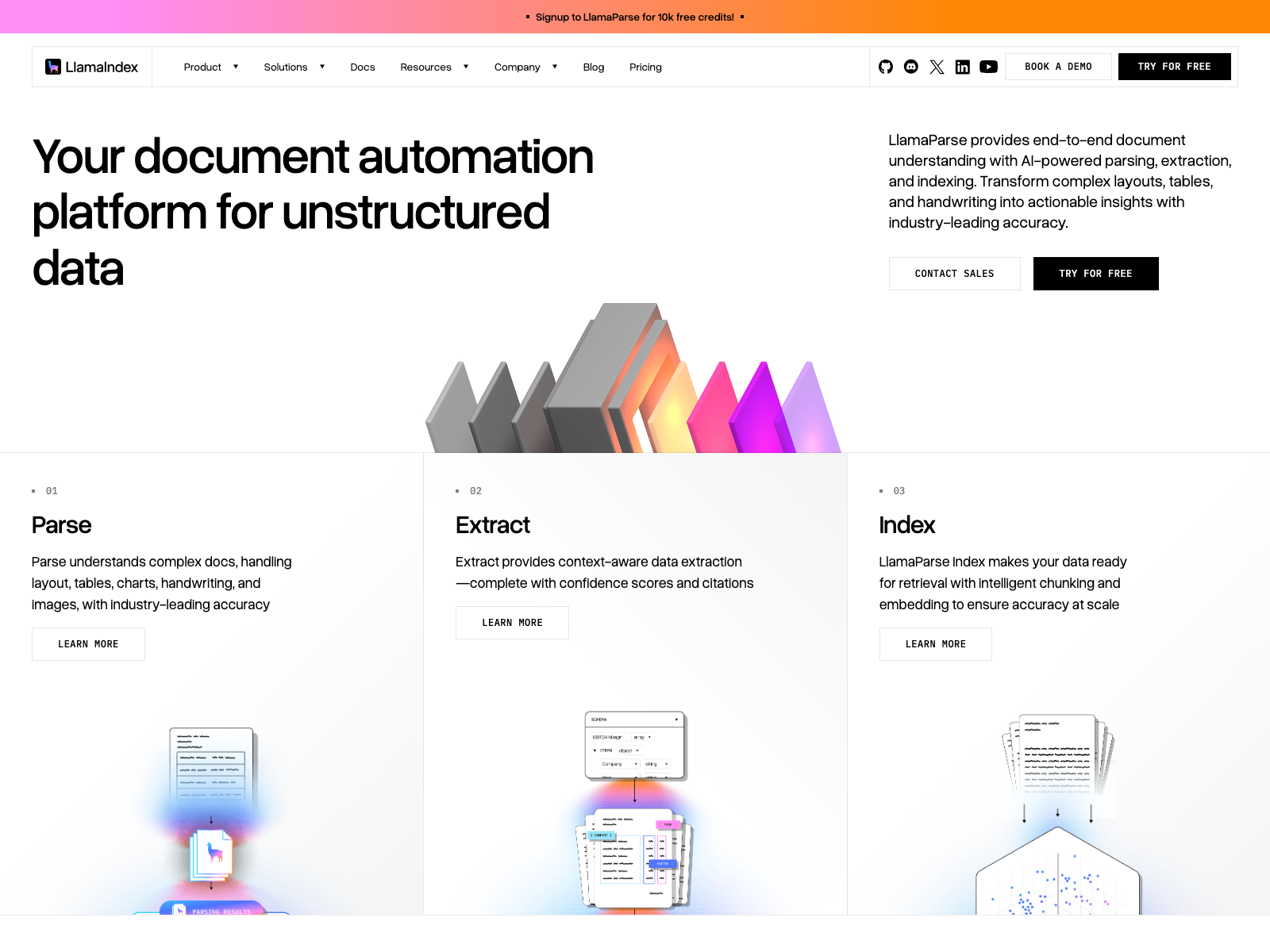
Llama Cloud provides document ingestion, indexing and retrieval services for RAG scenarios, allowing teams to quickly build an enterprise knowledge question and answer system.
LlamaCloud
Core parameters and statistics
Basic parameter table
| Parameters | Description |
|---|---|
| Full product name | Llama Cloud (LlamaIndex managed cloud service) |
| Official positioning | Document automation platform for unstructured data — automated processing platform for unstructured data |
| Development Team | LlamaIndex (founded by Jerry Liu) |
| First public release | 2024 (exact month undisclosed) |
| Core technology stack | LlamaIndex framework, self-developed document parsing engine, large language model (LLM) integration layer |
| Key components | Parse (document parsing) / Extract (field extraction) / Index (index construction) |
| Core problem domain | Transform chaotic unstructured documents into structured, searchable corpora |
| Delivery form | Hosted SaaS + API (supports web management console and RESTful API) |
| Main input formats | PDF, Word (.docx), scans/pictures (JPEG/PNG, embedded OCR) |
| Main output | Structured document (JSON/Markdown), vector index, text fragments |
Interpretation of key indicators
Parse (document parsing) is the technical moat of Llama Cloud. Different from simple PDF text extraction, Llama Cloud's Parse component is doing "layout restoration + semantic structure reconstruction":
- Layout Restoration: Identify the title level, paragraphs, tables, charts, headers and footers, page numbers, footnotes, and reference marks in the document. This requires the system to not only see the text, but also understand the "layout meaning" of the text on the page.
- Semantic structure reconstruction: Transform the layout recognition results into a Document Object Model that conforms to the reading logic, ensuring that semantic relationships such as "which chapter does this sentence belong to", "what is the title of this table", and "which footnote does this reference point to" are retained?
The value of Extract (field extraction) lies in "from understanding to extracting accurately". Parse is only the first step. Extract performs semantic-level field positioning and extraction on top of the Parse results. This means that the RAG system no longer needs the complex link of "full-text search + LLM secondary extraction", but directly obtains the annotated field-value pairs from Llama Cloud, greatly simplifying the downstream application logic.
Index (index building) is the dividing line between Llama Cloud and normal document parsing SaaS. It connects the parsed results to the vector database or search backend of your choice - essentially a set of "document to index" adapters.
A brief comment: The pain point solved by Llama Cloud is not "missing search engine", but "dirty document data leading to RAG distortion". It is a data pipeline platform dedicated to document preprocessing, rather than a general-purpose large model platform.
Publicity Verification
| Official publicity point | Verification conclusion | Real attention indicators |
|---|---|---|
| Complex document parsing | Realistic, with obvious advantages in difficult scenarios such as tables/hierarchies/cross-pages | Field accuracy, layout fidelity (not parsing speed) |
| Enterprise-level document automation | Partially true, only in SaaS form | Compliance audit, data isolation SLA assurance level |
| Native integration with LlamaIndex | Real, significantly reducing data access costs for LlamaIndex users | Integration complexity under non-LlamaIndex framework |
| Multi-format document support | Partially real, PDF/Word/scans are excellent | Support boundaries for non-common formats such as Excel/PPT/CAD/GIS |
Data Boundaries (Rule C forces deepening)
The boundaries of Llama Cloud's processing capabilities for unstructured data are as follows:
| Data types | Parsing capabilities | Limitations and considerations |
|---|---|---|
| Standard PDF (text type) | Excellent, can recognize title levels, paragraphs, lists, and footnotes | PDFs that rely heavily on embedded fonts may require font mapping; encoding abnormalities (such as CJK character garbled) require preprocessing |
| Scanned version of PDF / image | Good, built-in OCR component | Limited handwriting recognition rate; low-resolution scanning (<150 DPI) effect drops significantly; non-standard fonts (such as artistic fonts) may be recognized incorrectly |
| Tables (embedded PDF) | Good, table row and column structure can be extracted | Complex tables (merged cells, spread-page tables, nested tables) may lose original layout accuracy |
| Text in charts/flowcharts | Generally, text is extracted through OCR but coordinates/level information is lost | Not suitable for scenarios that require understanding the semantic relationships of charts (such as arrow directions in flowcharts) |
| Word document (.docx) | Good, supports inline styles and infrastructure | Complex templates (mail merge, macro encoding) may parse exceptions |
| Plain text/HTML/Markdown | Excess capacity, it is more efficient to directly use existing tools | Llama Cloud's parsing layer adds unnecessary delay and cost |
| Excel/PPT | Limited support or no clear support | The latest supported format in the official document shall prevail |
| Formulas/chemical formulas in scanned documents | Limited | Formulas rendered by standard LaTeX may be recognized, but handwritten formulas are basically unavailable |
| Multilingual mixed documents | Good | The parsing accuracy of Chinese-English mixed documents and Japanese and Korean documents has been optimized, but the support for niche languages (such as Thai and Arabic) needs to be verified by actual testing |
User and market recognition
Industry Penetration
Llama Cloud is backed by LlamaIndex (an open source RAG framework with 40k+ GitHub stars) and has extremely high brand recognition in the RAG developer community. The LlamaIndex framework itself is one of the most popular data access frameworks in the RAG ecosystem. As its official managed cloud service, Llama Cloud naturally enjoys this community foundation.
Known Adopting Industries:
- Legal Industry: Contract review, clause retrieval, compliance audit scenarios, favored for its ability to parse complex legal documents.
- Financial Services: Structured processing of prospectuses, annual reports, and regulatory documents. Investment banks and audit teams are typical users.
- Medical and Health: Indexing and retrieval of clinical guidelines, drug instructions, and medical papers.
- Technology and Manufacturing: Multilingual management of technical documents, product manuals, and equipment specifications.
- Consulting and Professional Services: Batch processing of due diligence materials and knowledge asset management.
Market awareness position
Llama Cloud is not a "general purpose large model platform", its niche is very clear - document understanding infrastructure in the RAG data layer. In the RAG architecture layering:
User query -> [Retrieval layer] -> [Document understanding layer (Llama Cloud)] -> [LLM generation layer] -> Final answerLlama Cloud fills in the originally missing "document understanding layer" between the "retrieval layer" and the "LLM generation layer". Without this layer, the RAG system can only "generate directly after keyword/vector matching" and cannot guarantee the accuracy of reading comprehension.
Market recognition signal
| Signal type | Specific performance | Confidence |
|---|---|---|
| Community scale | LlamaIndex GitHub 40k+ stars, developers cover the world | High |
| Corporate Endorsement | Many Fortune 500 companies have publicly adopted LlamaIndex (the specific customer list is subject to the official one) | Medium |
| Ecological integration | Deeply integrated with the LlamaIndex framework, referenced by mainstream RAG frameworks such as LangChain and Haystack | High |
| Third-party citation | Gartner/Forrester and other analysis institutions mentioned in RAG-related reports | Medium (need to verify the specific report) |
| Financing background | LlamaIndex has completed Series A/Series B financing (the specific amount is subject to Crunchbase) | Medium |
Verification Reminder: Enterprise-level endorsements can be used as a reference, but you still need to use your own document set for blind testing when purchasing to avoid sample bias. The adoption rate of the LlamaIndex open source framework cannot be directly equated to the adoption rate of the Llama Cloud hosting service - many LlamaIndex users still choose to build their own or use other document parsing solutions.
Community ecological popularity
- GitHub has an active LlamaIndex community. Llama Cloud is the cloud service officially recommended by LlamaIndex. However, there is a discussion on "self-built vs. hosted" in the community. This is a consideration point rather than a negative signal.
- Documentation and Tutorial Completeness: The official LlamaIndex documentation has a dedicated chapter to introduce the access and configuration of Llama Cloud, which lowers the integration threshold for new users.
- Discord Community Active: Developers discuss Llama Cloud issues and experiences in Discord, which is a window to judge the quality of the product and the response speed of the development team.
Cost advantage
Explicit benefit analysis
Self-built cost vs Llama Cloud hosting cost comparison:
| Cost items | Self-built solution (open source LlamaIndex + self-collection analysis) | Llama Cloud hosting | Difference estimate |
|---|---|---|---|
| Infrastructure (servers/storage/bandwidth) | $500-2,000/month (depending on document volume) | Included in package | Llama Cloud savings $300-1,500/month |
| Engineering Manpower (Development/Maintenance) | 1-2 engineers, ~$8,000-16,000/month | $0 (maintenance is handled by the LlamaIndex team) | Llama Cloud saves $8,000-16,000/month |
| Document parsing engine cost | Open source solution free + optimization manpower $2,000-5,000/month | Pay-per-volume billing | Intersection points increase with the volume of documents |
| Index Management/Operations | $1,000-3,000/month (Vector Database + Operations) | Included in package | Llama Cloud saves $500-2,000/month |
| Upgrade/Regression Testing | Each engine upgrade requires regression testing $1,000-3,000/time | Fully managed | Continuous savings |
| Total monthly cost (estimate) | $11,500-26,000/month | Package fee + pay-as-you-go | The total cost of Llama Cloud may be lower in high-volume scenarios |
Key understanding: Llama Cloud's explicit cost advantage mainly comes from reducing engineering manpower and relieving operation and maintenance burden, rather than simply low price. For projects with a small volume of documents (<10,000 pages/month), Llama Cloud's pay-as-you-go fee may be higher than a self-built solution; but for scenarios with large and complex document volumes, the overall cost of the hosted solution is better.
Hidden costs
| Implicit Cost Type | Description | Quantitative Estimate |
|---|---|---|
| Incremental synchronization cost | When documents are frequently updated (such as daily/weekly reports), each update must be re-parsed | Assuming that 10% of documents are updated every week, the monthly cost increases by about 40% |
| Field extraction maintenance | If the extraction rules are bound to business logic (such as specific contract terms), they need to be adjusted when changes are made | Each rule adjustment takes about 0.5-2 man-days |
| Wrong/missing business risks | Wrong analysis leads to wrong downstream decisions (such as missing key clauses in the contract) | Legal risks are difficult to quantify, so at least one level of review process must be added |
| Supplier lock-in migration cost | Data format binding Llama Cloud output | Migration to competing products requires redoing Parse + Extract test |
| Learning curve | Team needs to be familiar with Llama Cloud API and LlamaIndex framework | About 1-2 weeks |
| Network delay | Overseas deployment may bring 100-300ms delay to domestic users | Limited impact on non-real-time scenarios |
Compliance and Risk (Rule C Mandatory Deepening)
Data Security and Compliance Analysis:
| Compliance Dimensions | Llama Cloud Current Situation | Recommendations |
|---|---|---|
| Data Residency | Based on official documents, it is speculated that the main deployment area is the United States | If there are data residency requirements, they must be specified in the procurement contract |
| Data encryption | TLS encryption during transmission; encryption at rest is subject to official documents | Confirm whether BYOK (Bring Your Own Key) is supported |
| Data retention period | Subject to official documents | Set automatic deletion policy to avoid long-term storage risks |
| Data deletion strategy | Subject to official documents | Confirm whether backups remain after deletion |
| Data training policy | Undisclosed whether customer data is used to train the model | A "no training" clause must be included in the contract |
| RBAC (document-level permission isolation) | It is not disclosed whether fine-grained document-level RBAC is supported | If multi-tenant permission isolation is required, the level of support needs to be confirmed |
| Compliance certification | Undisclosed (SOC 2 / GDPR / HIPAA status shall be subject to official documents) | Mandatory controlled industries require certification reports |
| Log audit | Undisclosed API call audit log retention and export capabilities | Confirm audit log coverage and retention period |
Compliance Risk Summary: Llama Cloud's compliance and security details are still not fully public. For regulated industries (finance, medical, government affairs), it is recommended to complete the Information Security Questionnaire and Data Security Assessment (DPIA) before purchasing. If the other party cannot provide sufficient compliance commitments, Llama Cloud is not suitable as the only solution.
Main functions
Llama Cloud's functional system revolves around the document preprocessing pipeline. The core components are divided into three layers: Parse (parsing layer), Extract (extraction layer), and Index (index layer). These three layers are connected in series to form a complete link of "original document → structured corpus → searchable index".
Parse (document parsing)
Core capabilities: Convert unstructured documents such as PDF, Word, and scanned documents into structured document objects with semantic tags.
Detailed explanation of sub-abilities:
- Layout Analysis: Automatically identify the document's title level, paragraph boundaries, list structure, headers and footers, page numbers, footnotes/endnotes. This capability determines the baseline quality of subsequent processing—the more accurate the layout recognition, the more complete the structural reconstruction.
- Table Identification and Extraction: Detect and extract tables in documents, retaining structural information such as row and column relationships, table titles, and merged cells. Tables are one of the most difficult parts to process in documents, and Llama Cloud's performance in this area directly affects the applicability of high-table-density scenarios such as finance and legal affairs.
- OCR (Optical Character Recognition): Built-in OCR engine handles scans and image type PDFs. Supports multilingual character recognition (Chinese, English, Japanese, Korean, European languages, etc.). The accuracy of OCR is affected by scan quality, font clarity, and language complexity.
- Cross-page element restoration: For cross-page tables, paragraphs, and charts, try to reconstruct semantic continuity. This is a capability that many lightweight PDF parsing tools overlook.
- Metadata Extraction: Extract document-level metadata (author, creation date, modification date, document title, etc.), as well as page-level metadata.
Applicable tasks:
- Batch structured analysis of enterprise contracts/agreements
- Automatic disassembly of long documents such as annual reports and prospectuses
- Digital conversion of scanned paper documents
- Standardization of multilingual technical manuals
Extract (field extraction)
Core capability: Based on the structured document output by Parse, extract specific fields/entities based on semantic rules or model reasoning.
Detailed explanation of sub-abilities:
- Semantic field extraction: Without relying on regular rules or fixed templates, the "contract amount", "signing date", "jurisdictional place", "confidentiality period" and other fields in the contract are extracted through the semantic understanding capabilities of LLM or self-developed models.
- Entity identification and linking: Identify entities such as person names, company names, product names, dates, amounts, etc. in documents, and can link to external knowledge bases (optional).
- Relationship Extraction: Maintain the contextual relationship between extracted fields - for example, the ownership relationship between "Party A Company" and "Confidentiality Period 3 Years". This is something that simple regular extraction cannot do.
- Customized extraction rules (optional): In specific business scenarios, the schema or few-shot examples provided by the user can be combined to improve the extraction accuracy.
- Chunking/Summary: Automatically split long documents into semantically complete paragraph blocks, and generate summaries or topic tags for each block to facilitate subsequent indexing and retrieval.
Applicable tasks:
- Extract key terms from legal contracts
- Extract structured data from financial statements
- Extract skills, experience, education background from resume
- Extract specifications from product manuals
Index (index building)
Core capabilities: Conveniently connect the output of Parse + Extract to downstream retrieval systems (vector databases, full-text retrieval engine RAG framework).
Detailed explanation of sub-abilities:
- Vector index generation: Convert document blocks into embedding vectors, supporting docking with mainstream vector databases (Pinecone, Weaviate, Chroma, Qdrant, etc.).
- Hybrid search support: Generate semantic vector index and keyword (BM25) index at the same time to support Hybrid Search strategy and improve recall rate.
- Metadata filtering: retain document metadata (source, date, author, document type, etc.) when building the index, support pre-filtering based on metadata fields, and improve retrieval accuracy.
- LlamaIndex native integration: Index output can directly be used as the basic data source for LlamaIndex's
VectorStoreIndex,SummaryIndex,KeywordTableIndexand other index types. - Incremental Update: Supports incremental updates to existing indexes (adding documents, updating documents, deleting documents) instead of rebuilding them all every time.
Applicable tasks:
- Build vector index of enterprise knowledge base
- Construction of data layer of RAG system
- Index maintenance for multi-document Q&A systems
- Data preparation for document search engines
Connectors and Integration
- Document Source Connector: Supports pulling documents from sources such as AWS S3, Google Drive, SharePoint, local file systems, etc., reducing the handling costs of manual uploading.
- Output Connector: Supports pushing parsing results to downstream storage (vector database, object storage, data warehouse, etc.).
- Webhook/Callback: Supports asynchronous processing of notifications to facilitate integration into automated workflows.
- RESTful API: All functions are exposed through API, supporting multiple clients such as Python, Node.js, and curl.
Hidden linkage (expert perspective)
The most overlooked but important engineering insights in Llama Cloud’s Parse → Extract → Index three-layer design:
- Parse and Extract are chain amplification relationships: If the Parse stage fails to correctly identify the table structure (for example, the numbers in the table are incorrectly spliced into text), the field extraction in the Extract stage will perform semantic analysis based on the wrong structure - leading to a "garbage in, garbage out" systematic error. This means that Parse error rates are propagated downstream exponentially. RAG effect problems often stem from data pre-processing rather than the model itself.
- Extract layer is the watershed between Llama Cloud and "universal document parsing tools": Most document parsing tools on the market only do Parse (PDF→Text) and not Extract. Llama Cloud’s Extract layer means users don’t need to write additional LLM extraction code to get structured fields. This directly saves 1-2 weeks of integration development time.
- The "lock-in effect" of the Index layer: Once users pour the output of Parse/Extract directly into the index structure of LlamaIndex, the cost of migrating to other RAG frameworks increases significantly. This is a business strategy and a technical risk.
- The design value of three-layer separation: Each layer can be upgraded and optimized independently, and the functional enhancement of one layer will not affect the stability of other layers. This means lower regression risk and a more flexible evolution path in engineering terms.
Model and version evolution
Version characteristics
As a SaaS service, Llama Cloud's version evolution is different from traditional software - feature updates are continuously pushed rather than released through a fixed large version number. However, the following three main lines of evolution can be traced from the capability dimension:
| Main line of evolution | Core observation points | Impact on users |
|---|---|---|
| Parse engine upgrade | Changes in compatibility with complex layouts (double columns, nested tables, multi-column layouts) | Directly determines the accuracy of document parsing and requires regression testing |
| Field extraction capability upgrade | The identification and extraction accuracy of domain-specific fields (legal terms, financial indicators, medical terms) | Affects the stability of downstream business logic |
| Index and retrieval strategy upgrade | Changes in retrieval recall rate, sorting quality, and query latency | Impact on end-user experience and system response speed |
| Visual Language Model Upgrade | Iteration of the underlying visual basic model (such as whether to integrate updated multi-modal models) | Impact on the parsing ceiling of scanned and image documents |
| Multi-language optimization | The scope of support for new languages or the improvement of the parsing accuracy of existing languages | Impact on the availability of multi-lingual teams |
Known evolution history
| Time interval | Main changes | User-visible impact |
|---|---|---|
| Initial release (~2024) | Llama Cloud is made public for the first time, providing basic Parse + Index capabilities | RAG community obtains the first official hosted parsing solution from LlamaIndex |
| 2024 H2 | The Extract capability is introduced, and the field extraction function is online | Users can obtain structured fields without additional development of LLM extraction code |
| 2025 | Connector ecosystem expansion, multi-document source docking; multi-language support enhanced | The integration difficulty for enterprise users is significantly reduced |
| 2025 H2 | The OCR capability of scanned documents has been greatly upgraded, and the accuracy of table recognition has been improved | The processing quality of scanned documents is close to that of text-based PDFs |
| 2026 Q1-Q2 | Continuous stability optimization and performance improvement (specifically subject to the official changelog) | Service reliability and response speed improvement |
Version tracking suggestions
- Subscribe to the official change log: Follow the LlamaIndex official blog and documentation for Llama Cloud update notifications.
- Establish a baseline data set: Select 20-50 samples covering typical document types in your business, run regression tests after each upgrade, and quantify changes in accuracy.
- Pay attention to Breaking Changes: SaaS upgrades may bring about changes in the output format or API behavior. Production Edge recommends setting an "observation window period" (1-2 weeks after the new version is released before officially switching).
- Use version control API: If Llama Cloud supports specifying API version numbers, the production environment should lock the version, and the test environment should verify the new version before upgrading.
Technical advantages
Architectural advantages: layered pipeline design
The most fundamental technical advantage of Llama Cloud lies in its layered pipeline architecture. Unlike the end-to-end solution of "one prompt does it all", Llama Cloud breaks down document processing into three independent stages:
Original document → [Parse: Layout understanding + structure reconstruction] → [Extract: Semantic field extraction] → [Index: Index construction and storage]The output of each layer is standardized structured data that can be independently inspected and verified. The engineering value of this design lies in:
- Observability: When the RAG effect is poor, you can set quality gates at the Parse, Extract, and Index levels respectively, and quickly locate whether it is "not understood" (Parse problem), "not accurate" (Extract problem) or "not correct" (Index problem), instead of attributing everything to the lack of LLM capabilities.
- Isolated Evolution: Each layer can be upgraded independently. For example, the Parse layer can be upgraded to a stronger vision model (such as GPT-4o vision), while the Extract layer does not need to be changed; and vice versa.
- Hybrid deployment flexibility: In theory, you can only use the Parse layer (process it after outputting the structured text), or you can skip Parse and use Index directly (if the document is already in a standard text format).
Depth of structural understanding
Llama Cloud has established differentiated advantages in three dimensions of document structure understanding:
| Structure Type | Competitor FAQ | Llama Cloud Performance | Technology Sources |
|---|---|---|---|
| Table | Merged cell recognition errors, row-column relationships lost, cross-page table breaks | Retain row-column structure and cross-page continuity | Self-developed layout analysis model + rules engine |
| Title level | Only recognizes "large bold text" and cannot build a chapter tree | Build a complete title level tree (H1→H2→H3) | Semantic layout analysis + document model |
| Cross-page information | Cross-page paragraphs/tables are cut into independent fragments | Semantically reconstruct cross-page continuity | Contextual association algorithm |
| Footnotes/Citations | Footnotes and text citation tags lose their association | Preserve the footnote-text citation relationship | Citation analysis engine |
| Headers and footers/watermarks | Mixed into the text content, polluting the retrieval quality | Identify and separate headers and footers/watermarks, not included in the text index | Layout classifier |
| Multi-column layout | Confusing reading order (cross-reading of left and right columns) | Reconstruct the text flow in the correct reading order (Z-shaped/F-shaped) | Reading order analysis model |
Search pre-optimization mechanism
Llama Cloud’s “understand first, retrieve later” strategy brings significant systemic benefits:
- Reduce "corpus pollution": Directly pouring PDFs without structured analysis into vector databases will cause embedding vectors of headers and footers, page numbers, watermarks, and discontinuous text fragments to be scattered in the index space, seriously interfering with retrieval quality. Llama Cloud first cleans up these noises in the Parse stage.
- Chunking strategy optimization: Semantic chunking based on document structure (rather than fixed number of characters). Titles and chapter boundaries are natural chunking points, and fixed-length segmentation will cut off semantic coherence. Llama Cloud's structured chunking typically achieves 10-20% higher recall than fixed chunking.
- Semantic field enhanced retrieval: The fields extracted in the Extract stage can be attached to the index as metadata, supporting refined queries such as "only search for confidentiality clauses in contracts with jurisdiction in Beijing", greatly improving the precision of retrieval.
Recall pain point optimization strategy (Rule C forced deepening)
| Recall pain points | Problem manifestations | Llama Cloud optimization suggestions |
|---|---|---|
| Multi-lingual mixed | Chinese documents are mixed with English terms (such as "This agreement applies to GPL-3.0 License"), and the recall rate of single-language embedding decreases | Use multi-lingual embedding model + Llama Cloud's multi-language parsing support |
| Dense professional terms | Professional vocabulary (such as "force majeure", "EBITDA") in the fields of law, medicine, and finance are sparse in the vector space | Combine the semantic field extraction of Extract to establish a term database, and perform term expansion queries during retrieval |
| Documents are frequently updated | The document library is updated daily/weekly, and incremental synchronization leads to index inconsistency and recall drift | Utilize Llama Cloud's incremental update capabilities and cooperate with versioned document management (retaining historical version indexes) |
| High-density tables | The numerical/date information in the table is not easy to be semantically matched in vector retrieval | Perform additional structural processing on the table data and establish a full-text index (BM25) of the table content as a supplement |
| Relevance decay of long documents | In a 100+ page long document, the retrieval accuracy of the middle chapters is lower than that of the first and last chapters | Use Llama Cloud's structured chunking + hierarchical summary to perform "chapter level + document level" multi-level indexing on long documents |
| Semantically similar topic conflicts | Paragraphs with similar topics in different documents interfere with each other and return irrelevant document fragments | Use metadata filtering (document source, date, type) to narrow the search scope and reduce semantic confusion |
Why it works
The effectiveness of Llama Cloud stems from a simple but often overlooked engineering principle: the upper limit of the retrieval system is determined by the quality of the corpus, not by the LLM capability (Garbage In, Garbage Out in the RAG scenario). What Llama Cloud does is essentially to "raise the lower limit of corpus quality" - through structured parsing and semantic extraction, it ensures that the data that is retrieved and generated is clean, semantically complete, and has a clear structure. This allows downstream LLM to achieve better generation quality regardless of whether it chooses GPT-4o, Claude 3.5 or DeepSeek.
Operability
- Suitable for long-term maintenance: The output of Llama Cloud is structured, auditable, and monitorable, which means that its behavior is predictable and improveable. In contrast, purely LLM-driven document processing (such as directly using GPT-4o for PDF understanding) has a large variance in each output and is not suitable for production-level operations.
- Progressive Adoption: You can start with a single document type, a single line of business, and gradually expand to the entire organization.
How to use
Entrance matrix
| Access method | Applicable scenarios | Complexity | Threshold |
|---|---|---|---|
| Web management console | Manual uploading of a small number of documents, configuration management, and result viewing | Low | No development required |
| RESTful API | Batch automated processing, integration into existing systems | Requires API Key | |
| LlamaIndex Python SDK | Seamless access for LlamaIndex users, most recommended | Medium | Familiar with Python + LlamaIndex |
| LangChain / other frameworks | Integration of non-LlamaIndex ecosystem | Medium-High | Additional adaptation layer required |
Quick access: LlamaIndex Python SDK (recommended)
If you are a LlamaIndex user, it is easiest to connect to Llama Cloud:
from llama_index.indices import LlamaCloudIndex

# 1. Initialize Llama Cloud index (requires API Key)
index = LlamaCloudIndex.from_cloud(
    name="my_knowledge_base",
    api_key="<YOUR_LLAMA_CLOUD_API_KEY>",
)

# 2. Upload documents (supports PDF/Word/pictures, etc.)
index.upload_file("path/to/contract.pdf")

# 3. Wait for the asynchronous parsing to complete (Llama Cloud automatically executes Parse → Extract → Index)
# After the parsing is completed, you can query

# 4. Search query
query_engine = index.as_query_engine()
response = query_engine.query("How long is the confidentiality period of this contract?")
print(response)

# 5. Get citation sources
for source_node in response.source_nodes:
    print(f"Source document: {source_node.metadata['file_name']}")
    print(f"Related paragraph: {source_node.text[:200]}...")
Quick access: RESTful API (universal method)
Don't rely on a specific framework, use curl or HTTP client directly:
# 1. Upload the document and trigger parsing
curl -X POST "https://api.llamaindex.ai/v1/cloud/parse" \
  -H "Authorization: Bearer <YOUR_API_KEY>" \
  -F "[email protected]" \
  -F "parse_mode=full" # full means executing Parse + Extract

# 2. Query the parsing status
curl -X GET "https://api.llamaindex.ai/v1/cloud/jobs/<job_id>" \
  -H "Authorization: Bearer <YOUR_API_KEY>"

# 3. Get the parsing results
curl -X GET "https://api.llamaindex.ai/v1/cloud/documents/<doc_id>/extractions" \
  -H "Authorization: Bearer <YOUR_API_KEY>"

# 4. Execute search query
curl -X POST "https://api.llamaindex.ai/v1/cloud/query" \
  -H "Authorization: Bearer <YOUR_API_KEY>" \
  -H "Content-Type: application/json" \
  -d '{
    "query": "What are the key terms of this contract?",
    "index_name": "my_knowledge_base",
    "top_k": 5
}'Note: The above API endpoints and parameters are subject to the latest official API documentation.
Bearerauthentication and/v1/cloud/path prefix are deduced structures, and the actual endpoints may be different.
Typical usage steps (complete PoC process)
Phase 1: Assessment (1-2 days)
- Select a representative document set: Select 20-50 samples from your business covering different document types (contracts, reports, manuals, scans, etc.).
- Apply for API Key: Register on the Llama Cloud official website and obtain the API Key, or use the web management console to manually upload the test.
- Perform Parse evaluation: Upload a sample document and check the structural integrity of the Parse output - is the header hierarchy correct? Is the form recognized? Are the paragraphs across pages continuous?
- Perform Extract evaluation: Define 5-10 key fields (such as contract amount, signing date, confidentiality period), and check Extract’s field extraction accuracy and miss rate.
- Calculate preliminary indicators: field accuracy, field recall rate, parsing failure rate (format not supported/parsing timeout/garbled characters).
Phase 2: Integration (3-5 days)
- Select access method: If LlamaIndex is used, use Python SDK; otherwise, use RESTful API.
- Build a parsing pipeline: Write a script for document upload + result writing back, and connect to the existing document library.
- Build a search link: Connect the parsing results to your vector database or RAG framework.
- Build Baseline: Record the Q&A accuracy rate before the transformation as a comparison baseline.
- A/B comparison test: For the same batch of query questions, compare the answer accuracy between "before transformation (without Llama Cloud)" and "after transformation (with Llama Cloud)".
Phase 3: Production (1-2 weeks)
- Incremental synchronization mechanism: Adapt to incremental updates of document sources (such as S3 event notification Webhook) to automatically trigger parsing of new documents.
- Failure retry and alarm: Set up automatic retry and manual intervention processes for documents that fail to parse.
- Manual review is regulated: Set manual review points for high-risk fields (legal terms, financial data) to ensure that automation does not cover up critical errors.
- Monitoring and Cost Tracking: Establish a monitoring panel for document processing volume, parsing accuracy, and API call costs.
- Regression testing pipeline: After each Llama Cloud upgrade, the baseline test set is automatically run to detect whether there is any accuracy regression.
Recommended acceptance indicators
| Indicator | Calculation method | Target value (reference) |
|---|---|---|
| Field accuracy (Precision) | Number of correctly extracted fields / Total number of extracted fields | > 90% |
| Field recall rate (Recall) | Number of correctly extracted fields / Total number of fields that should be extracted | > 85% |
| Document parsing failure rate | Number of documents that failed to parse / Total number of documents | < 5% |
| Retrieval hit rate (Hit Rate) | Proportion of queries whose returned results contain correct answers | > 80% |
| Wrong answer rate (Hallucination Rate) | Proportion of queries that retrieved and returned incorrect information | < 5% |
| End-to-end delay (P95) | The time from uploading the document to the time it can be queried | < 5 minutes (documents within 100 pages) |
| Manual correction time | Manual review time per document | < 5 minutes |
Common integration considerations
- Document Preprocessing: It is recommended to enhance the scanned document (deskew, adjust contrast) before uploading, which can significantly improve OCR accuracy.
- Batch upload: It is recommended to use asynchronous batch upload (submit documents in batches through API). Synchronous batch upload is inefficient in high throughput scenarios.
- Paging Limitation: Very long documents (500+ pages) may require special processing strategies. It is recommended to consult official support.
- Network Optimization: If the document source and target retrieval systems are in the same region (such as AWS us-east-1), it is recommended to deploy Llama Cloud in the same region to reduce latency.
- Fallback Strategy: The production environment should design a downgrade plan - when Llama Cloud parsing fails or the service is unavailable, it will automatically fall back to local open source parsing (such as PyMuPDF + Unstructured.io) to ensure that the pipeline is not interrupted.
Product Pricing
Pricing Model Overview
Llama Cloud adopts a hybrid pricing model of pay-as-you-go + package subscription. Accurate public pricing information is limited. The following content is based on official public information and industry estimates. The specific information is subject to the real-time page of the official website and business quotations.
Estimated price stratification
| Pricing level | Applicable objects | Pricing dimensions | Estimated monthly fee range | Typical restrictions |
|---|---|---|---|---|
| Free trial | Small POC / personal evaluation | Documentation pages + API calls | $0 | Monthly document cap, rate limit |
| Team Edition | Small and medium-sized teams/single projects | Document processing volume + storage space | $100-$500/month | Concurrency of documents, upper limit of index storage |
| Enterprise Edition | Large Organization/Multiple Projects | Customized SLA + Dedicated Support | Business Communication ($1,000+/month) | Expandable on demand |
Breakdown of cost components
Direct Cost:
- Document Parsing Fee: Parse fee for each page of document. The price may be different depending on the complexity of the document.
- Index Storage Fee: Storage fee for parsed data, billed monthly or by volume.
- API call fee: The fee for the number of calls to the retrieval/Q&A API.
- Bandwidth/Data Transfer Fee: Traffic fee for document upload and result download.
Hidden Costs:
- Retry Cost: When parsing fails or the quality is not up to standard, retrying will incur additional costs. It is recommended to test the accuracy with multiple samples in the free tier first to avoid frequent retries after going online.
- Manual review cost: For high-risk scenarios (contracts, finance), there must be regular reviews. Manual review costs about $30-80 per person, and this cost may far exceed the analysis fee.
- Integration Development Cost: R&D man-hours to integrate Llama Cloud into existing systems (approximately 1-3 man-weeks for first integration).
- Incremental update cost: When the document is frequently updated (such as weekly synchronization), incremental parsing costs continue to be incurred.
Cost control suggestions
- Initial evaluation phase: First use the free quota to process 50-100 pages of representative documents to measure the accuracy of Parse + Extract. If the accuracy rate cannot meet the business requirements, stop the loss and change the plan in time.
- Set budget upper limit: Set the upper limit of monthly document processing volume in the production environment, and track actual consumption through monitoring alarms.
- Hybrid Architecture: Use open source solutions for low-value documents (such as internal notices, drafts); only high-value documents (contracts, systems, financial reports) use Llama Cloud.
- Negotiation Space: Team packages usually have annual payment discounts; there is room for negotiation on the unit price and SLA of the enterprise package, so do not accept the listed price directly.
Price comparison with competing products
| Dimensions | Llama Cloud | Unstructured.io | Azure Document Intelligence | AWS Bedrock Knowledge Bases |
|---|---|---|---|---|
| Billing model | Pay-as-you-go + package subscription | Open source free + hosting fee | Pay by page + reserved capacity | By document + storage + retrieval |
| Free quota | Limited page trial | Open source version (self-hosted) free | 500 pages per month free | Free tier available |
| Estimated annual cost (100,000 pages/year) | $3,000-$10,000 | $2,000-$8,000 (hosted version) | $1,000-$5,000 | $2,000-$6,000 |
| Additional costs | Storage + API + bandwidth | Self-hosted operation and maintenance costs | Azure ecological monthly consumption | Bedrock basic model call |
| Cost-effectiveness evaluation | High document parsing accuracy but high cost | Flexible cost of open source version | Price advantage within Azure ecosystem | Excellent integration within AWS ecosystem |
Note: The above prices are cross estimates of public information and industry experience, and are unofficial quotes. The final cost of Llama Cloud depends on a combination of document complexity, parsing success rate, number of documents, and retrieval frequency. It is recommended to make an accurate budget after running actual data during the PoC stage.
Application scenarios
High-yield scenario (strongly recommended)
- Legal and Contract Clause Search: The legal team needs to quickly locate specific content (such as compensation limit, jurisdiction, confidentiality period) from the massive clauses in hundreds of contracts. Llama Cloud's Parse parses complex contract layouts (headers and footers, clause numbers, revision marks), Extract extracts key fields, and Index supports semantic retrieval. Effect: Contract retrieval changes from manual reading (5-10 minutes per copy) to semantic search (return in seconds), and the field extraction accuracy can reach 90%+ (depending on the degree of document specification).
- Highly accurate Q&A in enterprise knowledge base: The internal systems, operating specifications, and technical manuals of large enterprises are usually scattered everywhere in PDF/Word format. After Llama Cloud's parsing results are plugged into the enterprise knowledge base, employees can ask questions in natural language and get quoted answers based on the original documents. Effect: The citation accuracy of knowledge base Q&A increased from 60-70% (plain text RAG) to 85-95% (RAG after structured parsing).
- Financial Reporting and Regulatory Document Analysis: Long documents (50-500+ pages) such as prospectuses, annual reports, and audit reports contain a large number of tables, charts, and details. Llama Cloud's table parsing capabilities can extract structured financial data to support subsequent automated analysis. Effect: The field extraction of a 200-page annual report is shortened from 2-3 manual days to 10-15 minutes by the system.
- Technical Documentation and Product Manual Automation: Multilingual version management and retrieval of user manuals, technical specifications, and maintenance guides for manufacturing and equipment manufacturers. Llama Cloud's multi-language processing capabilities are particularly valuable in such scenarios. Effect: After the manual is updated, the knowledge base automatically synchronizes the analysis results, reducing manual handling costs.
Extensible scenarios (certain applicable conditions apply)
- Document context input for the Agent system: Agent needs to read documents in various formats when performing tasks (such as PDF resumes uploaded by users, CSV reports exported by the system, and scanned contract photos). Llama Cloud can serve as the "document preprocessing module" of the Agent, converting original documents into structured data that the Agent can consume. Note: Agent framework (such as LangChain, LlamaIndex Agent, AutoGen) is required to integrate Llama Cloud API.
- Compliance Review and Due Diligence: When investment institutions or audit teams process due diligence materials (contracts, licenses, financial reports, etc.), they need to quickly locate risk clauses. Llama Cloud’s semantic extraction capabilities assist with initial screening. Note: High-risk decisions still require manual review and cannot be fully automated.
- Batch analysis of academic papers: Researchers track the latest progress of papers in specific fields, parse PDFs in batches, and extract structured information such as abstracts, methods, and experimental results. Note: The formats of academic PDFs vary greatly (double columns, complex mathematical formulas), and Parse compatibility needs to be verified.
- Customer Support Work Order Knowledge Base: Create a knowledge base after parsing product document FAQs and historical work orders for real-time retrieval and reference by customer service agents or manual customer service. Note: If the work order is mainly plain text/html, the added value of the parsing layer is limited.
Not suitable for the scene
- Real-time data stream processing: Llama Cloud is not suitable for non-document data such as real-time log analysis and IoT data streams.
- Large-scale plain text corpus: A knowledge base of hundreds of thousands of plain text articles. It is more efficient to directly use embedding + vector database.
- Image/Video Content Analysis: Llama Cloud focuses on the text content in the document and does not handle purely visual or video content.
Applicable people
Strongly adaptable to the crowd
- RAG Implementation Team for Document-Intensive Enterprises: If you process thousands of contracts, regulations, technical manuals or financial reports every day and have strict requirements on retrieval accuracy, Llama Cloud is currently the most cost-effective managed data preprocessing option. The time from "original document" to "searchable corpus" can be reduced from weeks to days.
- Teams that have built RAG but with poor results: When you have tried changing LLM, adjusting prompts, and changing embedding models but still cannot significantly improve the question and answer accuracy, the problem is likely to be the quality of the corpus. Llama Cloud’s Parse + Extract pipeline can directly improve this layer.
- The team that built the documented Agent system: If the Agent needs to frequently read unstructured documents such as PDF/Word/scans to obtain context, Llama Cloud can serve as a "document preprocessing middleware" to convert the chaotic original documents into structured context that the Agent can use directly.
- Multi-language document processing requirements: For teams that simultaneously process mixed documents in Chinese, English, Japanese, European languages, etc., Llama Cloud's multi-language parsing capabilities are better than most open source solutions and competing products.
Moderately suitable people
- Content Operations Team (Knowledge Base Maintenance): Content teams that need to consolidate scattered internal documents into a searchable knowledge base can use Llama Cloud to reduce the workload of manual sorting and tagging. But it needs to be used with a knowledge base front-end (such as Guru, Slab).
- Academic Research Team: Researchers who process a large number of PDF papers and patent documents can use Llama Cloud to implement automated literature information extraction. However, due to academic budget constraints, you can first evaluate whether the trial quota is sufficient.
Discourage/Inapplicable people
- Plain text small-scale corpus: If you only have a few thousand plain text documents (such as Markdown, TXT), Llama Cloud has serious excess capacity. Just use the ready-made embedding API + vector database without introducing a document parsing layer.
- Lightweight personal project: For individual developers to do experimental RAG demos, Llama Cloud's payment threshold and integration complexity are not cost-effective. It is recommended to use the LlamaIndex open source version + local parsing (such as PyMuPDF, pdfplumber) for verification first.
- Strong Compliance/Control Industry: Enterprises that are subject to financial supervision, confidentiality management, government security and other policy restrictions, and data must remain on the intranet. The lack of privatized deployment solutions prevents Llama Cloud from meeting this demand, and open source solutions or privatizable competing products should be given priority.
- Low frequency/low value document processing: Scenarios where dozens of pages of documents are processed every month and high accuracy is not required. Llama Cloud's fixed quota consumption does not match low-frequency demand, and billing by items will also make the unit cost higher.
Team size reference
| Team size | Adaptability | Suggested solutions |
|---|---|---|
| Individual/independent developer | Low | LlamaIndex open source version + local analysis |
| Small team (3-10 people) | Medium | Try out Llama Cloud (with free quota), decide after evaluation |
| Medium Team (10-50 people) | High | Llama Cloud Team Plan, focused on document capacity and concurrency |
| Large Enterprise (50+ people) | High | Enterprise Package + Business Negotiation, Contract Lock-in SLA and Compliance Terms |
Summary and Outlook
Core competitiveness
Llama Cloud's core competitiveness can be summarized in four words: layered governance. It does not use a "universal model" to do document understanding and retrieval at the same time, but divides and conquers the three problems of "understanding → accurate → recall" of unstructured data through the three-layer pipeline of Parse → Extract → Index. This architecture brings three key advantages:
- Observability: The output of each layer can be independently checked, and problem location no longer relies on guesswork.
- Optimizability: Each layer can be upgraded independently (such as changing to a better layout model, more accurate LLM extraction, faster indexing strategy) without affecting other layers.
- Chain Guarantee: The high-quality output of the previous layer is the baseline for the effect of the subsequent layer. This design of "the latter layer depends on the previous layer" is both a constraint and a guarantee - once the quality of Parse is stable, the lower limit of the effects of Extract and Index will be raised.
Current limitations
- Lack of privatization deployment: The threshold obstacle for strong control of the industry.
- Insufficient pricing transparency: Accurate billing information requires logging in or business communication to obtain, affecting the efficiency of selection and evaluation.
- Non-LlamaIndex ecological integration cost: Not friendly enough to non-LlamaIndex users.
- Boundaries of parsing capabilities: Insufficient coverage of edge scenes such as handwriting, non-standard charts, and ancient documents.
Follow-up observation points
- Private/Hybrid Deployment: Whether to launch privatized deployment or a solution within a VPC is the key for Llama Cloud to enter strong compliance markets such as finance and government affairs.
- Pricing strategy transparency: Whether the official website discloses a more detailed pricing calculator will directly affect the selection decisions of small and medium-sized teams.
- Continuous upgrade frequency of parsing engines: The rapid evolution of multi-modal basic models (such as GPT-4o, Claude 3.5 Vision, etc.) will continue to increase the upper limit of visual document parsing. Whether Llama Cloud can integrate new visual models in time determines the depth of its moat in this track.
- Ecological expansion: Whether to support native integration of non-LlamaIndex frameworks such as LangChain and Haystack will determine its market size ceiling.
- Evolution of Competitive Products: The growth of Unstructured.io in the open source community, the one-click integration advantage of Azure Document Intelligence within the Azure ecosystem, and the enhancement of Anthropic/OpenAI's own document processing capabilities, all pose competitive pressure on Llama Cloud.
Procurement/Adoption Risk Assessment
| Risk Item | Risk Level | Description | Mitigation Strategy |
|---|---|---|---|
| Vendor Lock-in | Medium | Is the Parse/Extract output format compatible with other platforms? Is it easy to remove? | PoC phase verifies data portability and retains copies of original documents |
| Out of control costs | Medium to high | Under the pay-as-you-go billing model, a surge in document volume or frequent updates will lead to non-linear growth in costs | Set a monthly budget upper limit and monitor the actual cost per thousand pages |
| Compliance is not up to standard | Medium | Data residency, encryption, and training policies are not fully disclosed | A "no training" clause is added to the procurement contract and SOC 2 reporting is required |
| Service outage | Medium | Dependence of SaaS services on network and platform availability | Confirm SLA, design downgrade strategy (fallback to open source resolution if necessary) |
| Functional degradation/upgrade regression | Low | Platform upgrade leads to changes in parsing behavior | Establish baseline data set + regression testing pipeline |
Final Verdict: Llama Cloud is one of the most mature managed data preprocessing solutions currently for document-intensive RAG scenarios. It is not suitable for all teams, but in the causal chain of "complex documents → poor corpus quality → poor RAG effect", it may be the shortest path to solve the problem. It is recommended that teams with clear RAG requirements and high document complexity include them in the PoC shortlist and complete 2-4 weeks of end-to-end verification with real business data before making the final purchasing decision.
Related tools: perplexity, you-com
Version Info
- first public release :The early version information has not been fully disclosed. It is recommended to refer to the official update log.
- Llama Cloud Q2 2026 :Continuously optimize stability and developer experience. Specific capabilities are subject to official real-time release.
User Reviews