 LlamaIndex
Free
LlamaIndex
Free
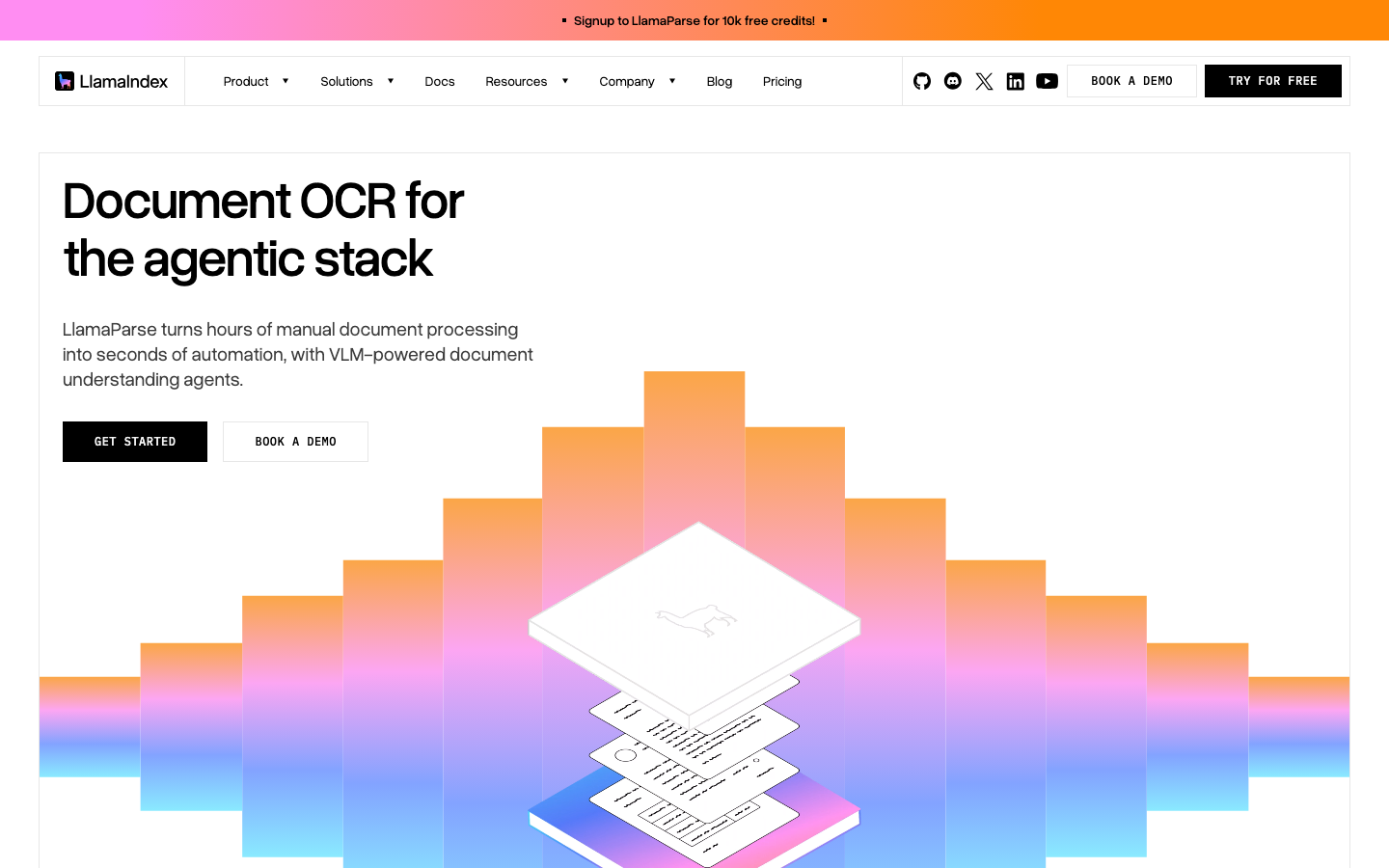
LlamaIndex is an open source data framework for large model applications, helping developers connect private data such as PDFs and database APIs to LLM to build retrieval enhanced generation (RAG) and agent applications. It provides a complete set of abstractions for data loading, indexing, retrieval and query, and is supported by LlamaParse document parsing and LlamaCloud hosting services. It is one of the mainstream frameworks for building production-level document Q&A and knowledge base applications.
LlamaIndex
Core parameters and statistics
LlamaIndex is a data framework for large model applications, officially positioned as "the leading framework for connecting private data to large models." It provides developers with a complete abstraction from data loading, indexing, retrieval to query and agent orchestration, allowing the construction of RAG and knowledge base applications to be modularized without having to splice various components from scratch.
| Projects | Public Information |
|---|---|
| Official positioning | Data framework connecting private data and LLM |
| Core capabilities | Data loading, indexing, retrieval, query, agent orchestration |
| Language implementation | Python and TypeScript two frameworks |
| Data Connections | LlamaHub provides a large number of data connectors and tools |
| Document Parsing | LlamaParse (Complex PDF/Table Parsing Service) |
| Hosting platform | LlamaCloud (hosted parsing, indexing and retrieval service) |
| Open Source License | MIT |
| Community size | GitHub about 50,000 stars, 7,500 forks |
| Latest version | Python v0.14.22 (2026-05-14, GitHub Releases) |
| Support form | Open source library + cloud hosting service |
Framework Value: The core of LlamaIndex is a set of "data-centric" abstractions. It standardizes "how to turn messy private data into context that can be retrieved by LLM". Developers can combine loaders, indexes and retrievers as needed to avoid reinventing the wheel.
Analytical Value: Complex PDFs, scans, and documents with tables are common difficulties with RAG. As a specialized document parsing service, LlamaParse converts such difficult-to-parse documents into structured and retrieval-friendly content, which is the key differentiator of LlamaIndex in enterprise document scenarios.
Dual-tier positioning: LlamaIndex provides both a free open source framework and commercial LlamaCloud/LlamaParse hosting services. The former is for self-built teams, and the latter is for teams that want to save parsing and indexing operation and maintenance. The two share the same set of design concepts.
User and market recognition
LlamaIndex’s recognition comes from the scale of the open source community and its fundamental position in the LLM application stack. The company does not disclose revenue data.
Community size: The GitHub repository run-llama/llama_index publicly shows about 50,000 stars and 7,500 forks, and is one of the most frequently cited frameworks for building LLM data applications. The supporting LlamaHub brings together a large number of community-contributed data connectors to form a reusable ecosystem.
Ecological status: Regarding the need to "enhance large models with private data", LlamaIndex and LangChain are often discussed side by side, with the former focusing more on data access and retrieval. Many tutorials, courses, and internal enterprise programs use it as the default starting point for RAG.
Prerequisites: LlamaIndex is a developer framework rather than an out-of-the-box application. Using it requires Python or TypeScript engineering capabilities; the retrieval effect also depends on the document parsing quality, segmentation strategy and selected model.
Cost advantage
- C-side/Individual: Usually a free version is provided to experience the core functions, and high-frequency use requires a paid package subscription.
- API/Developer: Billed by call volume, suitable for development teams that can be flexibly integrated into their own systems.
- Enterprise/Privatization: Contact the business owner to obtain customized quotation and deployment plan. The specific price is subject to the official real-time pricing page.
Main functions
The capabilities of LlamaIndex are organized around "accessing data into LLM so that it can be retrieved and organized":
- Data Loading: Access multi-source data such as PDF, database Notion, Slack, API, etc. through LlamaHub's large number of connectors.
- Indexing and retrieval: Provides vector index, keyword index and other indexing methods and combinable searchers, and supports hybrid retrieval and rearrangement.
- Query Engine and Agent: Encapsulate retrieval and generation into a query engine, and support the construction of agents and workflows that can call tools and perform multi-step reasoning.
- LlamaParse document parsing: Parse complex PDFs, tables and scans into structured content suitable for retrieval.
- LlamaCloud hosting: Provides parsing, indexing and retrieval services in a hosting manner, reducing the operation and maintenance costs of self-built pipelines.
Model and version evolution
LlamaIndex uses the Python framework as the main line to continuously release frequently and maintain an independent TypeScript implementation.
Mainline release
The latest version of the Python framework is v0.14.22 (2026-05-14), previously v0.14.21 (2026-04-21) and v0.14.20 (2026-04-03). The 0.14 series mainly focuses on the continuous iteration of the stability of integration modules, data connectors and query pipelines.
Multi-implementation collaboration
In addition to Python, LlamaIndex also maintains a TypeScript version to serve the front-end and Node ecosystem; LlamaCloud and LlamaParse on the business side provide hosting capabilities on top of the framework. The three evolve together, allowing teams to smoothly transition from open source frameworks to managed services without having to change the technology stack.
Technical advantages
The technical advantages of LlamaIndex can be explained by the chain of "mechanism-effect-scene".
Mechanism: Data-centric hierarchical abstraction. Split loading, indexing, retrieval, and query into composable modules. The effect is that each component of the RAG pipeline can be independently replaced and optimized. The applicable scenario is a team that needs to repeatedly tune the retrieval effect for specific data.
Mechanism: Specialized document parsing (LlamaParse). Specialized parsing of complex PDFs and tables. The effect is to significantly improve the retrieval usability of difficult-to-parse documents. The applicable scenarios are corporate documents with complex structures such as contracts, financial reports, and research reports.
Mechanism: Agents and Workflow Orchestration. Provides agents and multi-step workflow abstractions on top of retrieval. The effect is to modularize the complex tasks of "retrieve first and then act", which is suitable for applications that need to combine external tools to complete multi-step tasks.
How to use
LlamaIndex is for developers, and the main entrance is as follows:
- Python framework: Install through
pip install llama-index, and build RAG according to the process of "load data → build index → build query engine → ask questions". - TypeScript Framework: Build data-driven LLM applications in an equivalent way in the Node/front-end ecosystem.
- LlamaCloud/LlamaParse: Sign up to use managed parsing, indexing, and retrieval services through the API or console.
Three points need to be paid attention to when implementing: document parsing quality (complex documents are evaluated first by LlamaParse), segmentation and indexing strategies, and reordering and evaluation of search results, which directly determine the accuracy of the final Q&A.
Product Pricing
The pricing model is subject to the official real-time page. Usually a freemium or subscription system is used, and basic functions can be used for free. Advanced functions or high-frequency use require paid subscriptions, and users are advised to evaluate the optimal solution based on actual usage.
Application scenarios
- Enterprise document Q&A and knowledge base: Construct contracts, manuals, and reports into a Q&A knowledge base. The focus of verification is the parsing quality and retrieval hit rate of complex documents.
- Data-driven agent: Build an agent that can retrieve private data and call tools to complete multi-step tasks. The focus of verification is the controllability and observability of the workflow.
- Quickly build a RAG prototype: The R&D team uses the framework to quickly verify the RAG idea. The focus of the verification is the difference in effects of different indexing/retrieval strategies.
Applicable people
- AI application developers: Need to connect private data to large models and build RAG or agent applications.
- Corporate R&D Team: Build a production-level Q&A system for complex documents such as contracts and financial reports, focusing on parsing quality and scalability.
- Data and Platform Engineer: Hope to use a standardized framework to manage multi-source data access and retrieval pipelines.
Not suitable for the boundary: LlamaIndex is a development framework and is not suitable for non-technical users who do not have engineering capabilities and want to use out-of-the-box applications; simple single-document Q&A can be done with lighter tools, but the introduction of a complete framework is more important.
Summary and Outlook
It provides competitive solutions in its field, and its core value lies in lowering the threshold for AI use in this field.
Current limitations: Some advanced features require paid subscription, and the free version has function or usage restrictions; specific technical details and performance benchmarks have not yet been fully disclosed.
Related tools:  Hugging Face, replicate
Comparison of competing products
| Comparison dimensions | LlamaIndex | Competitor A | Competitor B |
|---|---|---|---|
| Core Differences | — | — | — |
| Price | — | — | — |
| Target Users | — | — | — |
Note: The above comparison is based on product public information, and actual differences are based on user experience.
Technical advantages and capability boundaries
As an AI model and API product, the core capabilities of LlamaIndex can be deeply understood through the following dimensions, which directly affect technology selection and implementation effects.
Inference Performance and Benchmark Performance The model’s reasoning performance is reflected in its performance on standard NLP tasks (text generation, code completion, semantic understanding, multi-turn dialogue, information extraction, etc.). It is recommended to conduct horizontal comparison through public benchmark test lists (such as MMLU, HumanEval, GSM8K, etc.), but please note that there may be a gap between benchmark test scores and actual business scenario performance. Key indicators that affect the actual user experience include: inference speed (Token/s or response delay, which directly determines the smoothness of the user experience), context window length (which determines the input size that can be processed at a time, affecting the complexity of the tasks that can be processed), and consistency of output quality (the stability of the results of multiple outputs of the same input, which affects the perception of reliability).
API Compatibility and Development Ecosystem The depth of API compatibility with mainstream development frameworks (LangChain, LlamaIndex, Semantic Kernel, etc.) directly affects the cost and cycle of integrated development. It is recommended to pay attention to the following integration dimensions: the coverage of language types supported by the SDK (whether mainstream languages such as Python, JavaScript, Go, and Java have official SDKs), streaming output support (SSE/WebSocket protocol compatibility), function calling and tool usage capabilities (whether it supports mapping model output to structured function calls), the flexibility of structured output (JSON mode), and the ability to integrate with enterprise-level infrastructure (VPC deployment, Private Link, unified identity authentication). Complete API documentation and rich code examples can significantly lower the entry barrier to development and reduce integration time and costs.
Deployment Flexibility vs. Cost Tradeoff Depending on data privacy requirements, latency sensitivity and usage scale, LlamaIndex can choose cloud API calls or on-premises deployment options. The advantages of cloud deployment are zero operation and maintenance costs and elastic scalability, which is suitable for scenarios with large fluctuations in usage and rapid prototype development; local deployment provides complete data sovereignty and low latency (no network round-trip overhead), but you need to bear the cost of purchasing hardware such as GPUs and operation and maintenance manpower. It is recommended to use a monthly API call volume of 1 million times or a monthly fee of US$1,000 as a reference dividing line: below this threshold, cloud APIs have better cost-effectiveness and flexibility. After exceeding this threshold, the total cost of ownership of the self-deployment solution should be comprehensively evaluated, taking into account factors such as hardware depreciation, electricity, operation and maintenance manpower, etc.
Model selection and version strategy
For the selection of LlamaIndex series models, it is recommended to match the model capabilities of different versions according to specific usage scenarios. The large-parameter version performs better on complex reasoning and multi-step tasks, but has higher costs and longer delays; the small-parameter version can already provide satisfactory output quality in scenarios such as daily conversations and simple question and answer, and the cost is only a fraction of the large version. The recommended selection strategy is: use small and medium versions in standard scenarios to reduce costs, and only call large version models when complex inference tasks need to be processed. This hierarchical calling strategy can reduce the overall API cost by 40-60% without significantly affecting the output quality.
Version Info
- LlamaIndex (Python) v0.14.22 :The latest Python version released by GitHub Releases continues the main line of data loading, indexing, retrieval and agent orchestration, and continues to improve integration with various models, vector libraries and data sources.
- LlamaIndex (Python) v0.14.21 :The 0.14 series of iterative versions improves the stability of the integrated module and query pipeline.
- LlamaIndex (Python) v0.14.20 :0.14 series version, continuously updating data connector and retrieval components.
User Reviews