 Locus Robotics
Locus Robotics is the world's leading warehouse automation robot platform. It coordinates Locus Origin, Locus Vector and Locus Array to form a unified robot fleet through the LocusONE™ physical AI platform, providing end-to-end solutions from collaborative picking to fully autonomous fulfillment for 3PL, retail e-commerce, medical and industrial fields.
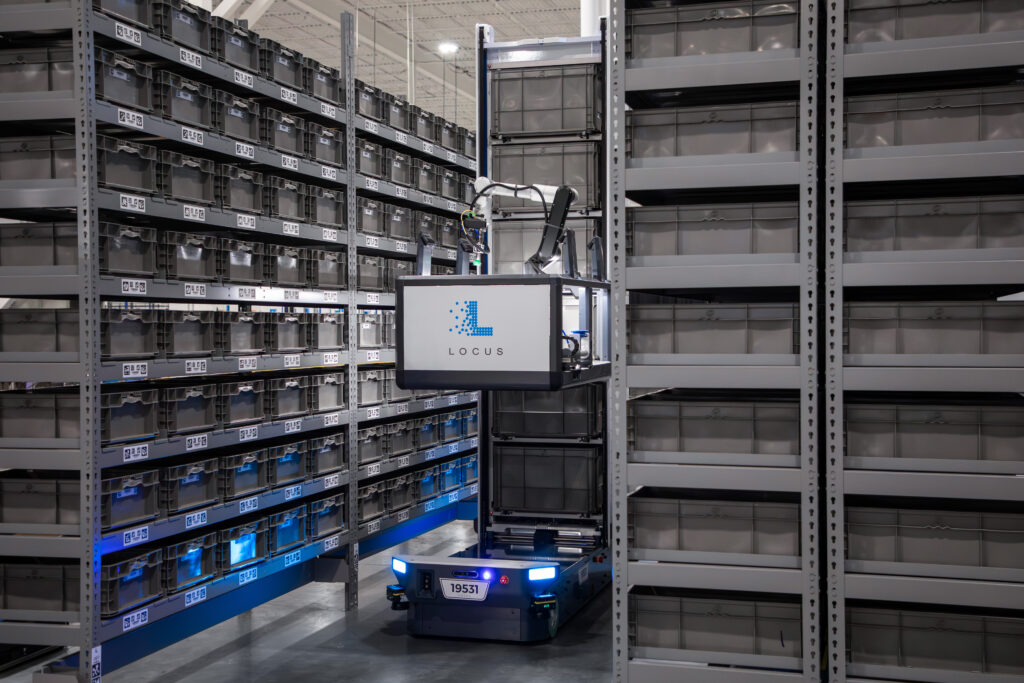
Locus Robotics’ in-depth analysis: the evolution path of warehousing physics AI from collaboration to full autonomy
Core parameters and statistics
The core positioning of Locus Robotics is not to be a single robot hardware manufacturer, but to unify multiple AMR (autonomous mobile robot) forms into a programmable intelligent workforce through the LocusONE™ physical AI platform. Its product matrix extends from collaborative picking to fully autonomous Robots-to-Goods (R2G) fulfillment, and its target customer base covers the four major industries of 3PL, retail e-commerce, medical health and industrial manufacturing.
| Projects | Public Information |
|---|---|
| Official positioning | Physical AI-driven flexible warehousing automation platform |
| Product Form | LocusONE™ Platform + Locus Origin / Locus Vector / Locus Array |
| Deployment scale | 360+ sites, 17,000+ robots |
| Cumulative picking | 7 billion+ times (as of early 2026) |
| Core customers | DHL, CEVA Logistics, Kenco, Radial, Staples Canada, S&S Activewear |
| Latest Products | Locus Array (released April 2026) |
| Support platform | Web (LocusONE management backend), API (WMS integration) |
| Place of Residence | United States (Wilmington, MA) |
Product layering logic: Origin solves the walking waste of "people looking for goods" (efficiency increased by 2 times), Vector handles heavy-duty material handling (600 lbs), and Array realizes "goods-to-person" fully autonomous fulfillment (manpower reduced by 90%+). The three are unifiedly orchestrated by LocusONE, and users can deploy them incrementally according to actual business needs without having to completely replace existing facilities at once.
Deployment Density: A single site of the LocusONE platform can support 1,000+ robots working simultaneously, covering more than 1 million square feet, indicating that its software architecture has mature verification in high-concurrency scheduling.
User and market recognition
Locus Robotics' market recognition is at the forefront of the warehouse automation field, and its customer list and third-party accolades provide verifiable proof.
Endorsement from top customers: DHL Supply Chain (one of the world’s largest logistics service providers) is Locus’ benchmark customer. DHL has deployed Locus Origin and Locus Vector in multiple warehouses in North America and has completed more than 1 billion picks (such as the "One Billion Picks" milestone announced in February 2026). Top 3PLs such as CEVA Logistics, Kenco, and Radial have also disclosed usage data and reviews in their official website cases.
Efficiency Improvement Data: Quantitative benefits disclosed in customer cases include - DHL increased from 78 UPH (units picked per hour) to 150 UPH; Kenco increased from 30-40 UPH to 120-150 UPH; Kimball Midwest increased replenishment efficiency by 100%+. These data come from officially released customer cases and are verifiable.
Industry Honors: Locus Array was shortlisted for the MODEX MHI Innovation Award in 2026; won the AI Excellence Award, RBR50 Award and AI Breakthrough Award in 2026.
Market Coverage: 360+ sites cover North America, Europe and the Asia-Pacific region, indicating that the adaptability of its solutions in different regions and regulatory contexts has been verified.
Cost advantage
The cost advantage of Locus Robotics does not come from the low price of a single hardware, but from the "progressive deployment + flexible scheduling" that greatly reduces the entry barrier and total ownership cost of automation.
Deduction from X to Y (deduced value, unofficial commitment):
- Pick picking manpower requirements: In the collaborative mode (Origin), the single-person production capacity is increased from 40-60 UPH to 120-150 UPH, which is equivalent to a reduction of about 60% in manpower requirements; in the fully autonomous mode (Array), officials claim that the manpower is reduced by 90%+.
- Automation implementation cycle: Traditional fixed automation (conveyor line AutoStore, etc.) usually requires 6-12 months of civil engineering renovation. Locus's AMR solution does not require the modification of existing facilities, and the deployment cycle can be compressed to a few weeks.
- Single picking cost: Locus Array officially claims that it is 40% lower than traditional automation. Combined with the R2G mode, the storage density is increased by 2 times, and more SKUs can be stored in the same area.
Hidden benefits: Personnel training is reduced from days to tens of minutes (Origin's tablet UI design), which significantly lowers the threshold for employment in a multi-language environment; flexible deployment means that the warehouse can gradually expand the number of robots according to SKU growth and order fluctuations, rather than a one-time large capital expenditure.
Hidden costs: The AMR solution requires stable Wi-Fi network coverage, investment in API integration with existing WMS, and robot maintenance and charging station configuration; although the fully autonomous mode (Array) has patent support for its adaptability to the physical form of SKUs, extreme special-shaped parts still require manual intervention.
Main functions
Locus' capabilities are divided into two levels: hardware and software, but its real competitiveness lies in the unified coordination of different hardware and external systems by the software orchestration layer (LocusONE).
- LocusONE™ Physical AI Platform: Unified coordination of robot scheduling, task allocation and path planning, supporting concurrent operations such as picking, replenishment, point-to-point transportation, automatic fulfillment, etc.; integrating LocusHub data insights and visual reports to provide labor guidance, predictive analysis and operational comparison.
- Locus Origin (collaborative mobile robot): Pick collaboratively with people to eliminate walking waste. Equipped with multi-layer shelf LiDAR + visual navigation, tablet UI, 14 hours of battery life, and supports dynamic task interleaving (simultaneous picking and replenishment). New employees can get started within minutes.
- Locus Vector (Material Handling Robot): Heavy-duty (600 lbs) omnidirectional mobile robot equipped with Mecanum wheel 90-meter 3D LiDAR, three-level safety system, suitable for full box picking, point-to-point transportation, docking with conveyor lines, etc.
- Locus Array (Fully Autonomous Fulfillment System): flagship product released in 2026. The robot goes directly to the shelf to perform picking, without the need for humans to follow. The patented end effector can handle complex SKUs such as soft packages, porous parts, and special-shaped parts without the need for tool switching or pre-training. Achieve 24/7 unmanned operation.
- WMS integration and third-party system docking: LocusONE can be integrated with any mainstream WMS system, and can also be linked with automated equipment such as sorting and packaging. It can be deployed in existing facilities (brownfield) or new facilities (greenfield).
Expert View: The core synergy of Locus is not in the performance of a single robot, but in the unified orchestration capabilities of three robot forms on the LocusONE platform - in the same facility, Origin does high-value "human-machine collaboration" picking, Vector does heavy-load transport, and Array does 24/7 autonomous operation in no-man's land. The three are assigned tasks by the same set of intelligent scheduling engines, realizing the transformation of warehousing labor from "fixed positions" to "dynamic resource pools."
Model and version evolution
The current public version information has been completely covered in the previous chapter "Version Evolution of Locus Robotics". If the official adds more granular version milestones and precise dates in subsequent iterations, it is recommended to refer to the official real-time page.
Technical advantages
The technical barrier of Locus is not only the hardware (robot body), but also the intersection between software (platform orchestration) and physical AI (end effector).
LocusONE's orchestration engine: Coordinate 1,000+ robots at a site to handle multiple concurrent tasks. The core challenge is not navigation and obstacle avoidance, but dynamic task allocation and priority scheduling. LocusONE receives WMS order data, robot status, personnel locations, and task queues in real time to dynamically redistribute workloads—when orders surge in a certain area, the system can interrupt low-priority tasks and redeploy the closest robots to high-priority areas.
Patented end effector: Array’s grabbing system does not rely on visual templates or SKU pre-training, but achieves broad SKU coverage (polyester bags, soft bags, porous parts, special-shaped parts) through soft adaptive grabbing + AI perception. This is the key technical support for Locus’ claim of “the broadest SKU coverage in the industry.”
Navigation and Safety: Origin uses LiDAR + vision hybrid navigation, Vector is equipped with 90-meter 3D LiDAR + dual safety-level LiDAR three-level safety system, and Array integrates AI-driven contextual awareness. All three support autonomous recharging (opportunity charging) to ensure continuous operation 24/7.
Integration Flexibility: LocusONE interfaces with any WMS system and supports brownfield (existing facility) deployment—no need to modify floors, racks, or building structures. This means customers can introduce automation without disrupting existing operations.
How to use
The deployment path of Locus Robotics is divided into three stages: evaluation, pilot, and expansion. The entire process is supported by the manufacturer.
| Phase | Activities | Time Estimate |
|---|---|---|
| Initial assessment | Contact sales team for site analysis ROI deduction | 1-2 weeks |
| Proof of concept (POC) | Deploy Origin/Vector in some areas to improve verification efficiency | 4-8 weeks |
| Scale expansion | Expand the number of robots based on POC data and introduce more functional modules | Advance on demand |
Deployment Prerequisites:
- The warehouse needs to be covered by a stable Wi-Fi network
- Requires WMS system to support API integration
- The flatness of the ground must meet the basic AMR traffic requirements (usually no special modification is required)
Typical usage process (taking picking as an example):
- LocusONE receives orders from WMS and assigns tasks to the nearest idle robot
- The robot navigates to the target location, and the person/Array performs picking.
- The robot guides people to the next cargo space or drives autonomously to the delivery station
- After the task is completed, the robot will automatically recharge and wait for the next round of allocation.
Product Pricing
Locus Robotics adopts a Robot-as-a-Service (RaaS) model. Specific pricing is not disclosed on the official website. You need to contact the sales team to obtain a customized quote.
- C-side/Individual: Not applicable. Locus is designed for enterprise-level warehousing operations and does not have a personal version.
- Enterprise/RaaS: Billed based on the number of robots, functional modules and deployment sites. A typical contract includes hardware leasing, software licensing, maintenance support and LocusONE platform usage fees. The official public Array page shows "<12 months ROI", which can be used as a reference for the investment return cycle.
- Hidden Costs: Network infrastructure upgrades, WMS integrated development, personnel change management, and optional advanced analytics module (LocusHub) may incur additional costs. For details, please refer to the official sales contract.
- Comparison with competing products: Compared with traditional fixed automation solutions (AutoStore, conveyor line systems), Locus's RaaS model reduces initial capital expenditures and converts CAPEX into OPEX, but at the same time brings ongoing monthly service fees. Compared with similar AMR vendors (such as Geek+, Fetch Robotics), Locus’ core differentiation lies in the orchestration capabilities of the LocusONE platform and the fully autonomous capabilities of Array.
Application scenarios
1. 3PL multi-client mixed fulfillment
Task Type: Process B2B/B2C orders for multiple customers in the same warehouse, with frequent SKU and order pattern changes. Actual benefits: Flexible scheduling can dynamically adjust robots to high-demand areas, avoiding the idle waste of traditional fixed automation when the customer structure changes. Cases such as DHL, CEVA, and Kenco have verified its applicability in complex 3PL scenarios.
2. Flexible expansion of retail e-commerce promotions
Task type: During peak periods such as Black Friday and Prime Day, the number of orders suddenly explodes, and labor costs are unsustainable in normal times. Actual benefits: By temporarily increasing the number of robots to cope with the peak, it can be reduced after the big promotion, without having to bear fixed labor costs throughout the year. The Staples Canada case demonstrates the ability to expand production capacity without increasing headcount during peak periods.
3. Compliance selection in medical and health warehouses
Task type: Accurate selection, traceability and temperature control management of medical consumables and equipment. Real Benefits: Locus’ precise navigation and task tracking capabilities meet the healthcare industry’s compliance audit needs while reducing human error rates in the operation of high-value medical supplies.
4. Industrial manufacturing material distribution
Task type: Scheduled delivery of production line materials (parts-to-line), empty box recycling, and work-in-progress circulation. Actual Benefits: Vector’s heavy-load capacity and omnidirectional movement characteristics are suitable for heavy-duty material handling in industrial scenarios, and LocusONE’s scheduling capabilities can ensure that materials for multiple production lines are on time.
Applicable people
- Warehousing/Logistics Operations Director: It is necessary to introduce automation without interrupting existing operations, reduce reliance on manual labor, and improve order fulfillment accuracy and throughput.
- 3PL Enterprise Manager: Need to maintain operational efficiency and customer SLA in the context of multiple customers, multiple SKUs, and volatile orders. Locus’ flexible deployment and RaaS model are suitable for 3PLs’ asset-light expansion strategies.
- Retail e-commerce supply chain leader: To cope with the peak pressure of major promotions, flexibly scalable fulfillment capabilities are needed. Locus’ progressive deployment path allows for scaling of bot numbers on a quarterly basis.
- Manufacturing Factory Logistics Manager: The human efficiency bottleneck of production line material distribution needs to be solved. Vector's heavy-load capacity and omnidirectional movement are differentiated advantages in industrial scenarios.
Unsuitable Scenarios:
- Warehouses with very small average daily orders (<500 orders/day): The investment return period of the AMR solution will be significantly longer, and at this time manual or simple conveying systems may be more economical.
- Warehouses with large-scale deployment of fixed automation systems such as AutoStore: Unless the existing system faces bottlenecks of insufficient flexibility, replacement costs are high.
- Campus without basic Wi-Fi network and IT support capabilities: The stable operation of AMR relies on reliable network infrastructure.
- Pure full box delivery scenario with very few SKUs and ultra-large batches: At this time, high-speed automatic sorting lines may be a more efficient choice.
Summary and Outlook
The core competitiveness of Locus Robotics lies in the triangular combination of "physical AI platform + polymorphic robot + progressive deployment": the LocusONE platform provides orchestration intelligence, Origin/Vector/Array covers a complete workflow from collaboration to full autonomy, and the RaaS model changes automation from large capital expenditures to operational expenditures, lowering the decision-making threshold for enterprises. The launch of Locus Array in 2026 marks the company's technological leap from "helping people walk less" to "completely replacing human labor."
Follow-up observation points:
- Quantitative data on SKU coverage of Array’s large-scale deployment in real production environments
- Whether the AI scheduling capabilities of the LocusONE platform can be further integrated into large language models to achieve natural language interaction
- Pace of market expansion outside North America (local adaptation in Europe and Asia-Pacific)
- Deep integration progress with large WMS vendors (SAP, Oracle, Manhattan Associates)
Procurement/Adoption Risk Assessment: Locus is a mature supplier verified by top customers, and its operational data of 7 billion picks provides strong endorsement of reliability. However, procurement decisions still need to focus on: ① Whether Array’s fully autonomous capabilities cover the core SKU types of its own warehouse (it is recommended to test the capture success rate of special-shaped parts and soft packages in the POC stage first); ② The integration complexity and API maturity of LocusONE and existing WMS; ③ The long-term total cost of the RaaS contract compared with the traditional CAPEX solution; ④ The response time and spare parts inventory depth of the manufacturer’s service support in the local market.
Related tools:
Version evolution of Locus Robotics
The product evolution of Locus Robotics reflects the technological transition route of the warehouse automation industry from "human-machine collaboration" to "full autonomy".
Version pedigree
| Milestones | Time | Change Points |
|---|---|---|
| Locus Origin released | ~2017 | The first commercial collaborative AMR, increasing picking efficiency by 2 times |
| LocusONE platform launched | ~2017 | Unified robot orchestration and management system |
| Released by Locus Vector | ~2020 | Entering the world of heavy-duty material handling with load capacities up to 600 lbs |
| Cumulative 100 million pickings | 2020 | Key node of market verification |
| Cumulative 7 billion pickings | 2026 | Significant scale effect |
| Locus Array released | 2026-04 | Fully autonomous Robots-to-Goods system, marking the official entry into the era of physical AI |
Roadmap Interpretation
From Origin to Vector to Array, Locus's product expansion path is very clear: first use collaborative robots to establish market trust and operational data foundation, then use heavy-duty robots to expand application scenarios, and finally use fully autonomous robots to achieve dimensionality reduction. The LocusONE platform runs throughout, ensuring that the three product lines are not isolated hardware from each other, but different terminals of the same system.
Version Info
- Locus Array (fully autonomous Robots-to-Goods system) :Locus Array is a fully autonomous fulfillment system launched by Locus Robotics in 2026. It adopts the Robots-to-Goods (R2G) model and is equipped with patented end-effector technology. It can handle a wide range of SKUs from soft packages to special-shaped parts without changing tools, achieving 24/7 high throughput of 90% + manpower reduction, 2 times storage density improvement and 40% reduction in single picking costs. Nominated for MHI Innovation Award at MODEX 2026.
- Locus Vector (material handling robot) :The AMR for heavy-duty material handling supports loads up to 600 lbs. It is equipped with omnidirectional Mecanum wheel 3D LiDAR (90-meter sensing range) and dual safety-level LiDAR systems. It is suitable for picking, replenishment, point-to-point transportation and integration with conveyor lines. There is no official precise date yet.
- Locus Origin (collaborative mobile robot) :Locus Robotics' first commercial AMR product is designed for high-throughput order picking scenarios and can work collaboratively with workers to increase picking efficiency by more than 2 times. It supports multi-layer shelves and various container configurations, is equipped with LiDAR and visual navigation systems, has 14 hours of battery life, and can be charged in 50 minutes. There is no official precise date yet.
- LocusONE™ Physics AI Platform :The unified robot coordination and management platform can support the collaborative operation of thousands of robots at the same time, covering more than 1 million square feet of warehouse sites. Integrate data science-driven LocusHub visual reports and real-time dashboards to support rapid integration with mainstream WMS systems. There is no official precise date yet.
User Reviews