 LooksMax AI
Free
LooksMax AI
Free
LooksMax AI analyzes and optimizes personal image photos through AI.
LooksMaxAI
Core parameters and statistics of LooksMax AI
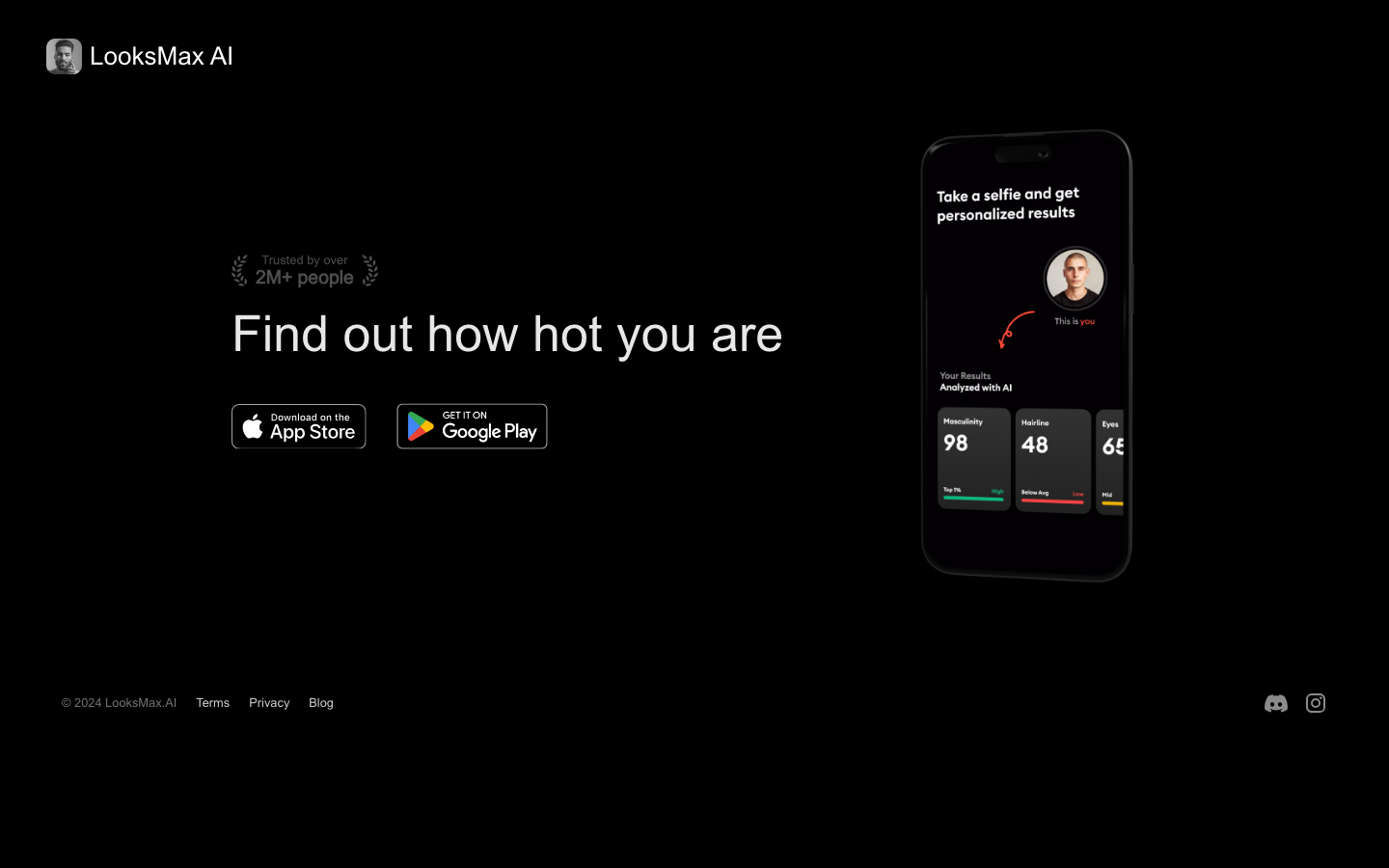
LooksMax AI is an AI appearance analysis and image optimization tool for individual users (Type D - productivity/business application). It uses computer vision technology to conduct multi-dimensional facial scoring and provide data-driven image improvement suggestions. Its product form is on the Web, no downloading and installation is required, and analysis results can be obtained by uploading photos.
| Projects | Public Information |
|---|---|
| Product positioning | AI appearance analysis and image optimization |
| Core Competencies | Multi-dimensional facial scoring, feature analysis, improvement suggestions, modeling simulation |
| Product form | Web |
| Business model | Free basic version + paid subscription |
| Place of Belonging | US (United States) |
| Supported languages | en-US |
| User scale | The official website claims to be "Trusted by over 2M+ people" |
| Latest version | 1.0 (~2026-07, no official precise date yet) |
Brief review in one sentence: LooksMax AI is not a beauty app, but a tool that "uses AI to score your appearance and tell you how to improve it" - upload a frontal photo, and AI will give scores and optimization directions from multiple dimensions such as facial symmetry, golden ratio, and skin quality.
Judgment Basis: This tool belongs to [Productivity/Business Application]. Its main delivery form is oriented to C-end individual consumers (non-developer APIs or enterprise mid-end). Its core value is to help individual users obtain objective image feedback and guide image management decisions, and has clear end-to-end business attributes. At the same time, it embeds an AI facial analysis model as a technical base, which is a typical "AI empowered consumer application".
LooksMax AI users and market recognition
The track where LooksMax AI operates is the intersection of AI beauty and "Looksmaxxing" (image maximization) cultural circles. This track has become a very popular topic on social media (TikTok, Reddit, YouTube), and the "looksmaxxing" related tags have been viewed billions of times.
User scale: The official website homepage publicly displays "Trusted by over 2M+ people", indicating that its registered or using users have exceeded 2 million, which is the top traffic level among similar tools.
Market positioning: What makes this tool different from traditional beauty apps (such as FaceApp, Qingyan Camera) is that it does not aim at "beautifying photos", but starts with "analysis and scoring" to guide users to make real image changes. This "analysis + guidance" model hits the pain point of decision-making in the "appearance anxiety" economy: users not only want to know whether they look good or not, but also want to know "where can be improved and how to change it."
Content Ecology: The official website blog publishes a large amount of content about mewing (tongue position correction), hairstyle selection, beard styling, skin care, etc., forming a knowledge matrix around "image improvement". This content is not only an entrance to SEO traffic, but also a means of user retention - after users obtain ratings, they can further read related blogs to obtain practical solutions.
Competitive Landscape: Similar tools include:
| Tools | Core differences | Number of public users |
|---|---|---|
| LooksMax AI | Comprehensive rating + styling simulation + blog content ecology | 2M+ |
| QOVES | Focuses on facial academic analysis, more research-oriented | Undisclosed |
| FaceSym | Focuses on facial symmetry analysis, single function | Undisclosed |
| Various beauty AI apps | Usually focus on skin care or makeup rather than comprehensive ratings | Varies |
However, LooksMax AI has not disclosed enterprise-level customer cases, financing information or third-party authoritative evaluation data. Its market influence currently mainly comes from social media communication and the accumulation of natural traffic.
Cost advantage of LooksMax AI: Admission is free, but detailed reports require payment to unlock
LooksMax AI adopts the "free basic analysis + paid in-depth report" model, and the cost structure is expanded on a single-tier C-side basis (no independent API or enterprise solution).
C client/individual user
- Free version: Provides basic overall rating and limited-dimensional analysis. Users can obtain a comprehensive score without paying to understand their approximate performance in facial symmetry, proportion and other dimensions.
- Paid version (estimated at $5–15/month): Unlocks detailed dimensional decomposition reports (such as scores for each sub-item), personalized improvement suggestions (hair style, beard, skin care, dressing direction), styling simulation function (switching preview of the effects of different hairstyles/beards on the face), and historical score trend tracking. Specific pricing brackets.
API/Developer
- No independent API exposed. Currently we do not provide batch analysis, private deployment or white label solutions for developers.
Enterprise/Privatization
- Undisclosed enterprise plan. The tool is currently positioned as an individual consumer product and does not provide team collaboration, permission management or customized enterprise services.
Free truth: The core value of the free version lies in "verification" - users upload a photo to get a comprehensive score and quickly determine whether the dimensions of the tool match. However, the free version does not provide detailed scores, which means that users cannot know "where the points were deducted." The actionability of suggestions for improvement is also limited. If users want a truly executable image optimization solution, the paid version is a must.
Hidden Costs:
- Psychological Cost: AI appearance ratings may have an impact on users’ self-perception. Users with low scores may experience negative emotions such as anxiety and self-doubt, especially among teenagers. The tool itself lacks psychological prompts or disclaimer guidance.
- Data Privacy Risk: Facial photos are biometric data. After being uploaded to the cloud server, its storage, transmission, and deletion policies directly affect user privacy and security. The privacy policy is not displayed in a simple summary form on the product homepage, and users are required to review it themselves.
- Aesthetic bias: AI's "beauty standards" are based on training data - if the training set is dominated by a specific race (such as Caucasians) or specific facial features, the scoring results may systematically disadvantage other groups. This problem is known in academic circles as "beauty AI bias", and the tool currently does not disclose the demographic distribution of its training data.
- Sunk cost of time: Users may buy skin care products, try complex hairstyles or fitness plans based on AI recommendations, but the actual effects of these recommendations vary from person to person, and AI cannot replace the personalized judgment of professional beauty consultants or dermatologists.
Main features of LooksMax AI
The functions of LooksMax AI are designed around "scoring→diagnosis→suggestion→simulation→tracking" rather than a single facial scoring tool.
-
AI multi-dimensional facial scoring: After uploading a frontal photo, AI automatically detects facial key points (68 points or more), gives sub-scores from dimensions such as symmetry, golden ratio (phi coefficient), eye distance, nose width, chin shape, jawline definition, skin smoothness and other dimensions, and weights the overall appearance score. Applicable tasks: Obtain objective and data-based facial feature analysis to replace subjective judgment by looking in the mirror.
-
Image improvement suggestions (diagnosis to prescription): Based on the scores of each dimension, AI gives corresponding improvement directions. For example, the low-scoring dimension is "jawline definition", and suggestions may include fat-reducing mewing exercises, hair modification, etc. Applicable tasks: From "knowing where your scores are low" to "knowing what to do", shortening the distance between self-diagnosis and action plans.
-
Styling simulation and comparison: After uploading photos, users can try different hairstyles, beard styles, and even accessories such as glasses to simulate the facial effects. The system will recalculate the score changes after simulation, allowing users to see the quantified results before changing the shape. Applicable tasks: Do "virtual trial and error" before actually changing the style to reduce the cost of trial and error (for example, if you get an unsuitable haircut, it will take months to grow back).
-
Before and after comparison and trend tracking: Take photos and upload them regularly to view the changing trends of scores in each dimension over time to quantify the actual effects of skin care, fitness or mewing exercises. Applicable tasks: Convert long-term image management behaviors (such as skin care, fitness) into a visual scoring curve to help determine which investments are truly effective.
-
Content Ecology (Blog + Guide): The official website has a built-in "Looksmaxxing" themed blog system, covering hairstyle selection (hundreds of illustrations of different hairstyles), mewing tutorials, skin care steps, outfit suggestions, etc. Applicable tasks: After users obtain ratings and suggestions, they can find specific implementation guidelines on the site without jumping to external searches.
Expert view: The value of LooksMax AI lies not only in "scoring", but also in stringing "scoring → suggestion → simulation → execution" into a service chain. Most facial analysis tools on the market only achieve the first step (scoring), and users don’t know what to do after getting the score. LooksMax AI uses blogging and simulation functions to complete the follow-up section, improving the user's stay time on the site and the possibility of conversion. However, the degree of personalization of these suggestions is limited - the "fat reduction and jawline improvement" given by AI is almost the same for everyone. Real high-value suggestions should be based on the user's age, gender, and skeleton basis to make more refined stratification.
Function matrix
| Features | Free version | Paid version | Core benefits |
|---|---|---|---|
| Comprehensive appearance rating | ✅ | ✅ (including detailed items) | Obtain objective benchmarks |
| Detailed dimension scores | ❌ | ✅ | Know where the deduction points are |
| Suggestions for improvement | Limited | Complete | Get direction for action |
| Modeling simulation | ❌ | ✅ | Reduce trial and error costs |
| Historical trends | ❌ | ✅ | Quantifying long-term effects |
| Blog Content | ✅ | ✅ | Get Implementation Guide |
Model and version evolution of LooksMax AI
LooksMax AI is not a basic large-model product. Its technical base is a facial key point detection and feature analysis model in the field of computer vision. The official complete version log has not been released. The following is a summary of the minimum milestones based on public information.
Current status
- Current version: 1.0 (~2026-07)
- Product Form: Available on the Web
- Underlying model: Based on Face Landmark Detection and facial feature extraction CNN, the specific architecture and training data scale are not disclosed
Known evolution nodes
Since the tool has not yet established a public version release page or Changelog, the following are the product evolution stages that can be inferred:
| Stages | Time | Inferred changes |
|---|---|---|
| Initial launch | ~2025-2026 | Basic facial analysis is launched, supporting comprehensive scoring |
| Content ecological construction | ~2026 | The blog module will be launched, covering topics such as hairstyle mewing |
| Style simulation function | ~2026 | Support hair/beard simulation effects |
| Current version 1.0 | ~2026-07 | Official website redesigned, number of users exceeded 2M |
Version Notes: The official does not provide a public Changelog or version release mechanism. The above evolution stages are logically deduced based on the launch of product function modules, and the exact date is subject to the actual official release.
Follow-up focus: ① Whether a mobile app (iOS/Android) will be launched; ② whether the API will be opened for third-party integration (such as fitness apps, skin care brands); ③ whether multi-modal inputs (profiles, videos, multi-angle photos) will be introduced; ④ whether the scoring model will regularly update training data to correct deviations.
Technical advantages of LooksMax AI
The technical advantage of LooksMax AI is not in "large model parameters" or "strong reasoning ability", but in turning mature facial analysis technology into a comprehensive experience for the C-side.
Technical route: Based on face key point detection (Face Landmark Detection), after detecting 68 or more key points on the face, calculate the proportional relationship (such as eye distance/face width ratio, nose width/face width ratio, mandibular angle, etc.), and compare it with the "high-scoring sample" distribution in the training data, and finally weighted output of each dimension score and comprehensive score.
Mechanism→Effect→Scene:
- Mechanism: Facial analysis is essentially a "feature extraction + distribution comparison" process - first locate key points, then calculate geometric features (symmetry, proportion, angle), and finally map to the scoring space.
- Effect: A single analysis can be completed within 10-20 seconds, and users can obtain multi-dimensional quantitative feedback without any professional knowledge.
- Applicable scenarios: Suitable for large-scale, low-latency personal image assessment, not suitable for facial diagnosis that requires medical-grade accuracy.
Relationship with academic research: Facial aesthetics analysis has decades of research history in academia. The core basis includes "the positive correlation between facial symmetry and attractiveness" (Rhodes, 2006), "the application of the golden ratio in facial aesthetics" (Pallett et al., 2010), etc. The scoring logic of LooksMax AI is likely to be inherited from these public research results, but its specific model weights, training data sets and verification methods are not disclosed.
Technical limitations:
- Light and Angle Sensitivity: Non-frontal lighting and extreme lighting conditions will significantly affect the accuracy of key point detection.
- Limited occlusion processing capabilities: Masks, sunglasses, bangs and other obstructions may cause key points to be missing or misjudged.
- Unable to process side faces: Currently only frontal or near-frontal photos are supported. Analysis of side faces or 45-degree angles is not supported.
- Generalization of different races is unknown: If the training data is mainly Caucasian, the scoring deviation for facial features of Asians and Africans may be larger.
How to use LooksMax AI: Complete appearance analysis in three steps on the web side
Currently, LooksMax AI only provides a web portal and does not have a native mobile app or API.
| How to use | Applicable scenarios | Restrictions |
|---|---|---|
| Web client (browser access) | Personal appearance analysis and image management | Stable network required, only front-facing photos are supported |
Typical steps:
- Visit the official website: Open the browser
https://looksmax.ai - Upload photo: Click on the upload area and select a clear frontal facial photo (natural light, frontal, no obstruction, no expression recommended)
- Get Rating: AI automatically detects faces and displays the comprehensive rating and dimensional decomposition after about 10-20 seconds
- Browse suggestions: View improvement suggestions given by AI based on low score dimensions
- Simulation (Paid): Try different hairstyles/beard styles to preview the effects
- Regular Tracking (Paid): Upload photos regularly to view rating trends
Usage threshold: extremely low. No registration is required to complete your first analysis (but you may need to create an account to save history). The entire process is designed to be "uploaded and used" without complex parameter configuration or technical terminology.
Bonus points usage:
- Decision Assistance: Use AI to simulate the effect before cutting or shaving to avoid the trial and error cost of "regret after cutting".
- Cycle Recording: Upload photos every 2-4 weeks to track the effects of your skin care or fitness program on your jawline, skin, and more.
- Style Comparison: Do A/B tests between different looks and use scores to quantify which style is more suitable for your facial structure.
Product Pricing for LooksMax AI
Please refer to the real-time pricing page of the official website. The following information is based on product logic and is not an official commitment.
| Plan | Pricing (estimate) | Core Equity |
|---|---|---|
| Free version (Free) | $0 | Comprehensive rating, limited improvement suggestions, blog access |
| Premium | ~$5–15/month or ~$30–60/year | Detailed ratings, full recommendations, styling simulations, historical trends |
Charge Features:
- Monthly/Yearly: It is expected to provide two levels of monthly payment and annual payment. The annual payment is usually equivalent to 50-70% of the monthly price (industry practice).
- Whether a one-time buyout is provided: Undisclosed. The current form of web products prefers subscription rather than permanent buyout.
- Refund Policy: Undisclosed. The refund window for subscription-based tools is typically 7-14 days.
Recommendation: Before paying, use the free version to upload 2-3 photos in different conditions to test the scoring consistency and the relevance of the recommendations. If the score value fluctuates too much under different lighting/angles, it means that the model is not stable enough to serve as a reliable reference for decision-making.
Application scenarios of LooksMax AI
Personal image improvement
- Task: Users lack objective knowledge of their facial features and want to know "what level they are in the eyes of others."
- Benefits: From subjective feelings → AI data-driven multi-dimensional analysis. Deduction: The fuzzy positioning that originally relied on mirrors + friends’ evaluations has been upgraded to 10+ dimensions and quantitative cognition with scores. The time for a single cognition acquisition has been shortened from "it may take many years of social feedback" to "you can know it once you upload it".
Reference for Styling Decisions
- Task: Before changing your hairstyle, beard style or trying a new look, you want to know "whether this style is suitable for your face shape".
- Benefits: Use AI simulation to replace "just cut and try". Deduction: The traditional trial and error cost is about 1-3 months (hair/beard growth cycle), and the AI simulation reduces the trial and error cost to 10 minutes.
Skin care and fitness results tracking
- Task: After continuing to use skin care products and performing fat reduction/mewing exercises, I want to quantify "has my face changed?"
- Benefits: Convert the vague "feeling better" into a comparable scoring curve. Deduction: By taking 5 minutes of photos and uploading them every month, you can get the dimensional change trend for 6-12 months to help determine which investments (A essence vs B facial mask, fat reduction vs muscle gain) contribute more to improving the facial score.
Content consumption and learning (blog ecology)
- Task: After obtaining the score, the user needs a specific implementation plan (such as what hairstyle to cut, how to do mewing).
- Benefits: Hundreds of blogs on the official website cover complete implementation guides from hairstyle illustrations to mewing tutorials. Users can complete the steps of "get ratings → read guides → try plans" within the site, without having to jump to an external site.
Quantitative cost reduction and efficiency increase (deduction)
The following is an estimate based on product logic, an unofficial commitment:
| Specific tasks | Traditional methods are time-consuming | LooksMax AI is time-consuming | Savings |
|---|---|---|---|
| Obtain objective analysis of facial features | It takes several years to accumulate social feedback | One upload takes 10-20 seconds | From blurring to quantification |
| Decide on a new hair/beard style | Browse hundreds of pictures + guess effects | Upload photos → AI simulation → Change 10 styles in about 5 minutes | Reduce trial and error time by 90%+ |
| Self-evaluation of skin care effects | Subjective feelings + mirror comparison | 5-minute photo shoot every month → score trend curve | From feeling → data-driven |
| Understand "where to improve your image" | Consult a beauty consultant (¥200-500/time) | Free rating + blog guide | 0 yuan entry |
Boundary of human-machine collaboration
- 100% Automable: facial analysis and scoring, styling simulation, trend tracking. These steps do not require human intervention and can be completed independently by AI.
- Human confirmation required: practical feasibility and personal aesthetic preference of improvement suggestions. The "fat reduction and jawline improvement" suggestions given by AI are reasonable for overweight people, but may not be suitable for users who are already thin; the "Korean style parting" recommended by AI may not meet the user's professional dress requirements. The final decision must be made by the user based on his or her own circumstances.
- Strong compliance/cannot be automated: In any scenario involving medical beauty diagnosis (such as recommending plastic surgery, recommending medical beauty projects), AI does not have medical qualifications and must not give diagnostic conclusions. Users seeking a medical-grade facial evaluation must consult a licensed physician.
Applicable groups of LooksMax AI
The target user portraits of LooksMax AI are relatively concentrated. The following are the main adaptation groups:
Adapt to the crowd
- **Young people (18-35 years old) who are concerned about personal image but lack objective feedback: This is the core user group. They are active on social media, have a certain understanding of the "looksmaxxing" culture, and hope to obtain quantifiable image feedback and executable improvement plans. The "sense of data" provided by AI ratings is more convincing than subjective evaluations from friends.
- People who are trying to change their style: Users who are considering changing their hairstyle, growing a beard or shaving, or trying different dressing styles can use the AI simulation function to preview the effect before changing, reducing the cost of trial and error.
- People who are doing fitness/fat loss/Mewing exercises: Need a quantitative tool to track facial changes. The scoring curve generated by uploading photos every month can be used as a reference indicator for the input-output ratio.
- Beauty and Personal Care Content Consumers: Users who are interested in topics such as hairstyles, skin care mewing, etc., and want to get both analytical tools and content guides in one platform.
Not suitable for people/people who need to use it with caution
- Minors (<18 years old): AI appearance scoring may cause appearance anxiety, self-perception bias and even eating disorders. Especially for teenagers who are in a sensitive period of physical development and psychological psychology, a low score of "5/10" may lead to long-term negative psychological effects. Not recommended for use by minors or with the knowledge and accompanying of a guardian.
- People who require professional medical cosmetic diagnosis: AI is not a substitute for evaluation by a dermatologist, plastic surgeon, or professional beauty consultant. Any scenario involving medical decision-making (such as whether to have rhinoplasty, whether skin treatment is needed) should be based on the physician's diagnosis.
- People who are highly sensitive to data privacy: Facial photos are uploaded to a cloud server for analysis. If the user cannot accept their biometric data being stored on a third-party server, this tool is not suitable for use. It is recommended to read the privacy policy carefully before use.
- Non-English users who need multi-language support: Currently only English interface and content are supported, and the experience for non-English users is limited.
Summary and Outlook
LooksMax AI enters the vertical consumption scenario of personal image management with "AI appearance rating + image optimization suggestions". Its core value does not lie in the advancement of AI technology (the underlying layer is mature facial analysis technology), but in integrating ratings, suggestions, simulations, tracking and content ecology into a complete service chain. The user scale of 2 million+ and the active blog ecosystem prove that it has found PMF (product-market fit) in a specific cultural circle.
Current Limitations:
- Insufficient transparency of evaluation criteria: The specific dimension weights of the scoring model, the composition of the training data, and the demographic distribution are not disclosed, and users cannot judge whether the scoring is fair to them.
- Cross-race generalization ability is questionable: The performance differences of the undisclosed model on the facial features of different races pose the risk of "beauty AI bias".
- Lack of mobile terminal and API: Only the web terminal limits the breadth of usage scenarios; no API means that it cannot be integrated by third-party ecosystems (fitness apps, skin care brands).
- Insufficient privacy and compliance disclosure: The storage, encryption, and deletion policies of facial biometric data are not presented in summary form on the product homepage. Users need to review the complete privacy policy by themselves.
Follow-up observation points:
- Whether a mobile app will be launched to expand usage scenarios (such as real-time analysis, camera integration);
- Whether the scoring model will be open sourced or third-party auditing will be introduced to build trust;
- Whether it will cooperate with professional beauty/skin care brands and shift from "consumer tool" to "beauty industry service platform";
- Whether an age verification mechanism will be established to prevent improper use by minors.
Procurement/Adoption Risk Assessment: For individual users, it is recommended to use the free version to upload multiple photos (different lights, different angles) to test the consistency of the scores, and then decide whether to pay after confirming the stability of the results and applicability to your personal face. Before paying, it is recommended to review the specific terms in the privacy policy regarding the storage period of facial photos, whether they are used for model training, and how the data is deleted. If the ratings fluctuate too much or the recommendations are too general (such as "it is recommended to maintain good living habits"), it means that the tool has limited value to you, and paid subscription is not recommended. For enterprises or brands, you need to confirm their data compliance status (certification status such as SOC2, GDPR, etc.) and the availability of API/white label solutions before considering working with them - this information is currently not public.
Related tools:
Version Info
- LooksMax AI :There is no official precise date yet.
- LooksMax AI :There is no official precise date yet.
User Reviews