 Luma
Luma
Luma has been upgraded from a single-point video generation tool to a multi-modal creation platform for creative teams, unifying research, generation, editing and collaboration into one workspace through Luma Agents, Ray3.2, Uni-1, Skills and Team Workspaces.
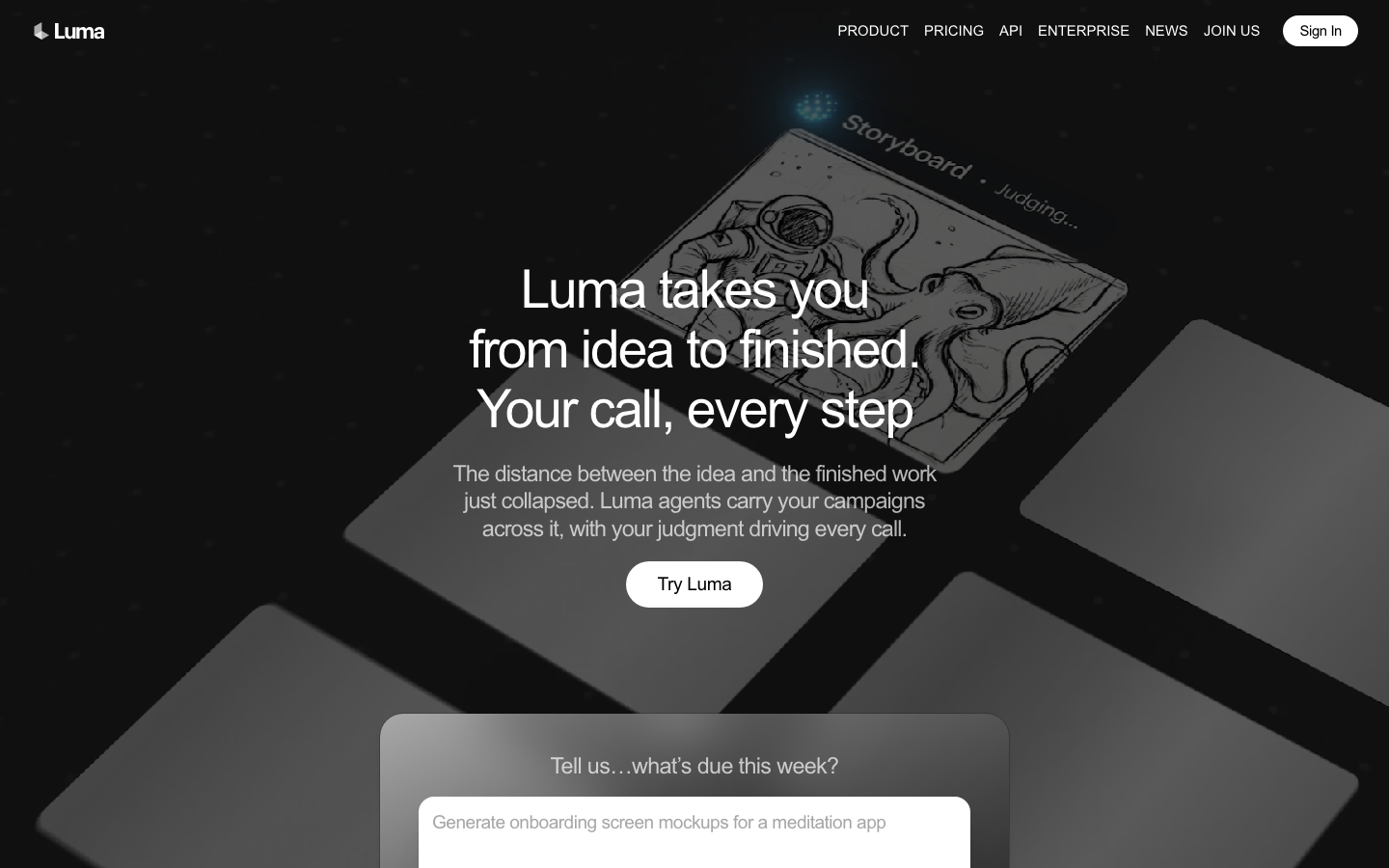
Luma - Multi-modal AI agency platform for creative teams
Luma’s core parameters and statistics
Luma has evolved from a single AI video generation tool to a multi-modal AI agency platform for professional creative teams. The current product form is centered on the Luma Agents workspace. The bottom layer is driven by the self-developed model stack (Ray3.2, Uni-1) and third-party models. The upper layer builds team-level collaboration capabilities through Luma Skills, Team Workspaces and Shared Credits. The company is located in Palo Alto, California, and the team size is described as "lean, high-achieving", implying that it is still in the deepening stage of product-market matching.
| Projects | Public Information |
|---|---|
| Official positioning | Creative agents that make you prolific |
| Core Form | Luma Agents Workspace (Research + Brainstorm + Create + Skills) |
| Self-developed model | Ray3.2 (video), Uni-1/Uni-1.1 (unified multi-modal), Ray3.14 |
| Open capabilities | Ray3.2 API, Uni-1.1 API (REST + Python/JS SDK) |
| Package Levels | Plus / Pro / Ultra / Team / Enterprise |
| Public monthly fee | $30 / $90 / $300 (Team and Enterprise require business confirmation) |
| Team Capabilities | Team Workspaces, Shared Credits, SSO, Skills Sharing and Packaging |
| Benchmark customers | Serviceplan, Dentsu, Publicis Groupe, Mazda, Boundless, Aperture |
Brief review in one sentence: Luma is not satisfied with being "a tool for generating videos", it is building the AI execution layer of the creative team - putting research, conception, generation, editing, brand management and team collaboration into the same continuous system.
Publicity Verification: The official website lists Agents, Shared Context, Skills, and Workspaces as first-level navigation, and publicly lists multiple leading advertising group customers. The platform proposition is supported by product facts and is not pure marketing rhetoric.
Expert view: The real difference of Luma lies not in the quality of a single model, but in the three-layer architecture of "model layer + agent layer + workflow layer" - Ray3.2 and Uni-1 provide generation capabilities, Luma Agents provide orchestration and context management, and Luma Skills solidify temporary workflows into reusable assets. After the three layers are superimposed, the completion speed of a single creative task is no longer the only indicator. The systematic improvement of team-level creative productivity is the core value.
Luma’s users and market recognition
Luma's market recognition signals mainly come from professional creative organizations rather than mass users, which is consistent with its pricing and product positioning.
Benchmark customer array: The official website publicly lists customers such as Serviceplan, Dentsu, Humain, Aperture, Publicis Groupe, Boundless, Mazda, Uncharted, etc. These names are concentrated in the fields of advertising, automobiles, and production, indicating that Luma's current focus is on capturing key nodes in the "creative supply chain" - advertising groups and production service companies, rather than directly serving brand owners or independent creators.
Production-level cooperation implemented: In April 2026, Luma and Wonder Project jointly launched Innovative Dreams, a production services company that integrates generative AI with traditional film production. This cooperation model means that Luma is not content with selling software subscriptions, but is exploring hybrid delivery of "tools + services" - customers can use both the platform and purchase production services, lowering the barrier to adoption.
Developer Ecosystem Starts: Uni-1.1 API has been published by partners including Envato, Comfy, Runware, Flora, Krea, Magnific (formerly Freepik), Fal and LovArt. These names cover the material market, workflow platform and image enlargement tool, indicating that Luma's ecological layout at the API level is evolving from a single generation capability to pipeline embedding.
Hidden competitive landscape: Luma’s direct competitors are not personal creator tools like Runway or Pika, but generative solutions from Canva (templating for corporate branding), Adobe Firefly (embedded creative suite), and Getty Images. The difference between Luma is that it does not rely on the existing design suite ecosystem, but rather rebuilds creative workflows as an independent platform.
Luma’s cost advantage: three-tier cost structure and budget trap
Luma's cost analysis must be split into three layers: C-side subscription API usage and enterprise contracts. The cost logic and hidden expenses of each layer are different.
C-end/Personal Cost: Plus $30/month (10,000 credits), Pro $90/month (40,000 credits), Ultra $300/month (150,000 credits). The overall positioning is in the price range of professional tools, much higher than Midjourney’s $10-60/month, but lower than the fixed labor costs of a small creative team. The speed of credit consumption depends on the generation resolution, video length and model selection. Video generation of Ray3.2 consumes faster than static images.
Developer/API cost: Uni-1.1 API provides two levels: Build and Scale, and is billed based on usage. The official statement is "less than half the price and latency of comparable models", benchmarking itself against DALL-E, Midjourney API, and Stable Diffusion. A single image generation takes about 31 seconds, and the pricing transparency is insufficient - the specific single call price is not listed on the news page, and you need to go to the API console or contact sales for confirmation.
Enterprise/Privatization Cost: Both Team and Enterprise packages require contacting sales, and the price range is missing from public information. Enterprise contracts usually include credits total commitment SSO, usage analysis and exclusive training, but the real hidden cost lies in internal promotion - if the team does not have a stable creative process and brand asset library, a large amount of credits may be wasted due to insufficient usage after the platform is introduced.
The truth about free: Luma provides a limited free trial entrance ("Try Free"), but the specific parameters of the free limit are not disclosed. The core product logic is not the popular route of "free customer acquisition → advertising monetization", but the professional sales funnel of "trial experience → paid subscription → team expansion".
Hidden cost warning: The Credits system naturally induces the team to "open up more directions, make more variations, and run more versions". If there is no supporting creative convergence mechanism (such as finalization confirmation process, version elimination rules), the actual consumption of the team may far exceed the budget. Before purchasing, enterprises should focus on confirming whether credits support pool management and whether unused credits can be rolled over to the next month.
Main functions of Luma
Luma's functional system has gone beyond the scope of "generator" to form a full-link capability set from creative research to delivery management.
- Luma Agents: core orchestration layer. Agent manages context, schedules models, and performs multi-step tasks. Users describe requirements in natural language, and Agent is broken down into sub-actions such as generation, editing, and variation. The difference from simple API calls is that Agent maintains session-level memory and supports cross-round corrections.
- Brainstorm Mode / Create Mode: Decouple creative ideation from asset production. The Brainstorm stage produces direction, mood boards, and style frames; the Create stage performs generation. This split reduces the loss of repeated modifications caused by "thinking and doing".
- Master Reference Assets: Brand-level asset anchoring. Upload characters, products, brand colors, and style frames as reference assets, and all subsequent generation will be based on these anchor points to solve the problem of brand consistency drift in multiple rounds of generation.
- Luma Skills: Workflow templating. Consolidate a set of proven creative processes (input → tool chain → instructions) into a reusable Skill that supports single-link sharing, package distribution and ZIP export. The Agent can also automatically identify the scene and match the appropriate Skill (for example, if it detects a motorcycle riding video, it will automatically call the "Safety First" helmet to add the Skill).
- Team Workspaces and Shared Credits: Team governance layer. Workspaces isolates the context of different brands or projects, Shared Credits implements budget pool management, and SSO and usage analysis support large-scale implementation.
Hidden linkage: Research → Brainstorm → Create → Skills form a complete creative process. Most AI generation tools only cover the "Create" aspect, while Luma attempts to cover the entire process from "receiving the brief" to "delivering the final version". The more Skills a team accumulates, the faster new projects can be launched and the higher the quality limit - this is a real network effect beyond the capabilities of the model.
Luma’s model and version evolution
Luma’s version evolution has been fully disclosed through official news channels, and three releases in the first half of 2026 form a clear platform roadmap.
Uni-1.1 API (2026-05-05): API-ification of the Unified Intelligence model. Uni-1 is a decoder-only autoregressive transformer. Text and image tokens are jointly trained in the same sequence instead of separate modalities and then spliced. The official claim is that it ranks first in Human Preference Elo (Overall, Style & Editing, Reference-based) and leads the RISEBench reasoning and spatial logic list. The API provides two endpoints: Generate Image and Modify Image, supports up to 9 reference images, and generates each image in about 31 seconds. The significance of this step is to open up brand intelligence from "product functions" to "platform capabilities".
Ray3.2 (2026-06-09): A major upgrade of the video generation model. Core improvements include: frame-level control with up to 16 keyframes, native HDR generation and 16-bit EXR export, up to 20 seconds of 1080p per clip, enhanced Reframe (post-composition adjustment), and facial expression tracking for up to 8 people. The Ray3.2 API will be opened at the same time, allowing developers to embed professional-grade video generation into their own tool chains. This step is aimed at the film, television and advertising production pipeline, rather than social media short videos.
Luma Skills (2026-06-16): A critical leap from tool to system. Skill is a "repeatable creative workflow" consisting of three parts: input, tool chain and instructions. The creation methods include manual writing and Agent automatic generation. The running methods include direct selection, slash command and Agent automatic recognition. The sharing level supports single link, packaging and ZIP export. This step officially upgrades Luma from a "generation tool" to a "creative process management platform."
Potential version direction: Luma’s technical report involves both Terminal Velocity Matching (inference time expansion) and Inductive Moment Matching (pre-training improvement), suggesting that subsequent models may achieve breakthroughs in both reasoning efficiency and data efficiency. The establishment of the Open Physical AI Lab also shows that Luma is laying out the understanding of the physical world in the medium and long term, but this direction will not directly affect creative tool products in the short term.
Luma’s technical advantages: three-layer collaborative engineering logic
Luma's technical advantages cannot be attributed solely to the quality of a single model. Its core competitive barrier lies in the collaborative design between the three layers of "model training → agent orchestration → workflow solidification".
Model layer: Unified multi-modal training of shared sequences. Uni-1 adopts a decoder-only autoregressive architecture, where text and image tokens are forward-propagated in the same sequence, rather than separate modalities and then spliced together. The direct effect of this design is that the ability to follow multi-constraint instructions is stronger - when the brief contains "Brand Color #334455", "Product enters the picture from the left" and "Warm Color Lighting" at the same time, the model is solved uniformly in a forward process instead of being approximated step by step. Officials use RISEBench reasoning and spatial logic leadership to prove the rationality of this architecture.
Agent layer: context persistence and model scheduling. The core of Luma Agents is not all about build quality, but "context preservation across steps." In the traditional workflow, users use Tool A to generate images, Tool B to modify images, Tool C to add text, and Tool D to convert videos, and the context is lost each time they switch. Agent maintains brand references, user feedback and historical versions in a single session, reducing the information loss caused by "reopening each round". The ability to generate multiple directions in parallel ("ten directions before the morning standup") also relies on the scheduling efficiency of this layer.
Workflow layer: Knowledge solidification mechanism of Skills. The value of Skills is not only "saving prompt words", but packaging "input conditions → tool selection → execution instructions → edge case processing" into reusable knowledge units. In an enterprise scenario, the working methods of senior creative directors can be distributed to the entire team in the form of skills, and the minimum quality limit no longer depends on the operator's personal experience. The Agent's ability to automatically identify scenarios and match appropriate Skills allows the Skills library to present a cumulative effect of "more accurate the more you use it."
Human-machine collaboration boundary: Luma can achieve a high degree of automation or even full automation when it comes to creative exploration, sketch generation, variant production, social media material output and local modification; however, when it comes to brand campaign strategy setting, high-risk customer delivery, irreversible final output approval, and review of cross-culturally sensitive content, final manual confirmation from the creative director or the client is still required.
How to use Luma: from solo exploration to team solidification
Luma's access path covers three scenarios: personal experiment API integration and team deployment. The entry method is related to the maturity of the team.
Web Application (Luma Agents): Visit app.lumalabs.ai to use it directly. The typical workflow is: Organize campaign direction in Brainstorm Mode → Upload Master Reference Assets to lock brand consistency → Enter Create Mode to let Agent generate multi-version materials → Use Skills to solidify high-reuse processes → Share context and credits with team members through Team Workspaces. The learning curve focuses on "how to write Skill instructions" and "how to organize reference assets", rather than the tool operation itself.
Ray3.2 API and Uni-1.1 API: REST interface, providing Python and JavaScript/TypeScript SDK. Suitable for developers who need to embed Luma generation capabilities into their own product pipelines. Typical scenarios include AI generation plug-ins for material platforms (such as Envato), image/video generation modules for e-commerce batch creative systems, and AI auxiliary panels for film and television post-production tools. Before accessing the API, you need to confirm the frequency control limit, concurrency limit and data retention policy.
Team and enterprise deployment: Multi-member collaboration is achieved through Team Workspaces, Workspaces isolates different brands or project contexts, Shared Credits enables budget pooling, and SSO and usage analysis support compliance audits. Enterprise-level deployment usually requires a small-scale pilot (1-2 high-frequency, low-risk creative tasks) to verify the reusability of Skills and the stability of Agent output, and then gradually expand.
Quantitative deduction for cost reduction and efficiency improvement: For the brand creative team, the variant exploration of a campaign usually goes through brief interpretation → multi-directional draft → internal review → modification → final draft. The traditional process requires design, copywriting, and video to be executed separately and multiple rounds of handover. Luma's unified workspace merges the first three steps into parallel generation in the same Agent session, compressing the first round of multi-directional drafts from 2-3 days to a few hours; the Skills mechanism further reduces repetitive work (such as the standard format of product launch videos, size adaptation of social media materials) from tens of minutes each time to "build once, run forever". This value is a deduction based on the workflow structure and is an unofficial commitment.
Luma’s Product Pricing: Pricing Logic for Professional Tools
Luma's pricing structure reflects its business logic of "selling creative capabilities rather than selling software licenses."
| Package | Public price | Core benefits | Positioning |
|---|---|---|---|
| Plus | $30/month | 10,000 credits, image/video model, commercial use license | Individual/small team entry verification |
| Pro | $90/month | 40,000 credits, 4x Luma Agents usage | Professional creator, high-frequency output |
| Ultra | $300/month | 150,000 credits, 15x usage | Heavy user, studio |
| Team | Contact Sales | Team Member Shared Credits, Usage Analysis SSO | Creative Team Collaboration |
| Enterprise | Contact sales | Commitment system, exclusive training, customized fine-tuning | Large brand/advertising group |
C-side pricing: The price range from Plus to Ultra covers $30-$300/month, falling between professional design tools (Adobe Creative Cloud ~$55/month) and advanced SaaS (Canva Enterprise Edition ~$30/person/month). A reasonable frame of reference is "1%-5% of a creative's monthly salary."
API Pricing: The two levels of Build and Scale of Uni-1.1 API cover the path from experiment to production. The official emphasized "less than half the price and latency of comparable models", but did not disclose the specific unit price in the press release. API users need to enter the console to view real-time prices or contact sales to obtain a quote.
Implicit terms of enterprise contracts: Before purchasing, enterprises should focus on verifying: whether credits are cleared on a calendar month basis or can be rolled over and unconsumed, whether there is a refund mechanism, whether API data is used for model training, whether the contract contains SLA guarantees (generation availability, maximum response time), and the data storage location and export format of Skills and reference assets.
Luma application scenarios
Luma's core applicable scenarios focus on creative production fields with "high frequency variation requirements" and "high brand consistency requirements".
- Brand campaign multi-platform adaptation: The same set of brand assets and creative direction, simultaneously output 16:9 TV ads 9:16 social media short videos 1:1 information flow graphics and horizontal version of the official website header image. Luma's Master Reference Assets ensure that brand colors, characters, and visual styles are unified across multiple size outputs, avoiding the cost of repeated communication "realigning each edition."
- E-commerce creative mass production: product image generation, scene image replacement, multi-language subtitle video. Uni-1.1's native multilingual rendering (including non-Latin text in China, Japan, and Korea) is particularly important for cross-border brands. The cycle from shooting to putting a single material on the shelves can be compressed from days to hours, but quality control during mass production (such as accuracy of product details, spelling of text) still requires manual inspection.
- Film, TV and Advertising Pre-Preview: Ray3.2's 16 keyframe control allows directors to generate precise storyboard previews and style framing before official shooting. The 20-second 1080p clip is enough to cover the rough cut of most 30-second spots, and HDR and EXR output ensure preview footage goes straight into the post pipeline.
- Content factory and A/B testing: For social media operations teams, the same tweet or product needs multiple versions of visual solutions for A/B testing. Luma's parallel generation capabilities ("fifty variants by end of day") reduce multi-version production from days to hours. The reusability of Skills ensures the quality consistency of weekly routine content (such as promotional posters, weekly header images).
Not suitable for scenarios: Luma is not suitable for projects that require highly original visual design (such as artistic creation, avant-garde advertising concepts), nor is it suitable for pure text or pure audio content production - its core advantage lies in multi-modal visual creativity, rather than single-modal in-depth content.
Applicable groups of Luma
Luma's product design clearly favors "professional teams with process governance capabilities" rather than all AI users.
- Creative Director & Brand Team: Need to find a balance between creative output and brand consistency. Luma’s Skills and Master Reference Assets enable them to solidify visual specifications and execution standards into the platform, allowing other team members to create freely within limited boundaries. The prerequisite is that the team already has clear brand visual specifications (color palette, fonts, character design, composition preferences).
- Video and Content Studio: A team that frequently tests styles and makes variations. Luma's parallel generation and Team Workspaces allow multiple creative directions to be advanced simultaneously, reducing the context reconstruction overhead of each direction switch. It should be noted that credits consumption will quickly increase in multi-person collaboration scenarios in the studio. It is recommended to use the Pro or Ultra package to conduct a monthly usage survey before deciding on the package level.
- Developers and Product Integration Team: Need to embed AI generation into their own products or services. Ray3.2 API and Uni-1.1 API directly provide REST interface and SDK, which are suitable for material platforms, e-commerce systems and film and television post-production tools. Before accessing, you need to confirm the concurrency limit of the API, the data privacy terms (whether the generated content is used for training), and the SLA commitment in the contract.
- Internal creative platform team: A team within a large organization responsible for building and managing the creative middle platform. Luma's Skills, Workspaces, and Enterprise SSO cover core needs from process templating to permissions governance. The Enterprise plan's customization and fine-tuning capabilities, such as brand-specific models, are a key purchasing driver for these types of teams.
Not suitable for the boundary: Users who do not have a stable brand asset library, no creative process management habits, and only do low-frequency personal experiments are often dissatisfied with the value of Luma - its pricing and capability density are more suitable for organizations where "creative production is the core business" rather than individuals who "occasionally need a picture."
Summary and outlook of Luma
Luma's product cadence for the first half of 2026 clearly indicates a strategic path: moving from "AI video generation tool" to "operating system for creative teams." Uni-1.1 API open model capability Ray3.2 improves professional-level control Luma Skills solidified workflow - the three releases correspond to the three dimensions of "infrastructure", "specialization" and "systematization". This three-layer architecture of "model + agent + workflow" is unique in the current AI creative tool market, and explains why it has attracted the interest of large advertising groups such as Dentsu and Publicis.
Current Limitations: The learning curve brought about by the high density of platform capabilities cannot be ignored. After the team introduces Luma, the first 2-4 weeks may be in the "exploring tool boundaries" stage, and actual output efficiency may not increase but decrease. The quality of Skills is highly dependent on the builder's process thinking - a Skill with "unclearly written instructions" will actually reduce team efficiency. At the API level, the pricing transparency of Uni-1.1 and the maturity of the Ray3.2 API still need to be verified by more public cases.
Procurement/Adoption Risk Assessment: It is recommended that potential purchasers evaluate in the following order: first use the Plus or Pro package to select 1-2 high-frequency, low-risk creative tasks (such as social media multi-size adaptation, batch generation of product images) for 2-4 weeks as a pilot, focusing on verifying the reusability of Skills and the consistency of Agent output; after the pilot is satisfactory, expand to Team Workspaces and more members; the credits settlement cycle and data storage location SLA must be verified before enterprise-level contracts. Terms and contract exit mechanisms. Luma's direction is highly consistent with the trend of "using AI to amplify rather than replace people" in the creative industry, but its degree of value realization still depends on the maturity of the purchaser's own process.
Related tools: runway, pika
Version Info
- Luma Skills :The official news announced the launch of Luma Skills, solidifying creative workflow into reusable skills, and further upgrading the Logo platform from a creative tool to a creative agency system.
- Ray3.2 :Ray 3.2 is released, emphasizing greater lens control, continuity and cinematic video generation quality.
- Uni-1.1 API :Uni-1.1 API released, bringing brand intelligence and style consistency to the orchestration interface layer.
User Reviews