 Magic Hour
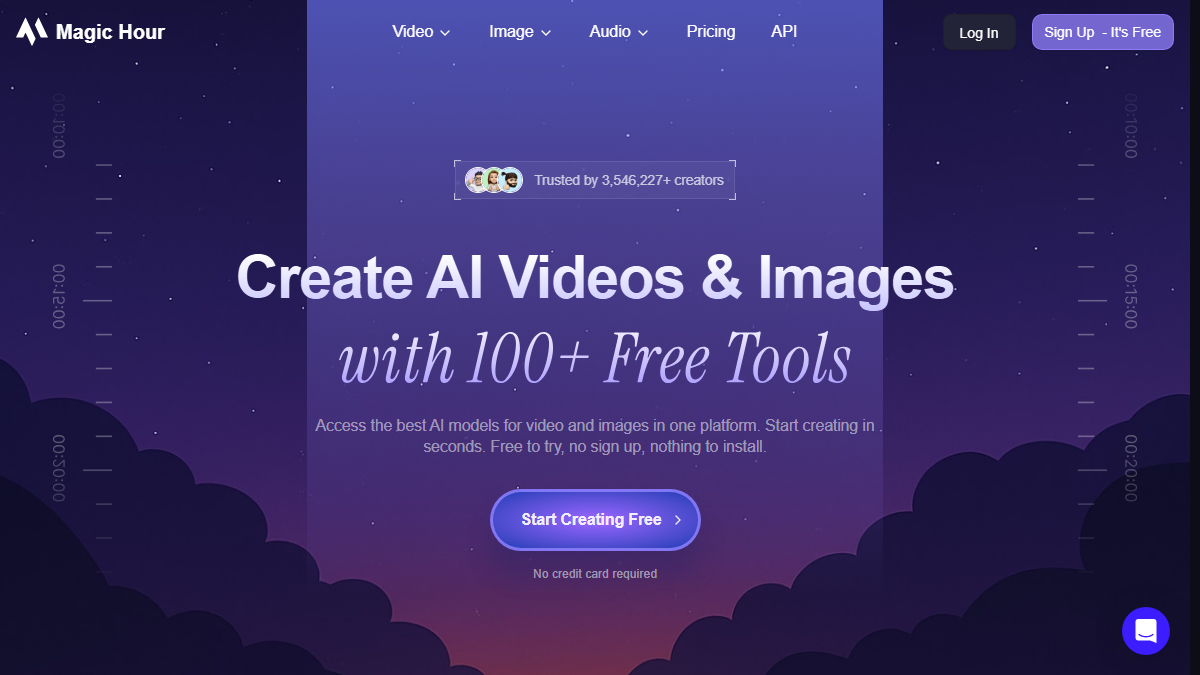
Magic Hour is a one-stop AI video, picture and audio creation platform that integrates 100+ AI tools, covering WenSheng video, TuSheng video, face swap, lip synchronization, voice generation and other capabilities. The product is aimed at content creators, marketing teams, e-commerce brands, developers and enterprises, providing a complete path from free experience to enterprise-level APIs. Incubated by YC, used by 3 million+ creators and 2,000+ teams.
MagicHour
Core parameters and statistics
Magic Hour's official positioning is a "one-stop AI video, picture and audio creation platform" - it is not a single-function AI tool, but attempts to collect the entire creative process (generation, editing, enhancement, speech synthesis) into one product. The product is incubated by Y Combinator and is aimed at users from individual creators to enterprise-level developers.
| Projects | Public Information |
|---|---|
| Official positioning | AI video/picture/audio one-stop creation platform |
| Number of tools | 100+ AI tools |
| Coverage capabilities | Video generation, picture editing, audio synthesis, face changing, lip synchronization |
| Template Library | 10,000+ Templates |
| Deployment method | Web, Mobile, REST API + SDK (Python/Node/Go/Rust) |
| User scale | 3 million+ creators 2000+ team |
| Well-known clients | Meta, NBA, L'Oreal, Puma, Cisco, Shopify, Dyson |
| Latest version | 2.2 (~2026-06) |
| Supported Platforms | Web, Mobile, API |
| Infrastructure | 99.9% uptime SLA |
Platform vs. single-point tools: The pricing page describes Magic Hour as "replacing a bunch of single-point tools." The core difference lies in using a set of subscriptions to cover face-changing, WenSheng video, TuSheng video, lip synchronization, voice cloning and other capabilities, reducing multi-tool switching and repeated payments. This "big and comprehensive" strategy lowers the cognitive threshold, at the cost of a single function not being as deep as a vertical tool.
Update rhythm: The official claims that "new models and new features are released every week." Combined with the YC background and rapid iteration style, the functional boundaries of the product are still expanding rapidly.
Magic Hour users and market recognition
Magic Hour's market verification mainly comes from user scale, brand customers and community reputation, rather than public revenue data.
User scale: The homepage publicly displays "3,528,134+ creators" (dynamic counting) and "2,000+ team adoption", indicating that it has passed the early verification stage and entered the scale growth period. The enterprise client list includes well-known brands such as Meta, NBA, L'Oreal, Puma, Cisco, Deel, Shopify, Dyson, DAZN, etc., covering sports leagues, consumer products, e-commerce platforms and technology companies.
Community reputation: The official website displays a large number of user reviews from X (Twitter), LinkedIn, Product Hunt, and Google Reviews. Several comments mentioned that "after using Magic Hour, the video received 1.1k+ views" and "became the fastest growing tool for the channel", implying that it has a quantifiable communication effect in the short video creation scenario. The NBA’s Dallas Mavericks have been cited many times as an example of a creative team using Magic Hour to create anime-style event promotions.
Industry Signal: The Adobe PM of the Dallas Mavericks publicly commented on LinkedIn that "the Mavericks may be one of the first NBA teams to use generative AI in game day production," indicating that Magic Hour has penetrated into the actual production process of the sports entertainment industry.
Prerequisites for implementation: The value of platform tools is most obvious among teams with "diversified creative needs but small single volume"; for teams that have already built a professional video pipeline (Premiere + After Effects + dedicated plug-ins), the replacement cost is higher than the tool price difference.
Cost Advantages of Magic Hour
The cost advantage of Magic Hour is not the "absolute low price", but the replacement of the superimposed costs of multiple single-point AI tools with one subscription. The pricing page clearly positions it as "cheaper than a professional tool and covers the entire creative process."
C-side/Individual: Provides free version, you can try some tools without registration, and free points are given every day. The paid version is divided into three levels:
- Creator Edition: SGD 14/month (annual payment), 120,000 points/year, about 1.4 hours of video or 24,000 pictures, no watermark, 1024px resolution, 3 concurrent tasks.
- Pro version: SGD 32/month (annual payment), 300,000 points/year, about 3.5 hours of video, 1472px resolution, 5 concurrent tasks.
- Business Edition: SGD 88/month (annual payment), 840,000 points/year, about 9.7 hours of video, 4K output, unlimited concurrency.
Developer/API: API access is included in the above subscription. There is no additional basic fee and is billed based on point consumption. There are also Credit Pack recharge packages: $10 (4,000 points), $30 (12,000 points), $75 (30,000 points), and the points never expire.
Enterprise: Enterprise pricing needs to be confirmed by contacting the business, and supports customized deployment, higher quotas and SSO integration.
Hidden costs: The output of the free version is watermarked; the point consumption speed varies by tool (for example, Video-to-Video consumes about 2.86 times per minute than Text-to-Video); the Business version can only achieve unlimited concurrency in high concurrency scenarios. Points can be accumulated across months and errors can be refunded. These terms reduce the risk of waste.
Main features of Magic Hour
Magic Hour organizes 100+ tools into three categories: video, pictures, and audio. The core capabilities can be summarized into the following six categories:
- AI video generation and editing: including Text-to-Video (Vincent Video), Image-to-Video (TuSheng Video Animation), Video-to-Video (Video Style Transfer), AI Video Editor (Natural Language Instruction Editing), AI Video Upscaler (Video Upscaling to 4K). The actual value lies in the direct production of short film material using a sentence or a picture, eliminating the need for traditional shooting or editing.
- Face Swap and Character Replacement: Face Swap Video/Photo (replace the face in the video/picture with a single image), Character Replace (replace the character in the video), Head Swap (head replacement), Body Swap (body replacement). Suitable for creative short films and brand co-branded content production; output quality is affected by the clarity and light matching of the reference image.
- Lip sync and voice driver: Lip Sync (synchronize any face with audio, support multiple languages), Talking Photo (upload photos + audio, generate speaking videos), AI Voice Cloner/Generator (voice cloning and text-to-speech). The linkage effect of this set of tools is obvious - first use voice to generate copywriting and dubbing, and then use Lip Sync to match it to the virtual character. A complete "virtual anchor" short film can be completed in a few minutes.
- AI image generation and editing: AI Image Generator (400+ styles), AI Image Editor (natural language image retouching), Background Remover (background removal), AI Image Upscaler (4x super score), AI Clothes Changer (clothing replacement), AI Headshot Generator (professional avatar generation). The actual value of image capabilities is in e-commerce scenarios: product image shooting, model dressing, and background replacement are all completed on one platform.
- AI audio tools: Voice Generator (text-to-speech), Voice Cloner (voice cloning), AI Music Generator (AI music generation), Voice Changer (voice changer). Audio tools provide support for video creation - no need to connect to a separate TTS or music generation service.
- Templates and one-click workflow: 10,000+ preset templates, covering common formats such as social media, e-commerce advertising, brand videos, etc. Users can apply and replace materials with one click. mold
The value of the board system lies in "not starting from scratch", which is especially suitable for social media operators with high daily update frequency.
Function linkage example: A typical path for a social media short video - first use AI Image Generator to generate product images → AI Clothes Changer to change clothes → Image-to-Video animation → Voice Generator with commentary → Lip Sync to match the mouth shape of the avatar. There is no need to leave Magic Hour or start other software during the entire process.
Magic Hour’s model and version evolution
Magic Hour adopts a "weekly update" rapid iteration strategy on the model side, rather than the traditional annual release of major versions. The product page shows that it integrates a variety of AI models (including Vincentian pictures, Vincentian videos, speech synthesis, etc.), and has an independent Model Leaderboard page for users to compare the output quality of different models.
Version context:
- v1.0 (~2025-03): Initial version, focusing on Wensheng video and basic video editing functions, launched as a single-point tool.
- v2.0 (~2026-01): Expanded to Tusheng video, video frame filling and face changing capabilities, moving from "Vension video tool" to "Multi-modal creation platform".
- v2.2 (~2026-06): Added real-time video style preview, batch processing and more efficient rendering pipeline, with the number of tools exceeding 100+.
Model Strategy: Magic Hour’s differentiation lies not in self-developed basic models, but in model orchestration and productization – packaging multiple open source/commercial models into a unified product experience, so users do not need to understand the differences in underlying models. The Model Leaderboard page exposes the performance of different models on specific tasks, reducing the cost of selection.
Update risk: Frequent updates mean that API endpoints and output styles may undergo incompatible changes. Enterprise-level users should upgrade the integration after staging verification.
Technical advantages of Magic Hour
Magic Hour's technical route is built around "unified platform + flexible orchestration" rather than a single model performance competition.
Unified inference pipeline: 100+ tools share the same set of rendering queues and media processing pipelines, so users do not need to separately configure the contextual parameters of each model. Parallel generation (Business version has no concurrency limit) and queue scheduling behave the same on the web side and the API side.
API-first architecture: REST API provides the same set of capabilities as the web side, and the official SDK supports Python, Node.js, Go, and Rust. The pricing page mentions that "authentication will be completed and generation will begin within 60 seconds" to reduce access resistance for developers. The API side provides 99.9% uptime SLA, suitable for production-level integration.
Points Economic System: Points are a unified unit of measurement, covering different resource dimensions such as video seconds, number of pictures, and audio duration. Points can be refunded for incorrect operations, and monthly points can be accumulated without expiring. These designs reduce the user's "trial and error cost" - encouraging frequent use rather than saving points.
Automatic template adaptation: 10,000+ templates cover the recommended sizes of major social platforms (TikTok 9:16, YouTube 16:9, Instagram 1:1, etc.). After users upload materials, the output format is automatically adapted to reduce manual cropping work.
Technical limitations: Due to the large number of tools, some long-tail tools may be maintained and updated less frequently than core tools. The output stability and style consistency when relying on third-party models are not as controllable as the end-to-end self-developed solution.
How to use Magic Hour
Magic Hour provides three usage methods: web, mobile and API, covering different needs from zero threshold to deep integration.
| How to use | Suitable for everyone | Steps to get started | Features |
|---|---|---|---|
| Web side | Personal creator, marketing operation | Visit magichour.ai → Select tool → Upload/enter content → Generate | No registration required to try, daily free points |
| Mobile | Social media operation, mobile office | Browser access or PWA added to home screen | Review and publish anytime, anywhere |
| REST API + SDK | Developer, Enterprise Integration | Register API Key → Install SDK → Call Endpoint | Python/Node/Go/Rust, 99.9% SLA |
Typical web process: Take creating an instagram Reels as an example - select a template → replace pictures or video materials → edit copy (AI-assisted generation) → add background music (AI Music Generator) → output with one click, which takes about 3-5 minutes.
API Quick Integration: Magic Hour’s API documentation provides endpoint-level examples, taking Image-to-Video as an example:
from magic_hour import Client
from os import getenv

client = Client(token=getenv("MAGIC_HOUR_API_KEY"))

res = client.v1.image_to_video.generate(
  style={"prompt": "waves crashing"},
  assets={"image_file_path": "/path/to/image.png"},
  end_seconds=15,
)
Implementation Suggestions: Individual creators should start with the free version on the web to verify the effect, and confirm that the output quality meets the requirements before upgrading and paying; corporate teams should give priority to doing PoC through the API (it is recommended to choose 1-2 high-frequency scenarios, such as Face Swap or Lip Sync), and test the concurrency limit and output consistency before signing a business-level contract.
Product Pricing for Magic Hour
Magic Hour adopts a hybrid pricing of "point subscription + recharge package", covering four levels: free experience, personal subscription, team purchase and API consumption.
Free version: Give away free points every day, no need to bind a credit card, and no need to register to try out some watermarked versions of the tools. Suitable for verifying output quality and workflow fit.
Subscription Plan (Annual Paid SGD):
- Creator SGD 14/month: 120,000 points/year, 1024px output, 3 concurrency, 2GB upload, no watermark, commercial license.
- Pro SGD 32/month: 300,000 points/year, 1472px output, 5 concurrency, 5GB upload, priority queue.
- Business SGD 88/month: 840,000 points/year, 4K output, unlimited concurrency, 10GB upload, full API permissions.
Credit Pack: $10 (4,000 points), $30 (12,000 points), $75 (30,000 points). Points never expire, and points can be refunded if you make any mistakes. Suitable for temporary replenishment after the subscription plan points are exhausted.
API Pricing: API usage is counted into the subscription point pool, and there is no independent call fee. Enterprise SLA (99.9% uptime) included with Business edition.
Refund Policy: You can apply for a one-time refund within 7 days and if you use less than 500 points.
Purchasing Judgment: For creators whose monthly video output is less than 10 minutes, the Creator version is the most cost-effective; for brand teams pursuing 4K output, the Business version is a must-have option; the Credit Pack is suitable for peak month replenishment, but long-term dependence is not recommended (the unit price is higher than the subscription).
Magic Hour application scenarios
The "big and comprehensive" feature of Magic Hour allows it to cover far more creative scenarios than a single tool, but not all scenarios are equally efficient.
- Social media short video creation: Creators use Text-to-Video or Face Swap to quickly produce TikTok/Reels/Shorts content. Official user cases show that a creator's single video received 1.1k+ views. The benefits are reflected in the compression of the time "from idea to release" from hours to minutes.
- E-commerce product visual production: After shooting the product, use Background Remover to remove the background → AI Image Editor for color matching and copywriting overlay → Image-to-Video for dynamic display material → AI Clothes Changer to quickly generate multi-color variations. A complete product image video can be completed in 15 minutes, whereas the traditional process requires hours of collaboration among photographers, retouchers, and video editors.
- Brand Marketing & Creative: The marketing team used Lip Sync and Talking Photo to create multilingual ad variations without the need for reshoots. AI UGC Ad Generator turns product information into ad creatives that mimic the style of user-generated content. The key acceptance metric for this scenario is "the marginal cost of generating multilingual versions of a piece of material."
- Old photo and old video restoration: AI Image Upscaler (4x super resolution), Photo Colorizer (colorization) and AI Video Upscaler are used in combination to restore low-resolution home videos or historical images to publishable quality. Ideal for content archives, media organizations, and family history organizing scenarios.
- Educational Content Production: Teachers or training teams use Text-to-Video to convert lesson plans into short videos, Talking Photo to create virtual lecturers, and Voice Generator to dub. The benefit is that there is no need for professional recording and broadcasting equipment and a post-production team.
Not suitable for scenes: For professional film and television post-production that requires frame-by-frame fine control (such as color correction, special effects synthesis, multi-track audio mixing), Magic Hour is not a substitute; for scenes that require highly customized character animation or 3D rendering, it is recommended to use professional tools such as Blender or Unreal Engine.
Magic Hour is suitable for people
Magic Hour's "full-stack" product design makes it suitable for multiple roles, but the value points and pitfalls of different roles are obviously different.
- Personal Content Creator: The core value is to use the lowest learning cost to produce short videos that conform to the platform format. Magic Hour’s templates + one-click workflow generation eliminates the learning curve of traditional editing software. Prerequisites: Accept that the output quality is limited by the model's capabilities, and scenes that require frame-by-frame control require additional tools.
- Social media operations and marketing staff: The core value is to batch produce different versions of materials for A/B testing. Parallel Generations (unlimited concurrency in Business Edition) makes it possible to generate multiple variants simultaneously. Acceptance focus: Whether the brand visual consistency can be accurately controlled through the prompt words of AI Image Editor, or does it require manual adjustment in the later stage.
- E-commerce and Brand Team: The core value is to reduce reliance on studios, models and outsourced editing. AI Clothes Changer and Background Remover can significantly shorten the visual material preparation cycle before products are put on shelves. Usage restrictions: The fidelity of clothing replacement is affected by the angle and light of the reference image. It is recommended that core categories (such as luxury goods and high-end beauty products) be reviewed manually before going online.
- Developers and Product Team: The core value is to embed AI creation capabilities into own product processes through APIs. Magic Hour's SDK covers four mainstream languages, lowering the integration threshold. Prerequisites: It is necessary to evaluate whether the API response time meets the requirements of real-time scenarios, and the cost predictability of the points consumption model in high concurrency scenarios.
- Educators and Students: The core value is to produce instructional videos and presentation materials at a very low cost. The free version meets basic needs. Limitations: Large-scale deployment by educational institutions requires confirmation of user management and SSO support for Business Edition, as well as copyright attribution terms for generated content.
Not suitable for people: Professional film and television post-production teams (heavy users of Final Cut Pro / DaVinci Resolve), producers who need ultra-realistic 3D character animation, and professional broadcasters that require output resolutions exceeding 4K.
Summary and Outlook
Magic Hour's core competitiveness lies in "using one platform to cover the complete creative process of AI video, pictures and audio", rather than pursuing the ultimate output quality in a single dimension. The combined effect of 100+ tools - such as Face Swap + Lip Sync + Voice Generator, which connects a complete workflow of "virtual character oral broadcasting" - is the essential difference from single-point tools.
Current limitations: The greater the number of tools, the harder it is to ensure the iteration depth and maintenance quality of a single tool; some long-tail tools may not be as stable as head tools. Some capabilities that rely on third-party models (such as the style consistency of Vincent's videos) are still changing rapidly, and the output performance may not be stable enough in the short term. A high-frequency update strategy means higher regression testing costs for users of API integrations.
Follow-up observation points: Whether Magic Hour's "weekly updates" can continue to improve model quality; the actual SLA fulfillment of enterprise-level APIs in high-concurrency scenarios; whether the Model Leaderboard can guide users to choose the most suitable model instead of using the latest version by default.
Purchasing and Adoption Recommendations:
- Individual creators/small teams: Start with the free version or Creator version, and spend 1-2 weeks to verify whether the output quality of the core tools meets the content standards. Focus on testing the output consistency of Face Swap (such as portrait face swapping) and Text-to-Video (such as quick short video generation).
- Brand/e-commerce team: It is recommended to conduct a 1-month trial run on a single category with the Business version to quantify the reduction in time "from shooting to shelves" before deciding whether to expand to all categories. Before signing a contract, you need to confirm the actual availability of 4K output in the Business version (whether it is limited by the point consumption rate).
- Developer/Enterprise Integration: First connect 1-2 high-frequency endpoints (such as Image-to-Video or Lip Sync) through API for technical verification, and test end-to-end latency, concurrency limit and error retry behavior. The enterprise contract needs to focus on confirming the fault response time and points refund mechanism in the SLA terms, as well as the API compatibility commitment when the model version is updated.
Related tools: runway, pika
Version Info
- Magic Hour 2.2 :Added real-time video style preview and batch processing functions to optimize rendering speed. There is no official precise date yet.
- Magic Hour 2.0 :Introducing Tusheng video and video frame filling functions to expand the boundaries of creative capabilities. There is no official precise date yet.
- Magic Hour 1.0 :The initial version focuses on Wensheng video and basic video editing functions. There is no official precise date yet.
User Reviews