 Mem0
Free
Mem0
Free
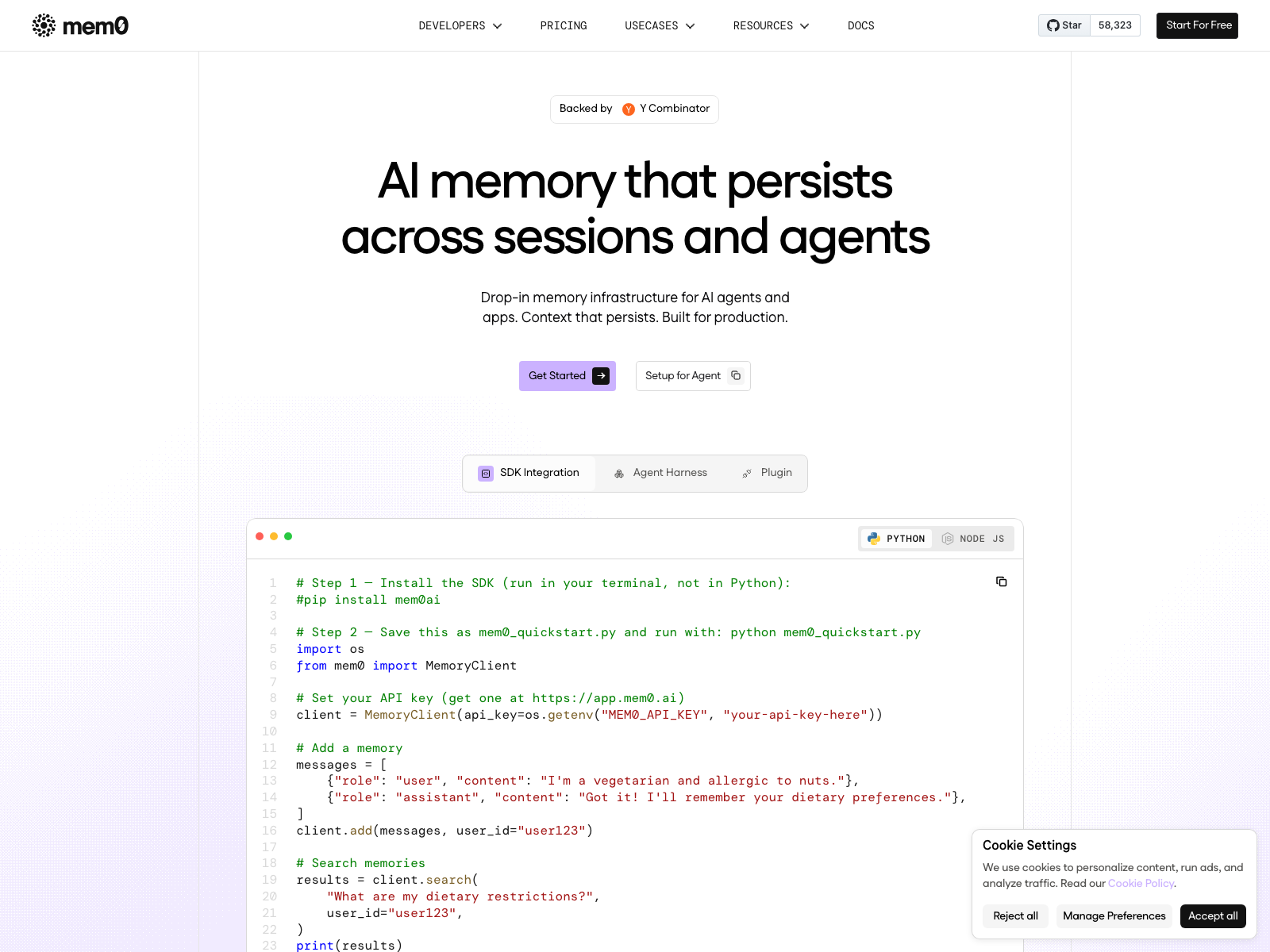
Mem0 provides a pluggable memory layer that supports session summarization, preference extraction and long-term memory retrieval, making it suitable for building continuous interactive AI products.
Mem0
Core parameters and statistics
Specific technical parameters (such as model size, context length, supported file formats, input and output restrictions, etc.) are subject to the official product page. It is recommended that users verify the latest technical specifications and system requirements before choosing to ensure that they match their own usage scenarios.
User and market recognition
Developer Approval: The official website disclosed that 90,000+ developers have connected, indicating that Mem0 has accumulated significant technical influence in the segmented track of AI Agent memory. The activity of GitHub's public repositories and Issue discussions further prove its popularity in the community.
Product Positioning Approval: The market positions Mem0 as an "AI Agent memory infrastructure layer" rather than a universal retrieval or RAG product. The difference between it and vector databases (such as Pinecone, Weaviate, Qdrant) is that the latter is only responsible for storage and similarity retrieval, while Mem0 is also responsible for automatic extraction, deduplication, update and expiration management of memory - this is a complete layer of memory life cycle management.
Production Verification Prerequisite: Public numbers can illustrate the scale of adoption, but they cannot replace "memory hit quality in your business" verification. The memory requirements of different scenarios vary greatly - the customer service scenario focuses on the accurate extraction of historical orders, the education scenario focuses on the continuity of learning progress, and the sales scenario focuses on the evolution of lead preferences. It is recommended that the team set its own acceptance indicators before accessing: memory hit rate (≥85% is initially usable), false recall rate (≤5% is acceptable), and repeated question reduction rate (optimization direction).
Cost advantage: Hidden benefits and governance costs brought by the memory layer
The cost analysis of Mem0 must distinguish between the three layers of C-end/individual, developer/API and enterprise/privatization, because the benefit structure and hidden costs of the three layers are completely different.
C client/individual:
- Significant benefits: For individual users, Mem0 enables the AI assistant to remember preferences and context across sessions, reducing the number of repeated descriptions of personal information (such as "I live in Beijing" and "I like simple style"), saving 200-500 tokens in context splicing overhead per conversation.
- Free Tier: Usually there is a free limit. During the trial period, individual developers can verify the quality of memory extraction before deciding whether to pay.
Developer/API:
- Significant benefits: Reduce repeated context splicing and token consumption; improve multi-round conversation continuity and reduce users' repeated questions; shorten the personalized experience establishment cycle - new users can get the "getting to know you" experience on their first interaction, rather than starting from scratch.
- Hidden Cost: False recall may lead to wrong suggestions, and the business risk is higher than the technical risk (such as pushing internal training to resigned employees); old memory pollution will continue to affect the quality of subsequent answers; improper configuration of memory deduplication and update strategies will cause Agent behavior drift.
- Cost-performance evaluation: Compared with self-built memory systems, Mem0 saves the development and maintenance costs of memory extraction pipeline, deduplication logic, retrieval sorting and expiration strategies. It usually takes 2-4 engineers 3-6 months to build a production-level memory layer, and it takes about 1-2 days to connect the Mem0 SDK.
Enterprise/Privatization:
- Compliance and Risk: When personal sensitive information is involved, the memory life cycle, desensitization strategy and auditable deletion mechanism need to be clarified. SOC 2/HIPAA compliance certification can reduce compliance review costs for enterprise procurement, but specific coverage needs to be confirmed in the contract.
- Implicit governance costs: The governance costs of the right to delete (GDPR "right to be forgotten") and retention policies are not low. Enterprises need to ensure that the memory layer supports complete deletion at user granularity, memory version traceability, and memory audit log export.
- Procurement/Adoption Risk Assessment: Enterprises need to verify three points before purchasing - the storage location and data sovereignty of the memory data (whether the cloud service is in the target region), whether the memory will be used for secondary training of the model (confirm that there is no such clause in the contract), and the version update strategy and SLA for privatized deployment. Memory is a data asset, and data governance clauses are the focus of contract review.
Main functions of Mem0
Memory writing (Add)
- Function: Takes natural language or structured input and converts it into retrievable memory entries.
- Technical mechanism: Vectorize the input text through the embedding model, combining timestamp, source context and metadata storage. Supports multi-level scope isolation such as
user_id,session_id,agent_id, etc. - Acceptance concerns: Write delay embedding consistency, multi-language support. Whether the extraction accuracy of Chinese memory is consistent with that of English needs to be tested in the target language.
Memory learning and updating (Learn/Update)
- Function: New information can automatically overwrite or merge old memories to avoid redundant accumulation of entries.
- Technical Mechanism: Through deduplication algorithm and weight calculation, determine the relationship between new input and existing memory - whether it is a supplement, correction or addition. Supports manual specification of memory importance (importance) and expiration time (TTL).
- Acceptance concerns: Whether the deduplication policy configuration meets business needs (such as whether the old address retains historical records after the address is changed), and whether the updated memory version is traceable.
Memory retrieval (Search / Retrieve)
- Function: Recall the historical memory most relevant to the request based on the current conversation context.
- Technical mechanism: Multi-signal fusion retrieval - semantic similarity + time decay + importance weight + metadata filtering. Supports fine control parameters such as
limit,threshold, andcategories. - Acceptance concerns: The tradeoff between recall accuracy and delay (larger top_k improves recall but increases LLM context burden), whether the time decay curve is consistent with business intuition (such as recent preference weighting is greater than long-term preference).
Memory Governance
- Function: View, edit, delete, export and audit memories.
- Technical mechanism: Provide REST API and SDK methods for memory management. Supports batch operations by user/session/time range.
- Acceptance concerns: Whether the deletion operation is complete (hard deletion vs soft deletion), whether the audit log is complete (who viewed whose memory when).
Hidden linkage (expert perspective)
- Extraction strategy determines memory quality: If key information cannot be accurately extracted when writing, subsequent retrieval will be meaningless even if it is perfect. The write strategy should have higher optimization priority than the retrieval strategy.
- Retrieval strategy determines hit accuracy: Multi-signal fusion can improve recall rate, but may also introduce more noise. Thresholds and weights need to be adjusted according to business scenarios.
- Update strategy determines long-term stability: An overly aggressive coverage strategy will lead to memory loss, and an overly conservative deduplication strategy will lead to storage expansion and retrieval noise. It is recommended that newly launched scenarios first adopt the strategy of "new additions as the main focus and coverage as the supplement", and then gradually enable automatic merging after observing for 2-4 weeks.
- When the three are well linked, the Agent can form a stable "personality and business memory" - users can experience a consistent personalized experience at different times and on different devices. Otherwise, answer drift will occur, that is, the same user continuously asks the same type of questions and gets inconsistent answers.
Mem0 model and version evolution
The version iteration of Mem0 is mainly driven by capability updates rather than large version numbers. The following is a publicly verifiable version:
| Version | Time | Key changes |
|---|---|---|
| Initial public version | Unpublished | Early version information has not been fully disclosed, it is recommended to refer to the official update log |
| v1.3 | 2026-06 | Continuously optimize stability and developer experience. Specific capabilities are subject to official real-time release |
It is recommended to track three categories of evolution, because these three categories directly determine the credibility of production context:
Memory extraction strategy update
Affects writing quality. Each adjustment to the extraction strategy may change the granularity (such as whether tone information is retained) and accuracy of the memory entries. It is recommended to compare the hit rate changes of the new and old strategies in the staging environment before going online.
Search strategy update
Affect recall accuracy. Changes in the weights of multi-signal fusion, time decay curve parameters, and threshold default values will directly affect the production of contextual memory recall performance. Producers should fix the search strategy version to avoid fluctuations in online performance that cannot be traced back.
Compliance Governance Update
Affect the feasibility of enterprise implementation. The coverage update of SOC 2/HIPAA certification, the enhancement of data deletion API, and the perfection of audit logs are key observation points to evaluate whether Mem0 can enter the compliance scenario.
Mem0’s technical advantages
Memory compression and structuring
Mem0's core technical advantage lies not in storage, but in compression - distilling unstructured information in raw conversation text into retrievable preference/fact/context entries. This process includes three steps: denoising (filtering colloquial redundancy), deduplication (merging multiple expressions of the same preference), and structuring (distinguishing long-term preferences from temporary intentions).
Mechanics → Effects: Compression ratios typically range from 10:1 to 30:1 (varying based on dialogue complexity), meaning 50 rounds of dialogue can be compressed into 2-5 effective memory entries. LLM only loads these compressed memories for each request, rather than the full session history.
Multi-signal fusion retrieval
Traditional semantic retrieval only relies on embedding cosine similarity. On this basis, Mem0 introduces time decay (recent memory has a higher weight), importance weighting (users/developers can mark important memories), and metadata filtering (filtering by scene/category).
Mechanism → Effect: Multi-signal fusion reduces the probability of false recall of "semantically similar but context-independent". For example: a user mentioned "wanting to buy cat food" a month ago, and today asked "recommended useful facial cleanser" - pure semantic search may mistakenly recall "cat food" (because they are all related to shopping), but the integration of time decay and category filtering can more accurately match current needs.
Enterprise Controllability
Mem0's multi-level scope (user_id / session_id / agent_id) and memory audit capabilities form the governance foundation for enterprise implementation. Combined with the self-hosted deployment option, data sovereignty and network isolation are guaranteed.
Effect → Applicable Scenario: The isolation of these three granularities means that the memories between different users are naturally separated, and memories can also be shared or isolated between different Agents (such as customer service agents and sales agents). This directly determines the architectural complexity in multi-tenant products (SaaS) and department-level Agent deployments.
How to use Mem0
Quick access (Python SDK)
from mem0 import Memory

# Initialize the memory layer (use local configuration by default; for production purposes, it is recommended to configure external vector storage)
m = Memory()

# Write to memory: automatically extract preferences/facts from natural language
m.add(
    "The user Zhang Ming is the purchasing manager of a Beijing company and prefers Japanese simple style home products",
    user_id="user_zhangming"
)

# Retrieve memory: recall relevant memories based on the current context
results = m.search(
    "What style of furniture does this user like?",
    user_id="user_zhangming"
)
# Return: ["User Zhang Ming is the purchasing manager of a Beijing company and prefers Japanese simple style home products"]
Complete access steps
- Install SDK:
pip install mem0(subject to the official PyPI). - Configure backend storage: Mem0 uses local storage by default. For production environments, it is recommended to configure an external vector database (such as Pinecone, Qdrant, Weaviate) to obtain persistence and high availability. Configuration is passed in through initialization parameters or contextual variables.
- Define memory strategy: Clarify before business access - which information needs to be remembered (whitelist), which information should not be remembered (blacklist), the memory retention period (TTL), and whether manual review of memory entries is required.
- Insert writing logic at key nodes:
m.add()is usually triggered when the selection dialogue ends, the user confirms the information changes, or the system determines that the user has expressed a clear preference. The writing frequency should not be too high, otherwise noise will be introduced. - Insert retrieval logic before inference: Execute
m.search()before each LLM call, and splice the retrieved memory into the system prompt or context front. It is recommended to start parameter adjustment from 5 for the retrieved top_k, and adjust it according to the hit rate and token overhead. - Evaluation Iteration: Use real conversations to evaluate memory hit rate (whether the retrieval content is relevant to the current question), false recall rate (whether the retrieval content misleads the answer direction), and repeated question reduction rate (whether the user no longer repeats the same type of questions). It is recommended to run on two tracks in the first two weeks - use Mem0 and the original memoryless version at the same time, and then decide to switch in full after comparing key indicators.
Tool list (Tool open list)
Mem0 exposes the following core Tool behaviors to LLM applications, forming a complete memory management solution:
| Tool name | Function | Calling time |
|---|---|---|
add |
Write to single or batch memory | When user expresses preference/fact change |
search |
Retrieve memory based on semantics and metadata | Before each LLM inference |
get |
Get the details of the specified memory entry | When you need to view the original text of the memory |
update |
Update existing memory entries | When information changes and need to be corrected |
delete |
Delete the specified memory entry | When privacy compliance or accidental writing |
reset |
Clear all memory for the specified user/session | When testing or when the user requests a reset |
history |
Get memory change history | For auditing and debugging needs |
Architecture link
User input → LLM application → [Mem0 SDK: search() retrieves related memories]
                                   ↓
                          Memories are spelled into prompt context
                                   ↓
                        LLM generates answers (perceptual memory)
                                   ↓
                        [Mem0 SDK: add() extracts new memory]
                                   ↓
                          Vector Storage ← Persistence
Control flow: Each user interaction triggers a retrieve → generate → write cycle. Data reflow: The timeliness and importance of memory items are dynamically updated in continuous interactions.
Engineering Pitfall Guide
- Memory pollution and Token inflation control: Unrestricted memory writing will cause storage expansion, and too many memory entries returned for each retrieval will overwhelm the context. Solution - Set a
max_memories_per_userupper limit (50-200 items are recommended), enable automatic deduplication and expiration policies, and usethresholdto filter low-relevance entries. Introducing memory compression (merging multiple similar memories into one generalized memory) for highly active users. - False recall leads to answer bias: Irrelevant memories in the retrieval results may produce wrong answers after being adopted by LLM. Solution - lower
thresholdinsearch()and increasetop_kto let LLM judge the relevance by itself (requires a strong enough basic model), or introduce an independent reranker component to secondary sort the search results. Production Context recommends retaining the "no memory fallback" logic - if the total length of all memories retrieved exceeds 30% of the context budget, only the memory with the highest score is retained. - Privacy Compliance and Data Governance: Cross-user/cross-Agent memory isolation vulnerabilities may lead to the disclosure of sensitive information. Solution - Strictly use
user_id/session_idto isolate different user memories, set confirmation points or dry-run mode for irreversible deletion operations (delete/reset), and enable audit logs in production environments. Scenarios involving GDPR/CCPA need to ensure the hard deletion (not soft deletion) capabilities and data export (portability) capabilities of the deletion API.
Product Pricing for Mem0
The pricing model is subject to the official real-time page. Usually a freemium or subscription system is used, and basic functions can be used for free. Advanced functions or high-frequency use require paid subscriptions, and users are advised to evaluate the optimal solution based on actual usage.
Mem0 application scenarios
Personalized customer service and member service
Task type: Automatic extraction and reuse of user historical preferences. Benefits: There is no need to repeatedly tell the identity and preferences in new conversations. The Agent can automatically obtain user levels, historical orders, complaint records and other contexts from the memory layer. The key point of verification is whether the memory extraction accurately distinguishes between "resident in Beijing" (long-term fact) and "going to Shanghai on a business trip next week" (temporary intention).
Long-term follow-up of sales leads
Task Type: Tracking customer preference evolution across sessions. Benefits: The sales agent automatically obtains the customer's historical behavior (products already understood, points of clear disinterest, budget range, etc.) before each contact to avoid repeated questions that bring negative experiences to customers. Key point of verification - How to configure the time decay parameter so that information "interested but decision-making completed 3 months ago" does not affect the current recommendation.
Educational learning trajectory management
Task Type: Continuous tracking of learners’ knowledge mastery. Benefits: The AI teaching assistant dynamically adjusts subsequent teaching content and difficulty based on the learner’s previous knowledge blind spots and knowledge points they have mastered. The key point of verification is whether the memory deduplication strategy will cause the knowledge points that learners have "mastered" and "still confused" to be incorrectly merged.
Medical and Compliance Dialogue (High Constraint Scenario)
Task type: Information management under strict memory management. Benefits: Complete data isolation at patient granularity, auditable memory entries, and data deletion processes that comply with compliance requirements such as HIPAA are required at the memory layer. Verification focus - the actual coverage of compliance certification (whether the SOC 2 Type II report can provide HIPAA's BA agreement and whether it is signed).
Applicable people of Mem0
- AI Agent Product Team: Developers and product managers who need to build long-term memory capabilities for Agent. Mem0's open source SDK can be quickly integrated, eliminating the engineering investment of building a self-built memory extraction and retrieval pipeline. Prerequisite - The team has determined that the usage scenario of the Agent requires cross-session memory (rather than separate conversations each time).
- Conversational SaaS Platform: Platform-based products that need to provide personalized experiences for multi-tenant users. Mem0's user_id isolation mechanism is naturally adapted to multi-tenant architecture. Prerequisite - the platform already has a user system (user_id mapping) and is willing to bear the additional API call cost for the memory infrastructure.
- Enterprise AI Infrastructure Team: A technical mid-office team that needs to provide unified memory services for multiple business lines under a compliance framework. Mem0's audit logs, role isolation and self-hosted deployment capabilities meet enterprise governance needs. Prerequisites - The enterprise has or plans to build vector storage infrastructure, and the IT team has the ability to maintain a self-hosted version.
Not suitable for the crowd:
- One-time question and answer scenarios (such as single translation, single calculation) - the memory layer has no positive benefits in such scenarios, but instead introduces unnecessary API call delays and governance costs.
- Tool applications that do not require personalization or long-term contextual appeal - if each interaction is independent and the user's identity cannot be identified, the value of the memory layer will be zero.
- Security-sensitive scenarios that have extremely strict requirements for independent memory control and are unwilling to rely on external SDKs - at this time, self-built solutions based on local files or lightweight databases are more suitable.
Summary and Outlook
The core benefit of Mem0 is to transform session history into operational long-term assets. It is not just a storage tool like a vector database, but a complete memory life cycle management system - from automatic extraction during writing, to multi-signal fusion during retrieval, to deduplication and expiration management during updates. In continuous interaction scenarios (customer service, sales, education, personal assistants), it can simultaneously improve experience and efficiency; in one-time question and answer scenarios, the memory layer is unnecessary complexity.
Current Limitations and Uncertainties:
- The quality of memory extraction depends on the accuracy of the embedding model. The performance in Chinese/multilingual mixed scenarios needs to be verified by actual measurements. The official has not disclosed the accuracy comparison data in different languages.
- False recall management capabilities still rely on the developer's parameter adjustment experience, and there is a lack of automated false recall detection and correction mechanisms. Community feedback shows that false recalls are the most common complaint point in the production environment.
- The specific coverage of compliance certification (SOC 2/HIPAA) (which functions have passed the audit) has not been fully disclosed by the official, and enterprises need to confirm it in the contract before purchasing.
- Memory consistency in high-frequency interaction scenarios - memory synchronization delay and conflict resolution strategies across devices/sessions for the same user. Official documents do not provide clear technical instructions.
Follow-up key observations: The multilingual improvement of memory extraction quality, the evolution of automatic false recall management capabilities, the completeness and certification coverage of compliance functions, and the performance differences between different Agent types in cross-scenario memory stability.
Implementation Suggestions: It is recommended to use the open source version to conduct a small-scale pilot on 1-2 high-interaction scenarios (goal: memory hit rate ≥85%, false recall rate ≤5%), verify the memory extraction accuracy and retrieval recall quality, and then decide whether to upgrade to the cloud service version. Before purchasing, enterprises need to confirm three key points: the storage location and data sovereignty of the memory data, whether the memory will be used for secondary training of the model, and the version update strategy and SLA terms of privatized deployment. For high-frequency interaction scenarios, it is recommended to provide PoC context and performance benchmark data during the business stage.
Related tools:  CrewAI,
  LangChain
Mem0 How to use
- Web client: You can use it by visiting the official website and registering an account. Most functions do not require installation.
- API Access: Provides RESTful API, developers can obtain the API Key and integrate it into their own applications.
Version Info
- first public release :The early version information has not been fully disclosed. It is recommended to refer to the official update log.
- Mem0 1.3 :Continuously optimize stability and developer experience. Specific capabilities are subject to official real-time release.
User Reviews