 MerusCase
MerusCase is a cloud-based legal practice management software focused on small and medium-sized law firms, especially in immigration law and personal injury cases, providing integrated case management, document automation and billing services.
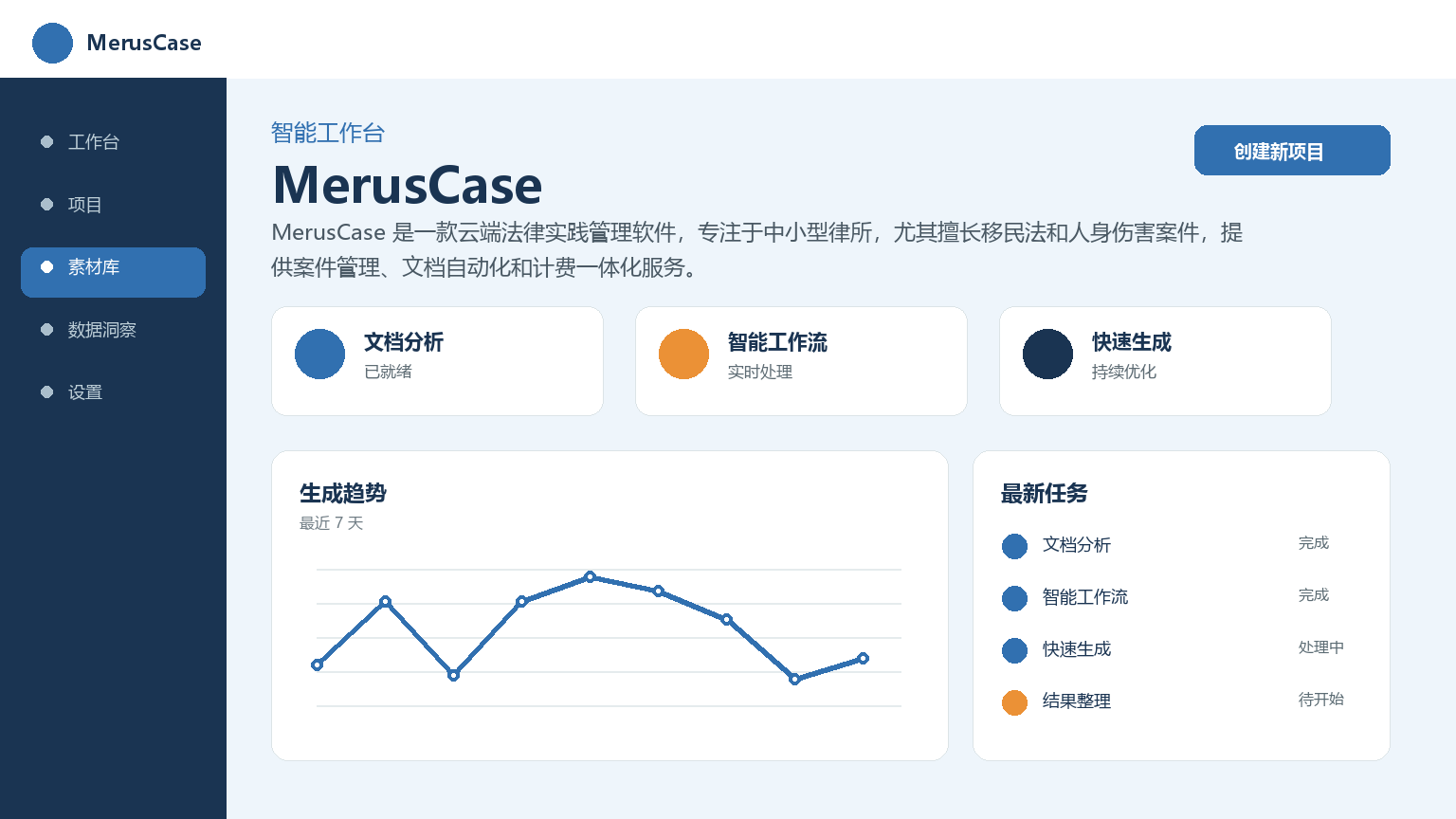
MerusCase
Core parameters and statistics of MerusCase
MerusCase is a cloud practice management platform that has been deeply involved in the US legal technology market for more than fifteen years. Its core positioning is not a "universal law firm management software", but a business operating system that provides deep adaptation for specific legal fields (immigration law, personal injury). The platform is delivered in SaaS mode and supports three-end access via Web, iOS and Android. The core modules cover case management, document automation and OCR, time billing, customer portal and compliance reporting. In the immigration law segment, MerusCase has established a native connection with the USCIS (United States Immigration Service) form system - including automatic filling, version tracking and fee update reminders for more than 20 common forms such as I-130, I-485, I-129, etc. This is a competitive barrier that is difficult to replace with general legal management tools.
| Projects | Public Information |
|---|---|
| Official positioning | Cloud-based legal practice management, for small and medium-sized law firms |
| Core areas of expertise | Immigration, Personal Injury |
| Secondary Support Areas | Criminal, Employment, Family Law, Workers' Comp |
| Deployment form | SaaS cloud, supporting Web / iOS / Android |
| Interface language | English, Spanish |
| Client size | Serving thousands of small and medium-sized law firms, with the highest proportion of immigration law users |
| Founded/Operated | Company Merus, Inc. Operating history dating back to 2008 |
| Latest version | MerusCase 2026 Edition (~2026-04) |
| API Availability | Developer API provided (RESTful, supports authentication and data integration) |
| Data security | Bank-Grade Security, unlimited storage space |
Positioning trade-off of "vertical deep cultivation vs. horizontal coverage": MerusCase voluntarily gave up general coverage of the entire legal field and concentrated its resources on the two high-process-density areas of immigration law and personal injury. The price of this trade-off is that if your business mainly involves corporate law, intellectual property or commercial litigation, MerusCase's customization capabilities will be significantly reduced, and competing products (such as Clio, MyCase) have more mature ecosystems in these areas. But conversely, for law firms that account for more than 60% of their immigration law practice, the USCIS form automation and case timeline tracking provided by MerusCase cannot be directly replaced by any general platform.
Customer experience reputation: The official case page shows multiple customer reviews - some law firms reported that "productivity doubled", "expenses dropped significantly", "from paper office to completely paperless using only one batch scanning function". This means that the actual benefits of the platform in document management and process standardization have a verifiable basis for recognition among the customer base.
Positioning differences from products in the same track: If the U.S. legal practice management market is divided into two dimensions: "general vs. vertical" and "large vs. small and medium-sized", MerusCase falls in the "vertical + small and medium-sized" quadrant. Clio occupies the "General + Full Scale" quadrant, PracticePanther is biased toward "General + Small and Medium", and Filevine is laid out in the "Vertical + Large" direction. This difference in positioning means that MerusCase’s competitors are not Clio itself, but tools that also target the immigration law vertical track (such as Docketwise, LawLogix), as well as the law firm’s own combination of Excel + email + third-party form tools.
Users and market recognition of MerusCase
MerusCase's market recognition is characterized by "solid customer reputation and limited quantitative data" - there are few publicly verifiable hard data such as financing amount, total number of customers, market share, etc., but the consistency of its long-term operating history and customer evaluations constitutes the underlying support for its market reputation.
Operating years and market precipitation: The company Merus, Inc. has been operating since 2008 and is an "old player" in the legal technology industry. More than fifteen years of continuous operation means that its products have spanned multiple technology cycles (from desktop to cloud, from local database to mobile-first), and the continuity of customer data and migration costs constitute natural retention barriers.
Customer Structure Inference: Judging from the client cases displayed on the official website, users are mainly small and medium-sized law firms (10-50 people), focusing on the two fields of immigration law and personal injury. The customer area is mainly the United States, and the interface supports Spanish, indicating that it has a clear intention to cover the Latino customer group.
Industry Benchmarking: In the U.S. legal practice management (LPM) market, MerusCase is positioned in a "vertical segmentation" and forms differentiated competition with Clio (a general-purpose market leader, serving more than 150,000 law firms), MyCase (friendly for small and medium-sized law firms), and PracticePanther (mobile-first). MerusCase’s unique position is that it does not try to compete with Clio in all areas of law, but rather builds a functional moat in the vertical track of immigration law. The long-term risk of this strategy is that if growth in the immigration law market slows down or Clio invests heavily in immigration law capabilities, MerusCase's competitive space will be squeezed.
Reuse indicators in customer reviews: Many customers mentioned quantifiable benefits such as "doubling efficiency", "decreasing expenses", and "paperless office". Although these are subjective customer reviews rather than audit data, their consistency suggests that the platform does have reproducible value in document automation and process standardization.
The Cost Advantage of MerusCase: The Cost Tradeoff of Vertical Customization vs. Generic Alternatives
MerusCase's pricing strategy does not pursue the "lowest price", but builds a value proposition around "hidden efficiency gains brought by vertical functions". Its cost structure needs to be evaluated from three dimensions: explicit subscription fees, implicit efficiency gains, and migration costs.
C-side/Personal Lawyer: The basic version starts at about USD 79/month/user, covering case management and basic billing. For an independent practicing immigration lawyer, if they handle 50+ cases per year, form automation can save 30-60 minutes of data entry time per case. Converted at an effective rate of USD 200/hour, the value that can be released per month is approximately USD 500-1000, which is much higher than the subscription cost.
Team Edition: Approximately USD 109-139/month/user, unlocks document automation USCIS form library and customer portal. Taking a five-person immigration law firm as an example, the monthly subscription cost is about USD 545-695. However, the reduction in rework costs due to reduced form errors, the reduction in communication time through the client portal, and the elimination of third-party document management tool fees due to unlimited storage constitute "hidden positive benefits."
Enterprise Edition: Negotiable pricing based on law firm size and customization needs. The main incremental costs are in data migration services, additional storage space, and advanced reporting modules. Updates and maintenance of the immigration form library are included in the subscription fee, and there is no need to purchase additional USCIS form update services.
Cost comparison with competing products:
| Cost Dimension | MerusCase | Clio (general competitor) | MyCase (competitor for small and medium-sized law firms) |
|---|---|---|---|
| Starting price (approx.) | USD 79/month/user | USD 85-125/month/user | USD 49-79/month/user |
| Immigration law-specific features | USCIS form library + timeline tracking | Third-party integration required | No dedicated support |
| Document storage space | Unlimited | Limited (according to plan) | Limited |
| Data migration service | Official guidance provided (experienced) | Requires third party or self-service | Requires third party or self-service |
| Hidden learning costs | Mature immigration law special training system | General training, special needs to be explored | General training |
| Long-term renewal risk | High vertical dependence | Strong versatility, flexible switching | Strong versatility, flexible switching |
Key takeaways from a cost perspective: For law firms with a high proportion of immigration law practice, the "vertical premium" of MerusCase (approximately 30-50% more expensive than general-purpose tools) can usually be recouped through the efficiency gains brought about by form automation and process standardization. But for law firms with diversified business areas, MerusCase's vertical pricing will become a "functional tax" - you pay extra costs for immigration functions that you don't use.
Main functions of MerusCase
MerusCase's functional design revolves around "case-centered information flow". Instead of piecing together multiple independent modules, it allows documents, timing, billing, and communication to be automatically associated around the same case ID.
-
Full-cycle management of immigration cases: For case types customized by immigration law (family immigration I-130, employment immigration I-140, naturalization N-400, asylum I-589, etc.), case milestone timelines are automatically generated and associated with corresponding USCIS forms, evidence lists, and interview preparation lists. Synergy effect: When a case is created, it automatically triggers associated templates, assigns tasks, and sets deadlines, reducing the manual configuration time from case receipt to case filing.
-
USCIS form automation and version tracking: The built-in immigration form library covers more than 20 commonly used USCIS forms, supports one-click filling of customer information, generates printable PDFs, and sends reminders when USCIS updates form versions or adjusts fees. Expert View: This not only reduces form-filling errors, but more importantly allows law firms to avoid the risk of being rejected by USCIS due to "using an expired form version" - the latter is a common low-level but costly error in immigration practice.
-
Document management, batch scanning and OCR full-text search: Supports scanning thousands of pages of documents at one time, and the system automatically divides them into single-page/multi-page files and associates them with corresponding cases. OCR full-text search and stackable filters allow lawyers to locate the PDFs they need on their phones in court. Predictive Search's "precaching algorithm" returns matching results before the user's input is completed, which directly reduces waiting anxiety in high-frequency search scenarios (such as trial preparation, client meetings).
-
Integration of timing, billing and trust accounting: The timer is directly embedded in the case activity panel, supporting three billing modes: hourly, fixed fee, and risk agency (Contingency). Online payments integration with Stripe / Authorize.net and native support for IOLTA trust accounting - an infrastructure-level requirement for personal injury and immigration law firm compliance operations. Synergies: Time recording, bill generation and payment tracking are all done in the same interface, eliminating the need to export/import data between multiple tools.
-
Client Portal: Customers can check case progress, upload documents, sign electronic documents, and receive automatic notifications online. For immigration customers, status changes of green card/EAD/employment card applications can be directly tracked. Expert View: In immigration cases, customer anxiety often comes from the "information black box" - the customer portal transforms case transparency into customer satisfaction, reducing high-frequency and inefficient communications such as "Lawyer, how is my case?"
-
Automatic filling of forms and templates: Supports one-click merging of case information (customer name, address, case number, case notes, etc.) into PDF court forms or Word documents, and automatically saves them to the corresponding case folder after completion. Implementation Tip: Template initialization requires the law firm to invest time in configuration, but once it is built, the time saved in each subsequent case will continue to accumulate.
MerusCase model and version evolution
MerusCase's version rhythm follows the model of "annual major version + continuous feature iteration", rather than the leap-forward release of major versions of traditional software. The publicly verifiable version nodes are limited. The following is the minimum milestones based on the product page and customer cases.
Mainline version
| Version ID | Type | Approximate time | Key changes |
|---|---|---|---|
| Early version of MerusCase | Initial release | ~2008-2012 | Prototype of cloud legal management platform, focusing on document management and case tracking |
| MerusCase Immigration Law Special Edition | Function deepening | ~2014-2016 | Introducing USCIS form library to establish vertical advantages in immigration law |
| MerusCase 2025 Release 2 | Annual Update | ~2025-10 | Enhanced immigration case timeline tracking and client portal functionality |
| MerusCase 2026 Edition | Current latest | ~2026-04 | Added USCIS form auto-fill AI-assisted document classification |
Version feature analysis
2025 Release 2: Focused on upgrading immigration case timeline tracking - visualizing USCIS processing time, interview arrangements, status changes and other nodes, and enhancing the self-service query capabilities of the customer portal. This shows that product iterations prioritize serving the core pain point of "transparent experience for immigrant customers". Sync improvements also include the reporting capabilities of the timekeeping and billing module and the stability of two-way synchronization of the calendar integration.
2026 Edition: The latest version introduces AI-assisted document classification – the system automatically identifies and archives incoming USCIS notifications (approvals, RFEs, denials, etc.). This is a "friendly but rudimentary" AI function: it reduces the labor overhead of document classification, but has not yet touched the most valuable AI application scenarios in immigration law-eligibility assessment prediction and case outcome prediction. In addition, this version also optimizes the user experience of form auto-filling and supports automatic adaptation of more USCIS form variants.
Industry context for release cadence: In line with the annual update cycle of the U.S. legal tech industry, MerusCase’s release cadence is also subject to changes in the frequency of USCIS form updates and legal compliance requirements. Whenever USCIS modifies the form version or adjusts the fee structure, MerusCase needs to follow up and push updates - such "compliance-driven" version updates are usually released silently and will not appear in marketing publicity, but the actual value to users is no less than the new functionality.
Limitations in version disclosure: The official does not disclose the complete changelog or version release history page. The above timeline is mainly derived from product function descriptions and indirect inferences from customer cases. The actual version node is subject to official real-time information. For law firms that are evaluating MerusCase, it is recommended to request a detailed summary of version updates directly from the sales team during the trial period.
MerusCase’s technical advantages
The technical advantage of MerusCase does not lie in the advancement of the underlying algorithm or AI model, but in the engineered encapsulation of legal business logic and data model adaptation for vertical scenarios.
Vertical Data Model: The core technical barrier of MerusCase is not UX or UI, but the native mapping of its underlying data structure to immigration law and personal injury business logic. Immigration cases have unique state machines—from client consultation, eligibility assessment, form preparation to USCIS submission, interview preparation, and final adjudication, each stage involves different forms, evidence types, time windows, and notification patterns. MerusCase builds this state machine into the case management engine instead of letting users manually configure it in a general CRM. The "state is logic" architecture means that when a case is advanced, the system automatically knows what files are needed for the next step and which nodes are about to expire.
Predictive search and pre-caching algorithm: The Turbo-Caching mechanism of document search starts matching before the user input is completed. Together with stackable filters (by file type, date range, parties, etc.) and full-text search (Global Search), it achieves quasi-real-time positioning of a large number of legal documents. In "time-sensitive" scenarios such as court hearings or client meetings, this search experience is improved from "available" to "reliable".
Cloud native and full-end coverage: The platform has been cloud native from the beginning (non-desktop software migrated to the cloud), which means that data consistency, cross-device synchronization and permission control are its infrastructure features rather than subsequent patches. The iOS/Android side is not a simple shell of the Web, but has been independently adapted for mobile scenarios (such as court review, on-site photo uploading).
Current Boundaries of AI Capabilities: The AI document classification introduced in 2026 Edition is a basic application of supervised learning - placing documents into preset categories based on their title, sender and content characteristics. It does not involve generative AI (such as automatically drafting legal documents or predicting case outcomes), and it has not yet introduced LLM-driven legal question and answer. For users who expect "AI to replace the work of junior lawyers", the current version will be lower than expected.
Integration and open capabilities: Through Developer API (RESTful + authentication mechanism), MerusCase allows law firms to connect case data with other business systems (such as accounting software CRM, automated marketing tools). It also supports one-click upload of Microsoft Word and synchronization of Outlook/Google Calendar, reducing the friction of migrating from a traditional office environment. Implementation Tip: API integration requires internal IT resources or outsourced development support in the law firm, which may be difficult for small solo law firms to fully utilize.
Data security architecture: The platform uses bank-grade encryption (Bank-Grade Security) to protect transmitted and stored data, and supports role-based access control (RBAC) and audit log tracking. For law firms dealing with client private information (PII) and immigration documents, SOC 2 compliance is a key provision to confirm with the MerusCase sales team—its compliance certification status is not explicitly mentioned in public information.
Technical generation difference from traditional desktop solutions: MerusCase represents the replacement of "cloud native" for "local deployment". Traditional legal management software (such as Amicus Attorney, PCLaw) requires law firms to manage servers, backups and upgrades themselves, while MerusCase moves these operations and maintenance tasks to the provider side. For a law firm with less than 10 people, this represents an annual savings of approximately USD 3,000-8,000 in IT operations outsourcing costs. But the cost of the cloud model is that law firms have less control over system availability—if MerusCase experiences an outage, law firms cannot recover on their own and have to rely on the provider's responsiveness. Furthermore, the long-term total cost of the cloud model is affected by user growth—as a law firm scales from 5 to 20 people, subscription fees increase linearly, while on-premises deployments have diminishing marginal costs.
Implicit technical value of the case correlation engine: MerusCase's case correlation engine automatically maintains many-to-many relationships between contacts, cases, documents, tasks, and timed entries, rather than letting users manually correlate them. This means that when you open a case page, the system has automatically aggregated all communications, document versions, timekeeping entries, and billing history related to that case. This "case-centered aggregation" looks like UX design, but in fact it relies on the support of the underlying graph data structure - it turns queries that require multi-table JOIN in traditional CRM into real-time object navigation. This is why when exporting data from MerusCase, the completeness of data relationships is higher than when exporting from a generic CRM - because the relational model is the foundation of the product, not an add-on feature.
How to use MerusCase
MerusCase's access path is designed around a four-stage design of "Demonstration → Trial → Migration → Online" to reduce the risk of law firms switching from traditional systems or paper-based processes.
| Stage | Operation | Suitable scenario | Estimated time |
|---|---|---|---|
| 1. Apply for a demo | Submit a Demo request on the official website, and the sales team will customize the demonstration one-on-one | First contact, need to confirm function matching | 1-2 working days for response |
| 2. Free trial | Open a 14-day trial account and configure cases and customers in the sandbox | Evaluate the degree of actual workflow adaptation | 14 days |
| 3. Data migration | The official team guides the import of historical data from the old system (has been performed thousands of times) | Law firms with existing case and client data | 1-4 weeks (depending on the amount of data) |
| 4. Official launch | Team training + permission configuration + template initialization | Rolling out after confirming the launch date | 1-2 weeks |
Typical Getting Started Steps:
- Account opening: Submit a demo application through the official website, and open a trial account after being contacted by the MerusCase sales team.
- Case type configuration: Preset case type labels and corresponding fields according to the law firm’s business direction (immigration/PI/criminal, etc.).
- Template and form initialization: Import commonly used document templates (employment agreement, evidence list USCIS form template), and configure automatic filling rules.
- User permission settings: Configure access permissions and operation scope according to roles such as lawyers, assistants, accountants, etc.
- Customer data import: Batch import via CSV or manually enter existing customer and case data.
- Team Training: Use the official YouTube Training Academy (MerusCase Training Academy) and user guide documents for hands-on learning.
Developer Access: Implement custom integration of case data, contacts, and documents through the Developer API (document address: docs.meruscase.com/guides/developers-guide/). The API adopts RESTful style and supports JSON format. You need to obtain an access token through the authentication mechanism first.
Usage threshold tip: MerusCase has a high function density. For paralegals with non-technical background, it is recommended to complete the complete process operations of 3-5 simulated cases in the training sandbox before entering the real situation. The official provides "white glove" training support, which is a high service standard among legal technology products.
Common challenges and solutions: ①Template configuration is time-consuming - It is recommended to sort out the list of commonly used document templates in law firms in Excel, sort them by frequency of use, and then import the configurations in batches. Do not try to complete the initialization of all templates at once. ②Historical data migration scope - Not all historical cases need to be migrated to the new system. It is recommended that only open cases and closed cases within the past 12 months be migrated. Early closed case data will be retained in the old system in archive form. ③Team Resistance - Paralegals may be resistant to system switching. It is recommended to designate a "system champion" to promote internally and use the video tutorials of the MerusCase Training Academy (YouTube) to assist self-study.
Special adaptation for mobile terminals: MerusCase’s iOS and Android applications are not simple scaled-down versions of the web version, but have independent functional designs for legal mobile scenarios. Lawyers can quickly access case documents, record time entries and view calendar arrangements through their mobile phones in court or at the client's site. However, the mobile terminal does not support complex operations such as case creation and template configuration, which still need to be completed on the web side.
MerusCase Product Pricing
MerusCase's pricing system does not pursue open and transparent pricing, but adopts a "customized quotation + free trial" model - this is a common strategy in B2B SaaS for law firms, but it also means that potential users need to invest more communication costs in the selection stage to get comparable prices.
Individual lawyer/single firm: The basic version is about USD 79/month/user. This position is suitable for independent practicing immigration attorneys or PI attorneys and mainly includes case management and basic hourly billing. Based on the average annual handling of 80-120 cases by independent immigration lawyers, each case form automation saves 30 minutes and can recover 40-60 hours of billable time in a year, which is equivalent to a potential income of USD 8,000-12,000, which is much higher than the annual subscription fee of USD 948.
Small and medium-sized teams (2-15 people): Approximately USD 109-139/month/user. Unlock document automation, USCIS form library, client portal, and unlimited storage. Taking an immigration team of 5 people as an example, the annual subscription cost is approximately USD 6,540-8,340. The core judgment indicator for this level is: whether the client portal can effectively reduce the frequency of "case progress inquiry" calls/emails - if each lawyer reduces 3 inquiry calls per day (5 minutes each), calculated at USD 200/hour, the value released per year is approximately USD 12,500.
Medium and large law firms (more than 15 people): Business negotiation is required for pricing. Key negotiation variables include: total number of seats, scope of data migration services, additional storage, advanced reporting modules, and customized training sessions. Updates and maintenance of the immigration form library are included in the subscription fee.
Comparison of price elasticity with competing products: MerusCase's pricing elasticity (Bargaining Power) is lower than large-scale competing products such as Clio - Clio has a customer base of more than 150,000 law firms and can share R&D costs through scale effects; MerusCase has a small customer base and has higher fixed costs to be shared in single-user pricing. This means that under the same functional conditions, the price per user of MerusCase is usually not lower than that of Clio's similar plans. But for law firms with clear needs for immigration law, MerusCase’s vertical functionality can offset this price disadvantage—because you don’t need to purchase and integrate additional third-party USCIS form tools.
Hidden Cost Tip:
- Data Migration: Historical data migration from the old system to MerusCase. Although the official claim is that it has been "performed thousands of times", the degree of complexity depends on the degree of data standardization of the old system - unstructured data migration may incur additional man-hours.
- Template Initialization: The initial configuration of document templates and form auto-fill rules requires the investment of manpower within the law firm, and this cost is often underestimated.
- Training cycle: Although official training support is provided, it usually takes 4-8 weeks for the team to fully master all functions, and the loss of productivity during this period needs to be included in the TCO calculation.
- No free API quota: Unlike some modern SaaS, MerusCase’s API calls do not disclose free quota information, and integration development costs need to be evaluated separately.
Application scenarios of MerusCase
The core application scenarios of MerusCase are concentrated in the legal business field of "high process density, high document volume, and high customer communication frequency". The following are three types of proven typical scenarios:
-
Full process digitization of immigration law firms: From client consultation (eligibility assessment questionnaire) to USCIS submission (form auto-filling + evidence package generation) to interview preparation (timeline tracking + document pre-checking), MerusCase covers more than 80% of the standardized operations of immigration cases. Cost reduction and efficiency improvement: Taking a standard I-130 marriage green card case as an example, traditional manual processing requires about 8-10 hours of data entry and form preparation time. After using MerusCase, it is expected to be reduced to 3-5 hours, a reduction of about 50%. However, when it comes to complex immigration court defense or exemption applications, the platform’s standardized tools are limited and lawyers still need to be deeply involved. Human-machine collaboration boundary: Form filling, document filing, and deadline reminders can be 100% automated; preliminary classification of USCIS notifications can be completed by AI; but case strategy judgment, client interview consultation, and court appearance preparation must be completed by lawyers.
-
Full-cycle management of personal injury (PI) cases: case receipt (accident report → medical record collection → insurance information registration), negotiation advancement (claims assessment → negotiation record → settlement agreement), case settlement (compensation distribution → IOLTA trust accounting → case closing report). Cost reduction and efficiency improvement: The management of medical records in PI cases is one of the most time-consuming aspects - in the traditional way, assistants need to track, download, name, and archive each medical record one by one. With MerusCase's batch scanning and automatic document classification capabilities, medical records processing time is expected to drop from 2-3 hours per case to less than 1 hour. Human-machine collaboration boundary: Automatic document archiving and timing tracking can be fully automated; claim amount recommendations and negotiation strategies must be led by lawyers; reconciliation and approval of IOLTA trust accounting require manual confirmation points.
-
Service Efficiency for Multilingual Client Groups: For law firms facing Spanish and other non-English clients, communication barriers can be reduced through the Spanish interface of bilingual client portals and documents. Scenario Value: In the field of immigration law, a large number of clients are native Spanish speakers. MerusCase's Spanish interface and client portal directly reduce the three-stage communication chain of "lawyer drafts English documents → assistant translates/explains to client → client confirms", turning partial confirmation into self-service completion by the client. Boundary of Human-Computer Collaboration: Portal information display and automatic notification can be 100% automated; the translation and interpretation of legal terms still need to be confirmed by a lawyer, and automatic translation must not be relied entirely on.
-
Paperless and Compliance Transformation of Law Firms: The batch scanning function converts paper files into digital documents, and with unlimited cloud storage and bank-level encryption, it meets the law firm's data retention period and security compliance requirements. Cost reduction and efficiency increase deduction: Many client reviews mentioned that "complete paperless" can save a 10-person law firm approximately USD 3,000-6,000 per year in physical storage, printing and express delivery costs. In addition, the searchability of digital documents also reduces the time loss of "looking for files" - paralegals spend an average of about 30-45 minutes a day looking for paper files. After going paperless, this part of the time can be reallocated to more valuable work.
-
Hybrid management of cross-disciplinary cases: When a law firm handles both immigration and PI cases, it can set up different management processes by case type in MerusCase - immigration cases go through the USCIS form line, and PI cases go through the medical records and claims line, but share a unified client database and billing module. Scenario value: There is no need to maintain two independent systems for different business areas. The unified backend means that customer information, financial data and documents are stored in one place, reducing the time cost of cross-system queries and the risk of data inconsistency.
Applicable groups of MerusCase
MerusCase's "vertical deep farming" positioning determines that it is an efficiency artifact for certain groups, but may be a cost burden for others.
-
Immigration Lawyers and Firms: This is the core target user of MerusCase. USCIS form automation and case timeline tracking directly hit the most frequent pain points of the immigration business. Applicable premise: The value is most significant when the proportion of immigration cases of a law firm is > 50%. Not suitable for borders: If your business is mainly immigration court defense (EOIR litigation) rather than USCIS applications, the form automation benefits will be significantly reduced; when handling irregular cases such as political asylum and injunction orders, the coverage of standardized templates is limited.
-
Personal Injury (PI) Lawyers & Firms: The medical record management, time billing, and IOLTA trust accounting needs of PI cases are a good match for MerusCase's feature set. Does not fit the boundary: Large PI law firms (50+ lawyers) may require more powerful data analysis and management reporting capabilities, and MerusCase’s capabilities at the BI level have not yet been fully benchmarked against similar tools.
-
Small and medium-sized comprehensive law firms (mainly immigration + PI): If a law firm's business portfolio accounts for more than 70% of immigration and PI, the integration advantages of MerusCase can be fully unleashed - there is no need to maintain three separate systems for case management, billing, and client portals at the same time. Prerequisite: The law firm management is willing to invest the time cost in template initialization and team training.
-
Not applicable crowd warning:
- Corporate / Intellectual Property / Commercial Litigation Firms: MerusCase has almost zero dedicated capabilities in these areas, and Clio, NetDocuments or iManage should be evaluated first.
- Law firms pursuing cutting-edge AI capabilities: MerusCase’s AI capabilities are limited to basic document classification. If you expect AI to assist contract review, legal research, or case prediction, you will need additional specialized AI legal tools.
- Extremely budget-conscious solo lawyers: The starting price of USD 79/month/user is not the lowest among similar products. If you only need basic timekeeping and billing functions, FreshBooks or a law firm-specific lightweight tool may be more economical.
Summary and Outlook of MerusCase
MerusCase’s core competencies are clear and focused – it’s not the most versatile legal practice management tool, but it is one of the cloud platforms with the best functional fit in immigration law. It does not seek to be big and comprehensive, but has achieved deep enough business adaptation in its chosen vertical track. The "iron triangle" functional combination of USCIS form automation, case timeline tracking, and customer portals has formed a data model and accumulated experience that is difficult to quickly replicate in the vertical track of immigration law.
Current main limitations: ① The coverage of business areas is too narrow - support for legal fields other than immigration law and PI is weak, and law firms may face system switching pressure after diversifying their business; ② The AI function is in its infancy - the 2026 Edition's AI document classification is still significantly different from the "intelligent legal assistant" and will not have a structural impact on the way the law firm works; ③ Insufficient transparency of public information - version history, total number of clients, API fees, SLA Key procurement information such as commitments are not disclosed, which increases the cost of information acquisition for selection evaluation; ④ No native electronic signature - although the customer portal supports document signing, there is an experience gap between the built-in signature function and professional solutions such as DocuSign.
Follow-up observation points: Can MerusCase go deep into the AI direction from current document classification to immigration qualification assessment prediction - if realized, this will truly change the operating model of immigration law firms, from "lawyer judgment + tool assistance" to "AI pre-judgment + lawyer review"; whether it will moderately expand business area coverage (such as adding corporate law or intellectual property modules) without diluting the core capabilities of immigration law; and in the face of Clio The potential follow-up of general platforms in immigration law functions, how to maintain a differentiated moat in terms of vertical data accumulation and service experience.
Procurement and Adoption Risk Assessment: Overall, for small and medium-sized law firms that account for more than 50% of their immigration law business, MerusCase deserves to be included in the priority evaluation list - it is recommended to select 3-5 real cases that are being processed, run through the entire process from case receipt to form generation within a 14-day trial period, and compare the time consumption, error rate and customer satisfaction with existing tools. For PI business-focused or comprehensive law firms, it is recommended to evaluate both Clio and MyCase as a comparison, focusing on: customer acceptance of the client portal, domain coverage of form automation, and the practical process of the data migration solution. Before purchasing, enterprises need to confirm in writing: the format and completeness of data export (to prevent vendor lock-in), the frequency control and availability terms of the API, and the flexible policy for the increase or decrease of the number of accounts. The current capabilities of AI capabilities should not be the dominant factor in purchasing decisions—it should be judged based on whether the existing capabilities can significantly improve the efficiency of core operations.
Version Info
- MerusCase 2026 Edition :No official precise date yet; new USCIS form autofill and AI-assisted document classification features.
- MerusCase 2025 Release 2 :No official precise date yet; enhanced immigration case timeline tracking and client portal functions.
User Reviews