 Exa (formerly Metaphor)
Free
Exa (formerly Metaphor)
Free
Exa (formerly Metaphor) is an AI neural search engine that, unlike traditional search engines, returns results based on a deep understanding of the semantics of the content. Exa understands natural language queries like "Give me an article about..." and returns the most relevant web pages and content. It provides two usage methods: Web search and API, and is aimed at developers and researchers who need semantic-level content discovery.
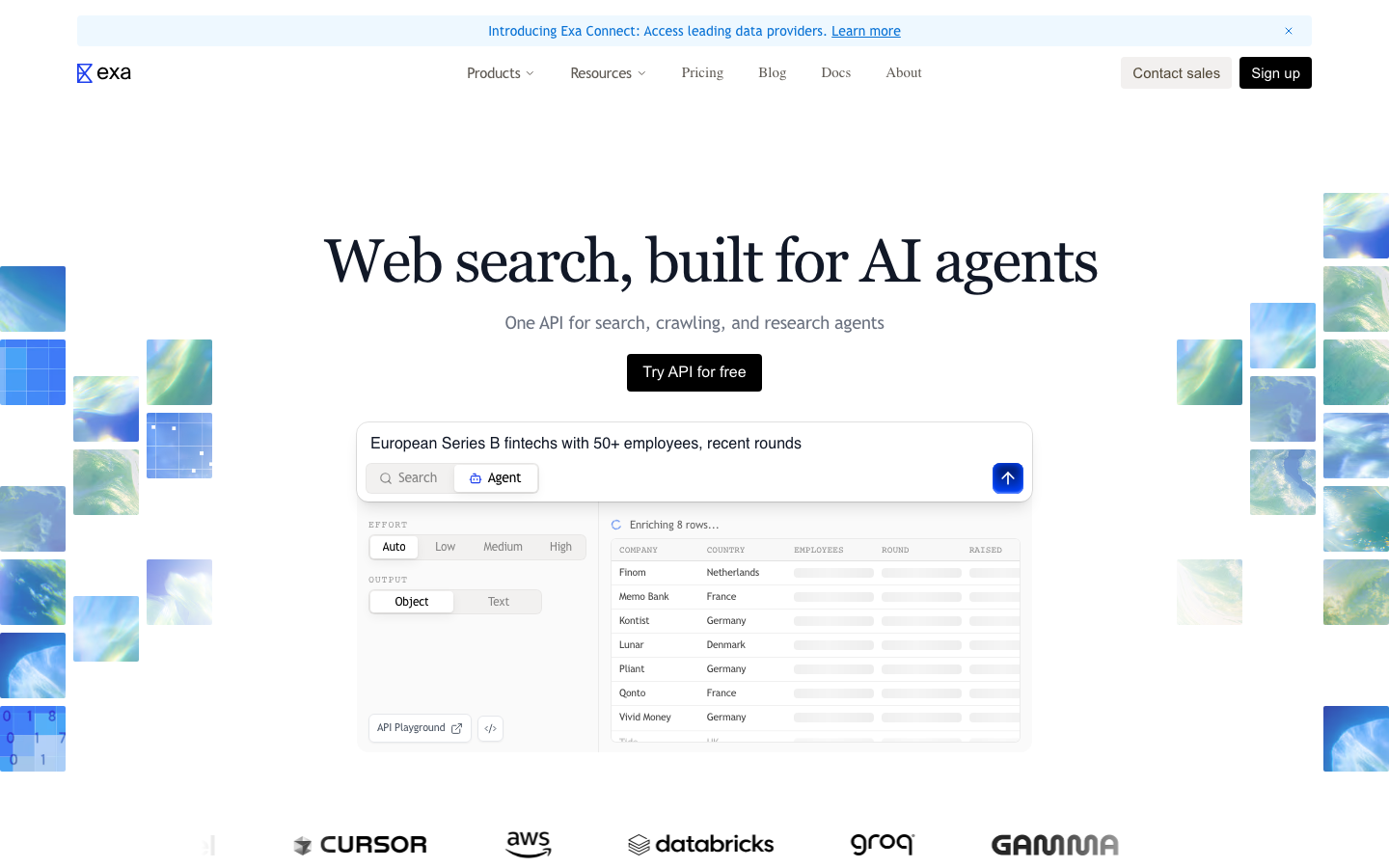
Exa (formerly Metaphor)
Core parameters and statistics of Exa (formerly Metaphor)
Exa (formerly Metaphor) is a neural search engine for AI Agents (Type D - productivity/business-side applications, the main delivery form is search API and Web). Its core difference is that it uses semantic understanding to replace keyword matching, so that Agents and human users can use natural language "description" rather than "piece of keywords" to discover content.
| Projects | Public Information |
|---|---|
| Official positioning | Web search, built for AI agents |
| Product form | Search API + Web client + MCP Server |
| Core Competencies | Semantic Search Highlights Summary, Structured Output Agent In-depth Research |
| Search mode | auto / instant(~250ms) / fast(~450ms) / deep-lite(4s) / deep(4-15s) / deep-reasoning(12-40s) |
| Vertical index | company(50M+) / people(1B+) / research paper(100M+) / news / financial report |
| Platform Support | Web, API, MCP |
| Home | US (San Francisco) |
| Business Model | Freemium + API Pay-As-You-Go + Enterprise Contract |
| latest version | current (~2026-01) |
| Security Certification | SOC 2 Type II, Zero Data Retention, SSO |
A brief comment: Exa does not replace Google's universal search, but is a search infrastructure specially designed for AI Agents and semantic discovery scenarios - it sacrifices the accuracy of "searching for keywords" in exchange for the freedom of "describing concepts", and saves about 90% in Token efficiency compared to traditional search.
Paradigm changes in search methods: Traditional search requires users to "translate" information needs into keyword combinations (such as "2024 SaaS financing amount European B round"), Exa allows direct description in natural language (such as "Find some European B round SaaS companies, the latest round is in 2024"), and can return structured tabular results. This difference determines that Exa is more suitable for "discovery search" rather than "location search".
Performance comparison benchmark: Exa officially disclosed comparative data on three retrieval benchmarks: FRAMES, Tip-of-Tongue, and Seal0 - taking Tip-of-Tongue as an example, Exa's accuracy is 54.2%, Perplexity is 36.7%, and Brave is 19.3%. It should be noted that these benchmarks focus on "semantic fuzzy query" scenarios, and the advantages in exact matching scenarios will be reduced.
Users and market recognition of Exa (formerly Metaphor)
Exa's market recognition is mainly reflected in the adoption of B-side Agent developers and enterprise customers, rather than C-side traffic. Officially disclosed customer and ecological data are more informative than similar search products.
Benchmark customers: Public cases on the official website include Cognition (Devin’s underlying search), Cursor (encoding Agent’s real-time document search), HubSpot (Agentic lead engine), and monday.com (completed 2.7 million pieces of data enrichment). These customers mean that Exa has passed the head product verification in the "Agent embedded search" scenario.
Ecological integration: Exa provides MCP Server, which supports AI assistants to directly call search capabilities. Both Python SDK (exa-py) and JavaScript SDK (exa-js) are provided, as well as cURL direct calls. The ecosystem covers programming Agent, chat robot, voice Agent, news monitoring, data enrichment and other directions.
Competitive landscape: Exa belongs to the same search API category as Perplexity (AI Q&A search), You.com (AI search), Google Search API (traditional search), and Brave Search API (private search). The difference of Exa is that it is specially optimized for AI Agents - the Highlights function compresses web pages into dense tokens required by LLM and outputs structured JSON instead of returning a bunch of links for LLM to digest by itself. This is obviously different from Perplexity's positioning for C-side Q&A Google API and general indexing.
Community and Trust: Officially provides SOC 2 Type II certification, Zero Data Retention (ZDR) option and SSO single sign-on, with clear compliance endorsement for enterprise procurement. There are also Startup & Education Grants, providing a free quota of $1,000 to attract early-stage teams.
Public Financing and Team: Exa Labs Inc. is headquartered in San Francisco. The specific financing rounds and amounts are based on public databases such as Crunchbase and are not stably displayed on the product page.
Cost advantage of Exa (formerly Metaphor)
Exa's cost advantage lies not in its absolute low price - its API pay-per-volume unit price is higher than that of traditional search engines - but in the hidden cost savings brought about by "Token efficiency optimized for AI Agent scenarios".
C-side/individual
Sign up to get $20 initial credit, and then automatically get $10 free credit every month, which can be used for web searches and Highlights calls. This free quota is enough for individual developers to conduct proof-of-concept and small-scale experiments. For web users who are not developers, the search function is free but the number of calls and advanced functions are limited.
API/Developer
Exa has four main billing dimensions by endpoint:
| Billing items | Price | Description |
|---|---|---|
| Search (Basic Search) | $7/1,000 requests (including 10 results) | Add $1 per 1,000 results for more than 10 results |
| Deep Search | $12-15/thousand requests | Multi-step reasoning + structured output |
| Contents | $1/thousand pages | Full text and Highlights extraction |
| Agent (asynchronous Agent running) | $0.012-$1.00/time (depending on the effort mode) | Minimal to X-high five levels |
| Monitors | $15/thousand requests | Scheduled crawls and webhook notifications |
| AI Page Summary | $1/thousand pages | Supplemental LLM Summary |
Agent runs also include per-component billing: Agent Compute Units $0.10/ACU, search tool calls $0.005/time, email enrichment $0.02/email, phone enrichment $0.07/phone.
The truth about free: The free quota of $10/month is enough for personal experiments, but for a team that produces an average of 1,000 searches per day under the circumstances, the monthly cost is in the range of $200-$700 (depending on the search type and number of results). Compared with traditional search engine APIs (Google Custom Search $5/thousand times but with more extensive results), Exa has a higher unit price but the information density of a single search is also higher - the Highlights function can compress web pages into dense fragments that can be directly consumed by LLM, reducing subsequent Token consumption and model calling costs.
Enterprise/Privatization
The Enterprise plan offers custom QPS (queries per second), custom index SLA/MSA contract 1:1 onboarding support, zero data retention customization, and volume discounts. Pricing requires business confirmation, and the official reminder is that "Startup & Education Grants" provides an additional $1,000 free credit.
Hidden costs: Exa’s index focuses on news, technical documents and corporate information, and its coverage in unpopular vertical fields is not as good as Google’s. If the application scenario requires a high recall rate (such as legal case retrieval, academic literature retrieval), it may be necessary to connect to a traditional search engine for supplementation, which will increase integration and maintenance costs.
Hidden benefits: The Highlights function can compress web pages into LLM dense fragments, which can reduce Token consumption by about 90% according to actual measurements. For agent applications that require a lot of web page context, the token cost savings from Exa may exceed the cost of the search API itself. In addition, the structured output function converts unstructured web pages into JSON, eliminating the need for subsequent model calls for information extraction.
[Promotion Verification]: Exa promotes "Highlights of 90% Token reduction" - this data has a clear technical basis (training a dedicated model for paragraph extraction and summarization) and is effective in typical scenarios. However, the token saving ratio depends on the correlation between the length of the original text and the question. Extremely short text or pages that are highly irrelevant to the query may save less.
Main functions of Exa (formerly Metaphor)
Exa's capabilities are designed around "providing search as a service for AI Agents", and the core functions can be summarized into six categories:
-
Semantic search (multiple speed modes): Supports six speed-quality gears: auto(~1s), instant(~250ms), fast(~450ms), deep-lite(4s), deep(4-15s), deep-reasoning(12-40s). Applicable scenarios: From real-time search of chatbots to complex reasoning of in-depth research. Acceptance focus: Whether the delay-quality trade-off of different gears in the application is in line with expectations, especially whether the instant mode is accurate enough in the Agent cycle.
-
Highlights: A specialized model trained by Exa compresses a full web page into only the key snippets required by LLM. A single return of 4,000 characters is recommended, which can achieve about 90% token reduction. Acceptance focus: Highlights whether the information retention rate in specific areas of application (such as medical, legal) is acceptable.
-
Structured Outputs: Use the
output_schemaparameter to directly output the search results as structured JSON, skipping the post-processing step. For example, searching for "top aerospace companies" can automatically return a table containing the company name, CEO, and year of establishment. Acceptance focus: parsing accuracy and field coverage of complex nested schemas. -
Vertical index search: Built-in special indexes for company (50M+ companies), people (1B+ people), research paper (100M+ papers), news, financial report, etc. Applicable tasks: contact data enrichment, competitive product intelligence collection, academic retrieval. Acceptance concerns: Vertical index update frequency and data integrity.
-
Agent in-depth research (Search Agent): Asynchronously running in-depth search Agent, supporting multi-step reasoning, structured output and reference tracing. Supports effort mode (Minimal/Low/Medium/High/X-high), and the price is proportional to the amount of calculation. Applicable tasks: Complex multi-step research tasks, such as "List of European Series B fintech companies".
-
Monitors monitoring search: Automatically search and webhook notify new content at a specified rhythm (daily/weekly/custom). Applicable tasks: news monitoring, competitive product dynamic tracking, early warning system.
Hidden Synergies: Exa’s Highlights + Structured Output combo is an underrated workflow accelerator. Developers can first obtain the relevant URL through Search, extract the summary using Highlights, and then obtain the complete text through the Contents API, maintaining a structured format throughout. This "search → abstract → full text" pipeline avoids the cross-tool switching cost of "Google search → manual page turning → copy and paste → throw to LLM" in the traditional solution.
MCP Server integration: Exa provides MCP Server (@exa-labs/exa-mcp-server), allowing AI assistants (such as Claude Desktop, Cursor, Copilot) to directly call Exa search capabilities. This means that the Agent can complete web search, content extraction and structured output without manually assembling API calls, significantly reducing the integration threshold.
Exa (original Metaphor) model and version evolution
Exa's product evolution has undergone a transformation from "experimental semantic search engine" to "AI Agent search infrastructure". The following are publicly verifiable milestones:
Metaphor Period (2023)
- Metaphor v1 (~2023-06): Launched with the concept of "neural search" and supporting natural language query and "Similar links" functions. At this stage, Exa is named Metaphor and is positioned as a semantic alternative to traditional search engines, targeting individual researchers.
Brand upgrade to Exa (2024)
- Exa Brand Release (~2024): Renamed from Metaphor to Exa, product positioning upgraded from "semantic search engine" to "AI-oriented search API". Launched the Highlights function and vertical index search, introduced the category parameter, and began to build enterprise-level capabilities.
Agent native stage (2025-2026)
- Search Agent Online (~2025): Launch of asynchronous in-depth research Agent, supporting multi-step reasoning and structured output, marking the evolution of Exa from a "search API" to a "search + reasoning" platform.
- MCP Server Release (~2025-2026): Release
exa-mcp-serverto enable AI assistants to directly call Exa search capabilities. - Exa Connect Release (~2026): Connect to external data providers to expand search coverage.
- Security Certification (~2026): Obtain SOC 2 Type II certification, add ZDR and SSO support, and meet enterprise purchasing thresholds.
The latest version is current (~2026-01), which is under official iteration. Since Exa is an API service rather than client software, the version is mainly updated on the server side and does not have a traditional semantic version number.
Technical advantages of Exa (formerly Metaphor)
Exa's technical advantage comes from the design goal of "optimizing search output specifically for LLM consumption" rather than index size or crawl speed for general-purpose search.
Dedicated summary model (Highlights): Exa has trained a model specifically for web page summarization, which can extract the fragments most relevant to the query from the complete web page and compress it into a dense token of about 4000 characters. Mechanically, it does not simply intercept the first paragraph, but performs paragraph-level selection and rewriting based on query relevance. In effect, officials claim that approximately 90% token reduction can be achieved while retaining key facts. Applicable scenarios: Any Agent pipeline that needs to input web content into LLM - the saved Token cost usually exceeds the cost of the search API itself.
Multi-modal search architecture: Exa provides six search latency options from 250ms to 40 seconds, behind which are index retrieval and inference pipelines of different depths. The instant mode relies on precomputed vector indexing to achieve sub-second response; the deep mode performs multi-step reasoning and cross-document synthesis after retrieval. This "speed-quality configurable" architecture allows the same API to serve the real-time needs of chatbots and the complete inference of deep research.
Vertical dedicated index: Exa maintains dedicated indexes such as company (50M+), people (1B+), research paper (100M+), etc., rather than a subset of the general web index. This means that when searching for "European Series B fintech CEO", Exa can retrieve it directly from a structured corporate database, rather than guessing from unstructured web pages. In contrast, general-purpose search engines often require additional named entity recognition steps to achieve equivalent accuracy.
Structured output pipeline: Through the output_schema parameter, Exa can output structured JSON during the search phase. Mechanically, the extraction and structuring of search results is completed by the back-end model before returning. Effectively, developers do not need to design additional information extraction prompts for LLM. Applicable scenarios: data enrichment, competitive product list construction, contact information completion.
Enterprise-Grade Compliance Architecture: SOC 2 Type II certified + Zero Data Retention Option (ZDR) + SSO. For enterprise procurement, this set of capabilities means Exa can pass security review and the data is not used for model training. Unlike most AI search products (Perplexity, Google SGE), Exa provides clearer controllable options for enterprise data governance.
Compare similar technical solutions:
| Dimensions | Exa | Google Custom Search | Perplexity API | Brave Search API |
|---|---|---|---|---|
| Design goals | Optimize output for AI Agent | Universal web index | AI Q&A | Private search |
| Output Format | Highlight Snippet + Structured JSON | Link + Summary | Generative Answer | Link + Summary |
| Token efficiency | High (dedicated summary model) | Low (need to handle it by yourself) | Medium (built-in summary) | Low |
| vertical index | company/people/paper/news | general index | general index | general index |
| Delay options | Six levels from 250ms to 40s | ~200-500ms | ~1-3s | ~200-500ms |
| MCP support | Officially provided | None | None | None |
| Security Certification | SOC 2 Type II + ZDR | Google Standard | SOC 2 | Unpublished |
Engineering Pitfall Guide: ① The Token reduction effect of Highlights is best on English content. The compression ratio of Chinese characters may be different, so benchmarking is required in the target language. ② The 12-40 second delay of deep mode is unacceptable in some real-time scenarios. It is recommended to do Loading state management on the front end or preset fallback to fast mode. ③ The category parameter (company/people/research paper) may miss relevant results when the query boundary is fuzzy. It is recommended to use the auto type as a backup in key scenarios.
How to use Exa (formerly Metaphor)
Exa provides three entrances: Web search interface REST API and MCP Server, each targeting different usage scenarios.
| How to use | Suitable for people | Features | Cost |
|---|---|---|---|
| Web client (exa.ai) | Individual researchers and content creators | Visual search, just enter natural language | Free quota covers light use |
| REST API | Developer AI Agent integration | Six search modes, structured output SDK support | Pay-as-you-go billing, $7-$15/thousand times |
| MCP Server | AI assistant user (Claude/Cursor/Copilot) | Directly call search through MCP protocol | Superimposed on API usage |
API quick access steps:
- Register an Exa account and obtain the API Key from Dashboard
- Install SDK:
pip install exa-py(Python) ornpm install exa-js(JavaScript) - Send the first search request:
from exa_py import Exa

exa = Exa() # Read the EXA_API_KEY contextual variable by default

result = exa.search(
    "blog post about artificial intelligence",
    type="auto",
    contents={"highlights": True},
)
curl -X POST "https://api.exa.ai/search" \
-H "Content-Type: application/json" \
-H "x-api-key: $EXA_API_KEY" \
-d '{
"query": "latest news on AI regulation",
"type": "auto",
"contents": {"highlights": true}
}'MCP Server mounting (taking Claude Desktop as an example, add it in claude_desktop_config.json):
{
  "mcpServers": {
    "exa": {
      "command": "npx",
      "args": ["@exa-labs/exa-mcp-server"],
      "env": {
        "EXA_API_KEY": "your-api-key-here"
      }
    }
  }
}
Recommendation for implementation path: First use Dashboard Onboarding to generate integrated code snippets, then test the search quality and latency in the staging environment, and finally connect to the production Agent to loop. The first week focuses on: ① the information retention rate of Highlights in target languages and fields; ② the response stability of instant mode in Agent circulation; ③ whether the coverage of vertical index meets business needs.
Product pricing for Exa (formerly Metaphor)
Exa's pricing is tiered by search type and premium features, with the overall structure being "Free trial → Pay-as-you-go → Enterprise contract."
| Product layer | Charging model | Core restrictions | Suitable scenarios |
|---|---|---|---|
| Free Tier | Registration $20 + $10 monthly quota | Quota system, if you exceed the quota, you need to upgrade | Personal experiment POC |
| Search | $7/thousand times (within 10 results) | No free permanent credit | Production search calls |
| Deep Search | $12-15/thousand times | Contains multi-step reasoning | Deep research application |
| Contents | $1/thousand pages | Content extraction only | Web page summary/full text extraction |
| Agent | $0.012-$1.00/time (depending on effort) | Including search + reasoning | Automated research tasks |
| Monitors | $15/thousand times | Including webhook | Continuous monitoring scenarios |
| Enterprise | Business Pricing | Custom QPS, Index SLA | Mass Production Context |
Real boundary of free quota: $10/month free quota can support approximately 1,400 Search calls ($7/thousand times) or 10,000 Contents calls ($1/thousand pages). It is sufficient for individual developers to experiment, but any production-level Agent requires a paid plan.
Hidden Cost Tip: The running cost of Agent mode fluctuates greatly - from Minimal's $0.012/time to X-high's $1.00/time, depending on the task complexity. If the Agent task requires a large number of search tool calls, a search tool fee of $0.005/time will be added. It is recommended to use multiple effort modes for cost-quality comparison during the selection stage to avoid higher than expected bills after launch.
Purchase Suggestion: It is recommended to first use Free Tier to verify the search quality, use a small recharge to test the structured output effect of Deep Search, and then evaluate whether the Enterprise solution is more economical based on the average daily request volume. In large-volume scenarios (above one million per month), priority is given to contacting the business to obtain bulk discounts.
Application scenarios of Exa (original Metaphor)
Typical scenarios of Exa focus on scenarios where "AI Agent needs to obtain real-time or structured information from the Internet". The following are the main proven usage directions:
-
Real-time document search for AI programming agents: Programming agents such as Cursor and Devin need to retrieve the latest API documentation GitHub repository and Stack Overflow Q&A when generating code. Exa's instant mode (~250ms) is suitable for embedding in coding loops and will not significantly increase code generation latency. Deduction: From "coding Agent relies on static training data" → "Agent can obtain the latest documents and community knowledge in real time".
-
GTM (Go-to-Market) Agent: Sales and marketing teams use Exa to search for target company information, contact data and financing updates. Vertical indexes company(50M+) and people(1B+) can directly output structured tables, skipping the manual process of "search→click→read→extract" in the traditional solution. Deduction: From "Manually query LinkedIn/Crunchbase one by one" → "Agent outputs target customer list in batches".
-
News and Dynamic Monitoring: The Monitors function searches and webhook notifications at a specified rhythm. Suitable for: competitive product dynamic tracking, industry regulatory updates, and technology blog subscriptions. The difference from traditional RSS is that the query is semantic - without matching keywords, it directly describes "the latest legislative developments regarding the EU AI Act". Deduction: From "maintaining dozens of RSS feeds and filtering them manually" → "monitoring the entire Internet in one sentence".
-
Data Enrichment: HubSpot and monday.com use Exa to complete information on existing customer/lead data - enter the company name or domain name, and output structured fields such as contacts, financing information, technology stack, etc. Deduction: From "retrieval of data through multiple SaaS tools" → "one API to complete full field enrichment".
-
Academic and Research Search: research paper index (100M+ papers) combined with deep mode, suitable for literature review, citation tracking and interdisciplinary discovery. The difference from Google Scholar/PubMed is that it supports natural language queries (such as "About the application of transformers in medical imaging") and structured output. Deduction: From "repeatedly combining trial and error with precise keywords" → "describing the research direction in one sentence, the system returns relevant papers + structured metadata".
-
Real-time search of voice agent: The 250ms delay in instant mode allows it to be embedded in the voice dialogue process, and the search is completed within the window from the user finishing a sentence to the model generating a reply. HubSpot’s Agentic lead engine falls into this category.
Quantitative deduction of cost reduction and efficiency improvement (unofficial commitment, an estimate based on product capabilities):
- Content Research Task: The traditional method requires researchers to search repeatedly on Google → open 10-20 tabs → read abstracts → organize notes. A single complete survey takes about 1-2 hours. Using Exa Search + Highlights can reduce the time to 5-10 minutes (search → read summary → structured output), improving efficiency by about 10-20 times.
- Data enrichment task: Manually query the financing information of a single company for about 3-5 minutes (search → find Crunchbase → excerpt). Exa company index batch searches can achieve a throughput of 1 second/item and have a search tool cost of $0.005/time. For batch enrichment of 100,000 records, the labor cost dropped from ~8,000 hours to API automation, and the cost dropped from ~$80,000 to ~$500 (search) + developer integration time.
- Competitive Product Monitoring Task: Traditional solutions require configuring Google Alerts (keyword matching, low accuracy) or hiring analysts to scan every day, with an annual cost of $20,000+. Exa Monitors dramatically reduces false positives through semantic queries at a cost of $15/thousand + integration maintenance fee.
Applicable groups of Exa (formerly Metaphor)
Exa's core user portraits are mainly developers, data researchers and AI Agent builders, but different portals (Web/API/MCP) serve different groups of people.
-
AI Agent Developer: A team that builds coding Agents, GTM Agents, and research Agents. The value of Exa is in embedding search as a "tool call" to the Agent rather than as an external source of knowledge. Prerequisite: The team has Agent orchestration capabilities and understands the LLM tool calling mode. Suitable for use with API and MCP Server.
-
Data and Intelligence Researcher: Industry analysts, investors, and competitive product analysts who need to collect company, personnel, papers, and news information in batches. Exa's vertical indexing and structured output replaces multiple manual search processes. Prerequisite: Master basic API calls or be able to use the web client.
-
Sales and Marketing Operations Team: Build target customer lists, complete contact information, and monitor industry trends through Exa. Suitable for GTM Automation scenarios. Prerequisites: There are system integration requirements such as HubSpot/Salesforce, or access through API/SDK.
-
Content Creators and Editors: Use the web side to conduct semantic search and discover articles and sources that "can't tell the keywords but know the concepts". Suitable for topic discovery and background research. Prerequisites: No technical threshold required, just an Exa account.
Unfit boundary: It is recommended to give priority to other search solutions in the following scenarios——
- Precise positioning search: Need to find certain information such as known URL, precise title, product model, order number, etc. Exa's semantic search is not as efficient as traditional keyword search in such scenarios.
- Ecommerce/Local Search: Search for product prices, restaurant reviews, flight information - Exa's index is not optimized for these areas.
- Applications with mainly Chinese content: Exa's indexing and Highlights models are optimized with English content as the core, and the coverage and summary quality of Chinese content may be significantly lower than English levels.
- Professional search with high recall rate requirements: Scenarios that require recall rate, such as legal precedents, medical literature, patent searches, etc. Exa's vertical index coverage may not be as deep as specialized databases (e.g., Westlaw, PubMed, Google Patents).
- High concurrency real-time scenario: Enterprise-level high QPS scenarios require the Enterprise solution, and the frequency control limitations of the standard API may not meet the needs.
Summary and outlook of Exa (formerly Metaphor)
The core value of Exa is that it redefines "search" for the age of AI Agents - from returning lists of links to returning dense information and structured data that can be directly consumed by LLMs. It forms barriers of differentiation on the three lines of Highlights Token efficiency, vertical indexing and structured output, and lowers the threshold for Agent integration through MCP Server and SDK.
Current limitations: ① The coverage and quality of the search index for non-English content is significantly lower than that of English; ② The delay of deep mode (4-40 seconds) is not available in some real-time scenarios; ③ The pricing is higher than traditional search APIs in large-scale scenarios (millions of requests per month), and batch discounts require business confirmation; ④ The complementary relationship with other search APIs adds a layer of dependence on the architecture, and the risk of single point failure needs to be evaluated.
Follow-up observation points: ① The language expansion plan covered by the index (whether there is an official large-scale index such as Chinese/Japanese); ② With the explosion of Agent applications, whether Exa's pricing will evolve to a more fine-grained billing based on Tokens; ③ The number and coverage areas of data providers in the Exa Connect ecosystem; ④ Whether there are leading search vendors (Google, Bing) launching competing features similar to "Highlights".
Procurement/Adoption Risk Assessment: Before adopting Exa, it is recommended to focus on verification - ① Search quality in the target language and field (it is recommended to use 50-100 real queries for Recall@10 comparison); ② Monthly cost corresponding to the average daily request volume, and compare the total cost of ownership (TCO) with Google Custom Search / Brave Search API (including the conversion of Token savings); ③ Contract terms Whether ZDR (Zero Data Retention) meets corporate compliance requirements and whether there are segregation of liability provisions for data breaches. If the search quality is verified and the total cost is within the budget, it is recommended to conduct a small-scale trial run with Free Tier for 2 weeks, and then gradually expand to production.
Related tools: perplexity, you-com
Version Info
- current :Current version.
- Metaphor :The first version of Metaphor is online.
User Reviews