 MeteoRA
Free
MeteoRA
Free
MeteoRA is a multi-task LoRA embedding framework launched by Nanjing University. It uses MoE gating to integrate multiple task adapters into an LLM, supporting the processing of composite tasks and multiple sub-problems in one inference.
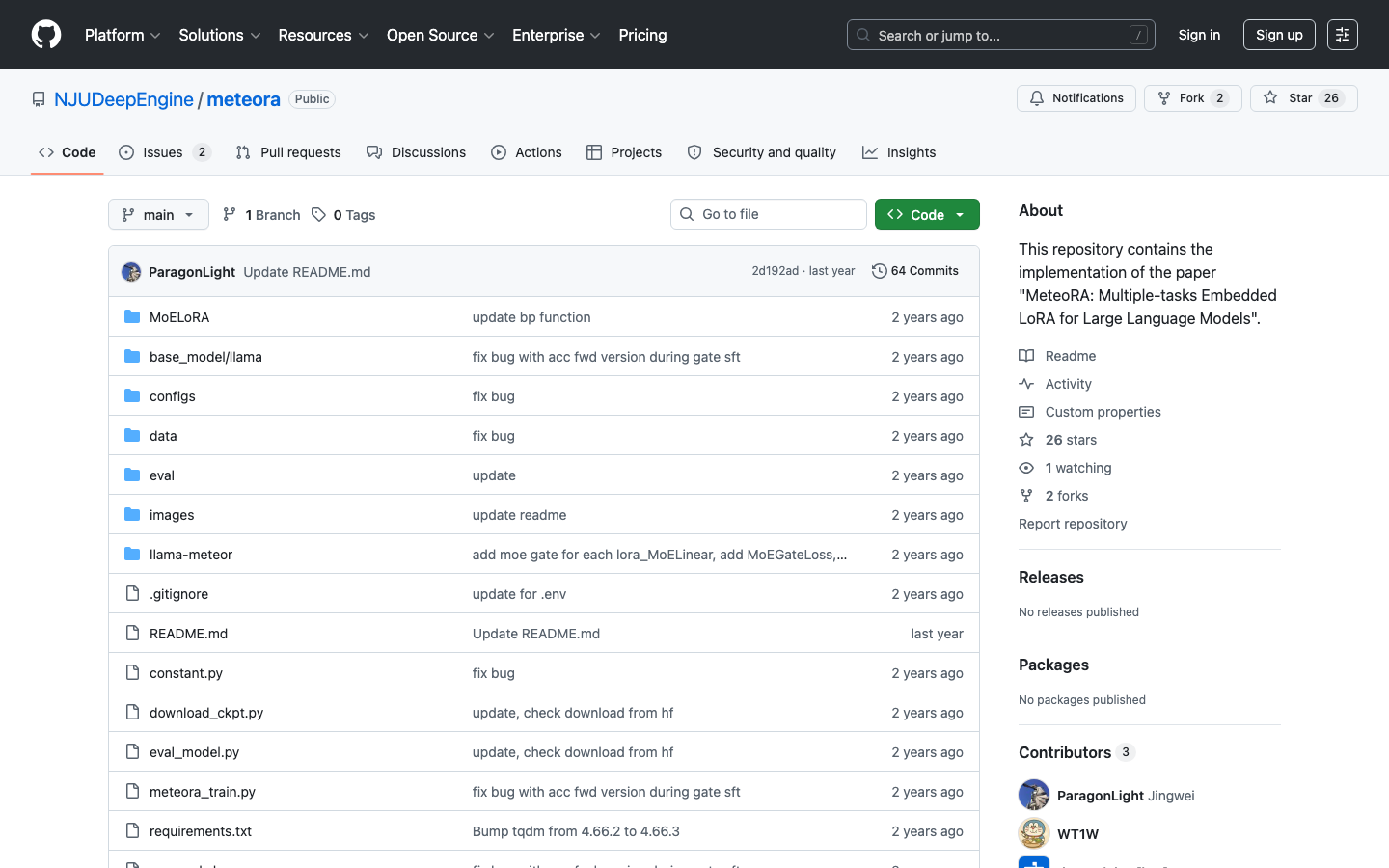
Full review of #MeteoRA
Core parameters and statistics
| Project | Specifications |
|---|---|
| Product Positioning | Multi-tasking LoRA embedding and dynamic routing framework |
| Development Agency | Nanjing University DeepEngine Team |
| Technical Roadmap | MoE Gating + LoRA Adapter Pool |
| Base Model | LLaMA2-13B, LLaMA3-8B |
| Adapter Size | Supports 28+ task adapters to coexist |
| Routing method | Dynamic top-k MoE gating |
| Open Source Agreement | Academic open source (subject to the warehouse) |
User and market recognition
MeteoRA is an open source research project of the DeepEngine team of Nanjing University and belongs to the field of parameter efficient fine-tuning (PEFT). Its innovation lies in changing the limitation of "one model can only do one thing" - by embedding multiple LoRA adapters in the model, one model can handle multiple different tasks.
Publicity verification: The actual use of gated routing of "one model handles multiple tasks" depends on the training quality of the gated network. If tasks are unevenly distributed in the training data, the gating network may favor high-frequency tasks, with adapters for low-frequency tasks rarely being selected. Routing fairness requires special design during the training phase.
MeteoRA provides a new idea in the PEFT community: not just fine-tuning multiple tasks for one model, but "storing" multiple LoRAs in one model and dynamically selecting them at runtime. This makes sense for deployment cost optimization in multi-tasking service scenarios - especially scenarios where 28+ adapters exist simultaneously.
Cost advantage
| Dimensions | Description |
|---|---|
| Code | Open source and free |
| Base Model | Need to obtain by yourself (LLaMA2/3) |
| Training GPU | At least single card A100-80GB |
| Inference GPU | Single card can run |
Open source academic project, code and pre-trained LoRA weights are made public. The actual cost is in base model licensing and GPU inference resources. Compared to deploying a separate model for each task, MeteoRA merges multiple LoRA adapters into the same model, significantly reducing deployment costs for multi-task scenarios.
The Free Truth: The code is free, but you need to obtain the base model first (the LLaMA series has licensing requirements), and training and inference require GPU resources. For research teams, the incremental cost of deploying MeteoRA on existing GPU clusters is low; for teams building an environment from scratch, hardware investment is the main threshold.
Main functions
-
Multi-task LoRA embedding: Embed multiple task-specific LoRA adapter parameters into the same base model, and different adapters share most of the parameters of the base model (only a small number of trainable parameters are added).
-
MoE Gated Routing: Input instructions or questions automatically select the most matching subset of LoRA adapters through the gated network, without the need to manually specify "which adapter should be used for this request". The gating network itself is also trainable.
-
Composite task inference: When a request contains multiple sub-problems (such as "translate this passage and then summarize it"), the gated network can dynamically switch to different LoRA adapters in a single inference.
-
Multi-task LoRA embedding: Embed multiple task-specific LoRA adapter parameters into the same base model, and different adapters share most of the parameters of the base model (only a small number of trainable parameters are added).
-
MoE Gated Routing: Input instructions or questions automatically select the most matching subset of LoRA adapters through the gated network, without the need to manually specify "which adapter should be used for this request". The gating network itself is also trainable.
-
Composite task inference: When a request contains multiple sub-problems (such as "translate this passage and then summarize it"), the gated network can dynamically switch to different LoRA adapters in a single inference.
Model and version evolution
Mainline release
- ~2026-05: MeteoRA is open sourced for the first time, supporting multi-tasking LoRA embedding of LLaMA2-13B/LLaMA3-8B.
Technical advantages
- Algorithm Optimization: Special optimization at the model or algorithm level has been carried out for the corresponding scenario to achieve a balance between response speed and result quality.
- Low-latency architecture: Adopts streaming or asynchronous processing architecture to reduce user waiting time and is suitable for high-frequency interaction scenarios.
How to use
- Download the code from the GitHub repository (https://github.com/NJUDeepEngine/meteora)
- Configure the context and base model (LLaMA2/3) according to the README
- Prepare multi-task training data and LoRA adapter configuration
- Training the Gating Network and LoRA Adapter
- Deploy as unified inference service
Product Pricing
| Project | Description |
|---|---|
| Framework code | Open source and free |
| Base Model | LLaMA2/3 Licensing Requirements |
| Training GPU | Recommended A100-80GB |
| Inference GPU | Single card can run |
| API/Hosted Services | Not Available |
Open source academic project with free code. Usage costs are in base model licensing and GPU inference resources.
Application scenarios
- Multi-task Unified Service: One model entrance simultaneously provides multiple capabilities such as translation, summary, question and answer, classification, etc., replacing the "one API for each capability" deployment method. The operation and maintenance cost is reduced from N models to 1 model.
- Cross-domain Q&A system: The QA system needs to answer questions from different fields such as technology, law, and medical care at the same time. Each field corresponds to a LoRA adapter. Users do not need to choose "which field of AI to consult", the gated network is automatically routed.
- LoRA Routing Research: An academic experimental platform to study the combination effects and routing strategies between LoRA.
Dissuade scenario: If your service only has 1-2 capabilities, the advantages of packaging with MeteoRA are not obvious - it is easier to directly use a single LoRA or a fully fine-tuned model. The value of MeteoRA only begins to emerge at scale effects of >5 adapters.
Applicable people
- LLM fine-tuning researcher: Scholars who study PEFT, LoRA combination and MoE routing strategies.
- Multi-task Service Platform Engineer: An engineering team that needs to aggregate multiple AI capabilities in one model entry.
- Model Deployment Team: An MLOps team that focuses on model deployment costs and inference efficiency in multi-task scenarios.
Dissuade scenario: If your service only has 1-2 capabilities, the advantages of packaging with MeteoRA are not obvious - it is easier to directly use a single LoRA or a fully fine-tuned model. The value of MeteoRA only begins to emerge at scale effects of >5 adapters.
Current limitations: Community adaptation is currently limited to the LLaMA2/3 series, and expansion to other base models (such as Qwen, Mistral) requires community contributions; the training of the gated network requires balanced multi-task data, and data imbalance will affect routing quality.
Summary and Outlook
It provides competitive solutions in its field, and its core value lies in lowering the threshold for AI use in this field.
Current limitations: Some advanced features require paid subscription, and the free version has function or usage restrictions; specific technical details and performance benchmarks have not yet been fully disclosed.
Related tools:  Hugging Face, replicate
Architecture design and technology selection
As an open source project, MeteoRA's architecture design, community health, and operation and maintenance maturity are core dimensions that need to be comprehensively considered when selecting technology. The following is a systematic framework for assessing the production readiness of open source projects.
Architecture and Modular Design The architectural design of the project directly determines the flexibility of secondary development and integration. Projects that adopt microservices, plug-in or event-driven architecture usually have better scalability and functional isolation, making it easier for the team to expand and customize specific modules on demand; the monolithic architecture is simple to deploy, intuitive to operate and maintain, and is suitable for small-scale use and rapid verification. However, as the functions increase, they may face the problems of increased maintenance complexity and accumulation of technical debt. It is recommended to read the project's architecture documents and developer guides before selecting, and evaluate the adaptability of the architecture design to the team's existing technology stack, as well as the scalability of the architecture as business grows in the future.
Community health and long-term maintenance The community health of an open source project is a key indicator of whether the project can be maintained and developed over the long term. It is recommended to comprehensively evaluate the following dimensions: the growth trend and absolute value of GitHub Stars (reflecting community attention and user base), the number and composition of contributors (the ratio of core maintainers to temporary contributors, ideally there are at least 3 active core maintainers), the median issue response time (ideally within 24 hours, reflecting the response efficiency of the maintenance team), PR merge rate and merge delay (reflecting the standardization and efficiency of project governance), and the time of the latest major Release (more than 6 Months without updates should be taken as a sign that project maintenance is stalled). An active community means faster bug fixes, more frequent feature updates, a richer third-party integration ecosystem, and it’s easier to get help from the community when you encounter problems.
Deployment, operation and maintenance and production readiness Production environment deployment needs to focus on evaluating the following aspects: the completeness of the Docker image and version labeling strategy (whether multi-architecture mirroring is provided), the availability and document quality of one-click deployment scripts (docker-compose, Helm Chart, Terraform, etc.), the number and management complexity of runtime dependent components (the more dependencies, the complexity of operation and maintenance increases exponentially), the integration support of monitoring and logging infrastructure (Prometheus indicator exposure, Grafana dashboard, structured log output), and complete documentation of backup, recovery, and high-availability solutions. It is strongly recommended to go through the entire deployment process in the test environment, strictly follow the documentation from scratch, verify the accuracy of each step and the compatibility of the environment, and put it into production after all functions have been verified.
Version Info
- MeteoRA :Open source for the first time, supporting multi-tasking LoRA embedding and MoE routing for LLaMA2-13B/LLaMA3-8B base.
- MeteoRA :Open source for the first time, no official precise date yet.
User Reviews