 MindStudio
Free
MindStudio
Free
MindStudio is a visual AI agent and application building platform that provides a drag-and-drop workflow editor, supports 200+ AI models, 1000+ preset integrations and 100+ scenario templates, allowing users to build, test and deploy AI agents without programming. AI agent
MindStudio
Core parameters and statistics of MindStudio
| Parameters | Data |
|---|---|
| Product positioning | Visual AI agent construction and deployment platform (AI-Native Workflow Automation) |
| Core capabilities | Drag-and-drop agent orchestration 200+ AI model routing 1000+ preset integration of 6 agent deployment forms |
| Supported models | OpenAI GPT-5, Anthropic Claude 4, Google Gemini, Llama, FLUX, Veo 3, etc. 200+ |
| Agent deployment form | Web application, browser extension, email trigger API/Webhook, scheduled task MCP Server |
| Security Compliance | SOC 2 Type II, GDPR, SSO, RBAC, audit logs, private deployment |
| Platform form | SaaS hosting + private deployment (self-hosted) |
| Target users | Individuals, operations/product managers IT/HR, system integrators, enterprises |
| Number of agents deployed | Publicly claimed 400K+ |
MindStudio is not positioned as a traditional low-code workflow engine (such as n8n, Make), but a construction platform with "AI agents" as its first citizens. The core difference is that each node in the workflow is no longer just a "trigger-action" mechanical connection, but an intelligent unit that can call large models for reasoning, decision-making, and generation. The platform's built-in Service Router routes 200+ models at cost (no price increase). Users can bring their own API Key or use the model quota hosted by the platform.
In terms of deployment coverage, MindStudio claims to have been deployed in small and medium-sized enterprises, large enterprises and government agencies, with a total of more than 400,000 AI agents deployed. Typical customers include TikTok, Microsoft, Intel, Adobe, Oracle, Booking.com, Novo Nordisk, Fujitsu, etc., covering social media, enterprise software, medical, finance, manufacturing and other industries.
MindStudio’s users and market recognition
Enterprise-level customer endorsements are abundant: The official website publicly quotes positive reviews from employees of front-line technology companies such as TikTok (Sr. Product Manager), Microsoft (Sr. Technical Program Manager), Adobe (Sr. ML Engineer), Intel (Principal Product Manager), Oracle (Principal Product Manager), etc. These reviews are not pure marketing excerpts, but include specific quantitative comparisons - for example, Dhwanit Agarwal of Adobe pointed out that "Compared to n8n or Zapier, MindStudio not only automates workflows, but also can design intelligent agents that can be reasoned and personalized"; David Cohn of Advance Local said "AI agents complete 800+ tasks per week, saving 13 to 400 hours of original manual work."
Community and education system construction: MindStudio University (online college) provides systematic AI agent building courses, including live workshops, on-demand video libraries and certification projects. There is also a Slack community (available on Individual and above plans) that brings together thousands of builders to exchange experiences and answer questions. This iron triangle model of "product + education + community" is relatively rare in the low-code/AI agent track, which is beneficial to reducing the onboarding friction for new users and improving retention.
Third-party comparison verification: The official website has specially set up a comparison page with competing products such as n8n, Make, Zapier, Botpress, LangChain, CrewAI, Retool, etc. to conduct transparent comparisons from dimensions such as "AI native degree", "code-free experience", and "deployment flexibility". Although these comparisons are officially released, they at least show that MindStudio dares to face competing products and attempts to establish differentiated recognition based on AI nativeness.
Cost Advantages of MindStudio
C Client/Personal Tier: Free plan ($0/month) includes 1 agent and 1,000 runs/month, with access to 200+ models (no need to prepare your own API Key), and the data is not used for model training. For personal experimentation and learning scenarios, this free credit is enough to complete a proof of concept. The Individual plan ($20/mo, annual $16/mo) unlocks unlimited agents, unlimited runs, advanced image/video models, and access to Remy Product Agent—priced significantly lower than Zapier (starting at $30+/mo) and Make ($9+/mo with limited features), but higher than n8n’s self-hosted free plan.
Developer/API layer: MindStudio's service model is different from traditional API billing - instead of selling API calls separately, usage is routed at cost through the Service Router of the platform's hosted model, and the platform itself does not earn the model call price difference. Users can also bind their own API Key and directly use existing quotas from providers such as OpenAI and Anthropic. This means that in high-frequency calling scenarios, developers only need to bear the cost of the underlying model + platform subscription fee, and there is no hidden usage premium.
Enterprise/Private Tier: The Business plan is a customized offer that includes enterprise features such as team workspaces, unlimited collaborators, fine-grained permissions SSO, audit logs, custom SLA, privatized deployment (self-hosted), and custom domain names. Compared with the cumulative cost of purchasing multiple independent SaaS tools (such as Zapier + separate AI model subscription + knowledge base tool), MindStudio's integrated solution has hidden cost advantages in management complexity and tool chain integration. However, please note: Enterprise customized pricing is not disclosed. Actual procurement needs to be confirmed by contacting sales. There may be a minimum annual commitment and deployment front-end costs.
Main functions of MindStudio
- Visual Agent Canvas: A drag-and-drop IDE that supports serial/parallel orchestration of LLM nodes, conditional branches, code execution (JavaScript/Python), API calls, data conversion, knowledge base retrieval and other nodes. The built-in real-time debugger can view input and output node by node to solve complex workflow troubleshooting problems.
- 200+ model routing (Service Router): A single interface calls mainstream models such as OpenAI GPT-5, Anthropic Claude 4, Google Gemini, Llama, FLUX, Veo 3, etc. The platform handles authentication, billing and frequency control in a unified manner, eliminating the need for separate registration and recharge for each provider. Supports A/B split testing to run multiple models side-by-side within canvas and compare output quality.
- Six agent deployment forms: After the AI agent is built, it can be deployed with one click as a web application (including custom front-end UI), browser extension (Chrome open source extension, code auditable), email trigger agent (triggered by forwarding/CC email), API/Webhook endpoint (for Zapier/Make/n8n call), scheduled task (such as execution at 9 a.m. every Monday) and MCP Server (exposed to the outside as Agentic MCP endpoint for other AI system call).
- Knowledge Base and RAG Engine: Supports the import and automatic block vectorization of PDF, web pages, documents, structured data and other formats. Automatically retrieve relevant context during reasoning to improve the accuracy and professionalism of answers. Supports direct connection to SQL database and query capabilities of vector database (self-built).
- Human-in-the-Loop: Supports the insertion of manual confirmation nodes, custom UI forms, file uploads, intention clarification and questioning and other interactive procedures into the agent execution process. Approval checkpoints can be set for irreversible operations (such as sending emails, writing to databases, and publishing content) to ensure that key operations are not out of manual control.
- Custom code and "Vibe Code": Non-technical users can generate JavaScript/Python cloud functions (Vibe Code) through natural language description; technical users can directly compile
Write or import custom packages to expand the boundaries of agent capabilities. This makes up for the lack of flexibility of pure no-code platforms in complex logic scenarios.
MindStudio model and version evolution
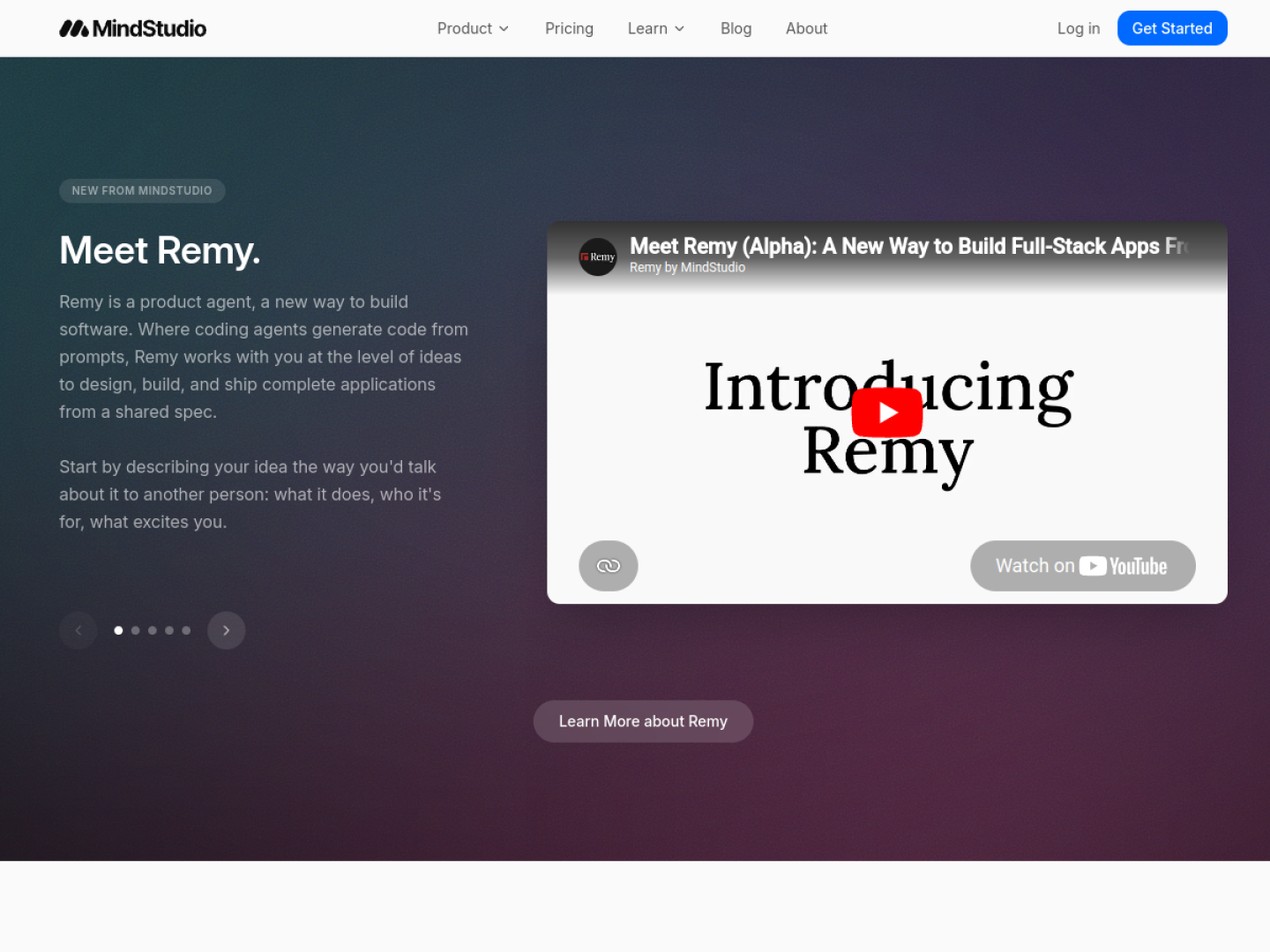
v2.5.0 (Stable, ~2026-04): Current stable version. Major enhancements include custom Agent template API deployment support and Remy Product Agent (preview). Remy is MindStudio's new attempt in the direction of "product agency" - users describe their ideas in natural language, Remy automatically generates product specification documents, and then generates complete application code, database and backend based on the specifications, delivering usable production-grade applications in about 30-60 minutes.
v2.0.0 (Major Release, ~2025-10): Milestone version. Officially introduces a drag-and-drop workflow editor, supports parallel invocation of multiple models, and launches an online template market (100+ preset templates) and knowledge base management functions. This version establishes the current core product form of MindStudio - transforming from a single-model chat tool to a multi-model AI agent orchestration platform.
v1.0.0 (Initial Release, ~2025-04): The first version is released, providing basic AI agent construction capabilities, limited model support, and the main deployment method is Web embedding. This stage mainly verifies the product hypothesis of "building AI agents without code".
It is worth noting that MindStudio has completed rapid iterations from single-model chat to multi-model orchestration, from single deployment to six deployment forms, and from pure no-code to supporting code expansion in about one year. The product evolution is rapid. Future version directions may include a deeper enterprise-level permission system (already partially implemented), better version control and rollback capabilities, and Remy's official GA.
Technical advantages of MindStudio
AI-Native architecture vs. traditional automation engine: Unlike mechanical automation based on "trigger-action" such as Zapier/Make/n8n, each workflow node of MindStudio is essentially a "reasoning unit" - what is passed between nodes is not fixed-format data, but structured information with contextual semantics. This allows the agent to dynamically decide on its next action based on intermediate results during execution, rather than following a preset fixed path. From the perspective of architectural links: User input → Agent Canvas (inference engine) → Model routing (Service Router) → 200+ models/tools → Output (Web/API/MCP), control flow and data flow cross in two directions instead of one-way pipeline.
Service Router's cost optimization mechanism: The platform's built-in model routing layer handles authentication, accounting, load balancing, and error retry at the same time. When users use the platform's hosting quota, MindStudio declares that it will be settled at cost price (no price increase); when using its own API Key, the traffic is directly connected to the provider, and the platform does not intervene in the billing link. This design eliminates the hidden costs of traditional AI platforms earning price differences on model calls, and is especially important for teams with large monthly call volumes.
Multi-Agent collaboration and MCP open protocol: MindStudio supports exposing the built agent as an MCP Server, which means that any AI system that supports the MCP protocol (such as Claude Desktop, other Agent frameworks) can call the agent in MindStudio as a tool. This design transforms the platform from a "closed build with context" to an "open node in the Agent network", improving the cross-platform reusability of agent assets.
Security and Compliance Engineering: The platform is certified for SOC 2 Type II and GDPR compliance, and the enterprise version supports SAML SSO, SCIM user-provisioned RBAC, audit logs, and budget/usage limits. For highly regulated industries (government, healthcare, finance), support privatized deployment - deploy the entire MindStudio runtime to the customer's own infrastructure (on-premises or private cloud), and the data does not leave the corporate network.
How to use MindStudio
Registration and Initial Configuration: Visit mindstudio.ai and register via email or Google Account. There is no need to bind a card to the Free plan to start using it. After logging in, enter the workbench. The agent list is on the left, the drag canvas is in the center, and the node configuration panel is on the right.
Typical build process (15-60 minutes):
- Choose a starting point: Select a scenario template (such as "Competitive Product Monitoring Agent") from the template market, or start from a blank canvas.
- Arrangement Node: Drag in the LLM node (select model and System Prompt), data source node (URL fetch/database query), logical node (conditional branch/loop), and output node (generate report/write Sheets) from the toolbox.
- Configure knowledge base: Upload reference documents or connect to an external database, and the agent automatically retrieves enhanced context during inference.
- Testing and Debugging: The built-in debugger runs node by node to view input, output and token consumption, and supports A/B comparison of the output quality of different models.
- Deployment and online: Choose the deployment form with one click - generate a public link to share with the team, embed as a Widget, expose as an API endpoint, or publish as a Chrome extension.
API access: The built proxy automatically obtains the REST API endpoint and supports calling through standard HTTP requests. Suitable for integrating AI agents into existing systems (such as CRM, ERP) as intelligent components. The specific API document address and authentication method are subject to the official document (university.mindstudio.ai).
Remy usage (Individual and above): Select "Remy" mode when creating a new project, and use natural language to describe application ideas (supports voice notes and pasted documents). After Remy generates product specifications, users review and confirm them, and then automatically generates complete application code and infrastructure. The entire process takes about 30-60 minutes.
Product Pricing for MindStudio
| Plans | Monthly Fees | Number of Agents | Number of Runs | Model Access | Key Features |
|---|---|---|---|---|---|
| Free | $0 | 1 | 1,000 times/month | 200+ text models | Comes with/Platform Key, no data training |
| Individual | $20 ($16 annually) | Unlimited | Unlimited | Image/video models included | Remy Alpha, Slack community, live workshops |
| Business | Customized Quote | Unlimited | Unlimited | All | Team Space SSO, Audit Log, Self-Hosting, Custom Domain Name |
- Free Plan: Suitable for personal experiments and POC verification, 1,000 runs/month is basically enough for light use, but is limited to 1 agent and does not support advanced multi-modal models.
- Individual Plan: $20/month ($16/month annually) unlocks unlimited agents and unlimited runs, making it the preferred tier for heavy users and independent builders. Compared to n8n (free for self-hosting but requires a server) and Zapier ($30+/month with limited credits), MindStudio’s model coverage and deployment flexibility are competitive at this price point.
- Business Plan: Pricing not disclosed, contact sales for quote. Mainly for teams and enterprises, it supports private deployment (self-hosted), custom domains, white labels, exclusive SLA and priority technical support. When purchasing, you need to pay attention to the minimum number of users and the annual commitment period.
- Usage Transparency: The platform provides detailed analysis panels, budget alerts and billing notifications to help teams control costs. The enterprise version also supports setting budget caps on a per-user basis to prevent accidental overspending.
MindStudio application scenarios
- Automation of internal operations of the enterprise: The HR department builds an "onboarding Q&A agent" and uploads employee handbooks and system documents. New employees can directly consult the agent about social security, leave, reimbursement and other processes, reducing HR's repeated answering time. The IT department builds a "work order classification agent" to automatically read the content of Helpdesk work orders, classify priorities and match them with the knowledge base to generate preliminary solutions. Based on actual cases from Advance Local, AI agents can replace 13-400 hours of manual repetitive work per week.
- Content Marketing and Social Media Matrix Management: The operations team arranges an automated workflow of "content monitoring → summary → LinkedIn publishing" - the agent monitors changes in competing product websites and social media on a daily basis, generates differentiated analysis reports, and automatically publishes them to the designated platform after manual review. With the help of 200+ models (including FLUX, Veo 3 and other image/video models), the entire link from copywriting generation, graphic design to multi-platform distribution can be completed in the same workflow, compressing the manual process that originally spanned 3-4 tools into a single platform.
- Customer Support and Service Delivery: Build a multi-layer customer service agent system - first-line agents automatically classify and respond to common questions (matching FAQs, querying order status), second-line agents handle complex issues that require reasoning (such as refund review, technical troubleshooting), and set up manual confirmation nodes for key operations (such as initiating refunds, modifying subscriptions). For SaaS enterprise and e-commerce scenarios, agents can be embedded into products as independent customer service widgets, online 24/7.
- Sales empowerment and customer interaction: The sales team builds a "customer portrait agent". After entering the company name, it automatically collects company information, key decision-makers, and recent developments from public channels, and generates a draft of personalized communication emails. A Strategy case shows that after its account managers used personalized profiles generated by AI agents, customer engagement rates increased significantly and preparation time was reduced from days
to several hours.
- Full-stack application rapid prototyping (Remy): Product managers can describe a SaaS tool idea in natural language, and Remy will generate a complete usable application including front-end, back-end, and database in 30-60 minutes. This scenario is particularly suitable for startup teams and internal tool builders – no need to wait for development resources to turn an idea into a demo-ready MVP.
Applicable groups of MindStudio
- Non-technical business personnel (operational HR, sales, marketing): MindStudio's core target group. The drag-and-drop canvas and 100+ templates allow business people with zero programming experience to independently build AI agents. The key is that business personnel need to have clear process thinking - being able to break down their daily work into a logical chain of "input → processing → output" in order to fully utilize the value of the platform. Users who are completely unfamiliar with business process abstraction still face barriers to getting started.
- AI Automation Experts & System Integrators: For consultants and integrators helping clients with their digital transformation, MindStudio offers faster delivery than n8n/CrewAI – from first contact to demo prototype in a single session. The platform supports custom code, private deployment and white labeling, making it suitable as a delivery base. But please note: Highly customized enterprise scenarios (such as private protocols that need to interface with old systems) may require the development of additional adaptation layers.
- Product Managers and Technical Managers: The Remy function allows product managers to directly transform ideas into runnable prototypes, shortening communication with the engineering team. In organizations with limited resources, product managers can independently verify the feasibility of requirements before entering the formal development process. Unsuitable scenarios include enterprise-level applications that require deep performance optimization, complex state management, or special compliance requirements. These scenarios still require the intervention of professional engineering teams.
- Not suitable for people/scenarios: Not suitable for scenarios that require completely offline operation and cannot accept SaaS dependencies (although self-hosting is supported, the operation and maintenance complexity is higher than that of a fully managed solution); not suitable for production systems that require large-scale distributed inference or ultra-low latency real-time response (millisecond level), because the Token generation delay of the agent inference itself cannot be compared with the native API direct connection; not suitable for applications that require deeply customized model training and micro-services
Tuned users - MindStudio is a platform for "building agents" rather than "training models".
Summary and Outlook
MindStudio's core competitiveness lies in the complete package of "AI-Native agent construction" - from visual orchestration, multi-model routing, knowledge base enhancement to an integrated experience of six deployment modes, which has established a differentiated positioning relative to traditional automation tools (n8n, Make, Zapier) in the AI agent platform track. 400K+ deployed agents and public endorsements from enterprise customers such as TikTok, Microsoft, Intel, and Adobe have verified the product’s execution capabilities in education and GTM.
The current main limitations include: 1. The runtime performance and debugging experience of complex agents (50+ nodes) are still not as flexible as pure code frameworks (such as LangChain/CrewAI) - the visual canvas simplifies getting started but also brings abstract leakage boundaries; 2. Remy function is currently in the Alpha stage, and the actual delivery quality highly depends on the complexity of the problem domain. It is recommended to fully verify before use in formal scenarios; 3. Platform lock-in risk - although it supports built-in API Key and MCP Open protocol, but the core orchestration logic and agent assets are stored in the MindStudio platform, and there are migration costs when switching to competing platforms.
Procurement/Adoption Risk Assessment: For individuals and small to mid-sized teams, the Individual plan ($20/mo) is a low-risk trial option - the free plan allows for full validation of suitability. For enterprise procurement, it is necessary to focus on verifying the following terms during the pilot stage: the operation and maintenance responsibility boundary of privatized deployment, data storage location and compliance certification coverage (whether SOC 2/GDPR covers self-hosted deployment), the annual commitment cycle and early termination clause of the Business contract, and the mechanism for future pricing adjustments of the platform. It is recommended to use the Free/Individual plan for 2-4 weeks to establish a POC in non-core scenarios, and then gradually expand to production-level deployment.
Related tools:  CrewAI,
  LangChain
How to use MindStudio
- Web client: You can use it by visiting the official website and registering an account. Most functions do not require installation.
- API Access: Provides RESTful API, developers can obtain the API Key and integrate it into their own applications.
Version Info
- Stable :Support custom Agent templates and API deployment, and introduce Remy Product Agent preview. There is no official precise date yet.
- Major Release :Introducing a drag-and-drop workflow editor and multi-model support, and launching template market and knowledge base functions. There is no official precise date yet.
- Initial Release :The first version is released, providing basic AI agent building capabilities and single model support. There is no official precise date yet.
User Reviews