 MiniMax Agent
MiniMax Agent is no longer a single chat agent, but has evolved towards a team-based Agent that can run for a long time, can divide labor in parallel, and can accumulate memory and skills. What is most noteworthy about it is not a one-time answer, but how to break down complex tasks into multi-agent processes that can be executed sustainably.
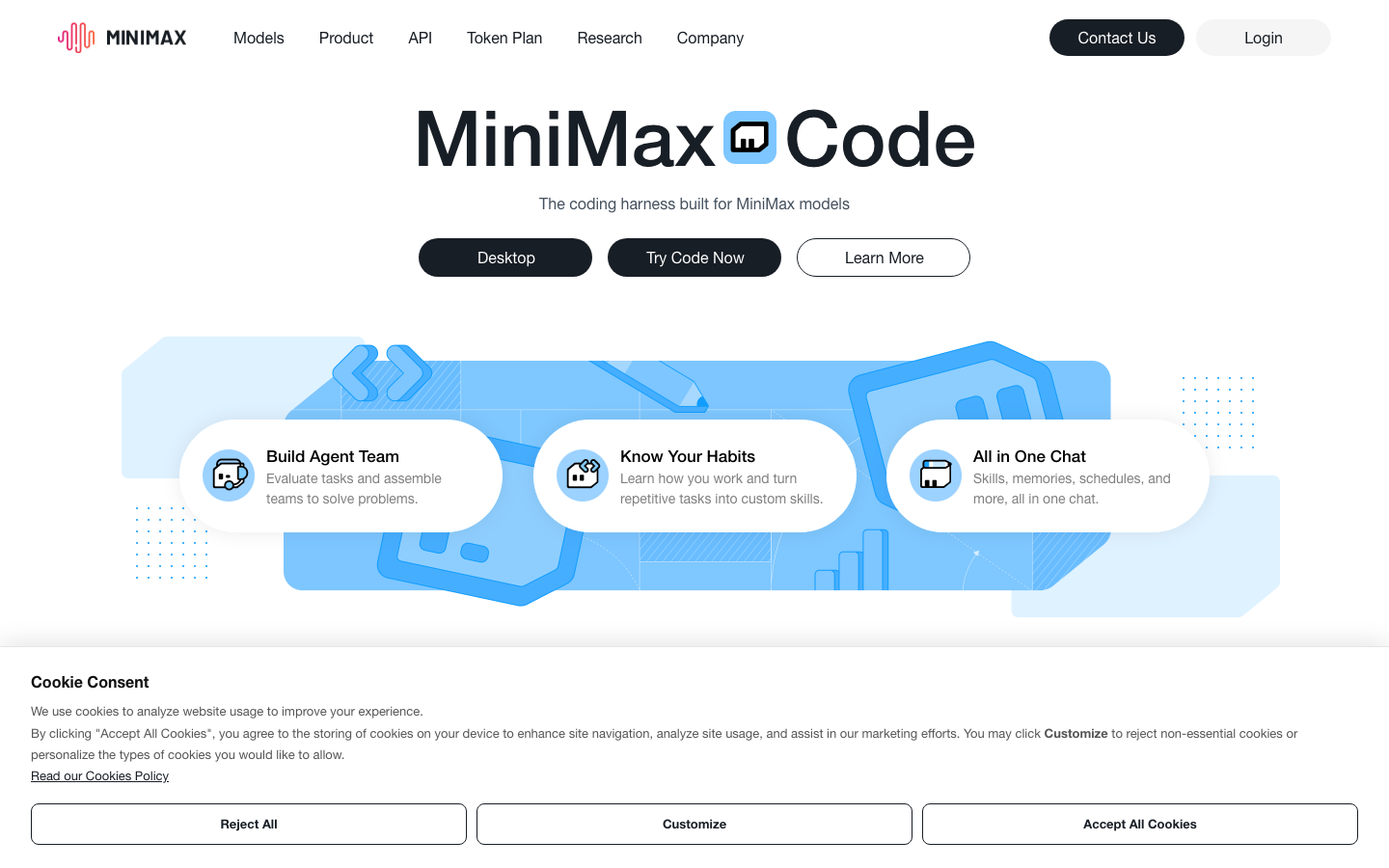
MiniMaxAgent
Core parameters and statistics
The main type of MiniMax Agent is [productivity/business-side application], but its core competitiveness actually comes from the multi-agent runtime. Brief review in one sentence: It is not a desktop application that is better at chatting, but wants to offload complex tasks to a "digital team" for execution.
| Projects | Public Information |
|---|---|
| Current Core Model | MiniMax M3 |
| Contextual capabilities | 1M context |
| Main product forms | Web + Desktop |
| Key Features | Agent Teams, Persistent Memory, Evolving Skills, Unified Billing |
| Upgrade node | 2026-05-27 Mavis / Agent Team upgrade |
| Subscription system | Merger of Token Plan and Agent Plan |
| Official positioning | Long task execution, continuous evolution, multi-role collaboration |
Publicity Verification: Both the official website homepage and official long articles repeatedly emphasize long tasks, quick response, memory, skills and multi-agent collaboration. This is not a marketing rhetoric, but an attempt to solve the real problem of a single agent "stopping halfway, running more and more chaotic, and unable to deliver stably" in long-link tasks.
Expert view: The most important change of MiniMax Agent is not to open more Agents, but to introduce team-style execution logic with quality gates and state machines such as Leader, Worker, and Verifier.
User and market recognition
The homepage of the MiniMax official website currently does not disclose clear and available global user and enterprise figures. The public count block is displayed as a placeholder, so those figures cannot be regarded as facts. But the density of the product line and the completeness of the research documentation indicate that it is more than a simple concept demonstration.
Publicity Verification: The official long article uses a lot of space to explain why a single Agent will experience context anxiety, quality degradation, insufficient acceptance, and asynchronous communication difficulties on long tasks. This shows that the product team has a strong engineering perspective on real delivery issues, rather than just showing off skills.
Hidden benefits: If users often ask AI to do research, write long articles, organize multiple documents, and run multi-step coding tasks, the multi-agent structure will reduce the probability of "the same context becomes full and then starts running wildly".
Hidden costs: Multiple agents are not inherently more economical. The official also clearly admits that handoff cost, sharing cost, aggregation cost and verifier cost are all very high. In other words, it saves the mental burden of manual monitoring of the process, but does not necessarily save tokens.
Cost advantage
The cost logic of MiniMax Agent cannot only look at the seat price, but must also look at the Token Plan.
C-side/Individual: The official statement clearly states "today, a single MiniMax subscription gives you access to both Agent and TokenPlan", which means that individual users no longer have to buy chat subscriptions and Agent subscriptions separately, and billing integration is its biggest obvious advantage.
Developer/API: MiniMax also has two systems: Pay as You Go API Pricing and Subscription Plans. For developers, unified subscription brings integration of tool and model budgets, but it may also obscure the true cost of a single task.
Enterprise: The real cost for enterprises is concentrated in multi-agent state machines, permissions, logging, retries and auditing, rather than the surface number of seats.
The truth about free: The official currently does not describe MiniMax Agent as a permanently free product, but more of a subscription system integration and sharing with Token Plan. True sustainable use will most likely rely on Plus, Max, Ultra or Team plans.
Hidden Cost: If simple tasks are also given to Team mode, time and tokens will be magnified. The official itself also emphasized that not every task is worthy of building a team.
Main functions
- Agent Teams: Pull up multiple Agents in parallel for complex tasks, allowing different roles to work together.
- Persistent Memory: Remember the background and preferences given by the user to reduce repeated explanations.
- Evolving Skills: Gradually accumulate repeated actions into skills instead of starting from scratch each time.
- Unified Billing: Agent and Token Plan are billed in a unified manner to reduce tool switching friction.
- Desktop Portal: Pull the Agent from web chat into the desktop workspace.
Expert View: The real hidden linkage lies in "Memory + Skill + Team Engine". Putting these three capabilities together, it is possible to transform Agent from a one-time assistant into a long-term collaboration partner.
Model and version evolution
MiniMax Agent has clearly entered the team-oriented stage.
- Classic Agent: Single-Agent mainline experience, suitable for short tasks and traditional chat-style interactions.
- Mavis / Agent Team: Upgraded nodes on 2026-05-27, focusing on multi-Agent parallelism, unified subscription and long task running.
- MiniMax M3 access: The official website currently regards M3 as the most intelligent and responsive model, supporting the Agent's long context and task execution capabilities.
Publicity Verification: The focus of Agent's iteration has obviously shifted from "stronger answers" to "more stable processes", which is a mature signal.
Technical advantages
Quantification of cost reduction and efficiency improvement (deduction): For knowledge workers who need to write long articles, do research, and organize materials, multi-agent execution can compress the time of "people staring at an Agent intermittently to advance" from 40 to 60 minutes to fewer intervention nodes; it does not mean that the total time is halved, but the time for manual continuous monitoring is less.
Human-machine collaboration boundary: MiniMax officials themselves admit that high-risk actions such as merging code, overwriting production data, and final issuance must retain manual confirmation points. It is suitable for automatic preparation and advancement, but not suitable for automatically taking responsibility for you.
Runtime Advantage: It treats multi-agent as a runtime, not a prompt tile, which is key. State machines, recoverable sessions, event logs, and whiteboard-style shared information determine whether it can run tasks for a long time.
Current Limitations: There is no fully disclosed enterprise-level permission model and more detailed billing instructions, so be cautious about reproducing the environment.
How to use
- Open the web or download the desktop version.
- Use M3 to initiate tasks, giving priority to complex tasks rather than pure chat.
- When long tasks are required, enable Agent Team to allow the system to be split and executed in parallel.
- Check the status, supplementary requirements or manual confirmation at key nodes.
Get started in 3 minutes: The most suitable first task is not to let it open Team randomly, but to give it a task that contains multiple materials, multiple steps, and has delivery format requirements, such as "organizing a batch of data and outputting Markdown + HTML". This is exactly the typical scenario used by the official long article to demonstrate.
Dissuade Scenario: Simple Q&A, temporary translation, and one-time small tasks are not worth activating a complex Team structure.
Product Pricing
MiniMax currently discloses two sets of payment logic: Token Plan and Pay as You Go, as well as the unified subscription direction of Agent and Token Plan.
- Subscription: For individuals and small teams, quotas are reset monthly.
- Pay as you go: For enterprises and developers, pay by token/call.
- Shared resources: Agent and Token Plan share the resource pool to reduce double subscriptions.
Hidden benefits: Unified subscription reduces the budget fragmentation of “subscribing one model to one Agent and then another”.
Application scenarios
- Long article research and writing: parallel research, verification, and synthesis of manuscripts. Suitable for knowledge work that requires referencing multiple information sources and integrating them into structured output.
- Coding Harness: division of labor among development, testing, and review. Agent Teams mode can perform code review and test verification in parallel, which is more efficient than single-threaded development.
- Office document pipeline: writing, typesetting, and verification are performed separately. Different Agents are responsible for different tasks, which is suitable for standardized document production processes.
Dimensionality reduction strike scenario: long tasks, multi-player roles with obvious logic, and tasks that require periodic rewards.
Persuasion Scenario: For a short, quick, and simple task that can be completed in one step, using Agent will increase unnecessary overhead.
Applicable people
- Knowledge Worker: People who frequently handle complex multi-document tasks. The parallel capabilities of Agent Teams can significantly shorten the research-to-production cycle.
- R&D Team: People who want to put Agent into verification. Unified subscription billing reduces tool switching friction.
- Agent Product Researcher: Someone who focuses on runtime rather than chat experience. Persistent Memory and Evolving Skills are technical directions worth paying attention to.
- Content Creation Team: A team that needs to standardize document production processes and reduce duplication of work.
Persuasion Scenario:
- People who just want a cheap chat tool, Agent’s capabilities go far beyond simple chat needs.
- Teams that do not have basic processes for permissions, logs, and manual confirmation need to establish a governance framework before introducing Agent.
Current Limitations: The desktop portal of MiniMax Agent currently covers macOS, and the availability of other platforms needs to be confirmed. In addition, the token consumption of multi-Agent collaboration in Agent Teams mode is high, and a reasonable usage strategy needs to be planned.
Summary and Outlook
The real value of MiniMax Agent is not to create another desktop AI, but to advance multi-agent execution from "concept" to "sustainable delivery". Its advantages are clear: long tasks, asynchronous execution, memory, skills, and Team structure; its costs are also clear: higher tokens, heavier systems, and the need for clear shutdown conditions and manual confirmation points.
Procurement/Adoption Risk Assessment: Suitable for verification in research, writing, and low-risk coding tasks first, rather than plugging into the production core process right away. Key checkpoints include task status visibility, failure retry strategy, shared memory pollution risk, and subscription resource consumption speed.
Related tools:  DeepSeek,
  ChatGPT
Comparison of competing products
| Comparison dimensions | MiniMax Agent | Competitor A | Competitor B |
|---|---|---|---|
| Core Differences | — | — | — |
| Price | — | — | — |
| Target Users | — | — | — |
Note: The above comparison is based on product public information, and actual differences are based on user experience.
Version Info
- MiniMax Agent Team/Mavis :Officially announced an overall upgrade of MiniMax Agent, giving it a new name Mavis, introducing shared subscription logic of Agent Teams, unified Token Plan and Agent Plan.
- MiniMax Agent Classic :The single-Agent mainline product form before the Agent Team upgrade still retains the classic entrance for switching to the old experience. There is no official precise date yet.
User Reviews