 MLflow
Free
MLflow
Free
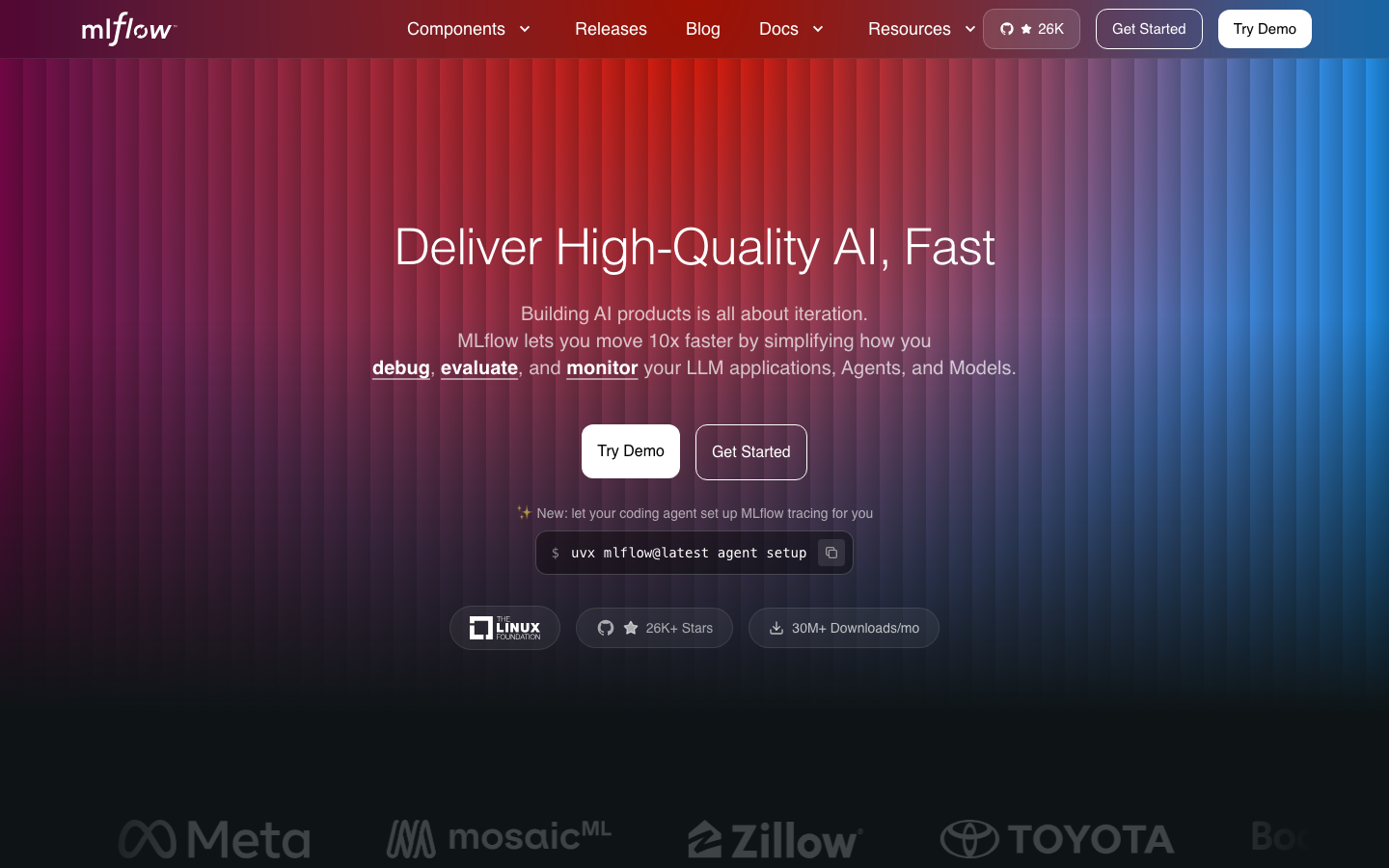
MLflow is an open source AI engineering platform launched by Databricks hosted by Linux Foundation. It covers Agent/LLM tracking, evaluation, prompt word management AI gateway, as well as traditional ML experiment tracking, model registration and deployment. It has been downloaded more than 30 million times a month and is used by thousands of companies for production delivery of AI applications.
MLflow
Core parameters and statistics
MLflow is currently the world's largest open source AI engineering platform (Type D - productivity/business application), officially positioned as "The Open Source AI Engineering Platform for Agents, LLMs & Models". It covers the complete link from Agent/LLM observability to the traditional ML life cycle. It is not just an experiment tracking tool, but unifies tracking, evaluation, prompt word management, AI gateway and model deployment into an open source platform.
| Projects | Public Information |
|---|---|
| Official positioning | The Open Source AI Engineering Platform for Agents, LLMs & Models |
| Core competency line | Agent/LLM observability, evaluation, prompt word management AI gateway, experiment tracking, model registration, model deployment |
| Deployment method | Self-hosted open source version / Databricks hosting service |
| Open Source License | Apache 2.0 |
| Community size | GitHub 27.1K Stars, 6K Forks, 1091+ contributors |
| Latest version | MLflow 3.14.0 (2026-06-17) |
| Monthly downloads | 30 million+ times (official public data) |
| Support Platform | Web, Desktop, API |
| Attribution | US (LF AI & Data Foundation) |
| Supported languages | Python, TypeScript/JavaScript, Java, R |
A brief comment: MLflow is not another ML framework or experiment management tool, but a "unified engineering control surface for AI projects" - integrating Agent tracking LLM evaluation, prompt word version management, model registration and deployment into a traceable engineering link, solving the problem of "lack of standardized infrastructure between AI development and production".
Community and iteration rhythm: GitHub shows 171 release versions. Since 2026, the official version has been pushed in a cycle of about 3 weeks (3.11.1→3.12.0→3.13.0→3.14.0), plus the rc candidate version to form a stable delivery rhythm. The core maintenance team comes from Databricks, but there are more than 1,091 community contributors, indicating that it has passed the single-company dominance stage and entered the ecological development stage of foundation governance.
Platform dimension vs. traditional MLOps tools: Different from focusing on a single segmented tool (such as W&B partial experimental tracking Langfuse partial LLM observability), MLflow attempts to cover the complete AI engineering link within the scope of open source. This "one-stop" strategy reduces tool-switching costs, but also means that each sub-module may not have as much depth as a dedicated player.
MLflow’s user and market recognition
MLflow leads the open source AI engineering platform in market recognition, and its adoption data has two verifiable anchors: GitHub community metrics and officially disclosed downloads/enterprise adoption.
GitHub community popularity: 27.1K Stars, 6K Forks, 1091+ contributors, belonging to the first echelon of open source projects in the field of AI/ML infrastructure. Comparing similar products: Kubeflow is about 14K Stars, Kedro is about 10K Stars, and Langfuse is about 8K Stars. The number of Stars itself is not proof of capability, but reflects the community's attention, problem response speed, and the activity of the plug-in/integration ecosystem - MLflow is leading in these three dimensions.
Downloads and Enterprise Adoption: Officially disclosed monthly downloads exceed 30 million times (from package managers such as PyPI), and enterprise customers include Databricks, Microsoft, Meta, MosaicML, Zillow, Toyota, Booking.com, Wix, Accenture, ASML, and more. These public company logos appear on the official website, but the specific usage depth and paid conversion data of each company are not disclosed.
Industry positioning changes: Before 2024, MLflow was mainly regarded as an MLOps tool; in 2026, its official positioning has fully shifted to "AI Engineering Platform", and the core narrative has shifted from ML experiment management to Agent/LLM observability. This shift both reflects a shift in market demand and means it will need to compete head-on with LLM observability tools such as Langfuse, Braintrust, LangSmith and others.
Prerequisites: The real value of MLflow will be revealed when the team already has an AI development process that has multiple people collaborating. The benefits of using MLflow in the single-person experimental stage are limited, and may even incur additional server operation and maintenance costs.
MLflow’s Cost Advantage: Hierarchy of Open Source Free and Hosted Services
MLflow's cost advantage is based on the hierarchical model of "free open source core + pay-as-you-go hosting service". The actual cost difference between different adoption paths is mainly in operation and maintenance rather than license.
C-side/individual developers: The open source version is completely free (Apache 2.0 license) and can be started locally or on a single server through pip install mlflow + mlflow server. This is zero-threshold for personal experimentation, academic research, and small team prototype verification. However, in a self-hosted scenario, individuals need to bear the infrastructure cost of running MLflow Server (a cloud server can run lightweight instances for about 50-200 yuan/month), as well as the hidden costs of database (SQLite is the default, PostgreSQL/MySQL is recommended for production) and storage (local or cloud object storage).
API/Developer: There is no API call fee for the open source version. The pricing of the Databricks hosted version of MLflow is based on the Databricks official pricing page (not displayed on the MLflow official website), and is usually billed based on computing resources (DBU) and storage volume. Developers can also perform programmatic integration through the REST API on self-hosted servers. The API endpoints are completely open source and have no frequency control or call volume limit.
Enterprise/Private: The open source version supports fully private deployment with no license fees. Enterprise-level capabilities (such as RBAC permission management, audit log SSO) have been provided directly in the open source version after MLflow 3.13.0 (based on the new role permission system), and are no longer limited to the Databricks hosted version. This means that enterprises can obtain complete rights management capabilities without paying any software license fees. But the true cost of enterprise deployment is: infrastructure (production-grade multi-node deployment + high-availability database + object storage), operations manpower (upgrades, backups, monitoring), and integration efforts with existing CI/CD and infrastructure. For teams that already have Kubernetes clusters, the official Helm Chart provided by MLflow 3.13+ can significantly reduce deployment complexity.
Real cost structure: For most teams, the hidden cost of MLflow is not in the software itself, but in "integration and maintenance" - the upfront investment required to migrate a team from "no unified AI engineering platform" to "using MLflow to manage the entire link", including: adaptation and transformation of existing workflows, design of Artifact storage strategies, planning of user permissions models, and docking with existing CI/CD pipelines (such as Jenkins, GitHub Actions). This investment is usually much higher than the running cost of MLflow Server itself.
Main functions of MLflow
MLflow's capability system can be understood from two dimensions: "for Agent/LLM scenarios" and "for traditional ML scenarios". Both share the same set of infrastructure (Tracking Server, Model Registry, UI), but the capability modules develop independently.
Agent/LLM scenario
- Observability/Tracing: Built based on OpenTelemetry, automatically captures the complete call link of Agent and LLM applications - including each Prompt input, tool call LLM response, intermediate steps and Token consumption. Supports multiple languages such as Python, TypeScript/JavaScript, and Java, and implements one-click automatic logging (AutoLogging) with 60+ frameworks. Differences from competing products: MLflow's Tracing is built into the open source platform rather than an independent product, which means that Trace data, experimental tracking, and model registration share the same storage and backend, and there is no need to jump between multiple systems for troubleshooting.
- Evaluation: Provides 50+ built-in scoring indicators and LLM-as-Judge evaluator, supporting user-defined evaluation logic. The
@mlflow.testpytest tag introduced in 3.14.0 allows developers to write regression tests directly into the CI pipeline, and each submission automatically triggers quality inspection and outputs it to the MLflow UI. Implementation Tips: The bottleneck of evaluation results is usually the "annotation quality of the test data set" rather than the evaluation tool itself. It is recommended to invest time in the early stage to build an annotation data set that covers the core scenarios. - Prompts & Optimization: Prompt Registry performs version management of prompts and supports stage upgrades from testing to production (Staging→Production). Built-in Prompt Optimization engine, using algorithms such as MemAlign to automatically optimize prompt word effects. The new LLM Playground in 3.14.0 allows iterating prompt words directly in the browser and comparing the effects of different versions in real time.
- AI Gateway: A unified OpenAI-compatible proxy layer that supports multi-model routing, rate limiting, fault-tolerant fallback, budget control, and access rights management. Can be connected to 20+ model providers (OpenAI, Anthropic, Gemini, Bedrock, Ollama, Groq, DeepSeek, etc.), and supports security and compliance checks before and after requests through the Guardrails mechanism. Architecture location: LLM → AI Gateway → Model provider, Gateway serves as a unified entrance for all model calls to achieve cost control, auditing and access governance.
- **A
gent Server**: FastAPI-based Agent hosting solution introduced in 3.14.0. Agent application can be deployed as a production-grade HTTP endpoint with one command, with built-in streaming response, request verification and automatic tracking.
Traditional ML scenario
- Experiment Tracking: records the parameter dictionary, indicator curve, code version and output artifacts (model weights, visual charts, etc.) of each training, and provides a sortable, filterable, and comparable experiment list through the UI. Core Collaboration: Linkage between experiment tracking and model registry - high-quality runs (Runs) in experiments can be upgraded to registered model versions with one click, eliminating the need to manually move weight files.
- Model Registry: A centralized management warehouse for model versions, supporting stage labels (Staging→Production→Archived), version descriptions, lineage traceability and approval workflows. Suitable for model release management and A/B testing scenarios.
- Model Deployment: Package the model in MLflow format as a REST API endpoint, supporting multiple target platforms such as Docker, Kubernetes, Amazon SageMaker, Azure ML, Nebius, etc. The
mlflow models servecommand can quickly start the model inference service locally. - Model Evaluation (ML Evaluation): An automatic evaluation tool, integrated into the experiment tracking process, supporting standardized indicator calculations for classification, regression, ranking and other tasks. Shares the same assessment infrastructure as the LLM assessment module.
MLflow model and version evolution
The version number of MLflow completed the major version transition from 2.x to 3.x from the end of 2025 to the beginning of 2026, marking a comprehensive shift in product positioning from "ML life cycle management" to "AI engineering platform". The following is a summary of key version nodes by stage:
1.x era: laying the foundation for ML experiment management (2020-2022)
- MLflow 1.0 (~2020-06): The first stable version, establishing the four major modules of Tracking, Projects, Models, and Registry, and using a lightweight, framework-independent design concept to differentiate it from heavyweight platforms such as Kubeflow.
- MLflow 1.x Series (2020-2022): Gradually improve the REST API, MLflow Projects packaging specifications, deep integration with Apache Spark, and the stage management capabilities of Model Registry. The core user base is in data science and ML engineering teams.
The 2.x Era: LLM and Deployment Scaling (2023-2026)
- MLflow 2.0 (~2023-03): Major architectural refactoring, introducing new Tracking UI, support for LLM scenarios (such as Prompt tracking), richer model deployment options (SageMaker, Azure ML, etc.), and better large file artifact management.
- MLflow 2.18 (~2026-04): The final version of the 2.x series, further enhancing LLM tracking and evaluation capabilities, paving the way for a comprehensive shift to 3.x. 2.x has experienced a total of about 20+ version updates, and the iteration rhythm is about one official version per month.
3.x era: AI engineering platform transformation (2026-present)
- MLflow 3.11.1 (2026-04-08): Introducing automatic issue detection (AI Issues Detection), Gateway budget alarm Trace graphical view, native OpenTelemetry GenAI semantic convention support, and UV package manager model dependency identification. At the same time, we began to peel off third-party dependencies such as LiteLLM and turned to self-built Provider routing.
- MLflow 3.12.0 (2026-05-06): Multi-modal tracking attachments (pictures, audios, and files are directly stored in Trace), Codex/Gemini/Qwen coding Agent tracking AI Gateway guardrail mechanism (Guardrails). TypeScript SDK package names moved to @mlflow/ organization scope.
- MLflow 3.13.0 (2026-06-02): RBAC role permission management system and Admin UI - This is an important milestone for the open source version. Enterprise-level permission governance no longer relies on the Databricks hosted version. The same version introduces Trace automatic archiving to object storage, official Helm Chart for K8s deployment, and Hermes Agent support.
- MLflow 3.14.0 (2026-06-17): The current latest version. One-click Agent access (
mlflow agent setupcommand), Claude Code low-latency persistence tracking (based on Write-Ahead-Log), Trace review queue (Review Queues), pytest regression test integration (@mlflow.test), LLM Playground prompt word iteration platform. Breaking Change: The default serialization format of sklearn and PyTorch is switched from pickle toskops/pt2to improve security.
Technical advantages of MLflow
The technical advantage of MLflow does not lie in a single algorithm innovation, but in the "platform unity" and "ecological openness" in architectural design - these two points determine its actual value in multi-tool collaboration scenarios.
Lightweight and framework-independent design philosophy: MLflow has adhered to the philosophy of "not a framework, not a platform, but a library" from the first day - as long as you can write training scripts in Python/R/Java/TypeScript, you can use import mlflow to access it. Compared with Kubeflow (which requires Kubernetes cluster Pipeline DSL and a complete DevOps process), MLflow's deployment threshold is extremely low: a single server or even a single laptop can run complete experiment tracking and model registration services. The price of this design is: when the team scales and requires multi-tenant isolation and fine-grained permissions, the default configuration of the open source version (SQLite + local file system) quickly reaches a bottleneck and must be moved to a production-grade database and object store.
Observability architecture based on OpenTelemetry: MLflow's Tracing module is built directly on the OpenTelemetry standard instead of developing a self-developed protocol. This means it can interoperate with any Collector, Exporter and visualization tool in the OTel ecosystem. 3.11.1+ supports OTel GenAI semantic contract export, so that Trace data can be consumed by standard OTel platforms (such as Grafana, Datadog). Mechanism→Effect: Teams do not need to choose between MLflow’s tracing format and existing observable infrastructure. MLflow Trace can enter a unified monitoring system as part of the OTel data flow.
Unified data model: Entities such as Experiment, Run, Model Version, and Trace share the same set of backend storage (SQL database + object storage), which means that you can directly jump from Trace to the corresponding experiment run in the UI, and trace back from the model version to the Run that trained it. This kind of "one-way traceability" feature is very critical when troubleshooting production problems - when the quality of a certain model version declines online, the operator can trace the complete parameters and indicators of the training experiment directly from the model registry.
Decentralized design of AI Gateway: 3.11.1+ begins to strip away the dependence on LiteLLM and instead builds in the Native Provider implementation of each model provider (OpenAI, Anthropic, Bedrock, Vertex AI, Ollama, xAI, etc.). This means that AI Gateway can run independently without external dependencies, reducing deployment complexity and potential security supply chain risks. Gateway also supports a Redis backend for budget tracking in distributed deployments, and Guardrails-based pre- and post-request security checks.
Explanation of pitfalls and boundaries of the project:
- Trace data expansion: After enabling Tracing in a production environment, if the sampling rate and retention policy are not set, the amount of Trace data written may quickly exceed the carrying capacity of the SQL database. The Trace automatic archiving mechanism of MLflow 3.13+ (moving cold data to object storage) is a necessary capability, but the archiving strategy (how long to archive, query delay after archiving) needs to be planned in advance based on the actual Trace magnitude.
- Existing Workflow Migration Cost: When migrating from existing tools (e.g. W&B, MLflow 1.x) to the latest version of MLflow 3.x, API compatibility and data migration options need to be evaluated. Version 3.x introduced Breaking Changes (such as permission system reconstruction, serialization format default change), and compatibility verification needs to be completed in the staging context before upgrading the production context.
- Multi-language SDK maturity differences: Python SDK has the most complete functions, TypeScript SDK (0.2.0) is still under rapid iteration, and the function coverage of Java and R SDK lags behind significantly. For teams that mainly use languages other than Python, you need to confirm in advance whether the required functions are available in the corresponding SDK.
How to use MLflow
MLflow provides multiple access methods, covering different needs from personal experiments to enterprise-level deployment.
| How to use | Suitable for people | How to start | Cost |
|---|---|---|---|
| Self-hosted open source version | Individual developers, technical teams | pip install mlflow + mlflow server |
Free (own infrastructure) |
| Databricks Hosted Edition | Enterprise Databricks Users | Enabled via Databricks Workspace | Billed at Databricks Pricing |
| Coding Agent quick access | Agent developer | uvx mlflow@latest agent setup |
Free |
| MLflow Assistant | Platform operation and maintenance | Start via CLI or Ollama/OpenAI backend | Free (LLM calling fee is at your own expense) |
Quick Start Guide (Self-Hosted):
# 1. Install MLflow
pip install mlflow

# 2. Start Tracking Server (default SQLite backend + local Artifact storage)
mlflow server --host 0.0.0.0 --port 5000

# 3. Integrate tracking in the training code
importmlflow
from sklearn.ensemble import RandomForestClassifier
from sklearn.metrics import accuracy_score

mlflow.set_tracking_uri("http://localhost:5000")

with mlflow.start_run():
    # Record parameters
    mlflow.log_param("n_estimators", 100)
    mlflow.log_param("max_depth", 10)

    #Train model
    model = RandomForestClassifier(n_estimators=100, max_depth=10)
    model.fit(X_train, y_train)
    preds = model.predict(X_test)

    # Record indicators
    acc = accuracy_score(y_test, preds)
    mlflow.log_metric("accuracy", acc)

    # Save model
    mlflow.sklearn.log_model(model, "model")
Agent/LLM tracking quick access (MLflow 3.14+):
# Install MLflow skills and start Agent tracking with one click
uvx mlflow@latest agent setup

# Start MLflow Server (same as above)
mlflow server --host 0.0.0.0 --port 5000
importmlflow
mlflow.set_tracking_uri("http://localhost:5000")
# Turn on OpenAI automatic tracking with one click
mlflow.openai.autolog()
from openai import OpenAI
client = OpenAI()
response = client.responses.create(
model="gpt-5-mini",
input="Hello!",
)Typical usage path: It is recommended to gradually access in the order of "first local experiment tracking → then model registration → then deployment". In the first week, add mlflow.start_run() and basic parameter indicator records to the project, and then introduce the model registration and evaluation process after confirming that the requirements are met. Be sure to complete the backend database migration (from SQLite to PostgreSQL/MySQL) and Artifact storage configuration (from local file system to S3/MinIO/ABS) before deploying in production.
Product Pricing for MLflow
MLflow's pricing is based on the principle of "open source core capabilities are free + hosting services are pay-as-you-go", and there is no feature-based paywall.
Open source version (all functions are free): Apache 2.0 license, covering all functions such as Agent/LLM tracking, evaluation, prompt word management AI Gateway, experiment tracking, model registration and deployment, etc. There are no function restrictions, no user limit, and no API call limit. The open source version of 3.13.0+ already includes enterprise-level capabilities such as RBAC permission management Admin UI, and you no longer need to pay to upgrade to the managed version.
Databricks Hosted Edition: For teams that don’t want to build their own infrastructure. The pricing logic is consistent with the Databricks platform - you pay based on computing resource consumption (DBU) and storage volume. The specific price is based on the Databricks official pricing page (not disclosed on the MLflow official website). The managed version is fully compatible with the API and SDK of the open source version, and the switching cost is low.
Support: Open Source Edition offers community support through GitHub Issues, Slack, community mailing lists, and regular Office Hours. Enterprise SLA support is purchased through Databricks.
Hidden cost reminder (previously expanded): The biggest hidden cost is not the software itself, but "process migration + infrastructure operation and maintenance" - for a small team without dedicated DevOps, maintaining a production-level MLflow Server (high-availability database, object storage, backup strategy, version upgrade) requires actual human investment. It is recommended that before deciding to self-host, run MLflow on a single machine on a lightweight cloud server to experience the core functions, and then plan a production-level deployment plan after confirming the value and demand.
Application scenarios of MLflow
MLflow’s implementation scenarios cover the three typical stages of AI engineering—development and debugging, quality assurance, and production delivery—and are distributed in the following four types of scenarios:
- Agent/LLM application development and debugging: Use MLflow Tracing to capture the complete trace of each Agent call - including multi-step reasoning, tool call LLM response and intermediate status. Developers can view Trace's span details, token consumption and delay distribution in the UI, and quickly locate "which step the agent made an error in" or "which tool call took the longest." Quantitative deduction: Without Tracing, it takes an average of 30-60 minutes to troubleshoot an Agent's abnormal behavior (repeatedly adding logs and replaying scenarios); after accessing MLflow Tracing, the time to locate the same type of problem can be shortened to 5-10 minutes. Note: This deduction is based on internal usage models and is not an official commitment.
- LLM Quality Assessment and Regression Testing: Integrate 50+ built-in assessment indicators and custom LLM Judge into the CI pipeline - automatically perform assessment after each Prompt or model update, and compare quality change trends in the UI. The
@mlflow.testpytest tag in 3.14.0 enables evaluations to be directly gated as CI (eg: build fails if accuracy < 90%). Human-machine collaboration boundary: The "pass/fail" determination of the assessment can be 100% automated, but the creation and maintenance of the assessment data set, and "edge case annotation" require manual intervention. It is recommended to automate 80% of regular regression testing and reserve 20% of high-risk scenarios for manual review (assigned to designated reviewers through Review Queues). - Model version management and production deployment: Data scientists will promote high-quality Runs in experiments to Model Registry with one click, mark them as Staging for pre-release verification, and after passing the verification, they will be promoted to Production and deployed to the production endpoint by the MLOps team. The deployment method supports Docker containers, Kubernetes (Helm Chart), SageMaker, etc. Implementation Tip: The stage improvement process of Model Registry is best linked with the CI/CD pipeline (for example: the improvement of Staging→Production triggers automatic deployment scripts) to avoid the risk of version confusion caused by manual operations.
- AI Governance and Compliance Audit: MLflow's Trace and experimental data provide
Complete audit link of "training data → model version → production inference". For teams that need to meet SOC2, GDPR or industry compliance requirements, the RBAC system of 3.13.0+ allows access control by role and user granularity, and the Trace archiving mechanism ensures that cold data is traceable but does not occupy unlimited online storage. Limitations: The open source version does not provide data desensitization and PII detection capabilities (these need to be supplemented through Gateway Guardrails or external tools), and compliance teams need to evaluate themselves. Whether MLflow’s audit records meet the regulatory requirements of the industry.
Applicable groups of MLflow
MLflow's "unified platform" strategy determines that it serves teams that need cross-role collaboration, rather than a single individual development tool. The following three types of roles are the core user groups:
- ML/AI Engineers and Data Scientists: Use experiment tracking to record training parameters and indicators, compare the effects of different experiments through the UI, and register the optimal model to the model warehouse with one click. Prerequisites: Basic Python programming skills are required; a certain understanding of MLflow’s Tracking API and MLflow model format. For users who only use AutoML or codeless ML platforms, MLflow's API integration model adds additional learning costs.
- LLM/Agent application developer: Use Tracing to capture Agent call links, evaluate LLM output quality through the Evaluation module, and use AI Gateway to manage multi-model call costs and permissions. Prerequisite: You need to understand the basic concepts of OpenTelemetry (Span, Trace) and the calling topology of the Agent application. For simple scenarios where only a single model is used (such as directly calling the OpenAI API), MLflow's observability gains are limited - the complexity of the tool chain can only be truly reflected when "multiple models + multiple agents + multi-person collaboration".
- MLOps/Platform Engineering Team: Responsible for deploying and maintaining MLflow Server, configuring RBAC permissions Trace archiving policies and AI Gateway routing rules, and embedding MLflow into existing CI/CD and monitoring systems. Prerequisites: You need to have basic capabilities in database management (PostgreSQL/MySQL), object storage configuration (S3/MinIO), and container orchestration (Docker/K8s). For small teams of 5-10 people without a dedicated infrastructure team, Databricks Hosted is recommended over self-hosting.
Does not fit boundaries:
- Not suitable for non-technical users who require end-to-end AutoML capabilities (MLflow is an engineering platform, not an AutoML service).
- Not suitable for scenarios that only require personal-level experimental records (you can use lighter tools such as W&B Free or TensorBoard).
- Not suitable for scenarios that have extreme requirements for data sovereignty and cannot accept any external components (MLflow requires a database and back-end storage, and is not a single-file recording tool).
- Not suitable for pure production model monitoring (MLflow's monitoring capabilities are focused on Trace and Evaluation, and it lacks the real-time drift detection and alarm functions of traditional Model Monitoring - this part requires cooperation with special monitoring tools such as Arize/WhyLabs).
Summary and Outlook
The evolution of MLflow's positioning clearly reflects two trends in the AI engineering market: First, "LLM/Agent observability" is replacing "ML experiment management" as the team's most urgent need; second, the battle for "unified platform vs. best combination of tools" is intensifying. MLflow chose the former - covering as many details as possible on an open source platform, and using "traceable data closure" (Experiment→Model→Deployment→Trace→Evaluation) to reduce the friction cost of cross-tool jumps.
Its core competitiveness lies in three points: the Apache 2.0 licensed open source strategy eliminates vendor lock-in concerns; the observability architecture based on OpenTelemetry allows it to be integrated into the existing monitoring ecosystem; and the integration ecosystem supported by 1091+ contributors (60+ frameworks with one click and 20+ model provider gateways). These advantages are particularly prominent in scenarios where teams require cross-role collaboration, multi-model management, and are sensitive to vendor lock-in.
Current Limitations and Uncertainties:
- Sub-module depth vs breadth: MLflow continues to invest in Tracing and Evaluation, but its prompt management and AI Gateway are still not as mature as Langfuse (focused on LLM observability) and LiteLLM (focused on Gateway). If the team only needs a single capability (such as Prompt management only), a professional focused tool may provide a better experience.
- Risk of Breaking Changes in version 3.x: The intensive release of 3.11→3.14 has brought a number of Breaking Changes (permission system rewriting, serialization format default change, TypeScript package name migration). For teams that have deployed 2.x production environment, upgrading to 3.x requires sufficient testing and verification.
- Chinese Ecology and Documentation: MLflow’s documentation and UI are currently only in English, and Chinese community resources and localized documents are relatively limited. For teams whose primary working language is Chinese, additional investment in document translation and internal training may be required.
- Commercialization Uncertainty: Does the rapid iteration of the open source version of MLflow rely on the commercial driving force of Databricks? Although Linux Foundation hosting ensures that the project will not be controlled by a single company, a relatively high proportion of Databricks employees are among the core contributors. If Databricks' business focus changes, it remains uncertain whether the community can maintain the current iteration pace.
Procurement/Adoption Risk Assessment: It is recommended to adopt the strategy of "open source verification first, then upgrade on demand" - first deploy the open source version of MLflow on small projects of 1-2 teams, and use 2-4 weeks to verify whether Tracing and Evaluation conform to the team workflow; after passing the verification, plan production-level deployment (PostgreSQL + Object Storage + K8s Helm Chart), and evaluate whether it is necessary to purchase the hosted version through Databricks to reduce the operation and maintenance burden. Enterprises need to focus on verification before purchasing: ① The annual TCO difference between self-hosted and hosted versions; ② Whether the 3.x RBAC permission model covers the organization's compliance requirements; ③ Whether the sampling rate and archiving strategy of LLM Tracing can meet the retention period requirements of audit data.
Related tools:  Hugging Face, replicate
Version Info
- MLflow 3.14.0 :Introducing one-click Agent access wizard (mlflow agent setup), Claude Code low-latency persistent tracking Trace review queue pytest regression testing integrated LLM Playground prompt word iteration platform, and multi-modal tracking attachment support.
- MLflow 3.13.0 :Introducing RBAC role permission management and Admin UI, Trace automatic archiving to object storage Helm Chart, production-level K8s deployment Hermes Agent tracing support.
- MLflow 3.12.0 :Multi-modal tracking attachment Codex/Gemini/Qwen coding Agent tracking supports AI Gateway guardrail Trace table paging. There is no official precise date yet, please refer to GitHub Releases.
- MLflow 3.11.1 :Automatic issue detection (AI Issues Detection), Gateway budget alarm and limit Trace graphical view, and native OpenTelemetry GenAI semantic convention support UV package manager identification.
- MLflow 2.18.0 :The final version of the 2.x series, enhancing LLM tracking and deployment capabilities. There is no official precise date yet.
- MLflow 2.0.0 :Major architectural refactoring, introducing LLM support, richer deployment options, and a new Tracking UI. There is no official precise date yet.
- MLflow 1.0.0 :The first stable version establishes three core capabilities: experiment tracking, model registration and deployment. There is no official precise date yet.
User Reviews