 Monica
Free
Monica
Free
Monica is a one-stop AI assistant for personal high-frequency office scenarios. It combines multi-model dialogue, web page summary ChatPDF, translation, writing enhancement and browser-embedded Agent capabilities into a unified portal.
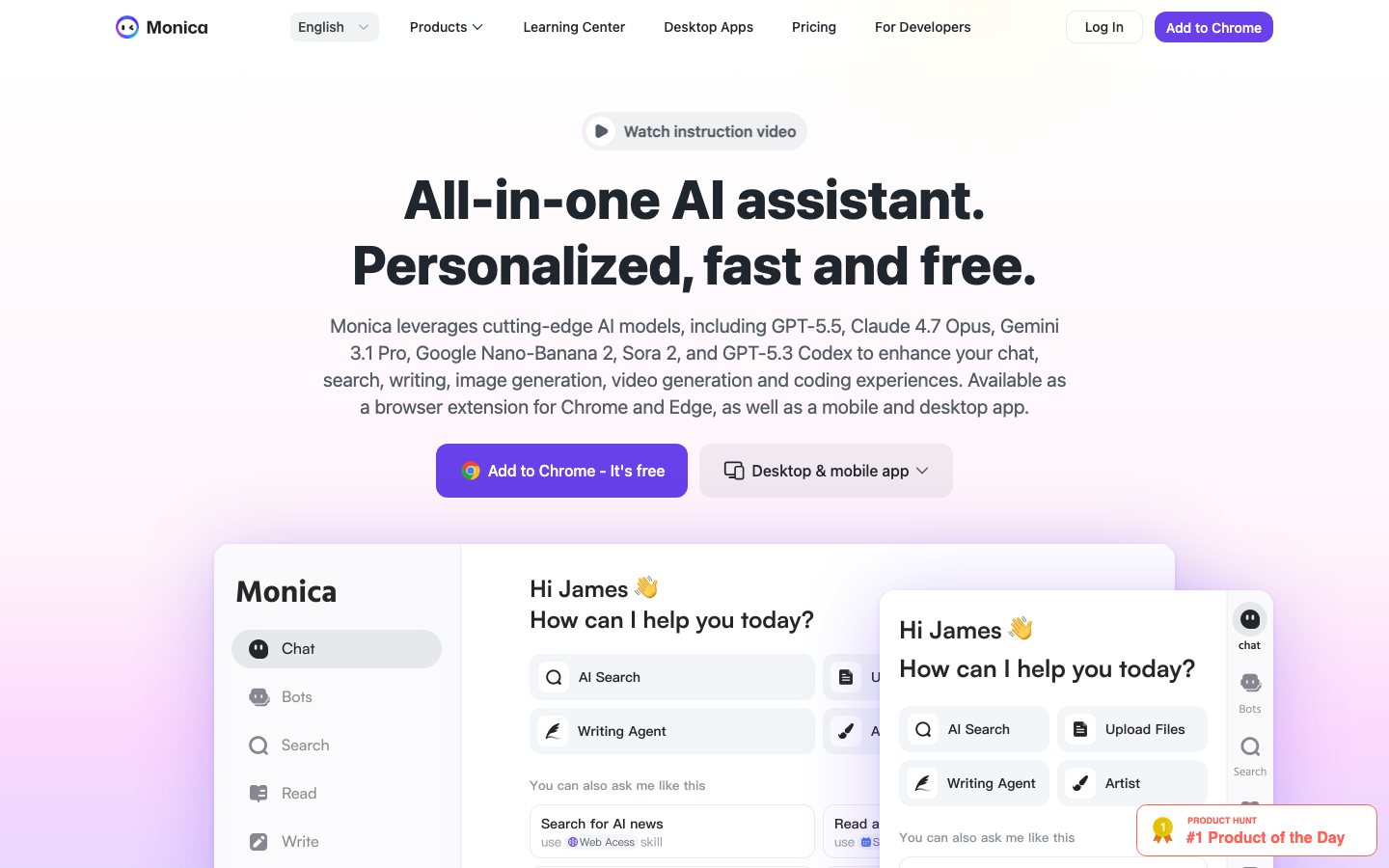
Monica
Core parameters and statistics
[A brief comment in one sentence]: Monica does not reinvent a chat box, but integrates multi-model capabilities into the browser, desktop and mobile terminals, so that high-frequency information processing tasks do not have to repeatedly switch applications.
| Projects | Public Information |
|---|---|
| Official positioning | One-stop AI assistant, personal AI expert available anywhere |
| Core form | Browser plug-in + desktop + mobile |
| Typical capabilities | Chat, search, summary, translation, writing, image/video ChatPDF, AI Agent |
| Current Packages | Free, Pro, Max, Ultra |
| Public user scale | 10 million+ users |
| Public rating signals | 160,000+ reviews Chrome Store 4.9/5.0 |
[Publicity Verification]: The official website emphasizes "more functions, cheaper prices, better experience, and faster response." The real value point is not in the model parameters, but in the entry integration. For people who frequently read web pages, reply to PDF summaries by email, and write across languages, this integrated portal really hits the core pain point of “excessive switching costs”.
User and market recognition
User base: The official website directly gives 10 million+ users and 160,000+ reviews, which shows that Monica is no longer an early niche plug-in, but a mature consumer-level AI efficiency product.
Platform Coverage: Current public entrances include Chrome, Windows, macOS, iOS, Android and VS Code. For individual users, this means that the same account can cover browser reading, desktop office work and mobile lightweight questioning, without having to buy another set of tools for different scenarios.
Market positioning: Monica does not package itself as an enterprise knowledge base or a serious automation platform, it is more like a "personal AI middle layer". The advantage of this type of product is that it is extremely fast to get started, but it also determines that it is better at personal productivity rather than organizational process management.
Cost advantage
【The Free Truth】: The Free plan is an available but significantly limited trial tier. The official website publicly states that there are 40 normal model visits per day, and the images, videos, ChatPDF and AI Agent only provide limited experience and are not suitable for heavy users to use it for free for a long time.
C-side/Individual: The annual payment for Pro is about US$99, the annual payment for Max is about US$199, and the annual payment for Ultra is about US$995. For heavy users, the focus of price is not whether it is cheap, but whether it can replace multiple decentralized subscriptions.
Developer/API: The official website provides a developer entrance, but the public page does not stably display the unified API price. Please refer to the official real-time page for details. For developers, Monica is more like an application layer aggregator, not the lowest-cost underlying model procurement solution.
Enterprise/Team: The current public information still relies on individual subscription logic. Organization-level permissions, auditing, and centralized purchasing terms are not fully disclosed. Additional verification is required before large-scale adoption by teams.
[Hidden benefits/costs]: If a position originally requires subscribing to translation, web page summarization, email polishing, and multi-model question and answer tools at the same time, Monica's integration will significantly reduce the switching time; but if the team already has a unified knowledge base and enterprise-level AI platform, Monica may become another layer of shadow IT.
Main functions
- Multi-model dialogue: It integrates GPT, Claude, Gemini and other capabilities into one portal, suitable for people who need to quickly compare answer styles.
- Webpage/PDF Summary: Webpage summary, file summary ChatPDF directly solves the problem of long text reading and information compression.
- Writing and Translation Enhancement: Selected text in emails, social media, and web pages can directly trigger rewriting, translation, and grammar correction.
- AI Agent Features: In-depth research, slideshow creation, image workshop, browser operator have entered the current package narrative.
- Cross-platform expansion: Browser, desktop, mobile phone and VS Code form a unified account system.
[Expert point of view]: The real "hidden linkage" is that reading, asking questions, writing, and inputting all occur on the current page. Instead of summarizing the web page first, then switching to another tool to write an email, and then switching to a third tool to do translation, users can complete it in one step, which will directly reduce fragmented mental consumption.
Model and version evolution
Monica is a typical continuous iteration cloud product, and the version context is more suitable to be understood in terms of capability milestones rather than traditional semantic versions.
Monica 4.0 stage: It shows that the product has moved from a single plug-in to a more complete personal AI assistant form.
Multi-terminal suite stage: After the public entrance of desktop and mobile VS Code extensions appeared, Monica was upgraded from a browser companion to a cross-terminal workbench.
AI Agent upgrade stage: The current package clearly incorporates in-depth research, browser operator AI Slides and other capabilities into the main line, which means that the product begins to advance from a "question and answer tool" to a "light agent workspace".
Technical advantages
Mechanism -> Effect -> Scenario: The core of Monica is not to train its own large model, but to integrate multi-model routing, browser context, plug-in entry and templated actions. The effect is that ordinary users can continuously switch between reading, summarizing, translating, and writing with almost zero configuration. Most suitable for high-frequency light tasks, rather than long-process engineering arrangements.
Entry advantage: The browser plug-in allows Monica to naturally occupy a position next to "what the user is already doing". This is closer to the real workflow than opening a separate web chat assistant.
Multi-terminal consistency: Cross-platform accounts and capabilities are consistent, reducing the sense of disconnection of "what can be done on the desktop but cannot be done on the mobile terminal".
[Compliance and Risk]: The value of Monica is based on multi-model aggregation and content transfer. When it comes to email PDF and web page content, it is necessary to clarify which data will enter the third-party model link. Sensitive documents should not be uploaded by default.
How to use
The most common path: Install the browser plug-in, log in to your account, chat, summarize, translate or rewrite content directly in the sidebar of the web page.
Second path: Use it as a general AI workbench on the desktop or mobile side, suitable for organizing and outputting across tabs.
The third path: Call Monica Code related benefits in VS Code, suitable for lightweight code interpretation, rewriting and debugging assistance.
[Quantified cost reduction and efficiency increase] Deduction: For new media operations, the "reading + summarizing + rewriting into social media copywriting" process of a single piece of information can usually be reduced from 20 minutes to 8 to 10 minutes; for sales or customer service, email summary and reply drafting can be reduced from 10 minutes to 3 to 5 minutes. The above is a workflow deduction, not an official commitment.
Product Pricing
Free: $0, good for trying out regular models and basic abstraction capabilities.
Pro: Pays approximately $99 per year and offers more model access, premium credits, and more complete content handling capabilities.
Max: Annual payment is about US$199, for more frequent advanced model and Agent usage needs.
Ultra: The annual payment is about US$995. It is aimed at extremely heavy users. The public description also reminds that the cost of upstream models will be adjusted in the future.
[Procurement/Adoption Risk Assessment] Preliminary observation: The value of the package is highly dependent on the upstream model supply policy. Once OpenAI, Anthropic or Google adjust the cost structure, Monica's high-end package boundaries will also change accordingly.
Application scenarios
- Dimensionality reduction attack scenarios: Monica is the easiest to use for tasks such as information research, cross-language reading, email reply PDF summaries, and web page writing enhancement, which are "frequent, short, fast, and repeatedly switching pages" tasks.
- Content Team: Very suitable for hot spot sorting, preliminary scanning of competing products, first edition copywriting and translation.
- Knowledge Workers: Researchers, consultants, and sales support are suitable for using it as a personal information processing layer.
Applicable people
- Individual heavy office users: People who need an entrance to solve reading, writing, translation and Q&A.
- Freelancers and content creators: People who want to reduce the number of subscriptions and publish articles quickly.
- Lightweight Code User: People who occasionally need to interpret code, rewrite scripts, and do simple debugging.
[Dissuade/not applicable]: Enterprise teams that require strong auditing, strict data isolation, complex approvals and irreversible business operations should not use Monica as the main platform; development teams that need to deeply customize Agent orchestration should not use it as the underlying infrastructure.
Summary and Outlook
Monica's core value is to compress common personal AI tasks into a readily available portal. Its most powerful feature is not its single-point model capability, but its integration of fragmented workflows, which is of great practical value for high-frequency office scenarios. The hidden cost is that the more you rely on its aggregation layer, the more you have to accept external changes in model routing, points mechanisms, and third-party links.
[Boundary of Human-Computer Collaboration]: Sections such as reading summary, first draft generation, and translation polishing can be highly automated; manual confirmation points should still be set up for important external emails, business plans, contract summaries, and uploads involving sensitive data. If you want to purchase a higher-end package, it is recommended to use a one-week pilot to verify "whether it can really replace at least two to three existing tools" before deciding whether to upgrade to Max or Ultra.
Related tools:  Notion AI, google-workspace
Comparison of competing products
| Comparison dimensions | Monica | Competitor A | Competitor B |
|---|---|---|---|
| Core Differences | — | — | — |
| Price | — | — | — |
| Target Users | — | — | — |
Note: The above comparison is based on product public information, and actual differences are based on user experience.
Business process integration and ROI analysis
As a productivity tool for enterprises or professional positions, the true value of Monica depends on the depth of integration with existing workflows and the quantifiable efficiency improvement effect. The following is a systematic analysis from three core dimensions.
System integration and data interoperability The ability to interoperate with existing business systems is a key prerequisite for productivity tools to be integrated into workflows. It is recommended to focus on evaluating the following integration dimensions: the openness and documentation quality of the RESTful/GraphQL API (whether a complete API reference and SDK examples are provided), the support scope of Webhook event notifications (which business event types are supported for automatic push), the number and depth of pre-built integrations with common collaboration SaaS tools (WeChat Enterprise, DingTalk, Feishu, Slack, Notion, Jira, etc.), and enterprise-level identity authentication support (SSO/SAML/OAuth and LDAP/AD directory integration). Products that lack integration capabilities are easily isolated into information islands, which in turn increases the cognitive cost and operational friction for teams to switch between different tools.
Efficiency Quantification and ROI Estimation Methodology Before purchasing decisions, it is recommended to quantify the input-output ratio through a structured method: Step 1, choose 3-5 Standardized tasks that are frequently repeated and time-consuming in each team are used as test samples; in the second step, the average time consumption of a single task before and after tool intervention, first-time pass rate or error rate, and the number of links requiring manual intervention are recorded under controlled conditions; in the third step, the saved manpower time is converted according to the comprehensive cost of the position (salary, benefits, management sharing), and soft benefits (increased employee satisfaction, standardization of work quality, and improvement in response speed to core business) are superimposed to obtain a comprehensive ROI estimate. It is recommended to continue tracking ROI trends on a monthly basis, as the value of a tool usually increases over time as team proficiency increases and workflows are optimized.
Phase-based implementation strategy and risk control It is recommended to adopt a three-stage implementation path of "pilot verification-gradual promotion-continuous optimization". In the pilot stage (1-2 weeks), a single team or a single business scenario is selected for small-scale verification. The core goal is to verify technical feasibility and user acceptance, and establish preliminary usage specifications and success standards; in the promotion stage (2-4 weeks), after the pilot verification is passed, the coverage is gradually expanded, and standardized activation processes and training materials are developed; in the optimization stage (continuous), the workflow configuration is continuously adjusted based on actual usage data and user feedback, and more high-value application scenarios are explored. Clear quantitative key result indicators should be set at each stage to avoid blindly expanding the scope of use without data support.
Version Info
- Monica AI Agent upgraded version :The official pricing page has incorporated Deep Research, Create Slideshows, Image Workshop, and Browser Operator into current product capabilities, and there is no official precise release date yet.
- Monica Full Platform Suite :The current official website has provided portals for Chrome, Windows, macOS, iOS, Android and VS Code at the same time, forming a complete multi-terminal product form. There is no official precise date yet.
- Monica 4.0 :The official site still retains the external rating entrance for Monica 4.0, indicating that this version is an important public milestone for the current product line, and there is no official precise date yet.
User Reviews